What Is a Mini Hippo Dog? Traits, Temperament, Care & More


Canine Bible is reader-supported. We receive affiliate commissions via some of our links. Learn more.
A Mini Hippo dog is a designer mixed breed created by crossing a Cocker Spaniel with a Chinese Shar-Pei. Despite its unusual name, it has no connection to a hippopotamus—the nickname comes from its broad muzzle and distinctive facial features. These dogs can vary considerably in size, coat type, temperament, and appearance depending on which parent they inherit more traits from. Some have the Shar-Pei’s wrinkles, while others look noticeably more like a Cocker Spaniel. Their mixed genetics can also bring different grooming needs, health concerns, and behavior patterns that prospective owners should understand. Questions about shedding, lifespan, training, and whether Mini Hippos make good family pets are especially common. Knowing what to expect can help you decide whether this unique crossbreed is the right dog for your home.
Mini Hippo Dog at a Glance
| Key Area | What Dog Owners Should Know |
|---|---|
| Breed type | A Mini Hippo is usually a Cocker Spaniel and Chinese Shar-Pei mix. |
| Size | Most are sturdy small-to-medium or medium dogs rather than truly miniature pets. |
| Temperament | They may be affectionate and loyal while also showing independence or stranger reserve. |
| Exercise needs | Most benefit from moderate daily exercise combined with training and mental enrichment. |
| Grooming | Care needs vary widely depending on coat length, ears, skin folds, and shedding. |
| Health concerns | Owners should watch the eyes, ears, skin, joints, and Shar-Pei-related inflammatory risks. |
| Best owner fit | They suit owners prepared for consistent training, grooming, socialization, and preventive veterinary care. |
| Biggest variable | Appearance, size, coat, and personality can differ considerably because the mix is not standardized. |
History and Origins of Mini Hippo Dog
The Mini Hippo dog is a relatively modern designer mix created by crossing a Chinese Shar-Pei with a Cocker Spaniel. Unlike its parent breeds, which have long and well-documented histories, the Mini Hippo does not have an established breed standard, recognized founder, or precisely recorded date of origin.
Chinese Shar-Pei History

The Chinese Shar-Pei is an ancient breed originating in China, particularly in southern regions where dogs of this general type were kept for practical work. Historically, Shar-Pei-type dogs served as farm dogs, property guardians, hunters, and general-purpose companions.
Their sturdy bodies, alert temperaments, and protective instincts made them useful around homes and farms. Features now strongly associated with the breed—including the broad muzzle, small ears, loose skin, and rough coat—became defining characteristics over generations.
Shar-Pei numbers declined dramatically during the 20th century, and the breed came close to disappearing. International breeding efforts later helped preserve the Shar-Pei and establish populations outside China. Modern Shar-Peis remain recognizable for their independent temperament, strong attachment to family, and unusually distinctive appearance.
Cocker Spaniel History

Cocker Spaniels developed from the much older spaniel family of sporting dogs. Spaniels were historically bred to locate and flush game birds for hunters, with different types gradually becoming specialized according to their size and the type of game they worked.


The name “Cocker” is associated with the breed’s historical use in hunting woodcock. Over time, distinct English and American Cocker Spaniel types developed. The American Cocker Spaniel became smaller and more heavily coated, with a rounded head and pronounced companion-dog appeal, while the English Cocker Spaniel retained somewhat more of the traditional working-spaniel build.
Today, Cocker Spaniels are widely kept as companion dogs while retaining the intelligence, enthusiasm, and responsiveness associated with sporting ancestry. They are often affectionate, people-oriented dogs that thrive on interaction and structured activity.
Breed Development of the Mini Hippo Dog

With the ancient Chinese Shar-Pei on one side and the sociable, sporting Cocker Spaniel on the other, breeders eventually began combining the two very different dogs. From that pairing came the Mini Hippo Dog, a designer cross named largely for the broad muzzle and sturdy appearance that some puppies inherit from the Shar-Pei.
Because the Mini Hippo is not a standardized breed, its development has focused more on desirable combinations of parent-breed traits than on maintaining a fixed appearance. Breeders may aim for a compact, family-oriented dog with moderate exercise needs, recognizable facial features, and a manageable companion temperament, but individual puppies can still vary considerably.
What shaped the Mini Hippo Dog’s development:
Mini Hippo Dog Size and Appearance
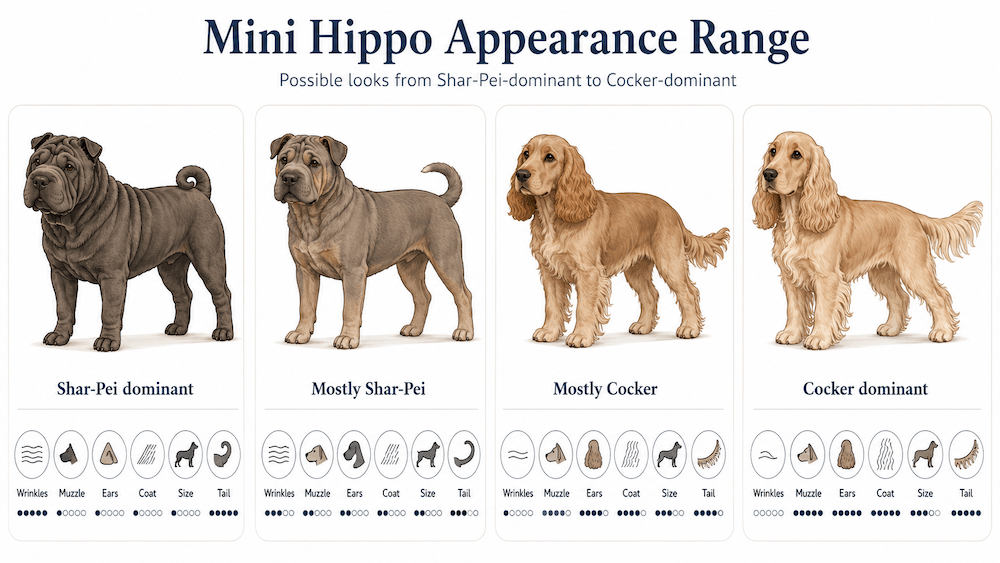
Mini Hippo dogs can vary noticeably in both size and appearance because they may inherit different combinations of traits from the Cocker Spaniel and Chinese Shar-Pei. Most mature into sturdy small-to-medium or medium-sized dogs, while features such as body build, muzzle shape, wrinkles, ears, coat length, and texture can lean more strongly toward either parent breed.


How Big Does a Mini Hippo Dog Get?
| Size Trait | Typical Mini Hippo | Helpful Context |
|---|---|---|
| Typical weight | About 35–40 lb (16–18 kg) | A commonly reported range for mature adults. |
| Broader weight range | About 25–55 lb (11–25 kg) | Genetics can produce noticeably lighter or heavier dogs. |
| Adult height | About 14–20 in (36–51 cm) | Measured from the ground to the shoulder. |
| Size category | Small-to-medium to medium | Despite its name, it is not a toy-sized dog. |
| Cocker parent | About 20–30 lb; 13.5–15.5 in | May contribute a smaller, lighter frame. |
| Shar-Pei parent | About 45–60 lb; 18–20 in | May contribute greater height, bone, and body mass. |
| Best size predictor | Adult size of both parents | Parent measurements are more useful than the “Mini” label. |
Coat Colors and Texture
Mini Hippos can appear in numerous colors because both parent breeds occur in a variety of colors and patterns. Black, brown, cream, tan, red, buff, and mixed or parti-colored coats may occur depending on the parents.
Texture, on the other hand, is harder to predict than color. The coat may be very short and firm, soft and plush, wavy, or moderately long with feathering. This matters beyond appearance because coat type changes the dog’s grooming requirements dramatically.
Mini Hippo Dog Temperament and Personality
A Mini Hippo can inherit a particularly interesting combination of behavioral tendencies. The Cocker Spaniel side may contribute sociability, enthusiasm, affection, sensitivity, and an eagerness to interact with people. The Shar-Pei side may contribute loyalty, independence, confidence, watchfulness, and greater reservation toward unfamiliar people or dogs.
The result is not automatically a perfect halfway point. One Mini Hippo may be outgoing and eager to greet visitors, while a littermate may prefer observing strangers before interacting.
Early socialization matters because inherited tendencies are only part of the picture. Puppies benefit from carefully managed exposure to different people, surfaces, household sounds, friendly dogs, grooming, veterinary-style handling, vehicles, and new environments during development.
Are Mini Hippo Dogs Good Family Dogs?
They can be excellent family companions in the right household. Many are affectionate with their families and enjoy participating in everyday activities. However, you should avoid assuming that every Mini Hippo will have the highly social personality often associated with spaniels. A dog leaning more toward the Shar-Pei side may be more selective about unfamiliar people, handling, or other dogs.
Families with children should focus on the individual dog’s temperament rather than the designer-breed label. Children should learn not to climb on dogs, grab facial folds, disturb sleeping dogs, or interfere with food and chew items. Dogs and young children should be actively supervised together regardless of breed.
What About Other Dogs and Pets?
Compatibility varies. A well-socialized Mini Hippo may live comfortably with other dogs, particularly when introduced appropriately at a young age. Others may be less interested in unfamiliar dogs or more selective as they mature. Socialization should therefore focus on calm, neutral behavior rather than trying to make the dog enthusiastically greet every animal it sees.
Introductions to cats and small animals should also be controlled. Individual history, prey interest, social experience, and temperament are more useful predictors than the Mini Hippo name itself.
| Trait | Cocker Influence | Shar-Pei Influence | Mini Hippo Result |
|---|---|---|---|
| Social style | Friendly and people-focused. | Loyal and more reserved. | Affectionate but sometimes selective. |
| Training | Responsive and sensitive. | Independent and strong-minded. | Best with reward-based training. |
| Coat | Soft, silky, and feathered. | Short and coarse. | Short, wavy, or lightly feathered. |
| Ears | Long and floppy. | Small and close-set. | Variable length and shape. |
| Build | Compact and athletic. | Stocky and substantial. | Compact with a sturdy frame. |
| Face | Soft, refined features. | Broad muzzle and folds. | Rounded muzzle with possible wrinkles. |
Training and Exercise Needs of a Mini Hippo Dog
Mini Hippos generally benefit from consistent positive-reinforcement training beginning in puppyhood. Food rewards, play, praise, and access to activities the dog enjoys can make training clearer and more productive than confrontational methods.
A Cocker-leaning dog may learn quickly but become discouraged by harsh corrections. A Shar-Pei-leaning dog may understand an exercise perfectly well while deciding that performing it repeatedly is unnecessary. Short, purposeful training sessions tend to work well for either personality.
Important early skills include recall, loose-leash walking, settling calmly, leaving objects on cue, cooperative handling, and remaining comfortable around unfamiliar people without being required to greet them.
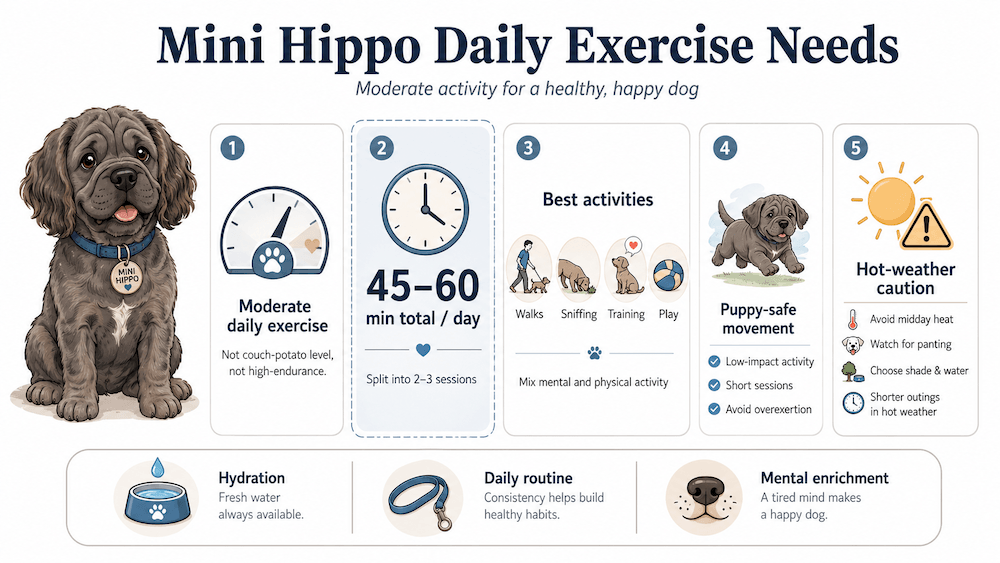
How Much Exercise Does a Mini Hippo Need?
Most healthy adult Mini Hippos do well with 45–60 minutes of moderate daily activity, combining walks, sniffing, training, and play. Puppies need shorter, low-impact sessions, while hot weather may require cooler, shorter outings with plenty of water and rest.
Mini Hippo Dog Grooming and Shedding
Grooming requirements can range from surprisingly simple to fairly demanding because the parent breeds have very different coats. A short-coated Mini Hippo may need routine brushing primarily to remove loose hair and monitor the skin. A Cocker-coated dog may require frequent combing, bathing, trimming, and professional grooming to prevent mats around the ears, legs, chest, and underside.
Wrinkle and Skin Care
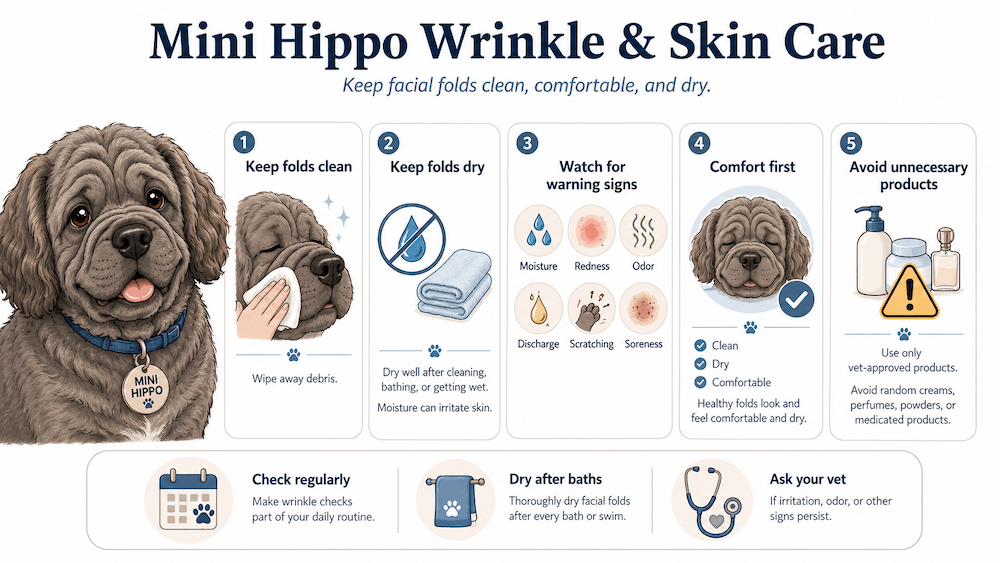
Mini Hippo facial folds should be kept clean, comfortable, and dry to help prevent irritation. Check regularly for redness, odor, discharge, soreness, or scratching, and consult a veterinarian if problems persist.
Ear Care Can Be Especially Important
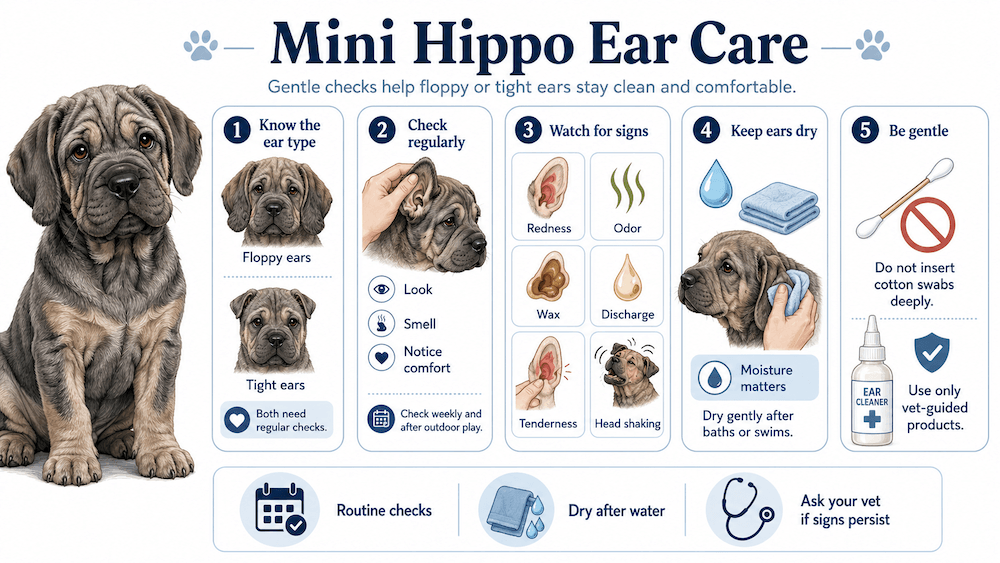
Mini Hippo ears benefit from regular, gentle checks, especially if they are floppy, tight, or frequently exposed to water. Watch for redness, odor, excess wax, discharge, tenderness, or head shaking, and have persistent problems evaluated by a veterinarian.
Eye and Nail Care
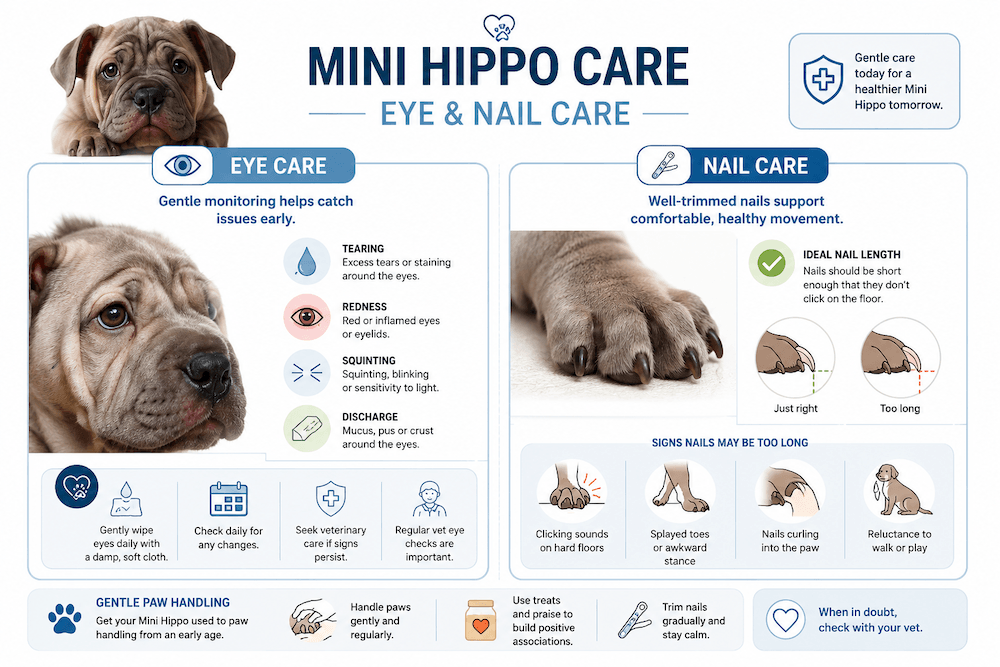
Mini Hippo eye and nail care should focus on early detection and comfortable movement. Watch for tearing, redness, squinting, or discharge, and keep nails trimmed to a healthy length so they do not interfere with normal walking.
Feeding and Weight Management for a Mini Hippo Dog
Mini Hippos do not need a special diet simply because they are designer dogs. Most should eat a complete and balanced food suited to their life stage, adult size, activity level, and health needs.
Portion control is especially important because excess weight can place more stress on the joints and reduce exercise tolerance. Use body condition as well as scale weight: you should be able to feel the ribs easily, see a waist from above, and notice an abdominal tuck from the side.
Treats, chews, table food, and food toys all add calories and should count toward the daily total. Supplements such as vitamins, calcium, oils, or joint products are usually unnecessary unless a veterinarian recommends them for a specific reason.
Mini Hippo Dog Health Concerns and Lifespan
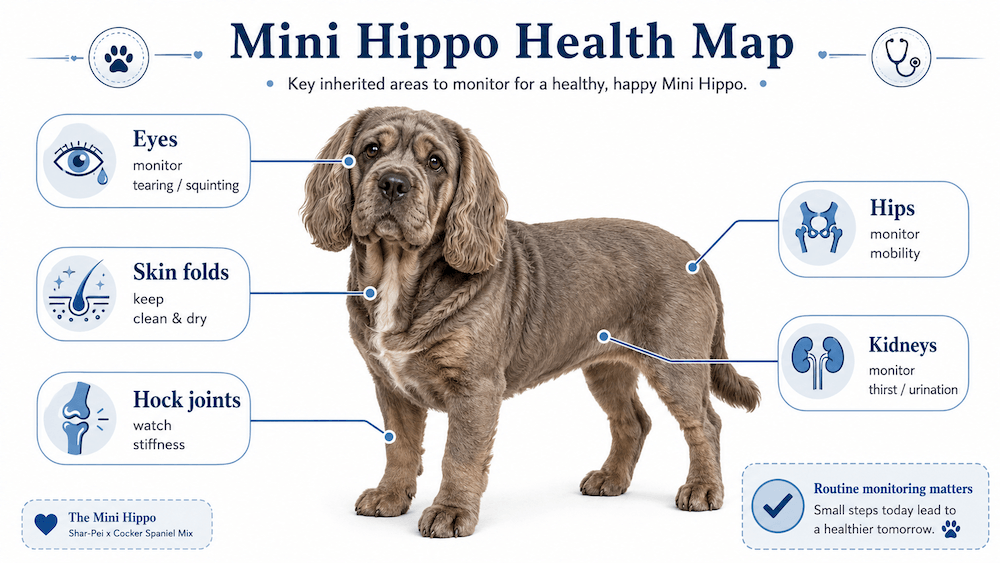
Being a mixed-breed dog does not make a Mini Hippo automatically unhealthy, but it also does not erase inherited risks from the parent breeds. Puppies can inherit physical features and genetic variants associated with either side of the cross. For Mini Hippos, several areas deserve particular attention: eyes, ears, skin, joints, and Shar-Pei-associated inflammatory disease.
Mini Hippo Dog Lifespan
Mini Hippo dogs commonly live around 10–15 years, although there is no large breed-specific lifespan dataset because the Mini Hippo is not a standardized breed. Individual longevity depends on genetics, body condition, preventive care, diet, exercise, and whether inherited health problems develop.
Dogs that remain lean, receive regular veterinary care, and avoid serious complications from conditions such as chronic ear disease, eye problems, joint disease, or Shar-Pei-associated inflammatory disorders may reach the upper end of that range. The health and lifespan of both parent dogs can also provide useful clues when evaluating a puppy.
When a Mini Hippo Dog Needs Veterinary Attention
Routine wellness examinations allow a veterinarian to follow weight, skin, ears, eyes, joints, dental health, and age-related changes over time. Mini Hippo owners should also make sure their veterinarian knows the dog has Shar-Pei and Cocker ancestry because that information may change which conditions are considered when symptoms develop.
Do not give leftover prescription medications or human pain relievers in an attempt to treat fever or pain unless a veterinarian has specifically instructed you to do so.
Mini Hippo Dog Ownership Costs
Mini Hippo ownership costs vary by breeder, location, grooming needs, and health care. For U.S. owners, current puppy listings span from under $1,000 to $2,500 or more, while routine dog ownership can easily reach several thousand dollars per year.
| Cost Area | Typical U.S. Estimate | What It Covers |
|---|---|---|
| Mini Hippo price | $800–$2,500+ | Puppy purchase price varies by breeder and litter. |
| Initial ownership | $700–$1,500+ | Crate, supplies, exams, vaccines, microchip, and training. |
| Monthly costs | $125–$250+ | Food, preventives, grooming, treats, and routine supplies. |
| Annual costs | $1,500–$3,000+ | Routine care, food, grooming, preventives, supplies, and optional pet insurance. |
| Unexpected costs | Highly variable | Emergency care or chronic health problems can raise expenses. |
How to Choose a Mini Hippo Puppy Responsibly
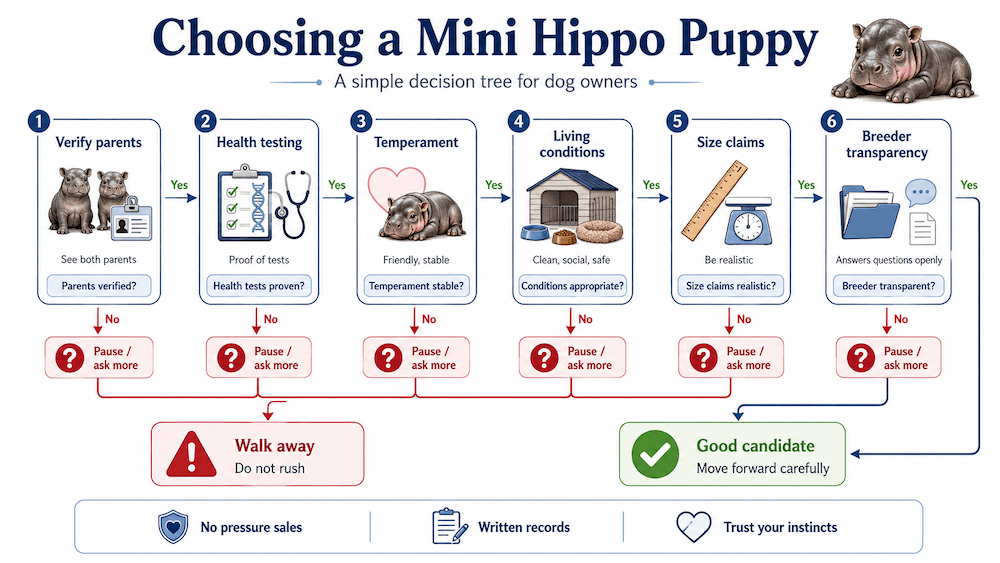
Because the Mini Hippo has no standardized breeding program, choosing a responsible breeder is especially important. Labels such as “designer,” “rare,” F1, or F1b do not guarantee quality, so ask which type of Cocker Spaniel was used, how the puppy was bred, and whether both parents completed appropriate health screening beyond a basic veterinary exam.
Where to Find a Mini Hippo Dog
Mini Hippos are relatively uncommon, so finding one may require patience. Whether buying from a breeder or adopting, focus on health history, transparency, temperament, and responsible placement rather than color, wrinkles, or unusually low prices.
| Where to Look | What to Search For | Places to Check |
|---|---|---|
| Adoption websites | Mini Hippo, Shar-Pei mix, or Cocker Spaniel mix. | Petfinder |
| Local shelters | Ask specifically about Shar-Pei/Cocker-type mixes. | Petfinder Shelter Search |
| Cocker rescues | Check Cocker Spaniels and Cocker-mix listings. | Camp Cocker Rescue |
| Mixed-breed rescues | Search both parent breeds rather than the nickname alone. | Adopt a Pet |
Is a Mini Hippo Dog Right for You?
A Mini Hippo can be a good match for owners who are comfortable with moderate exercise, regular grooming, consistent training, and some variation in adult size and temperament. They tend to suit people who value an affectionate companion but are also prepared for possible independence, ongoing skin and ear care, and routine veterinary expenses.
| Owner Factor | Good Fit If… | Think Twice If… |
|---|---|---|
| Exercise | You can provide moderate daily activity. | You want a very low-energy dog. |
| Training | You enjoy patient, reward-based training. | You expect instant obedience with little practice. |
| Grooming | You can manage ears, skin, nails, and coat care. | You want minimal grooming responsibilities. |
| Temperament | You are comfortable with some independence or reserve. | You need a highly social dog with everyone. |
| Health care | You can budget for routine and unexpected veterinary care. | You want a dog with highly predictable health needs. |
| Predictability | You accept variation in size, coat, and personality. | You want tightly standardized adult traits. |
Frequently Asked Questions
The Bottom Line
A Mini Hippo dog is a Chinese Shar-Pei and Cocker Spaniel mix known for its broad muzzle, compact build, and highly variable appearance. Because the mix is not standardized, adult size, coat type, temperament, and grooming needs can differ considerably between dogs. Many are affectionate and loyal companions, although some may inherit the Shar-Pei’s independence or reserve alongside the Cocker Spaniel’s sociability. Owners should be prepared for regular exercise, consistent training, coat and ear care, and attention to possible eye, skin, joint, and inflammatory health concerns. Choosing a breeder who performs appropriate health screening is especially important, while adoption can also be an option through breed-specific and mixed-breed rescues. For owners comfortable with some unpredictability and willing to provide thoughtful lifelong care, the Mini Hippo can make a distinctive and rewarding companion.
To learn more about the breeds and health considerations behind the Mini Hippo, explore our guides to the Chinese Shar-Pei and Cocker Spaniel. You may also find the dog life expectancy calculator, ideal dog weight guide, and mixed-breed dog DNA testing guide helpful for understanding your dog’s size, longevity, and ancestry.