
How Heavy Should My Dog Be? Vet-Approved Ideal Weight Chart & Obesity Signs

Canine Bible is reader-supported. We receive affiliate commissions via some of our links. Learn more.
A dog should weigh enough to maintain a visible waist, a tucked abdomen, and ribs that are easy to feel but not prominently visible. In most cases, this aligns with your dog’s breed standard, size, and body condition score rather than a single fixed number. But what if your dog doesn’t fit the “typical” mold—or is a mix with no clear standard? Small shifts in weight can signal bigger health issues, from obesity to underlying disease. Age, activity level, and even neuter status can all change what “ideal” really looks like. So how do you know if your dog is just a little chunky—or at real risk? And can two dogs of the same breed have different healthy weights? In this guide, we’ll break down exactly how to assess your dog’s ideal weight, what signs to look for, and how to adjust safely if they’re off track.
Why Understanding Dog Weight Matters
| Key Area | Why It Matters |
|---|---|
| Supports overall health | Keeping your dog at a healthy weight lowers the risk of problems such as joint strain, diabetes, heart disease, breathing issues, and reduced mobility. |
| Affects behavior and energy levels | Dogs at an unhealthy weight may seem more tired, less playful, less willing to exercise, or more frustrated because movement feels harder. |
| Reduces veterinary costs | Preventing unhealthy weight gain can help lower the chances of expensive long-term care tied to obesity-related conditions, medications, and mobility support. |
| Makes preventive care easier | Monitoring weight helps catch changes early, whether the issue is overfeeding, lack of exercise, illness, aging, or an underlying medical condition. |
| Gives owners peace of mind | Knowing your dog is at a healthy weight helps you feel more confident that you’re meeting their nutritional and physical needs properly. |
| Guides better feeding decisions | Understanding healthy weight makes it easier to portion meals correctly, manage treats, and avoid common mistakes that lead to gradual weight gain. |
| Reveals hidden health concerns | Sudden weight gain or loss can be an early warning sign of thyroid disease, digestive problems, parasites, cancer, or other medical issues. |
How Heavy Should My Dog Be?
Your dog should weigh enough to keep a visible waist from above, a noticeable abdominal tuck from the side, and ribs that are easy to feel under a thin layer of fat. The right number depends on breed, frame size, sex, age, muscle mass, and activity level, so “healthy weight” is not one universal figure.
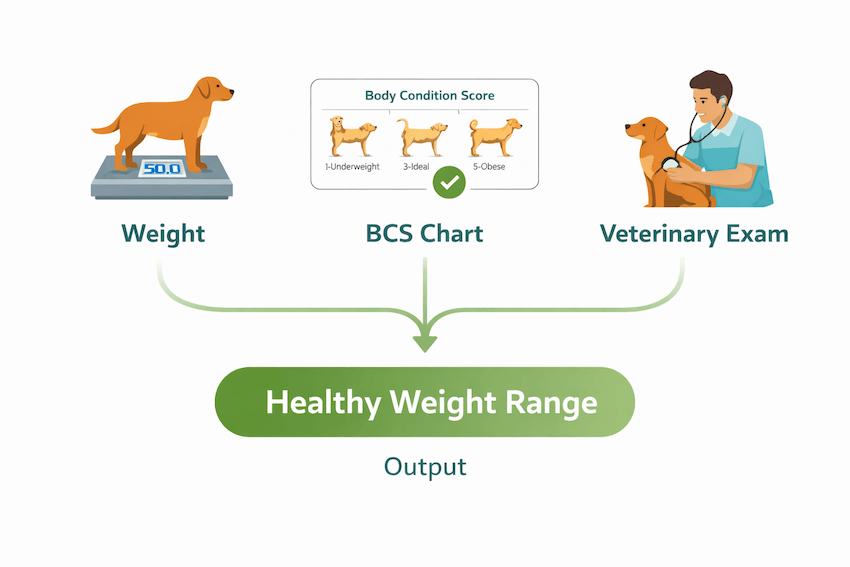
That means the best way to judge ideal weight is not by the scale alone. You want to match your dog’s body weight to a healthy body condition score, then compare that with breed expectations and your veterinarian’s assessment.
How To Use The Dog Body Condition Score (BCS)
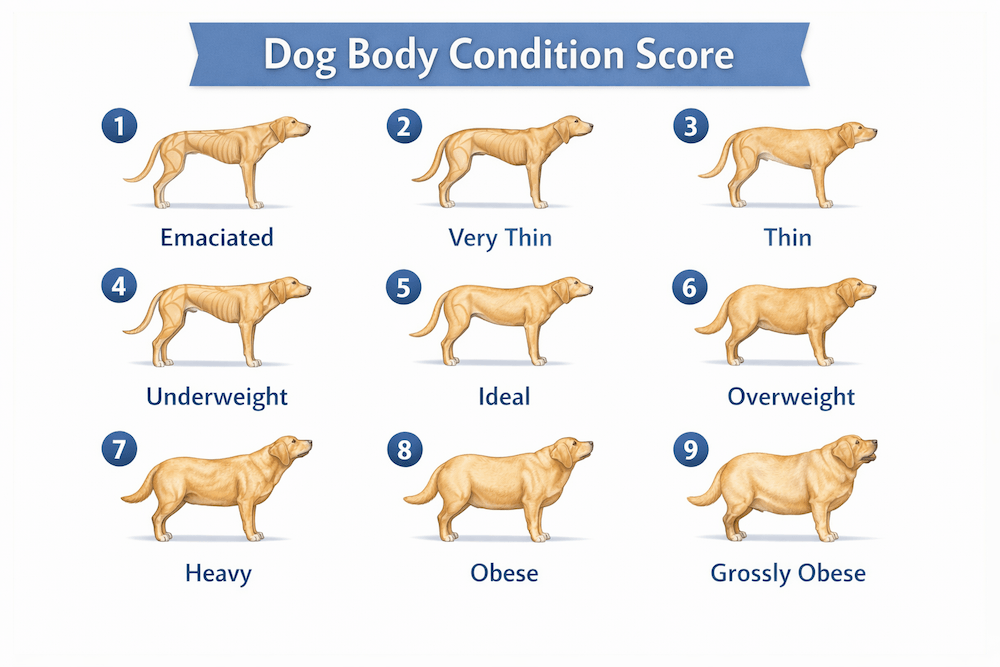
Instead of solely focusing on the number on the scale, the BCS considers your dog’s overall appearance and well-being. Can you easily feel their ribs without exerting excessive pressure? Does your dog have a discernible waist when viewed from above? Additionally, is there a tuck-up behind the ribs when viewed from the side? These are the indicators that veterinarians examine when determining an appropriate weight range for your dog.


Use our dog calorie calculator to determine how many calories your dog should eat per day based on their body condition score, then choose the right dog food to help them lose weight or dog food to gain weight safely.
How to Determine Your Dog’s Ideal Weight
Follow these steps to determine if your dog is at an ideal weight.
1. Start With Body Condition Score, Not the Breed Chart Alone
Breed weight ranges are useful, but they are only a starting point. Two dogs of the same breed can both be healthy at slightly different weights if one has a larger frame or more lean muscle. Veterinary nutrition guidelines from WSAVA and AAHA recommend using body condition score alongside body weight because the scale cannot tell you whether the extra pounds are fat or muscle.
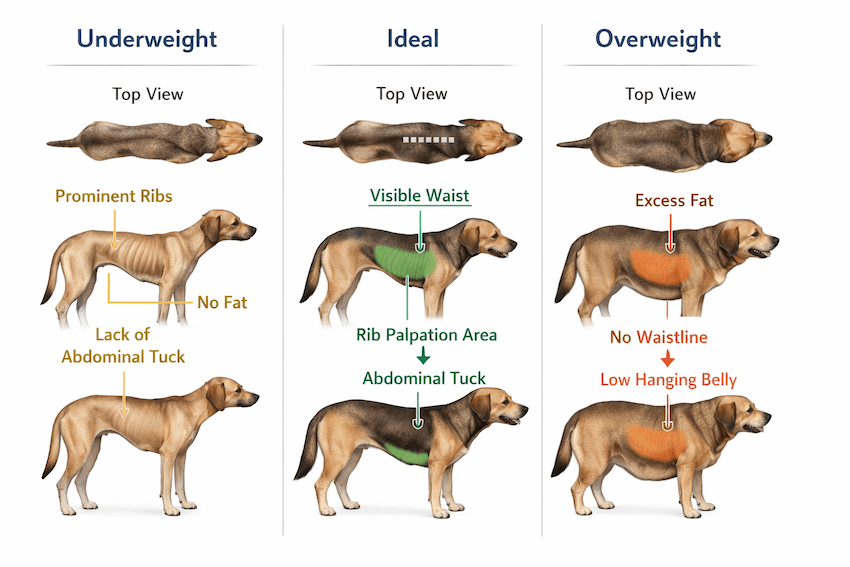
A dog is usually close to ideal when:


- the ribs are easy to feel without pressing hard
- the waist is visible from above
- the abdomen tucks up behind the rib cage
- there are no heavy fat pads over the spine, tail base, or chest
2. Feel Your Dog’s Ribs, Waist, and Abdomen
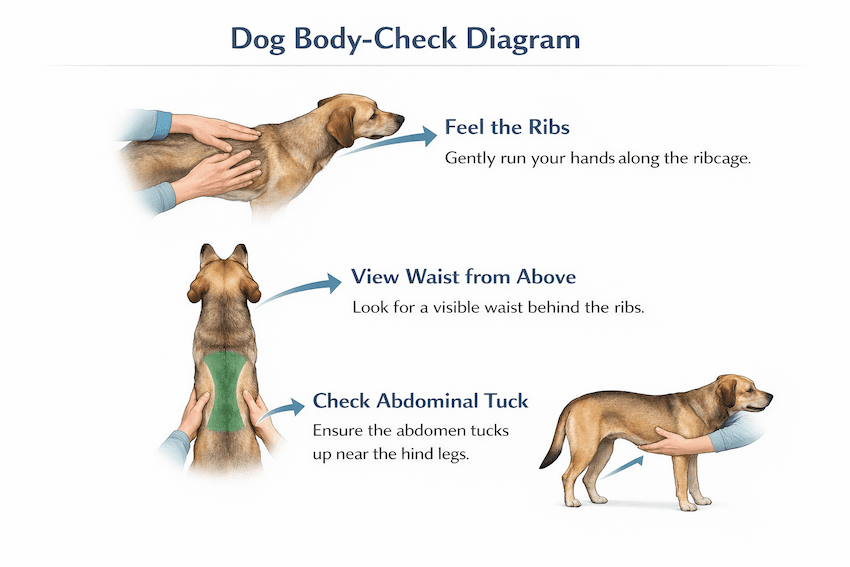
Hands-on assessment is one of the fastest ways to judge whether your dog is in the right range. If you can feel the ribs easily with a thin fat covering, that is usually a good sign. If the ribs are hard to find, your dog may be overweight. If the ribs, spine, and hips are sharply visible, your dog may be underweight.
A simple rule:
- Too thin: ribs, spine, and hips very obvious
- Ideal: ribs easy to feel, waist visible
- Too heavy: ribs hard to feel, waist reduced or absent
3. Compare Your Dog to Breed, Age, and Life-Stage Expectations
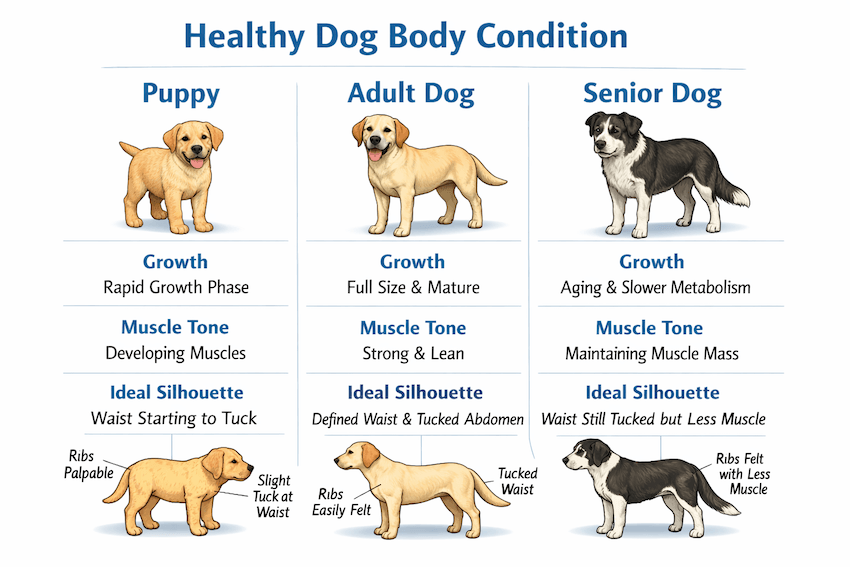
Puppies, seniors, working dogs, and highly athletic dogs may sit at different healthy weights even when their body condition is normal. Large-breed puppies should stay lean during growth, while older dogs may lose muscle and need both a body condition score and a muscle condition score. This is why veterinarians do not rely on breed charts alone.
General rule:
- Puppies: should grow steadily without looking round or heavy
- Adults: should maintain stable weight and visible body shape
- Seniors: may need closer monitoring for muscle loss or hidden weight gain
4. Watch for Weight Changes Over Time, Not Just One Weigh-In
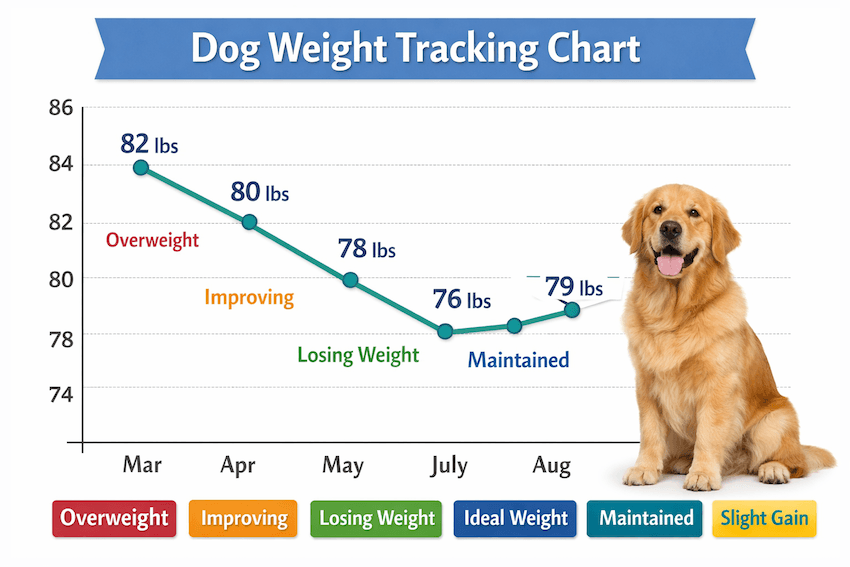
A single number matters less than the trend. A dog that slowly gains weight over six months may be moving into overweight territory even if the current number still looks close to the breed range. Sudden weight loss can also be a red flag for illness, poor nutrient absorption, dental pain, or other medical problems.
Good monitoring habits include:
- weighing monthly
- checking body shape every few weeks
- logging food, treats, and activity
- asking your vet about unexplained gain or loss
5. Use a Healthy Weight Formula Only as a Rough Estimate
If your dog is clearly overweight, veterinarians sometimes estimate ideal weight from current body condition score. AAHA’s weight-management material includes body-fat percentage estimates tied to high body condition scores, which can help clinicians calculate a target range. Still, this is best used as a rough guide, not a replacement for a physical exam.
In practice, the most accurate answer is:
- use body condition score first
- confirm with your veterinarian
- set a target range, not one exact pound number
Dog Weight Chart Guidance by Body Type
Use this quick framework before relying on a breed standard alone.
| Dog Type | What Healthy Usually Looks Like | What to Watch Closely |
|---|---|---|
| Toy and small breeds | Ribs easy to feel, slight waist, no round belly | Even small gains can matter quickly |
| Medium breeds | Visible waist, clear tuck, steady muscle tone | Treat overload and reduced exercise |
| Large and giant breeds | Lean outline, ribs palpable, no heavy fat pads | Joint stress rises fast with extra weight |
| Athletic or working dogs | Leaner look, strong muscle, defined waist | Do not confuse muscle with underweight |
| Seniors | Stable weight, fair muscle, easy rib palpation | Muscle loss can hide behind body fat |
What Research Says About Healthy Dog Weight
Veterinary guidance consistently supports using body condition score plus body weight rather than body weight alone. WSAVA and AAHA both describe the ideal dog as one with a palpable rib cage, visible waist, and abdominal tuck, which is why visual and hands-on assessment is central to deciding how heavy a dog should be.
A landmark lifelong feeding study in Labrador Retrievers found that dogs kept lean lived longer and had delayed onset of chronic disease, including osteoarthritis, compared with dogs allowed to eat more freely. Clinically, that matters because even modest long-term excess weight can affect both lifespan and mobility.[1]
Research and reviews on canine obesity also show that excess body fat is common and linked with important metabolic and orthopedic consequences. That supports the practical takeaway here: a dog does not need to look “very heavy” before the extra weight begins to matter.[2]
Healthy Weight Ranges For Popular Breeds
Breed-specific weight ranges are not arbitrary. They are drawn from veterinary references, breed standards, and long-established canine health data. A standard dog weight chart can offer a useful starting point, but many of these ranges are broad and often do not separate males from females. In general, females tend to fall toward the lower end of the range, while males are usually heavier.
This is not a complete list of every breed, but it does include many of the most popular dog breeds in the U.S.
| Breed | Ideal Weight Range |
|---|---|
| Labrador Retriever | 55–80 lbs |
| French Bulldog | 16–28 lbs |
| Golden Retriever | 55–75 lbs |
| German Shepherd | 50–90 lbs |
| Poodle | 40–70 lbs |
| Dachshund | 16–32 lbs |
| Bulldog | 40–55 lbs |
| Beagle | 20–30 lbs |
| Rottweiler | 80–135 lbs |
| German Shorthaired Pointer | 45–70 lbs |
| Pembroke Welsh Corgi | 22–30 lbs |
| Australian Shepherd | 40–65 lbs |
| Yorkshire Terrier | 4–7 lbs |
| Cavalier King Charles Spaniel | 13–18 lbs |
| Doberman Pinscher | 60–100 lbs |
| Boxer | 50–80 lbs |
| Siberian Husky | 35–60 lbs |
| Cane Corso | 85–120 lbs |
| Miniature Schnauzer | 11–20 lbs |
| Great Dane | 110–175 lbs |
| Shih Tzu | 9–16 lbs |
| Boston Terrier | 12–25 lbs |
| Pomeranian | 3–7 lbs |
| Havanese | 7–13 lbs |
| Shetland Sheepdog | 15–25 lbs |
| Bernese Mountain Dog | 70–115 lbs |
| Brittany | 30–40 lbs |
| English Springer Spaniel | 40–55 lbs |
| Cocker Spaniel | 20–30 lbs |
| Mastiff | 120–230 lbs |
| Chihuahua | 2–6 lbs |
| Border Collie | 30–55 lbs |
| Pug | 14–18 lbs |
| Basset Hound | 40–65 lbs |
| Vizsla | 45–65 lbs |
| Maltese | 4–7 lbs |
| Belgian Malinois | 40–80 lbs |
| Weimaraner | 55–90 lbs |
| Newfoundland | 100–150 lbs |
| Collie | 50–75 lbs |
| Rhodesian Ridgeback | 65–90 lbs |
| West Highland White Terrier | 13–22 lbs |
| Portuguese Water Dog | 35–60 lbs |
| St. Bernard | 120–180 lbs |
| Shiba Inu | 17–23 lbs |
| Bichon Frise | 10–18 lbs |
| Akita | 70–130 lbs |
| Bloodhound | 80–110 lbs |
| Whippet | 25–40 lbs |
| Papillon | 5–10 lbs |
| Alaskan Malamute | 70–95 lbs |
| Samoyed | 35–65 lbs |
| Soft Coated Wheaten Terrier | 30–45 lbs |
| Dalmatian | 45–70 lbs |
| Chinese Crested | 8–12 lbs |
| Airedale Terrier | 40–65 lbs |
| Australian Cattle Dog | 35–50 lbs |
| Basenji | 20–24 lbs |
| Italian Greyhound | 7–14 lbs |
| Jack Russell Terrier | 13–17 lbs |
| Miniature Pinscher | 8–12 lbs |
| Lhasa Apso | 12–18 lbs |
| Bull Terrier | 50–70 lbs |
| American Staffordshire Terrier | 40–70 lbs |
| Staffordshire Bull Terrier | 24–38 lbs |
| Chow Chow | 45–70 lbs |
| English Cocker Spaniel | 26–34 lbs |
| Flat-Coated Retriever | 55–75 lbs |
| Irish Setter | 55–75 lbs |
| Scottish Terrier | 18–22 lbs |
| Old English Sheepdog | 60–100 lbs |
| Greyhound | 60–70 lbs |
| Keeshond | 35–45 lbs |
| Cairn Terrier | 13–18 lbs |
| Australian Terrier | 14–16 lbs |
| Pekingese | 7–14 lbs |
| American Eskimo Dog | 18–35 lbs |
| Bullmastiff | 100–130 lbs |
| Leonberger | 90–170 lbs |
| Great Pyrenees | 85–160 lbs |
| Irish Wolfhound | 105–180 lbs |
| Wire Fox Terrier | 15–20 lbs |
| Fox Terrier | 15–18 lbs |
| Norfolk Terrier | 11–12 lbs |
| Norwich Terrier | 11–12 lbs |
| Schipperke | 10–16 lbs |
| Belgian Tervuren | 45–75 lbs |
| Belgian Sheepdog | 45–75 lbs |
| Belgian Laekenois | 55–65 lbs |
| English Setter | 45–80 lbs |
| Gordon Setter | 45–80 lbs |
| Treeing Walker Coonhound | 45–80 lbs |
| Bluetick Coonhound | 45–80 lbs |
| Redbone Coonhound | 45–70 lbs |
| Plott Hound | 40–75 lbs |
| Afghan Hound | 50–60 lbs |
| Saluki | 35–65 lbs |
| Tibetan Terrier | 18–30 lbs |
| Tibetan Spaniel | 9–15 lbs |
| Japanese Chin | 4–9 lbs |
| Brussels Griffon | 8–12 lbs |
| Boykin Spaniel | 25–40 lbs |
Additional Tips for Maintaining a Healthy Dog’s Weight
| Tip | Why It Helps | How to Apply It |
|---|---|---|
| Use monthly weigh-ins | Trends reveal problems earlier than occasional random checks. | Weigh your dog on the same day each month. |
| Check body shape | Visual changes often appear before major scale changes. | View your dog from above and from the side. |
| Measure food precisely | Loose scoops often lead to steady overfeeding. | Use a gram scale or standard measuring cup. |
| Count treat calories | Extras can quietly push daily intake too high. | Include treats in your dog’s total daily ration. |
| Track muscle condition | Muscle loss can distort weight-only assessments in seniors. | Ask your vet to score muscle at routine visits. |
| Adjust for activity | Energy needs change with exercise, weather, and routine. | Reassess portions after schedule or lifestyle changes. |
Common Mistakes Dog Owners Make
| Mistake | Why It’s a Problem | How to Avoid It |
|---|---|---|
| Trusting breed charts only | Breed ranges ignore frame size and muscle differences. | Pair breed charts with body condition scoring. |
| Ignoring rib palpation | The scale alone cannot distinguish fat from muscle. | Feel the ribs every few weeks. |
| Reacting to one weigh-in | Single numbers miss slow patterns and normal fluctuation. | Track weight changes across several months. |
| Overlooking senior muscle loss | Older dogs may look normal while losing lean mass. | Ask for both body and muscle scoring. |
| Estimating portions loosely | Small overfeeds add up surprisingly fast. | Measure meals and reduce guesswork. |
| Missing sudden weight loss | Fast loss can signal disease, pain, or poor intake. | Call your veterinarian for unexplained change. |
What to Do After Assessing Your Dog’s Weight
Once you have a likely healthy range, focus on consistency. Keep meal portions stable, monitor treats, recheck body shape regularly, and weigh your dog about once a month. Success usually looks like an easy-to-feel rib cage, a visible waist, steady energy, and a stable trend on the scale.
Monitor more closely if your dog is a puppy, senior, recently neutered, less active than usual, or starting a new food. Seek veterinary help if your dog gains or loses weight without explanation, seems weak, loses muscle, develops exercise intolerance, or cannot stay in a healthy body condition despite reasonable feeding and activity changes.
Frequently Asked Questions
The Bottom Line
Finding your dog’s ideal weight isn’t about chasing a perfect number—it’s about maintaining the right body condition for their unique build and lifestyle. A healthy dog should look lean, move comfortably, and have ribs you can feel without excess fat covering them. Small changes in weight can have a big impact over time, affecting everything from joint health to energy levels and lifespan. That’s why regular check-ins—both visual and hands-on—matter more than occasional weigh-ins alone. If something feels off, trust your instincts and involve your veterinarian early. Staying proactive with your dog’s weight is one of the simplest ways to support long-term health, comfort, and quality of life.