Dog Feeding Calculator: Daily Calories, Portions & Feeding Chart


Canine Bible is reader-supported. We receive affiliate commissions via some of our links. Learn more.
Figuring out how much to feed your dog is not as simple as matching their weight to the feeding chart on a bag. Two dogs that weigh the same can have very different calorie needs because of age, activity, body condition, neuter status, health, and individual metabolism. The Dog Feeding Calculator below estimates your dog’s daily calorie needs and converts those calories into a practical food portion using the calorie information from your dog’s food. Use the result as a starting point, then adjust it based on your dog’s weight trend and body condition rather than treating it as an exact prescription. This guide also includes dog feeding charts by weight and life stage, calorie formulas, portion examples, common feeding mistakes, and guidance on when veterinary input is appropriate.
Remember to ALWAYS consult your veterinarian if you are unsure how much to feed your dog, especially if your dog is growing, pregnant, nursing, underweight, overweight, highly active, or has a health condition. If you can't reach your vet, you can chat live with a registered online veterinary professional via our online vet chat or video chat support (24 hours a day, 7 days a week). Or use Chewy's online vet services (6 a.m. - midnight ET). Additionally, at-home dog gut health tests can analyze your dog’s microbiome, offering insights into which nutrients their diet should include. Similarly, at-home dog allergy testing kits can identify ingredients that may not be suitable for your dog, enabling you to choose the right diet and care plan to support optimal digestion, nutrition, and health.
How Much Food Should I Feed My Dog?
The right amount of dog food is the portion that supplies your dog's appropriate daily calories while maintaining a healthy body weight and body condition. A useful way to think about feeding is:
Your dog → daily calorie requirement → calories in the food → daily food portion
Weight is an important starting point, but it is not enough by itself. A young puppy, a sedentary neutered adult, and a working dog may all need very different calorie amounts even if they happen to weigh the same. The food matters just as much. One dry dog food might contain 320 kcal per cup while another contains 450 kcal per cup, so feeding both dogs "two cups" would provide very different amounts of energy.
How Many Calories Does a Dog Need Per Day?
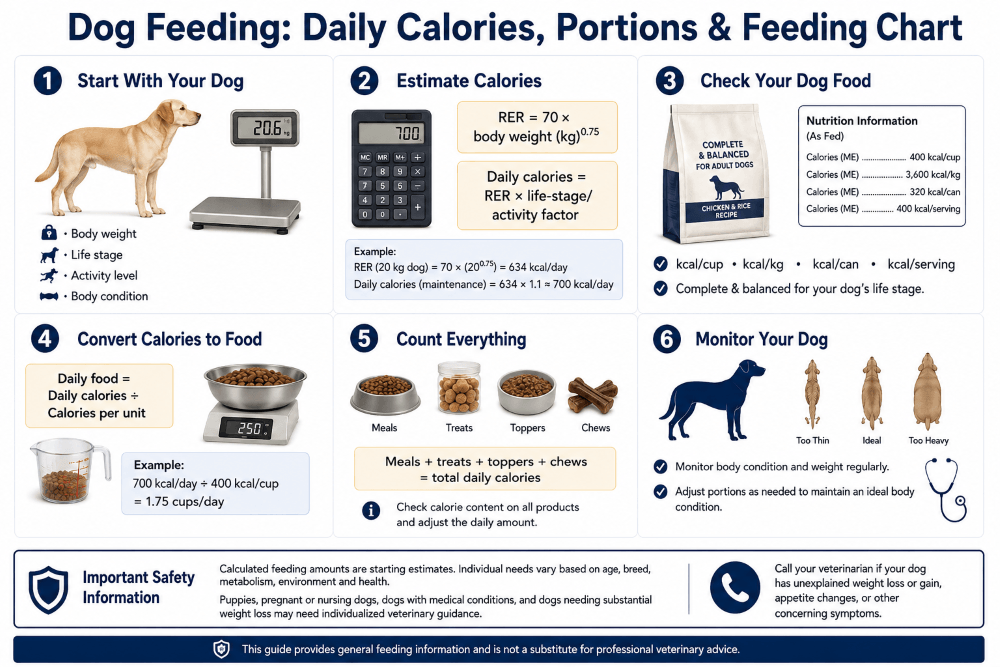
A commonly used starting point is the dog's resting energy requirement, or RER: RER = 70 × body weight (kg)^0.75
RER estimates the energy used by a healthy animal at rest. It is then multiplied by an appropriate life-stage or maintenance factor to estimate daily calorie needs. For example, commonly used starting factors include:


- Healthy neutered adult: 1.6 × RER
- Healthy intact adult: 1.8 × RER
- Obesity-prone adult: 1.4 × RER
- Puppy younger than 4 months: 3 × RER
- Puppy older than 4 months: 2 × RER
These are starting estimates, not fixed feeding requirements. Individual dogs may need substantially more or less than a calculated value.
How Do Calories Convert Into Dog Food?
Once you have an estimated daily calorie target, divide it by the number of calories in one unit of food. Daily food amount = Daily calories ÷ Calories per unit of food
For example, if a dog needs an estimated 700 kcal per day and the food contains 400 kcal per cup: 700 ÷ 400 = 1.75 cups per day
- If that dog eats two meals:
- 1.75 ÷ 2 = 0.875 cup per meal
When possible, weighing dry food in grams can make portions more consistent than estimating with a measuring cup.
Dog Feeding Chart by Weight
The chart below shows RER and an example maintenance estimate using 1.6 × RER, a commonly used starting factor for a healthy neutered adult dog. It is not a universal feeding prescription.
| Dog Weight | Weight (kg) | Approx. RER | Example Adult Calories* |
|---|---|---|---|
| 5 lb | 2.3 kg | 129 kcal | 207 kcal/day |
| 10 lb | 4.5 kg | 218 kcal | 348 kcal/day |
| 20 lb | 9.1 kg | 366 kcal | 585 kcal/day |
| 30 lb | 13.6 kg | 496 kcal | 794 kcal/day |
| 50 lb | 22.7 kg | 727 kcal | 1,164 kcal/day |
| 70 lb | 31.8 kg | 936 kcal | 1,498 kcal/day |
| 80 lb | 36.3 kg | 1,035 kcal | 1,656 kcal/day |
| 100 lb | 45.4 kg | 1,223 kcal | 1,958 kcal/day |
Example adult calories use 1.6 × RER and are shown only as a reference starting point. Actual requirements vary with body condition, activity, life stage, environment, health, and individual metabolism.
Dog Feeding Chart by Life Stage
Life stage can change calorie requirements considerably. These factors provide useful starting points for healthy dogs but should be adjusted based on the individual dog's response.


| Dog | Starting Factor | Practical Note |
|---|---|---|
| Puppy under 4 months | 3 × RER | Growth needs are high and change quickly. |
| Puppy over 4 months | 2 × RER | Recalculate as body weight and growth rate change. |
| Neutered adult | 1.6 × RER | Use as a starting point and monitor body condition. |
| Intact adult | 1.8 × RER | Individual needs may still differ substantially. |
| Obesity-prone adult | 1.4 × RER | Weight-loss plans may require veterinary guidance. |
| Working or athletic dog | Highly variable | Workload, duration, and environment can change needs. |
| Pregnant or nursing dog | Highly variable | Use an individualized nutrition plan. |
The puppy and healthy-adult factors above are established starting formulas, but they are not intended to override body-condition monitoring or veterinary judgment.
Dog Food Portions by Calorie Density
The same calorie target can produce very different cup measurements depending on the food. This chart shows why calories per cup matter.
| Daily Calories | 300 kcal/cup | 350 kcal/cup | 400 kcal/cup | 450 kcal/cup |
|---|---|---|---|---|
| 400 kcal | 1.33 cups | 1.14 cups | 1 cup | 0.89 cup |
| 600 kcal | 2 cups | 1.71 cups | 1.5 cups | 1.33 cups |
| 800 kcal | 2.67 cups | 2.29 cups | 2 cups | 1.78 cups |
| 1,000 kcal | 3.33 cups | 2.86 cups | 2.5 cups | 2.22 cups |
| 1,200 kcal | 4 cups | 3.43 cups | 3 cups | 2.67 cups |
Check your own package rather than assuming a standard calorie value. Pet food calorie statements are generally expressed as kcal/kg as fed and in a familiar unit such as kcal/cup, kcal/can, or kcal/biscuit.
Dog Feeding Guidelines
A feeding calculator works best when it is treated as the beginning of the decision rather than the end. The calculation gives you a reasonable starting amount; your dog's body condition, weight trend, appetite, and health tell you whether that starting amount is appropriate.
Start With Your Dog's Weight and Body Condition
Use an accurate, recent body weight whenever possible. Weight alone, however, does not reveal whether your dog is carrying too much or too little body fat. Body condition scoring adds important context. On the commonly used nine-point scale, scores around 4–5 out of 9 represent ideal body condition, while lower scores are under ideal and higher scores are over ideal.
If your dog is substantially overweight or underweight, do not assume their current weight should automatically be used as the nutritional goal. A veterinarian can help determine an appropriate target weight and calorie plan.
Estimate Resting Energy Requirement
The preferred general RER formula is: RER = 70 × body weight (kg)^0.75
A simpler equation is sometimes used: RER = 30 × body weight (kg) + 70
The linear shortcut is intended for animals weighing more than about 2 kg and less than 45 kg, while the exponential formula can be used across body weights.
Estimate Daily Energy Needs
RER is not the same thing as the amount your dog should automatically eat each day. Daily maintenance energy requirements account for factors such as age and neuter status, while real-life needs can also change with activity, lean body mass, environment, breed, and individual metabolism. In practice, calorie formulas work best when paired with regular reassessment. Dogs of identical body weight may differ significantly in the number of calories needed to maintain ideal condition.
Check the Dog Food Label
Look for the Calorie Content statement on the package. Depending on the food, you may see values such as:
- kcal/kg
- kcal/cup
- kcal/can
- kcal/tray
- kcal/patty
- kcal/biscuit or treat
Also check the nutritional adequacy statement. A food labeled complete and balanced is intended to provide all required nutrients in appropriate proportions for the life stage named on the label. Recognized categories include growth, adult maintenance, gestation/lactation, and all life stages. Feeding directions on the package are a useful starting point, but they may need to be modified for the individual dog.
Factors That Can Affect Your Dog's Feeding Results
Several factors can move your dog's real calorie requirement above or below a calculated estimate.
| Factor | Why It Matters | What Owners Should Check |
|---|---|---|
| Body weight | Energy needs rise with body size but not in a simple one-to-one ratio. | Use a recent, accurate weight. |
| Body condition | Two dogs at the same weight may have different ideal calorie needs. | Check ribs, waist, and abdominal tuck. |
| Age and life stage | Growth, adulthood, pregnancy, and lactation change energy needs. | Select the correct life stage. |
| Activity | Working and athletic dogs may use much more energy. | Consider actual daily workload. |
| Neuter status | It can influence the starting maintenance estimate. | Choose the appropriate calculator setting. |
| Health | Disease and some medications can change appetite or energy needs. | Follow veterinary diet guidance when applicable. |
| Food calories | Foods with different kcal values require different portions. | Use the calorie value from the current package. |
| Treats and extras | Small extras can add substantial daily calories. | Count treats, chews, toppers, and table food. |
Age, activity, lean body mass, breed, life stage, and environment are among the recognized reasons calorie needs can vary between dogs.
Common Dog Feeding Mistakes to Avoid
Most feeding errors are not dramatic; they are small inconsistencies repeated every day. Correcting them can make a meaningful difference over time.
| Mistake | Why It Matters | Better Approach |
|---|---|---|
| Using weight alone | Dogs of equal weight can have different calorie needs. | Include life stage, activity, and body condition. |
| Assuming cups are equal | Calories per cup vary widely between foods. | Check kcal/cup on the package. |
| Mixing up units | kcal/kg and kcal/cup are not interchangeable. | Match the calculator input to the label unit. |
| Ignoring treats | Extras can quietly push intake above the target. | Count all calorie-containing foods. |
| Never recalculating | Needs change with growth, weight, activity, and diet. | Update inputs when your dog changes. |
| Treating estimates as exact | A formula cannot predict every dog's metabolism. | Adjust according to weight and body condition. |
| Severe calorie restriction | Cutting a maintenance diet too far can also reduce nutrient intake. | Use veterinary guidance for significant weight loss. |
Feeding directions are intended as guidelines, and calculated energy requirements should likewise be adjusted according to the dog's response.
Safety Guidelines for Feeding Your Dog
Feeding amounts are only part of a healthy nutrition plan. The type of food, your dog’s life stage, body condition, health, and any treats or extras also matter, so use the calculator as a starting point and adjust with veterinary guidance when needed.
Choose a Complete and Balanced Diet
Calories tell you how much energy a food supplies; they do not tell you whether the diet provides all essential nutrients. For a commercial food intended to make up the main diet, look for a nutritional adequacy statement indicating that it is complete and balanced for the appropriate life stage. Growth, adult maintenance, gestation/lactation, and all life stages have different nutritional requirements.
This distinction is especially important with homemade diets. Meeting a calorie target does not automatically mean a recipe supplies appropriate protein, minerals, vitamins, fatty acids, or calcium-to-phosphorus balance.
Keep Treats and Extras in Perspective
Treats, chews, toppers, scraps, training rewards, and calorie-containing supplements all contribute to daily intake. A practical general target is to keep treats and extras to about 10% or less of total daily calories, leaving most calories for a complete and balanced diet. If your veterinarian has prescribed a therapeutic diet or a stricter nutrition plan, follow that plan instead.
Don't Make Large Calorie Cuts on Your Own
An overweight dog may need fewer calories, but simply feeding dramatically less of a standard maintenance food can also reduce intake of essential nutrients. Dogs needing substantial weight loss may benefit from a diet specifically formulated for calorie restriction so that adequate nutrients are delivered in a smaller calorie allowance. Unusually low calorie requirements can also justify checking for an underlying medical issue.
When Should You Contact a Veterinarian?
Ask your veterinarian for individualized feeding guidance if your dog:
What to Do If Your Dog Is Overweight or Underweight
If Your Dog Is Overweight
Start by looking at the entire day's intake, not just the food bowl. Include treats, dental chews, scraps, training rewards, supplements, and food used to hide medications. Measure meals consistently and track your dog's body weight and body condition over time. For significant excess weight, work with your veterinarian on an appropriate target weight, calorie goal, and monitoring schedule rather than making a large unsupervised reduction.
If Your Dog Is Underweight
First, confirm that your dog is actually receiving the amount you think they are. Check the food's current calorie content, measure portions accurately, and make sure another pet is not stealing food. Do not simply double the meal size if your dog is unexpectedly losing weight. Unexplained weight loss, persistent poor appetite, vomiting, diarrhea, increased thirst, or other changes deserve veterinary assessment.
Special Feeding Considerations for Certain Dogs
How to Calculate How Much Food Your Dog Needs Manually
You can reproduce the basic calculator process with a few simple equations.
Step 1: Convert Pounds to Kilograms
If your dog's weight is in pounds: Weight in kg = Weight in lb ÷ 2.2046
- For a 50-pound dog:
- 50 ÷ 2.2046 ≈ 22.7 kg
Step 2: Calculate RER
Use: RER = 70 × weight (kg)^0.75
- For a 22.7 kg dog:
- RER ≈ 727 kcal/day
Step 3: Apply an Appropriate Starting Factor
For a healthy neutered adult dog, an example starting calculation is: 727 × 1.6 ≈ 1,163 kcal/day
Rounded for practical feeding: ≈ 1,160 kcal/day
Remember that the multiplier creates an estimate, not a guarantee of actual energy needs.
Step 4: Find the Food's Calorie Density
- Suppose the dog's dry food contains:
- 400 kcal/cup
Calorie content should be listed on the package, usually in kcal/kg and a familiar serving unit such as a cup or can.
Step 5: Convert Calories Into Food
- 1,160 kcal/day ÷ 400 kcal/cup = 2.9 cups/day
- So the initial daily food amount would be approximately:
- 2.9 cups per day
Step 6: Divide the Food Into Meals
- For two meals per day:
- 2.9 ÷ 2 = 1.45 cups per meal
That is the mathematical starting point. Over the following weeks, your dog's weight trend and body condition should determine whether the amount remains appropriate.
Dog Feeding Calculator Infographic
Frequently Asked Questions
The Bottom Line
A Dog Feeding Calculator is most useful for answering two separate questions: How many calories might my dog need, and how much of this particular food provides those calories? Start with body weight, life stage, and body condition. Estimate daily calories, check the calorie content on your dog's food, convert calories into a practical portion, and remember to count treats and extras. Then watch the dog, not just the number. If weight and body condition stay appropriate, your starting portion is probably close. If they trend in the wrong direction, adjust gradually or talk with your veterinarian, especially if the change is unexpected or your dog has a medical condition.
Canine Bible readers can benefit from related readings such as dog calorie calculator, how long will dog food last calculator, dry dog food feeding calculator, dog food transition calculator, and dog protein calculator.