Dog Weight Loss Calculator: Find Your Dog’s Ideal Weight Loss Goal & Plan

Canine Bible is reader-supported. We receive affiliate commissions via some of our links. Learn more.
Helping an overweight dog reach a healthier body condition usually takes more than simply cutting their food. A useful plan starts with a realistic target weight, an appropriate calorie estimate, accurate food portions, and regular progress checks. The Dog Weight Loss Calculator below estimates a starting daily calorie target, how much weight your dog may need to lose, a reasonable weekly weight-loss range, and an approximate timeline.
Always consult your veterinarian before starting a weight-loss plan, especially if your dog is a puppy, senior, pregnant or nursing, has a medical condition, takes medications, or needs to lose a significant amount of weight. If you can't reach your vet, you can chat live with a registered online veterinary professional via our online vet chat or video chat support (24 hours a day, 7 days a week). Or use Chewy's online vet services (6 a.m. - midnight ET).
How Much Weight Should My Dog Lose?
Your dog's goal should be based on reaching a healthy body condition, not simply hitting an average breed weight. Two dogs of the same breed and height can have different healthy weights because their frame size and muscle mass differ.
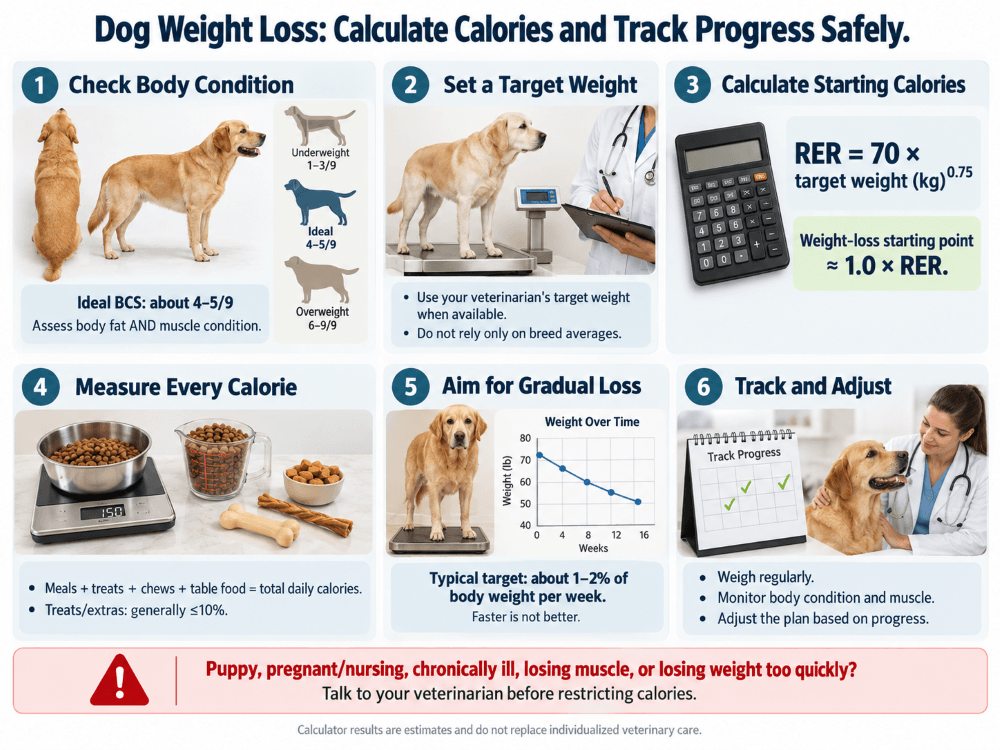
Veterinary body condition scoring commonly uses a 9-point scale. A score of about 4–5/9 is considered ideal, while scores above 5 indicate increasing amounts of excess body fat. If your veterinarian has already given you an ideal weight, use that number in the calculator. It is more useful than an automatically estimated target.
What Is a Healthy Body Condition Score for a Dog?
At an ideal body condition, your dog's ribs should be easy to feel without a thick layer of fat covering them. Viewed from above, there should also be a visible waist, and the abdomen should tuck upward behind the ribs when viewed from the side. Body condition and muscle condition are not the same thing. A dog can carry excess fat while also losing muscle, particularly with aging or chronic illness, so both should be considered during a weight-loss plan.
For dogs above ideal condition, a 9-point BCS can provide a rough estimate of excess weight. A BCS of 6/9 corresponds to roughly 10% excess body weight, 7/9 to about 20%, 8/9 to about 30%, and 9/9 to about 40%. These percentages are screening estimates rather than exact target-weight measurements.


Example
Suppose a dog currently weighs 55 pounds and has a BCS of 7/9. That score suggests the dog may be approximately 20% above ideal body weight. That information can help estimate a starting target, but the dog's build and muscle mass still matter. A veterinarian-confirmed ideal weight should take priority over the estimate.
Dog Weight Loss Chart
The charts below provide useful starting points for planning and monitoring. They should not be treated as fixed calorie prescriptions for every dog.
Dog Weight-Loss Calories by Target Weight
This chart uses the commonly used canine weight-loss starting calculation of approximately 1.0 × RER based on target or ideal weight.
| Target Weight | Approx. Starting Calories/Day |
|---|---|
| 5 lb | 129 kcal |
| 10 lb | 218 kcal |
| 15 lb | 295 kcal |
| 20 lb | 366 kcal |
| 30 lb | 496 kcal |
| 40 lb | 615 kcal |
| 50 lb | 727 kcal |
| 60 lb | 834 kcal |
| 70 lb | 936 kcal |
| 80 lb | 1,035 kcal |
| 100 lb | 1,223 kcal |
These values use 70 × target weight in kg^0.75. A dog's actual needs may differ, so monitor progress and adjust the feeding plan rather than assuming the calculated number will remain correct throughout weight loss.
Safe Dog Weight Loss per Week by Weight
For adult dogs on a structured weight-management plan, approximately 1–2% of body weight per week has traditionally been used as a desired range. Aiming near the slower end can be appropriate for many dogs, especially when preserving muscle and maintaining a sustainable routine.
| Current Weight | 1% per Week | 2% per Week |
|---|---|---|
| 10 lb | 0.1 lb | 0.2 lb |
| 20 lb | 0.2 lb | 0.4 lb |
| 30 lb | 0.3 lb | 0.6 lb |
| 40 lb | 0.4 lb | 0.8 lb |
| 50 lb | 0.5 lb | 1.0 lb |
| 60 lb | 0.6 lb | 1.2 lb |
| 80 lb | 0.8 lb | 1.6 lb |
| 100 lb | 1.0 lb | 2.0 lb |
Faster weight loss is not automatically better. If your dog is losing more than about 2% per week, losing visible muscle, becoming weak, or eating poorly, contact your veterinarian before restricting calories further.
Dog Body Condition Score and Excess Weight Chart
Body condition score can help when you do not already know your dog's ideal weight.


| BCS | General Category | Approx. Excess Weight |
|---|---|---|
| 4/9 | Ideal | None expected |
| 5/9 | Ideal | None expected |
| 6/9 | Above ideal | About 10% |
| 7/9 | Overweight | About 20% |
| 8/9 | Obese range | About 30% |
| 9/9 | Obese range | About 40% |
These percentages are screening estimates. Your dog's frame, muscle mass, breed characteristics, and medical history can change what an appropriate target weight looks like.
How Many Calories Should a Dog Eat to Lose Weight?
There is no single calorie number that works for every overweight dog. A common veterinary starting method calculates your dog's resting energy requirement (RER) using ideal or target body weight, then monitors how your dog responds.
- For weight reduction, a commonly used starting point for dogs is approximately:
- RER = 70 × target body weight (kg)^0.75
- Starting weight-loss calories ≈ 1.0 × RER
The important detail is that the calculation uses ideal or target weight, not simply the dog's current overweight weight.
Why the Calorie Number May Need to Change
Calorie formulas estimate energy needs; they do not directly measure your dog's metabolism. Dogs of the same weight can need substantially different amounts of energy because of differences in age, activity, lean body mass, neuter status, environment, health, and individual metabolism. That is why the most useful number is not just the initial calorie estimate. It is the calorie intake at which your individual dog gradually moves toward ideal body condition while maintaining muscle and overall health.
Dog Weight Loss Guidelines
A successful dog weight-loss plan usually combines calorie control, accurate feeding, regular monitoring, and appropriate activity.
Set an Appropriate Target Weight
Use a veterinarian-provided ideal weight whenever possible. A previous healthy adult weight can also provide useful context if your dog's build has not changed significantly. Breed averages are much less useful because healthy weights can vary considerably within the same breed.
Choose an Appropriate Diet
When a dog needs substantial calorie restriction, simply feeding a very small portion of a standard maintenance food may reduce the intake of essential nutrients along with calories. Diets designed specifically for weight reduction can provide adequate nutrients while delivering fewer calories.
If your dog needs a large calorie reduction, ask your veterinarian whether a therapeutic or purpose-formulated weight-management diet would be more appropriate.
Measure Food Accurately
A small measuring error repeated twice every day can make a major difference over several weeks. A kitchen scale that measures food in grams is generally more consistent than estimating kibble volume by eye. Check the package for the Calorie Content statement. Pet-food calorie information may be listed as kcal/kg and as calories per cup, can, biscuit, or another familiar unit.
Count Treats, Chews, and Extras
Calories from training treats, dental chews, cheese, peanut butter, table scraps, and food used to give medication still count toward the day's total. As a general nutrition rule, treats and other foods that are not complete and balanced should make up no more than about 10% of the dog's daily calorie intake.
For a dog whose total allowance is 500 kcal per day, that means roughly 50 kcal or less from treats and extras, leaving the large majority of calories for the complete and balanced diet.
Track Progress Consistently
Weigh your dog on the same scale when possible and under similar conditions. A recheck approximately every two weeks can help identify whether the starting calorie target is producing an appropriate trend. Do not judge progress from weight alone. Recheck body condition and muscle condition as well.
Factors That Can Affect Your Dog's Results
Several factors can make two dogs with the same body weight need different calorie targets or lose weight at different rates.
| Factor | Why It Matters | What Owners Should Check |
|---|---|---|
| Target weight | Weight-loss calories are commonly based on ideal weight. | Use a veterinarian-set target when available. |
| Body condition | Scale weight alone cannot show how much body fat is present. | Check ribs, waist, and abdominal tuck. |
| Muscle mass | Muscle loss can occur even in an overweight dog. | Watch the spine, shoulders, skull, and hips. |
| Age | Energy needs and muscle preservation change across life stages. | Identify puppy, adult, or senior status. |
| Activity | Sedentary and athletic dogs can need very different calories. | Consider typical daily exercise, not occasional activity. |
| Diet | Foods differ greatly in calories per cup or gram. | Read the calorie statement on the exact food. |
| Treats | Small extras can erase the planned calorie deficit. | Count chews, scraps, and medication foods. |
| Health | Disease and some medications can affect weight or appetite. | Discuss unexplained changes with your veterinarian. |
Common Mistakes to Avoid
Most stalled weight-loss plans are easier to fix when you can identify where extra calories or inaccurate assumptions are entering the routine.
| Mistake | Why It Matters | Better Approach |
|---|---|---|
| Guessing target weight | The wrong goal changes the calorie calculation. | Use BCS or a veterinary target. |
| Using current weight | An overweight weight can overestimate weight-loss calories. | Calculate from ideal or target weight. |
| Wrong units | Mixing pounds and kilograms changes the result dramatically. | Convert lb to kg before using the RER formula. |
| Ignoring food calories | Equal-sized portions can contain very different calories. | Use the exact label's kcal value. |
| Forgetting extras | Treats and scraps can add substantial daily calories. | Include every food source in the budget. |
| Cutting food sharply | Overrestriction can make the diet nutritionally inappropriate. | Use a structured plan and suitable diet. |
| Treating results as exact | Energy requirements vary between individual dogs. | Adjust based on measured progress. |
| Ignoring symptoms | Unexpected weight change can be related to illness. | Contact your veterinarian if your dog seems unwell. |
Safety Guidelines for Dog Weight Loss
Intentional weight loss should improve health without causing poor nutrition, weakness, or unnecessary loss of lean muscle. A calculator cannot tell whether an underlying medical condition is contributing to your dog's weight problem.
Talk to a Veterinarian Before Starting If Your Dog:
Abnormal body condition, muscle loss, unexplained weight changes, disease, and certain life stages warrant a more individualized nutritional assessment.
What If My Dog Is Losing Weight Too Fast?
Check the weight again to rule out a measurement error and review exactly how much food is being fed. Make sure calories from the main diet, treats, chews, supplements, and medication foods have all been counted correctly. If loss is consistently above roughly 2% of body weight per week, or you notice decreasing muscle mass, poor appetite, or lethargy, contact your veterinarian. Do not keep cutting calories simply because the scale is moving quickly.
Symptoms That Need Veterinary Attention
Arrange veterinary care if weight changes are accompanied by:
These signs do not necessarily mean the diet caused the problem, but they should not be managed by adjusting a calculator result alone.
What to Do If Your Dog Is Overweight
Start by confirming your dog's current weight and body condition. If you are uncertain whether the extra weight is body fat, or if the weight gain has been unexpected, schedule a veterinary assessment before beginning a restrictive diet. Once weight loss is appropriate, a practical plan looks like this:
- Set a realistic target weight. Use your veterinarian's target whenever available.
- Calculate a starting calorie allowance. Base the estimate on target or ideal body weight.
- Choose an appropriate complete and balanced diet. Significant restriction may require a food designed for weight management.
- Measure every meal. A gram scale is particularly useful for dry food.
- Budget treats before feeding them. Do not add them on top of the daily calorie allowance.
- Increase activity gradually. Match exercise to your dog's fitness, age, joints, and medical condition.
- Reweigh regularly. Approximately every two weeks is a useful starting interval for many plans.
- Adjust according to progress. A plateau should trigger a review of the whole plan rather than an automatic drastic calorie cut.
Exercise is valuable for fitness, mobility, enrichment, and weight management, but it works best alongside controlled calorie intake rather than as a substitute for portion control.
Special Considerations for Certain Dogs
How to Calculate Dog Weight-Loss Calories Manually
The calculator automates the math, but understanding the formula makes it easier to check the result.
Step 1: Convert Pounds to Kilograms
- If your dog's target weight is in pounds:
- Weight in kg = weight in lb ÷ 2.2046
Step 2: Use the Target Weight
Whenever possible, use the ideal weight your veterinarian has recommended. If no target has been established, a body condition score can help estimate one, but it is less precise than an individual assessment.
Step 3: Calculate Resting Energy Requirement
- Use:
- RER = 70 × body weight (kg)^0.75
The exponential RER equation can be used across a wide range of dog sizes.
Step 4: Estimate Starting Weight-Loss Calories
- A commonly used starting factor for canine weight reduction is:
- Weight-loss calories ≈ RER × 1.0
This is a starting estimate, not a guarantee of how many calories your dog ultimately needs.
Step 5: Convert Calories Into Food
- If the food lists calories per cup:
- Cups per day = daily calorie target ÷ kcal per cup
- If the label gives kcal/kg:
- kcal per gram = kcal/kg ÷ 1,000
- Then:
- Grams per day = daily calorie target ÷ kcal per gram
Using grams can make small feeding adjustments easier to measure consistently.
Step 6: Calculate Weekly Weight Loss
- Use:
- Weekly weight loss % = weight lost ÷ previous weight × 100
- If you are comparing measurements several weeks apart:
- Average weekly loss % = total percentage lost ÷ number of weeks
Example Calculation
Suppose your dog currently weighs 60 lb, and your veterinarian recommends a target weight of 50 lb.
- First, convert the target weight: 50 ÷ 2.2046 = 22.7 kg
- Then calculate RER: 70 × 22.7^0.75 ≈ 727 kcal/day
- Using a starting weight-loss factor of 1.0 gives: Estimated starting target ≈ 727 kcal/day
- If the food provides 360 kcal per cup: 727 ÷ 360 ≈ 2.0 cups per day
That does not mean every 50-pound target-weight dog should eat exactly two cups. The food's calorie density, the dog's actual progress, treats, medical history, and individual energy needs still matter. If treats are included, their calories should come from the same daily allowance rather than being added on top.
Dog Weight Loss Infographic
Frequently Asked Questions
The Bottom Line
A dog weight loss calculator can help turn a vague goal like “my dog needs to lose a few pounds” into a practical starting plan. The most useful outputs are a realistic target weight, an estimated daily calorie allowance, a measurable food portion, and a gradual progress range. The calculation is only the beginning. Measure food accurately, count treats and extras, monitor body condition and muscle as well as scale weight, and adjust the plan according to your dog's actual response.
For dogs with significant obesity, chronic disease, unexplained weight changes, muscle loss, or special life-stage needs, work with your veterinarian rather than relying on a calculator alone. If you are planning your dog's overall nutrition, a Dog Calorie Calculator, Dog Feeding Calculator, or Dog Protein Calculator can also help put weight-management numbers into context.