How Much Dry Food Should I Feed My Dog Calculator [Dog Feeding Tool]

Canine Bible is reader-supported. We receive affiliate commissions via some of our links. Learn more.
Figuring out how much dry food to feed your dog is not as simple as matching their weight to a number of cups on the bag. Two dogs that weigh the same can have different calorie needs, and two dry foods can pack very different numbers of calories into the same one-cup serving. The calculator below estimates your dog’s daily calorie needs first, then converts those calories into an estimated amount of their specific dry food. This guide also covers feeding charts by weight, kibble calorie density, life stage, body condition, manual calculations, common feeding mistakes, and when it is worth talking with your veterinarian.
Remember to ALWAYS contact your veterinarian if you are unsure how much dry food to feed your dog, especially if your dog is underweight, overweight, growing, pregnant, nursing, or has a health condition. If you can't reach your vet, you can chat live with a registered online veterinary professional via our online vet chat or video chat support (24 hours a day, 7 days a week). Or use Chewy's online vet services (6 a.m. - midnight ET). Additionally, at-home dog gut health tests can analyze your dog’s microbiome, offering insights into which nutrients their diet should include. Similarly, at-home dog allergy testing kits can identify ingredients that may not be suitable for your dog, enabling you to choose the right diet and care plan to support optimal digestion, nutrition, and health.
How Much Dry Food Should I Feed My Dog?
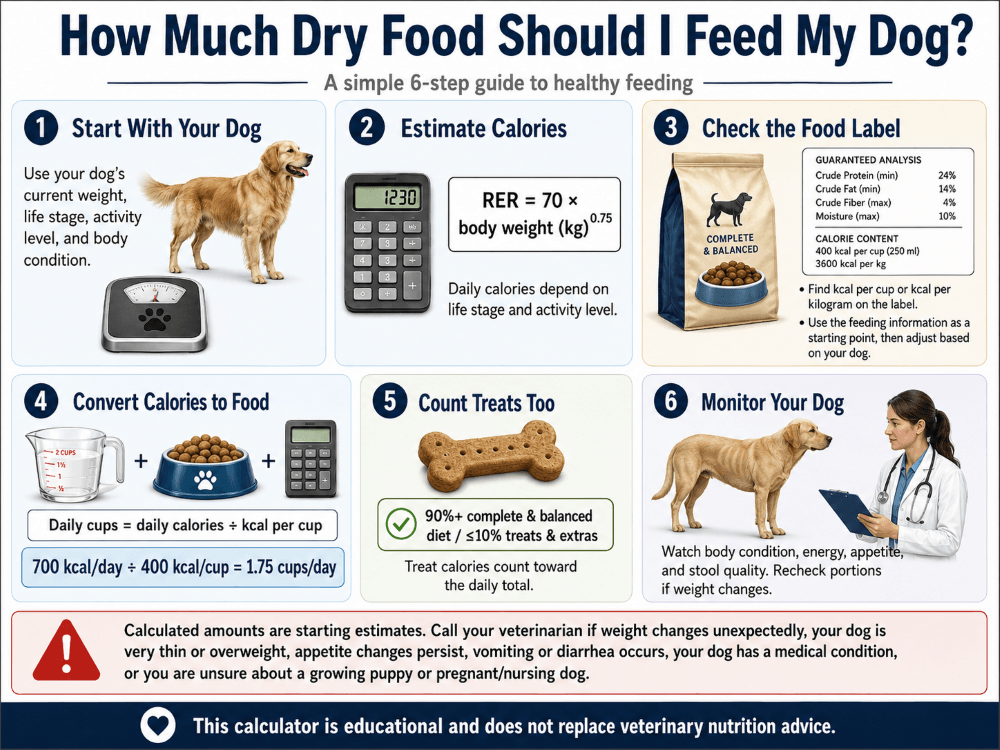
The best way to estimate a dog's dry food portion is to work in calories first, cups second. Start by estimating how many calories your dog needs each day. Then find the dry food's kcal per cup on the package and divide the dog's estimated calorie requirement by that number.
Daily cups of dry food = daily calorie requirement ÷ calories per cup
For example, suppose your dog is estimated to need 700 calories per day and their kibble contains 400 calories per cup:
700 ÷ 400 = 1.75 cups per day
That does not mean every dog with a similar weight should eat 1.75 cups. A dog's calorie needs can change with age, activity, reproductive status, body condition, environment, and individual metabolism. The calorie density of the food matters just as much. A dog eating a 300-kcal-per-cup food would need a larger volume than the same dog eating a 500-kcal-per-cup food.
There Is No Universal Cups-Per-Pound Rule
A feeding chart based only on body weight can be useful for a quick estimate, but it cannot tell you exactly how much kibble an individual dog needs. A better feeding calculation considers:


Feeding directions on commercial food packages are useful starting points, but they may need to be adjusted for the individual dog.
Dry Dog Food Feeding Chart
The following charts show how body weight, calorie density, and life stage can affect a dog's estimated feeding amount.
Dry Dog Food Chart by Weight
This chart gives a starting calorie range for healthy neutered adult dogs and shows what that range would look like if the kibble contained exactly 400 kcal per cup.
| Dog Weight | Estimated Calories/Day | At 400 kcal/Cup |
|---|---|---|
| 5 lb | 181–207 kcal | 0.45–0.52 cup |
| 10 lb | 305–348 kcal | 0.76–0.87 cup |
| 20 lb | 512–585 kcal | 1.28–1.46 cups |
| 30 lb | 694–794 kcal | 1.74–1.98 cups |
| 40 lb | 862–985 kcal | 2.15–2.46 cups |
| 50 lb | 1,018–1,164 kcal | 2.55–2.91 cups |
| 60 lb | 1,168–1,335 kcal | 2.92–3.34 cups |
| 70 lb | 1,311–1,498 kcal | 3.28–3.75 cups |
| 80 lb | 1,449–1,656 kcal | 3.62–4.14 cups |
| 100 lb | 1,713–1,958 kcal | 4.28–4.89 cups |
These figures use the standard RER equation and an adult neutered starting factor of approximately 1.4–1.6. They are not universal feeding recommendations, and the cup estimates apply only to a food containing exactly 400 kcal per cup.
How Kibble Calories Change the Amount You Feed
Consider a dog estimated to need 700 calories per day. The amount of kibble changes considerably depending on the food's calorie density.
| Kibble Calories | Food for 700 kcal/Day |
|---|---|
| 300 kcal/cup | 2.33 cups/day |
| 350 kcal/cup | 2.00 cups/day |
| 400 kcal/cup | 1.75 cups/day |
| 450 kcal/cup | 1.56 cups/day |
| 500 kcal/cup | 1.40 cups/day |
In this example, the same 700-calorie requirement could translate to about 1.4 to 2.3 cups per day depending only on the kibble. This is why the calorie statement on your actual dog food matters more than a generic cups-by-weight chart. On U.S. pet-food labels, look for a section called “Calorie Content.” Calorie information is expressed as kcal/kg and may also be shown per familiar household measure, such as a cup.
Dog Calorie Factors by Life Stage and Activity
Veterinary energy calculations commonly multiply a dog's resting energy requirement by a factor that reflects life stage or activity. These factors are useful starting points, not guarantees of an individual dog's needs.
| Dog Category | Starting Energy Factor | Practical Note |
|---|---|---|
| Inactive/Obesity-Prone Adult | RER × 1.0–1.2 | Monitor body condition closely. |
| Neutered Adult | RER × 1.4–1.6 | Common maintenance starting range. |
| Intact Adult | RER × 1.6–1.8 | Needs still vary by activity. |
| Puppy Under 4 Months | RER × 3.0 | Recalculate as the puppy grows. |
| Puppy 4+ Months | RER × 2.0 | Use food appropriate for growth. |
| Light Work | RER × 1.6–2.0 | Depends on actual workload. |
| Moderate Work | RER × 2.0–5.0 | Needs can vary widely. |
| Heavy Work | RER × 5.0–11.0 | Best managed individually. |
These multipliers are general energy-estimation guidelines. Body weight and body condition should be monitored so the feeding amount can be adjusted for the individual dog.


Dry Dog Food Feeding Guidelines for Dogs
The calculator works in four basic stages: estimate your dog's resting calorie requirement, adjust it for life stage and activity, check the calorie density of the food, and convert calories into an amount of kibble. That approach is more useful than treating cups as the starting point.
Step 1: Estimate Resting Energy Requirement
A dog's resting energy requirement, or RER, estimates the calories needed by a healthy animal at rest in a comfortable environment. The standard exponential equation is: RER = 70 × body weight in kilograms^0.75
For dogs between 2 and 45 kilograms, a simplified formula can also be used: RER ≈ 30 × body weight in kilograms + 70
The exponential equation can be used across body sizes, making it a better choice for an automated calculator.
Step 2: Estimate Daily Energy Needs
RER is not usually the final feeding target. A life-stage or activity multiplier is applied to estimate the dog's maintenance or daily energy requirement. For example, a healthy neutered adult might start around:
Daily calories = RER × 1.4–1.6
The important word is start. Calculated calorie needs are estimates, and the correct amount for an individual dog is the amount that supports an appropriate weight, body condition, and muscle condition over time.
Step 3: Check the Dry Food's Calorie Content
Turn the dog food bag over and look for Calorie Content. You may see something similar to:
- 3,650 kcal/kg
- 390 kcal/cup
Use 390 kcal/cup when calculating cups per day. Do not enter 3,650 kcal/kg into a field asking for kcal/cup; those units describe different quantities. Feeding directions on the package are still useful as a comparison point. They simply should not be treated as an exact prescription for every dog.
Step 4: Convert Calories Into Cups or Grams
Once you know the dog's estimated calories and the food's calorie density, the conversion is straightforward.
Cups per day = daily calories ÷ kcal per cup
If the label provides kcal/kg and you prefer weighing food: Grams per day = daily calories ÷ kcal/kg × 1,000
- For example, a dog eating 720 kcal/day from a food containing 3,600 kcal/kg would receive:
- 720 ÷ 3,600 × 1,000 = 200 grams per day
A kitchen scale can make small portion changes easier to measure consistently, especially with calorie-dense kibble.
Step 5: Count Treats, Toppers, and Extras
Dry food is only one part of the calorie total. Training treats, dental chews, cheese, peanut butter, table food, meal toppers, and foods used to give medication all contribute calories.
For most healthy dogs, keeping the complete and balanced main diet at about 90% or more of total calorie intake and treats or other extras at 10% or less helps prevent extras from displacing too much of the dog's primary nutrition. If your dog receives many treats for training, it can help to reserve part of the daily kibble ration and use those pieces as rewards.
Factors That Can Affect Your Dog's Results
A calorie formula is only the starting point. These factors can move your dog's real food requirement above or below the estimate.
| Factor | Why It Matters | What Owners Should Check |
|---|---|---|
| Weight | Heavier dogs generally need more total energy. | Use a recent, accurate weight. |
| Body Condition | Scale weight does not show whether a dog is lean or overweight. | Check ribs, waist, and abdominal tuck. |
| Age & Life Stage | Growth, adulthood, and aging can change calorie needs. | Select the dog's current life stage. |
| Activity | A working dog may use far more energy than a sedentary pet. | Choose activity based on real daily exercise. |
| Spay/Neuter Status | Reproductive status can affect maintenance requirements. | Use the correct adult category. |
| Kibble Calories | Calorie density determines how many cups provide the target. | Read the kcal/cup on the label. |
| Treats & Extras | Extra foods can add meaningful daily calories. | Count treats, toppers, chews, and table food. |
| Health | Disease or medication can change appetite and nutritional needs. | Ask your vet when health issues are present. |
Body condition and muscle condition are especially useful because two dogs at the same scale weight may have very different proportions of body fat and lean tissue. Nutrition plans should be reassessed when body condition is outside the ideal range, muscle loss develops, or weight changes without an obvious reason.
Common Dog Feeding Mistakes to Avoid
Small errors in measuring or interpreting food labels can add up quickly over weeks and months.
| Mistake | Why It Matters | Better Approach |
|---|---|---|
| Using Weight Alone | Dogs of the same weight can have different calorie needs. | Include life stage, activity, and body condition. |
| Assuming All Kibble Is Equal | Calories per cup can differ substantially. | Use the kcal/cup from the actual food. |
| Mixing Up Units | kcal/kg is not the same as kcal/cup. | Match the label number to the calculator field. |
| Ignoring Treats | Extras can push total calories above the target. | Count all food given during the day. |
| Guessing Portions | Heaping scoops make intake inconsistent. | Use a standard cup or kitchen scale. |
| Treating Estimates as Exact | Individual metabolism varies. | Track weight and body condition over time. |
| Using Adult Math for Puppies | Growing dogs have different energy needs. | Use puppy-specific calculations and food. |
| Not Updating the Plan | Needs change with weight, age, activity, and diet. | Recalculate after meaningful changes. |
One of the easiest mistakes to make is measuring the same visual “cup” after switching foods. If the new kibble contains more calories per cup, keeping the old volume can increase calorie intake even though the bowl looks unchanged.
Safety Guidelines for Feeding Dry Dog Food
A dry dog food calculator works best for generally healthy dogs when you need a sensible starting point. It should not replace an individualized veterinary feeding plan when there are significant weight, growth, or health concerns.
When Should You Ask Your Veterinarian How Much to Feed?
Contact your veterinarian if your dog:
Abnormal body condition, muscle loss, unexplained weight change, gastrointestinal problems, disease, and certain life stages are reasons for a more detailed nutritional assessment rather than relying only on a general calculator.
Do Not Use a Maintenance Calculator as a Weight-Loss Prescription
If your dog needs to lose a substantial amount of weight, simply cutting their normal food far below the calculator result is not the best approach. Weight-loss planning may involve an appropriate target weight, a specific calorie target, a nutritionally suitable diet, measured portions, activity planning, and scheduled reassessments.
Calorie calculations for weight reduction are generally based on an appropriate or ideal weight and then adjusted to the individual dog. A dedicated dog weight loss calculator can help organize the numbers, but significant weight loss should still be supervised by your veterinary team.
Choose Food Appropriate for Your Dog's Life Stage
Portion size is only part of feeding well. The food itself also needs to provide the right nutrient balance for the dog's stage of life. A growing puppy, for example, should not simply receive a larger portion of an adult-maintenance diet unless that food is labeled as appropriate for growth. Check the nutritional adequacy statement and feeding directions on the package when choosing the main diet.
What to Do If Your Dog Is Gaining or Losing Weight on the Calculated Amount
A calculator result is a starting point. Your dog's weight trend tells you whether that starting point is working. If the scale begins moving in the wrong direction, work through these steps before making a large change.
1. Measure What Your Dog Actually Eats: Check the amount that goes into the bowl, but also count food from everyone else in the household. A few training treats, a dental chew, scraps after dinner, or another pet's leftovers can make reported intake very different from actual intake.
2. Recheck the Dog Food Label: Confirm that you entered kcal per cup rather than kcal/kg. If you recently changed recipes, even within the same brand, check the calorie statement again. Different formulas may not have the same calorie density.
3. Reweigh Your Dog: Use a current weight rather than relying on a number from months ago. For small dogs and puppies, even modest changes can affect the calculation enough to justify updating the feeding amount.
4. Look at Body Condition, Not Just the Scale: At an ideal body condition, the ribs should generally be easy to feel without a heavy fat covering, and there should be a visible waist when viewed from above. A body condition score gives more useful context than scale weight by itself. If you are unsure, ask your veterinarian to show you how to score your own dog.
5. Recheck Activity and Life Stage: A dog recovering from an injury may suddenly exercise less. A puppy's calorie requirements change as growth progresses. A previously active adult may become more sedentary with age. Recalculate when those circumstances change rather than assuming the old feeding amount will remain appropriate indefinitely.
6. Make Small Adjustments When Appropriate: For an otherwise healthy dog with a mild, explainable weight trend, measured adjustments are easier to evaluate than dramatic changes. Recheck body weight and body condition after the adjustment. If weight change is substantial, persistent, unexplained, or accompanied by other symptoms, involve your veterinarian instead of repeatedly changing food amounts on your own.
Special Feeding Considerations for Certain Dogs
How to Calculate How Much Dry Food to Feed Your Dog Manually
You can reproduce the basic calculator calculation with a standard calculator.
Step 1: Convert Pounds to Kilograms
If your dog's weight is in pounds, weight in kilograms = weight in pounds ÷ 2.2046
- For a 30-pound dog:
- 30 ÷ 2.2046 = about 13.6 kg
Step 2: Calculate RER
Use: RER = 70 × body weight in kg^0.75
- For a 13.6-kg dog:
- 70 × 13.6^0.75 ≈ 496 kcal/day
That is the resting energy requirement, not yet the final amount to feed.
Step 3: Apply an Appropriate Energy Factor
For a healthy neutered adult, a common starting range is: RER × 1.4–1.6
- Using the 496-kcal RER:
- 496 × 1.4 = 694 kcal/day
- 496 × 1.6 = 794 kcal/day
- So the estimated maintenance starting range is about 694–794 kcal/day.
Step 4: Convert Calories to Dry Food
- Assume the dog's food contains 400 kcal per cup.
- 694 ÷ 400 = 1.74 cups/day
- 794 ÷ 400 = 1.98 cups/day
A reasonable starting estimate for this example would therefore be roughly 1¾ to 2 cups per day of that particular food. If the same dog switched to a food containing 500 kcal/cup, the equivalent calorie range would be only about 1.39–1.59 cups per day. This is why cup measurements cannot be transferred blindly from one kibble to another.
Example Calculation: 30-Pound Adult Dog
- Here is the full calculation in one place:
- Dog: 30 lb
- Weight in kilograms: 13.6 kg
- RER: about 496 kcal/day
- Adult neutered estimate: about 694–794 kcal/day
- Food: 400 kcal/cup
- Estimated portion: about 1.74–1.98 cups/day
- If feeding two meals, that works out to approximately:
- 0.87–0.99 cup per meal
That is a mathematical starting point. The dog's weight and body condition over the following weeks determine whether the amount actually fits that individual.
How Much Dry Food Should I Feed My Dog Infographic
Frequently Asked Questions
The Bottom Line
The best answer to “How much dry food should I feed my dog?” starts with calories, not cups. Estimate your dog's calorie needs using weight and an appropriate life-stage factor, check the kcal per cup on the actual food, then convert those calories into a measured daily portion. Remember to include treats and toppers in the total.
Most importantly, treat the calculator result as a starting point. Monitor your dog's weight, ribs, waist, body condition, and muscle condition, and update the amount as your dog's needs change. If your dog is substantially overweight or underweight, has unexplained weight changes, has a medical condition, is pregnant or nursing, or is not growing as expected, ask your veterinarian for an individualized feeding plan.
For a more complete nutrition picture, pair this tool with a Dog Calorie Calculator, Dog Feeding Calculator, Puppy Feeding Guide, Dog Protein Calculator, and How Long Will Dog Food Last Calculator.