
Puppy Weight & Size Calculator: How Big Will My Dog Be & Growth Charts

Canine Bible is reader-supported. We receive affiliate commissions via some of our links. Learn more.
Whether your puppy is a tiny toy breed, a fast-growing large breed, or somewhere in between, it’s natural to wonder how big they’ll get. Puppy growth can vary by breed, age, sex, nutrition, and genetics—so guessing adult size isn’t always simple. That’s why we created this Puppy Weight & Size Calculator—to help you estimate your puppy’s adult weight and size based on their current age, weight, and breed type. In this guide, you’ll also find puppy growth charts, size categories, development milestones, and tips to help you track healthy growth as your pup matures.
How Big Will My Puppy Get?
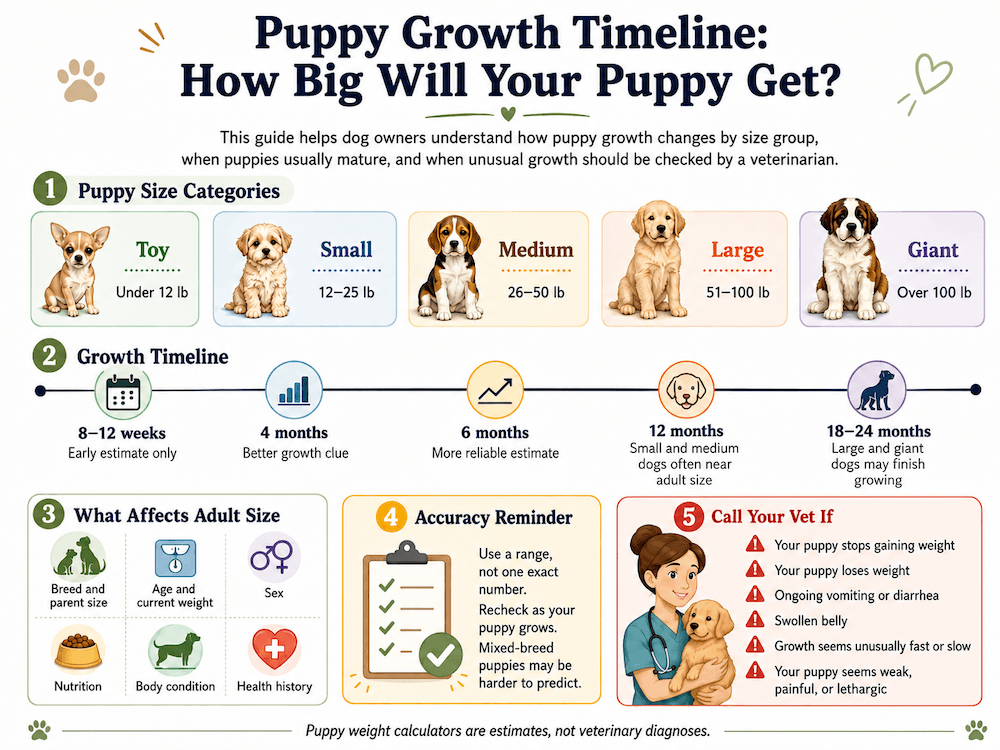
Your puppy’s adult size depends mostly on breed, genetics, age, current weight, sex, nutrition, and body condition. Toy and small breeds usually reach adult weight sooner, while large and giant breeds may keep growing and filling out for 18–24 months or longer.
In general, the older your puppy is, the more reliable the estimate becomes. A 12-week-old puppy can give a rough clue, but a 6-month-old puppy usually provides a better prediction because more of their growth pattern is already visible.
The best way to estimate how big your puppy will get is to combine current weight, age, breed size, parent size when known, and overall body condition. Use the result as a range rather than an exact number, especially for mixed-breed puppies or puppies with unknown history.
Puppy Weight & Size Chart for Dogs
Use the charts below to understand the most common adult size categories for dogs. These ranges can help you choose the closest breed-size option in the calculator.


Puppy Adult Size Chart by Expected Weight
| Adult Size | Expected Adult Weight | Common Examples | Growth Pattern |
|---|---|---|---|
| Toy | Under 12 lb | Chihuahua, Toy Poodle, Maltese | Fast growth; often mature by 6–9 months |
| Small | 12–25 lb | Dachshund, Shih Tzu, Pug | Most growth complete by 9–12 months |
| Medium | 26–50 lb | Beagle, Cocker Spaniel, Border Collie | Often mature by 12–15 months |
| Large | 51–100 lb | Labrador Retriever, Boxer, German Shepherd | May grow until 15–18 months |
| Giant | Over 100 lb | Great Dane, Mastiff, Saint Bernard | May mature at 18–24+ months |
Puppy Growth Chart by Age and Breed Size
Puppy growth is not the same for every dog. Smaller dogs usually reach adult weight faster, while large and giant breeds grow more slowly over a longer period.
| Puppy Age | Toy/Small | Medium | Large | Giant |
|---|---|---|---|---|
| 8 weeks | Early growth | Early growth | Early growth | Early growth |
| 12 weeks | Rough estimate | Rough estimate | Highly variable | Highly variable |
| 16 weeks | 45–60% grown | 35–50% grown | 25–40% grown | 20–35% grown |
| 6 months | 70–90% grown | 60–75% grown | 50–65% grown | 45–60% grown |
| 9 months | Near adult size | Close to adult size | Still growing | Still growing |
| 12 months | Usually mature | Near adult size | May fill out | Still growing |
| 18–24 months | Mature | Mature | Usually mature | Often mature |
Puppy Weight Estimate Chart by Current Weight
Your puppy’s current weight can provide a helpful clue, but age matters just as much. A 10-pound puppy at 8 weeks may grow into a much larger dog than a 10-pound puppy at 6 months.
| Current Weight | Likely Size Clue | What to Check |
|---|---|---|
| Under 5 lb | Toy or small | Confirm age and breed type |
| 5–10 lb | Small to medium | Age changes the estimate |
| 10–20 lb | Medium to large | Compare with growth stage |
| 20–40 lb | Medium to large | Common in large puppies |
| 40–70 lb | Large to giant | Check body condition |
| Over 70 lb | Giant or very large | Ask about joint-safe growth |
Puppy Growth Guidelines for Dogs
Puppy growth is not linear. Most puppies grow fastest during the first few months, then slow down as they approach adult size. Small breeds usually finish growing earlier, while large and giant breeds need more time for bones, joints, and muscle mass to mature.
A good puppy weight estimate should combine age, current weight, breed size, growth stage, and body condition. Weight alone is not enough because the same number can mean very different things at different ages.


For large and giant breeds, steady growth is especially important. Overfeeding or encouraging rapid weight gain can place extra stress on developing bones and joints. Use the calculator as a planning tool, not as a reason to push your puppy toward a specific number on the scale.
Factors That Can Affect Your Puppy’s Results
Several factors can affect your puppy’s estimated adult weight and size, including age, breed, current weight, sex, body condition, growth rate, and overall health.
| Factor | Why It Matters | Better Approach |
|---|---|---|
| Age | Older puppies give better estimates. | Use the most accurate age. |
| Breed & Parent Size | Genetics shape adult size. | Use breed type or parent weights. |
| Weight & Body Condition | Thin or overweight puppies skew results. | Check weight with body shape. |
| Sex | Males may be larger in some breeds. | Use sex as extra context. |
| Nutrition | Diet supports healthy growth. | Feed a complete puppy diet. |
| Spay/Neuter Status | Timing may affect growth patterns. | Ask your vet about timing. |
| Health Conditions | Illness can affect weight gain. | Call your vet if growth seems off. |
Common Puppy Weight Calculator Mistakes
Avoid these common mistakes when using a puppy weight calculator or growth chart.
| Mistake | Why It Matters | Better Approach |
|---|---|---|
| Expecting exact results | Growth varies by dog. | Use a weight range. |
| Wrong age | Age affects the formula. | Use weeks or months carefully. |
| Ignoring breed size | Growth timelines differ. | Choose the closest size group. |
| Using weight alone | Weight depends on age. | Combine age, weight, and breed. |
| Skipping body condition | Thin or overweight puppies skew results. | Check ribs, waist, and shape. |
| Never recalculating | Puppies change quickly. | Update every few weeks. |
| Comparing littermates | Siblings may mature differently. | Track your puppy’s trend. |
| Assuming mixes are predictable | Unknown genetics widen results. | Use a broader range. |
What to Do If Your Puppy’s Weight Estimate Seems Abnormal
First, check the inputs. Make sure the age, weight, and unit of measurement are correct. A simple mistake, such as entering kilograms as pounds, can create a very inaccurate result.
Next, compare your puppy’s trend over time instead of focusing on one weigh-in. A puppy that is steadily gaining weight, eating well, staying active, and maintaining a healthy body condition may simply be growing at an individual pace.
Call your veterinarian if the estimate seems abnormal and your puppy also has symptoms such as poor appetite, lethargy, vomiting, diarrhea, coughing, bloating, weakness, pain, or sudden weight loss.
Growth Red Flags to Discuss With Your Veterinarian
Some growth differences are normal, but certain signs should not be ignored. Use this table as a quick safety check.
| Sign | Why It Matters | What to Do |
|---|---|---|
| No weight gain | May signal illness or poor intake. | Call your vet. |
| Weight loss | Unexpected loss is concerning. | Book a checkup. |
| Swollen belly | May involve parasites or bloating. | Seek veterinary advice. |
| Vomiting or diarrhea | Can affect hydration and growth. | Call if persistent. |
| Very rapid growth | May stress developing joints. | Review diet with your vet. |
| Weakness or pain | May indicate a health issue. | Get prompt care. |
How to Calculate Puppy Adult Weight Manually
A simple manual method is to estimate how much of adult weight your puppy has likely reached based on age and breed size.
Basic formula:
Adult weight estimate = Current puppy weight ÷ Estimated percentage of adult weight reached
For example, if a medium-breed puppy weighs 20 pounds and is estimated to be about 50% of adult weight:
20 ÷ 0.50 = 40 pounds estimated adult weight
This method is only a rough estimate. Accuracy depends on correct age, healthy body condition, breed size, and whether your puppy’s growth pattern is typical.
Example Calculation
A 6-month-old Labrador Retriever puppy weighs 45 pounds. Large-breed puppies may be around 50% to 65% of adult weight at this stage.
Using a broad range:
45 ÷ 0.65 = about 69 pounds
45 ÷ 0.50 = about 90 pounds
Estimated adult weight range: about 70 to 90 pounds, depending on sex, genetics, nutrition, and body condition.
Frequently Asked Questions
The Bottom Line
The Puppy Weight & Size Calculator helps estimate your puppy’s future adult weight, size category, and growth stage based on age, current weight, breed, and growth patterns. Use the result as a helpful planning guide, not an exact prediction, since puppies can grow at different rates depending on genetics, nutrition, health, sex, and breed mix.
If your puppy’s projected size seems higher or lower than expected, start by checking the age, weight, breed, and size category you entered. Growth estimates are most useful when combined with regular weigh-ins, body condition checks, and your veterinarian’s guidance. You can also compare your puppy’s current body shape with our guide on how heavy your dog should be to make sure they are growing steadily without becoming too thin or overweight.
Because nutrition plays a major role in healthy puppy growth, you may also want to estimate daily energy needs with our Dog Calorie Calculator, review feeding options in our best dry puppy food guide, or learn how much wet food to feed a dog if you use canned or mixed meals. If you are comparing feeding styles or budgeting for your puppy’s future size, check our Dog Food Cost Calculator or Raw Dog Food Calculator.