Dog Amoxicillin Dosage Calculator: How Much to Give & Charts

Canine Bible is reader-supported. We receive affiliate commissions via some of our links. Learn more.
Whether your dog has a bacterial skin infection, wound, dental infection, urinary issue, or respiratory problem, amoxicillin is a commonly prescribed antibiotic in veterinary medicine. But while it can be safe and effective when prescribed correctly, giving the wrong dose—or using leftover antibiotics without veterinary guidance—can be dangerous and may worsen your dog’s condition. That’s why we created this Dog Amoxicillin Dosage Calculator—to help you estimate a veterinarian-prescribed dose based on your dog’s weight. In this guide, you’ll also find dosage charts, safety tips, side effects, and answers to frequently asked questions to help you use amoxicillin responsibly.
How Much Amoxicillin Can I Give My Dog?
The only safe answer is: give the exact amoxicillin dose prescribed by your veterinarian. Amoxicillin dosing can depend on your dog’s weight, infection type, infection severity, medication formulation, dosing interval, health history, and whether the product is plain amoxicillin or amoxicillin-clavulanate.
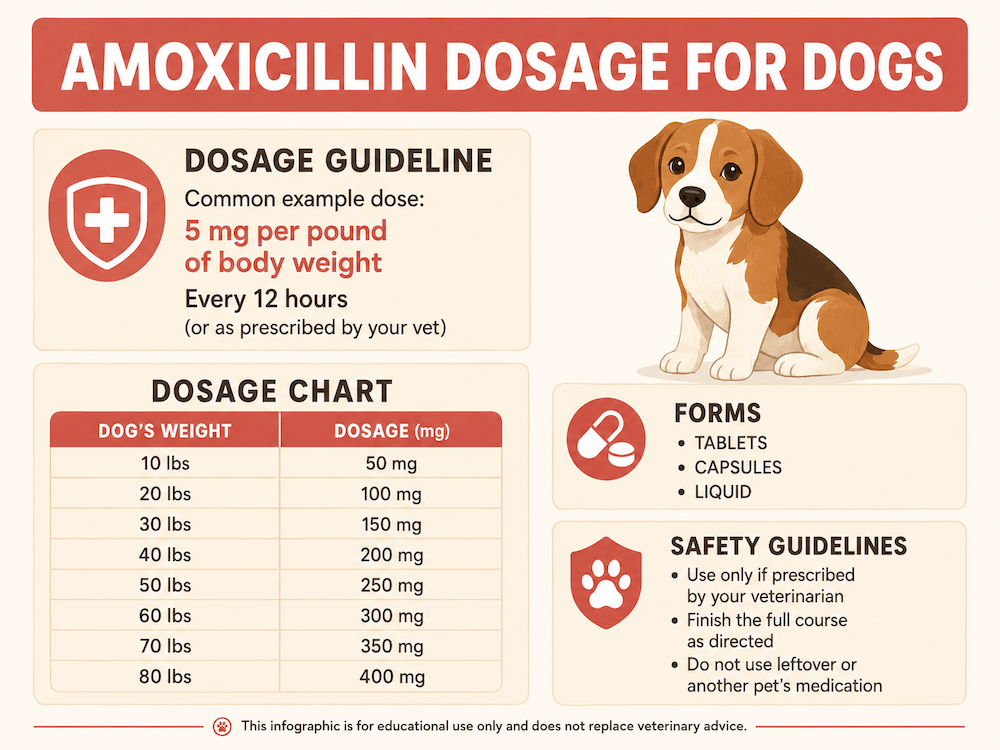
A commonly referenced FDA-approved veterinary label dose for plain amoxicillin tablets and suspension is 5 mg per pound of body weight twice daily for dogs, while veterinary drug references may list broader amoxicillin dose ranges depending on route, indication, and clinical judgment. That does not mean every dog should receive that dose; it means your veterinarian must decide whether amoxicillin is appropriate and what dose, interval, and duration your dog needs.
For example, if your veterinarian prescribed 5 mg/lb every 12 hours for a 40-lb dog, the estimated amount would be 200 mg per dose. But your dog’s actual prescription may be different, so always follow the label or call your veterinarian if the numbers do not match.
Do not start amoxicillin because your dog has a cough, wound, urinary signs, skin irritation, dental pain, or diarrhea. Different conditions need different treatment, and antibiotics are not appropriate for every illness.
Amoxicillin Dosage Chart for Dogs by Weight
This chart shows example plain amoxicillin amounts at 5 mg per pound of body weight per dose. Use only for dogs with a current veterinary prescription.


| Dog Weight | Amoxicillin Dose | 50 mg Tablets | 100 mg Tablets | 200 mg Tablets |
|---|---|---|---|---|
| 5 lb | 25 mg | ½ tablet | ¼ tablet | ⅛ tablet |
| 10 lb | 50 mg | 1 tablet | ½ tablet | ¼ tablet |
| 15 lb | 75 mg | 1½ tablets | ¾ tablet | ⅜ tablet |
| 20 lb | 100 mg | 2 tablets | 1 tablet | ½ tablet |
| 25 lb | 125 mg | 2½ tablets | 1¼ tablets | ⅝ tablet |
| 30 lb | 150 mg | 3 tablets | 1½ tablets | ¾ tablet |
| 35 lb | 175 mg | 3½ tablets | 1¾ tablets | ⅞ tablet |
| 40 lb | 200 mg | 4 tablets | 2 tablets | 1 tablet |
| 45 lb | 225 mg | 4½ tablets | 2¼ tablets | 1⅛ tablets |
| 50 lb | 250 mg | 5 tablets | 2½ tablets | 1¼ tablets |
| 60 lb | 300 mg | 6 tablets | 3 tablets | 1½ tablets |
| 70 lb | 350 mg | 7 tablets | 3½ tablets | 1¾ tablets |
| 80 lb | 400 mg | 8 tablets | 4 tablets | 2 tablets |
| 90 lb | 450 mg | 9 tablets | 4½ tablets | 2¼ tablets |
| 100 lb | 500 mg | 10 tablets | 5 tablets | 2½ tablets |
| 110 lb | 550 mg | 11 tablets | 5½ tablets | 2¾ tablets |
| 120 lb | 600 mg | 12 tablets | 6 tablets | 3 tablets |
| 130 lb | 650 mg | 13 tablets | 6½ tablets | 3¼ tablets |
| 140 lb | 700 mg | 14 tablets | 7 tablets | 3½ tablets |
| 150 lb | 750 mg | 15 tablets | 7½ tablets | 3¾ tablets |
Tablet columns show mathematical equivalents only. Do not split, crush, round, or combine tablets unless your veterinarian specifically approves it. This chart does not apply to amoxicillin-clavulanate.
Amoxicillin Liquid Dosage Chart for Dogs
This chart shows example liquid amounts using a 5 mg/lb dose for educational prescription-checking only. Always follow your veterinarian’s label and measure liquid medication with an oral syringe, not a kitchen spoon.
| Dog Weight | Example Dose at 5 mg/lb | 125 mg/5 mL Liquid (25 mg/mL) |
250 mg/5 mL Liquid (50 mg/mL) |
100 mg/mL Liquid |
|---|---|---|---|---|
| 5 lb | 25 mg | 1 mL | 0.5 mL | 0.25 mL |
| 10 lb | 50 mg | 2 mL | 1 mL | 0.5 mL |
| 15 lb | 75 mg | 3 mL | 1.5 mL | 0.75 mL |
| 20 lb | 100 mg | 4 mL | 2 mL | 1 mL |
| 25 lb | 125 mg | 5 mL | 2.5 mL | 1.25 mL |
| 30 lb | 150 mg | 6 mL | 3 mL | 1.5 mL |
| 35 lb | 175 mg | 7 mL | 3.5 mL | 1.75 mL |
| 40 lb | 200 mg | 8 mL | 4 mL | 2 mL |
| 45 lb | 225 mg | 9 mL | 4.5 mL | 2.25 mL |
| 50 lb | 250 mg | 10 mL | 5 mL | 2.5 mL |
| 60 lb | 300 mg | 12 mL | 6 mL | 3 mL |
| 70 lb | 350 mg | 14 mL | 7 mL | 3.5 mL |
| 80 lb | 400 mg | 16 mL | 8 mL | 4 mL |
| 90 lb | 450 mg | 18 mL | 9 mL | 4.5 mL |
| 100 lb | 500 mg | 20 mL | 10 mL | 5 mL |
| 110 lb | 550 mg | 22 mL | 11 mL | 5.5 mL |
| 120 lb | 600 mg | 24 mL | 12 mL | 6 mL |
| 130 lb | 650 mg | 26 mL | 13 mL | 6.5 mL |
| 140 lb | 700 mg | 28 mL | 14 mL | 7 mL |
| 150 lb | 750 mg | 30 mL | 15 mL | 7.5 mL |
Liquid amounts are mathematical examples only. Use the exact concentration on your dog’s prescription label and measure with an oral syringe. Do not use this chart to give amoxicillin without a veterinarian’s prescription. This chart does not apply to amoxicillin-clavulanate.
Plain Amoxicillin vs. Amoxicillin-Clavulanate
Plain amoxicillin and amoxicillin-clavulanate are not the same medication. Amoxicillin-clavulanate contains clavulanic acid in addition to amoxicillin, and it may be prescribed for different infections or with different instructions. Do not swap one product for the other unless your veterinarian specifically tells you to.
| Product Type | Key Point | Owner Safety Note |
|---|---|---|
| Plain amoxicillin | Amoxicillin only. | Use only as prescribed. |
| Amoxicillin-clavulanate | Includes clavulanic acid. | Do not dose like plain amoxicillin. |
| Human amoxicillin | May differ in strength or ingredients. | Use only if vet-approved. |
| Leftover antibiotics | May be expired or wrong. | Do not reuse without a vet. |
| Fish antibiotics | Not prescribed for dogs. | Do not give to dogs. |
Amoxicillin Liquid Strength Chart
Liquid dosing mistakes often happen when owners confuse mg with mL. Milligrams measure the amount of drug. Milliliters measure the volume of liquid. To calculate liquid amoxicillin correctly, you need the concentration from the bottle or prescription label.
| Liquid Strength | Meaning | 100 mg Dose | Owner Note |
|---|---|---|---|
| 50 mg/mL | 50 mg in 1 mL. | 2 mL | Enter 50 mg/mL. |
| 100 mg/mL | 100 mg in 1 mL. | 1 mL | Measure carefully. |
| 125 mg/5 mL | 25 mg/mL. | 4 mL | Convert first. |
| 250 mg/5 mL | 50 mg/mL. | 2 mL | Common suspension. |
| Compounded liquid | Strength varies. | Check label. | Do not guess. |
Tablet and Capsule Strength Guide
Some amoxicillin prescriptions match common capsule or tablet strengths cleanly. Others do not. Never split, crush, combine, or round medication unless your veterinarian says it is safe for that specific product.


| Match Type | Example | Meaning | Owner Action |
|---|---|---|---|
| Exact match | 250 mg dose / 250 mg capsule. | One whole unit. | Follow the label. |
| Partial match | 125 mg dose / 250 mg tablet. | May need splitting. | Ask your vet first. |
| No clean match | 180 mg dose / 250 mg capsule. | Strength does not fit. | Ask about liquid. |
| Multiple units | 500 mg dose / 2 × 250 mg capsules. | More than one unit. | Confirm the label. |
| Do not crush | Coated, flavored, or special product. | May be unsafe to alter. | Ask vet or pharmacist. |
Safety Dosage Amoxicillin Guidelines for Dogs
1. Amoxicillin is a penicillin-type antibiotic used for certain bacterial infections. It does not treat viral infections, parasites, allergies, pain, inflammation by itself, or every wound, cough, dental issue, or urinary problem.
2. Amoxicillin should be used only under veterinary direction. Antibiotics are not appropriate for every illness, and using them when they are not needed can contribute to poor treatment outcomes and antibiotic resistance.
3. Never give amoxicillin to a dog with a known penicillin allergy unless your veterinarian specifically clears it. Watch for vomiting, diarrhea, appetite loss, lethargy, hives, rash, facial swelling, breathing changes, collapse, or seizures.
4. Use these guidelines whenever your veterinarian prescribes amoxicillin:
- Use only when prescribed by a veterinarian.
- Follow the prescription label exactly.
- Give doses at the interval your vet prescribed.
- Finish the full course unless your vet tells you to stop.
- Do not double up after a missed dose unless your vet specifically instructs you to.
- Do not substitute amoxicillin-clavulanate for plain amoxicillin, or plain amoxicillin for amoxicillin-clavulanate.
- Do not use old, expired, shared, or human medication unless directed by your vet.
- Call your vet if your dog worsens, develops side effects, or does not improve.
Factors That Can Affect Your Dog’s Results
Your calculator result is only as accurate as the information entered. These factors can change the final dose, product choice, or safety plan.
| Factor | Why It Matters | What to Do |
|---|---|---|
| Weight | Dose is often weight-based. | Use current weight. |
| Medication form | Strengths vary by tablet, capsule, or liquid. | Check the exact label. |
| Infection type | Different infections need different plans. | Do not self-treat. |
| Age | Puppies and seniors need caution. | Follow vet directions. |
| Health issues | Kidney, liver, or GI disease may affect safety. | Tell your vet. |
| Other meds | Interactions or side effects can overlap. | Share all medications. |
Common Mistakes to Avoid
Many amoxicillin dosing problems happen because an owner misreads the label, confuses units, or uses the wrong product. The safest approach is to call your veterinarian whenever the label, calculator, or dose does not make sense.
| Mistake | Risk | Do This Instead |
|---|---|---|
| Using human meds | Wrong strength or ingredients. | Use only if vet-approved. |
| Mixing up mg and mL | Wrong dose amount. | Check concentration. |
| Using teaspoons | Inaccurate liquid dose. | Use an oral syringe. |
| Giving leftovers | Expired or wrong antibiotic. | Call your vet. |
| Stopping early | Infection may return. | Finish as directed. |
| Doubling doses | More side effects. | Follow the label. |
| Confusing products | Amoxicillin products differ. | Match the label exactly. |
| Ignoring symptoms | Reaction may worsen. | Contact your vet. |
| Self-prescribing | Wrong treatment choice. | Use only with a prescription. |
What to Do If Your Dog Gets the Wrong Amoxicillin Dose
If your dog gets the wrong amount of amoxicillin, speak with a veterinarian immediately. Check the medication name, strength, amount given, time given, and your dog’s weight. Take a photo of the label or bottle if possible.
1. Call your veterinarian or an emergency vet. If your dog received too much amoxicillin, the wrong concentration, an extra dose, a dose meant for another pet, or a human medication, call your veterinarian or an emergency vet for guidance. If you can't reach your vet, you can chat live with a registered online veterinary professional via our online vet chat or video chat support (24 hours a day, 7 days a week). Or use Chewy's online vet services (6 a.m. - midnight ET).
2. Do not give another dose until you get advice: If you accidentally gave the wrong amount, do not try to “correct” it by giving more, skipping several doses, or doubling the next dose unless your veterinarian tells you to.
3. Gather important information: When speaking with your vet, be ready to provide your dog’s weight, the prescribed dose, the amount actually given, the medication strength, the time it was given, and whether it was a tablet, capsule, or liquid. If you have the bottle, syringe, package, or prescription label, keep it nearby.
4. Follow veterinary instructions: Your vet may recommend monitoring at home, adjusting the next dose, giving the medication with food, changing antibiotics, or bringing your dog in for treatment.
- Keep your dog calm and prevent access to more medication.
- Do not induce vomiting unless a veterinarian specifically instructs you to.
- Bring the amoxicillin bottle, packaging, and dosing syringe to the clinic if your dog needs to be seen.
How to Calculate Amoxicillin Dosage for Dogs Manually
Use manual calculations only to understand your veterinarian’s prescription—not to create your own dose.
Formula for pounds:
Dog’s weight in lb × prescribed mg/lb = mg per dose
Formula for kilograms:
Dog’s weight in kg × prescribed mg/kg = mg per dose
Liquid formula:
Mg per dose ÷ liquid concentration in mg/mL = mL per dose
Tablet estimate:
Mg per dose ÷ tablet strength = number of tablets or capsules
Manual calculations can be wrong if the wrong unit, concentration, product, or dosing interval is used. Always compare your result with the prescription label and call your veterinarian if anything seems off.
Example Calculation
A veterinarian prescribes 5 mg/lb every 12 hours for a 40-lb dog.
40 lb × 5 mg/lb = 200 mg per dose
If the liquid is 50 mg/mL:
200 mg ÷ 50 mg/mL = 4 mL per dose
This example shows the math only. It does not mean every 40-lb dog should receive this dose.
Frequently Asked Questions
The Bottom Line
The Dog Amoxicillin Dosage Calculator is designed to help you double-check a vet-prescribed amoxicillin dose by weight and compare liquid or tablet amounts more easily. It should not be used to decide whether your dog needs antibiotics, replace your veterinarian’s instructions, or treat leftover symptoms at home. If your dog was prescribed amoxicillin, give it exactly as directed and finish the full course unless your veterinarian tells you otherwise. Contact your vet right away if your dog develops swelling, hives, severe vomiting, diarrhea, trouble breathing, collapse, worsening infection signs, or unusual behavior after taking the medication.
If the problem may be allergy-related rather than a bacterial infection, read our guide to allergies in dogs, compare options in allergy medicine for dogs, or use our Benadryl Dog Dosage Calculator only if your vet has said Benadryl is appropriate. For recurring itching, ear problems, or food and environmental triggers, our Dog Allergy Test guide can help you know what to discuss with your veterinarian. If your dog is dealing with ear symptoms, you may also find our guide on how to clean a dog’s ears helpful, but avoid using ear cleaners or medications without veterinary guidance if there is redness, odor, discharge, swelling, pain, or head shaking.