Dog Food Transition Calculator: Create A Safe Transition Schedule

Canine Bible is reader-supported. We receive affiliate commissions via some of our links. Learn more.
Whether you are switching a puppy, adult, senior, active, or overweight dog to a new food, deciding how much old and new food to serve each day can be confusing. Dog foods vary widely in calories, moisture, portion size, and feeding recommendations, so changing diets too quickly or mixing equal portions may lead to digestive upset, overfeeding, or underfeeding. That’s why we created this Dog Food Transition Calculator—to help you estimate the correct old-to-new food ratio, daily portions, amount per meal, and transition timeline based on each food’s full serving amount. In this guide, you’ll also find transition charts, calculation examples, food-type considerations, safety tips, and answers to frequently asked questions to help you switch your dog’s food responsibly.
Remember to ALWAYS consult with your vet before making any changes that could affect your dog’s health, nutrition, or well-being. If you can’t reach your vet, you can chat live with a registered online veterinary professional via our online vet chat or video chat support (24 hours a day, 7 days a week). Or use Chewy’s online vet services (6 a.m. – midnight ET). Additionally, at-home dog gut health tests can analyze your dog’s microbiome, offering insights into which nutrients their diet should include. Similarly, at-home dog allergy testing kits can identify ingredients that may not be suitable for your dog, enabling you to choose the right diet and care plan to support optimal digestion, nutrition, and health.
How Do I Transition My Dog to a New Food?
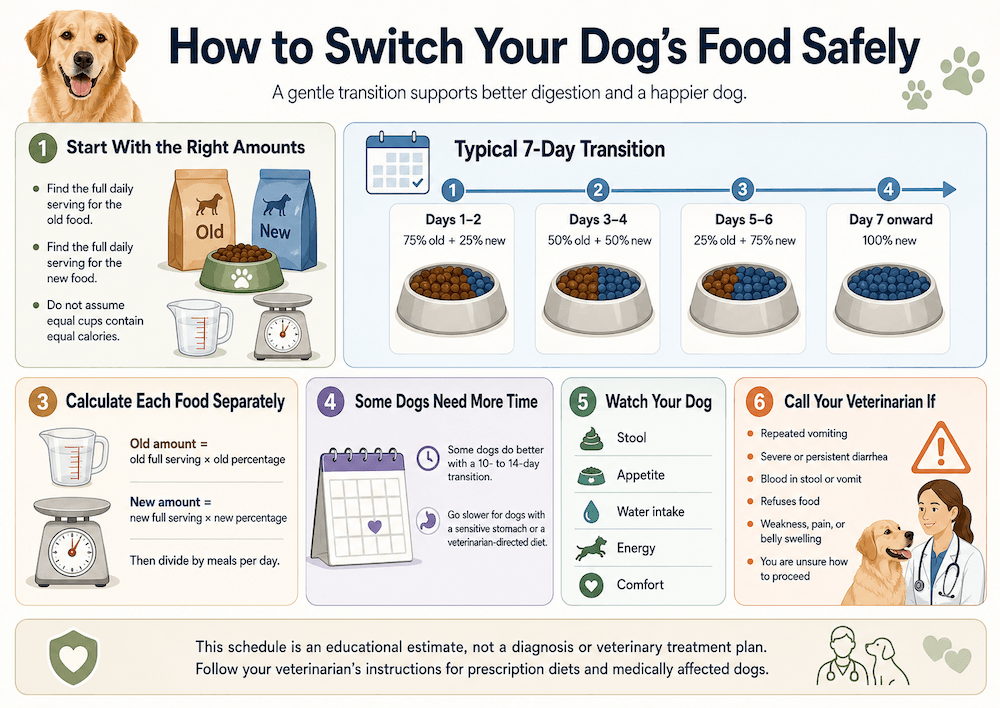
For many healthy dogs, a gradual seven-day transition is a practical starting point. Begin with approximately 75% old food and 25% new food, progress to an even mixture, and then increase the new food to 75% before serving it alone.
Some dogs need 10 to 14 days, particularly if they have previously developed loose stool, vomiting, or appetite changes during food switches. The important point is to monitor the dog rather than advancing the schedule simply because another day has passed. Calculate each food from its own full daily serving. “50% old and 50% new” does not necessarily mean equal cups, equal grams, or two equal scoops.
For example, suppose your dog currently eats 200 grams of the old food per day, but the appropriate full serving of the new food is 160 grams per day. At the 50/50 stage, you would serve:

- 100 grams of the old food
- 80 grams of the new food
For two meals, that becomes 50 grams of old food and 40 grams of new food at each meal.
This method helps account for differences in calorie density and serving size between the two products.
Dog Food Transition Chart
The following schedules are general examples for dogs who are otherwise well. A veterinarian may recommend a different progression based on your dog’s health, diet, or reason for changing food.
Standard 7-Day Dog Food Transition Chart
This schedule uses four easy-to-measure stages.
| Transition Stage | Current Food | New Food | What to Do |
|---|---|---|---|
| Days 1–2 | 75% | 25% | Introduce a small portion of the new food. |
| Days 3–4 | 50% | 50% | Continue if stool, appetite, and comfort remain normal. |
| Days 5–6 | 25% | 75% | Increase the new food while monitoring tolerance. |
| Day 7 onward | 0% | 100% | Serve the new food at its appropriate full daily amount. |
A five- to seven-day progression is commonly used for healthy dogs, but it is not a deadline. Slow the transition if your dog develops digestive changes.
Slow 10-Day Dog Food Transition Chart
A 10-day schedule makes smaller daily changes and may be easier for dogs that have experienced mild stomach upset during previous transitions.
| Day | Current Food | New Food |
|---|---|---|
| Day 1 | 90% | 10% |
| Day 2 | 80% | 20% |
| Day 3 | 70% | 30% |
| Day 4 | 60% | 40% |
| Day 5 | 50% | 50% |
| Day 6 | 40% | 60% |
| Day 7 | 30% | 70% |
| Day 8 | 20% | 80% |
| Day 9 | 10% | 90% |
| Day 10 onward | 0% | 100% |
A slower transition can be useful for dogs prone to stomach upset, provided they are otherwise well and not showing signs that require veterinary care.
Extra-Slow 14-Day Dog Food Transition Chart
This example holds each ratio for two days, giving owners more time to observe the dog before increasing the new food.
| Days | Current Food | New Food |
|---|---|---|
| Days 1–2 | 90% | 10% |
| Days 3–4 | 75% | 25% |
| Days 5–6 | 60% | 40% |
| Days 7–8 | 50% | 50% |
| Days 9–10 | 40% | 60% |
| Days 11–12 | 25% | 75% |
| Day 13 | 10% | 90% |
| Day 14 onward | 0% | 100% |
A seven- to 14-day transition may be appropriate in some situations. Dogs with diagnosed gastrointestinal disease or a prescribed diet need an individualized plan from their veterinarian.
Transition Amount Examples
These examples show why each food should be calculated separately. They are not daily feeding recommendations.
| Full Daily Servings | 75% Old / 25% New | 50% Old / 50% New | 25% Old / 75% New |
|---|---|---|---|
| Old: 100 g New: 80 g |
75 g old + 20 g new | 50 g old + 40 g new | 25 g old + 60 g new |
| Old: 200 g New: 160 g |
150 g old + 40 g new | 100 g old + 80 g new | 50 g old + 120 g new |
| Old: 400 g New: 320 g |
300 g old + 80 g new | 200 g old + 160 g new | 100 g old + 240 g new |
Dog weight is important when establishing the appropriate full daily ration, but it does not determine the transition percentage by itself. Two dogs of different sizes may follow the same percentages while receiving very different quantities.
Transition Considerations by Food Type
Changing the food format can create large differences in moisture, calorie density, and portion size.
| Food Change | Main Consideration | Practical Approach |
|---|---|---|
| Dry to dry | Calories per cup can differ. | Enter each food’s separate full daily serving. |
| Dry to wet | Moisture and portion sizes differ greatly. | Use the label unit for each food instead of matching volume. |
| Wet to dry | The dry portion may look much smaller. | Do not increase kibble based only on bowl appearance. |
| Kibble to fresh | Cups may be less precise for fresh food. | Use grams or ounces when available. |
| Freeze-dried | Preparation and rehydration directions vary. | Follow the product’s preparation instructions separately. |
| Therapeutic diet | The transition may be condition-specific. | Use the schedule provided by your veterinarian. |
| Elimination diet | Extra foods can interfere with the trial. | Feed only veterinarian-approved foods and treats. |
Check the nutritional adequacy statement and feeding directions before using a new food as your dog’s main diet. The product should be appropriate for dogs and for your dog’s life stage.
Dog Food Transition Safety Guidelines
A safe dog food transition depends on accurate portions, gradual changes, and close monitoring throughout the process. The following guidelines can help reduce digestive upset and make it easier to identify whether your dog is tolerating the new food.
Even when these precautions are followed, a food transition should only proceed when your dog is otherwise well. A routine food-transition calculator should not be used to dismiss serious symptoms. Contact your veterinarian if your dog has repeated vomiting, severe or persistent diarrhea, blood or black stool, refusal to eat, marked weakness, dehydration, abdominal pain or swelling, collapse, or worsening signs from a known condition, as these symptoms may indicate infection, parasites, pancreatitis, toxin exposure, organ disease, or intestinal blockage.
Factors That Can Affect Your Dog’s Results
The calculator performs the percentage calculation, but the best transition length and serving amounts depend on the information entered.
| Factor | Why It Matters | What to Check |
|---|---|---|
| Full serving amounts | Incorrect starting amounts produce an inaccurate schedule. | Use the daily amount for each food when fed alone. |
| Calorie density | Equal scoops may provide different calories. | Check kcal per cup, can, tray, or kilogram. |
| Digestive history | Sensitive dogs may need smaller changes. | Review previous vomiting, diarrhea, or appetite loss. |
| Life stage | Nutrient needs differ for growth, adulthood, and reproduction. | Read the nutritional adequacy statement. |
| Health conditions | Some diseases require specific foods or schedules. | Follow the veterinarian’s nutrition plan. |
| Food format | Wet, dry, and fresh foods use different portion units. | Keep the correct unit attached to each food. |
| Treats and extras | Additional calories or ingredients can affect tolerance. | Keep extras consistent and veterinarian-approved. |
| Current symptoms | Digestive signs may have causes unrelated to the food. | Contact a veterinarian when signs are concerning. |
Common Dog Food Transition Mistakes to Avoid
These mistakes can lead to inaccurate portions or make digestive problems harder to interpret.
| Mistake | Why It Matters | Better Approach |
|---|---|---|
| Switching overnight | A sudden change may trigger digestive upset. | Use a gradual schedule unless your veterinarian directs otherwise. |
| Mixing equal scoops | The foods may contain different calories. | Calculate each food from its own full serving. |
| Adding both full servings | This can nearly double the daily intake. | Feed only the calculated percentage of each serving. |
| Using the wrong unit | Cups, grams, cans, and ounces are not interchangeable. | Use the unit listed for that specific food. |
| Changing treats too | Several new foods make reactions difficult to trace. | Keep treats and toppers consistent. |
| Ignoring life stage | The new food may not meet the dog’s nutritional needs. | Confirm the food is appropriate before transitioning. |
| Advancing despite symptoms | Continued increases may worsen a problem. | Pause and seek veterinary guidance when needed. |
| Treating results as exact | Individual calorie needs and tolerance vary. | Monitor weight, body condition, stool, and appetite. |
What to Do If Your Dog Gets Diarrhea or Vomits During the Transition
Do not automatically move to the next stage when your dog develops digestive signs. Record the current food ratio, when the symptoms began, and whether anything else changed. The appropriate response depends on the severity of the signs and your dog’s overall condition.
| What You Notice | Practical Next Step | When to Call a Vet |
|---|---|---|
| Slightly softer stool | Do not increase the new food until the stool normalizes. | Call if it persists, worsens, or your dog seems unwell. |
| One vomiting episode | Pause the transition and monitor closely. | Call if vomiting repeats or other signs appear. |
| Reduced appetite | Check food freshness and avoid forcing the new food. | Call if appetite loss continues or your dog is lethargic. |
| Frequent diarrhea | Stop relying on the routine schedule. | Contact a veterinarian promptly. |
| Blood or black stool | Do not continue adjusting the food at home. | Seek urgent veterinary guidance. |
| Swelling, pain, or collapse | Treat this as more than a food-transition problem. | Seek emergency veterinary care. |
Use a lower threshold for contacting a veterinarian when symptoms affect a puppy, senior dog, small dog, pregnant dog, or dog with a chronic health condition. If your veterinarian recommends restarting the transition, follow the new plan rather than returning automatically to a standard seven-day schedule.
Special Considerations for Certain Dogs
How to Calculate a Dog Food Transition Manually
You can calculate each stage of a dog food transition using two simple formulas. Calculate the old and new foods separately because their full daily serving amounts may be different.
- Old food amount: Full daily old-food serving × old-food percentage
- New food amount: Full daily new-food serving × new-food percentage
- Convert each percentage to a decimal before multiplying. For example, 75% becomes 0.75, while 25% becomes 0.25.
- To calculate the amount of each food per meal, use: Daily amount of each food ÷ number of meals per day
Example calculation
- Suppose your dog currently eats 240 grams of the old food per day. The appropriate full daily serving of the new food is 180 grams.
- At the 75% old and 25% new stage:
- Old food: 240 g × 0.75 = 180 g
- New food: 180 g × 0.25 = 45 g
- The daily mixture contains:
- 180 grams of old food
- 45 grams of new food
- For two meals per day, serve:
- 90 grams of old food per meal
- 22.5 grams of new food per meal
Why the total is different from the old serving
The combined mixture weighs 225 grams rather than 240 grams. This does not automatically mean your dog is receiving too little food. The new food has a smaller full daily serving, which may mean it provides more calories per gram. Portion weight and bowl volume alone do not show how many calories a food contains.
When manual calculations may be inaccurate
A manual calculation may be less reliable when:
- You do not know the appropriate full daily serving of either food.
- The feeding guide uses a broad weight range.
- Your dog needs a veterinarian-calculated calorie target.
- Homemade food does not have reliable calorie information.
- The food is measured with an inconsistent scoop.
- Your dog is gaining or losing weight unexpectedly.
- A medical condition changes your dog’s calorie or nutrient needs.
A kitchen scale can make smaller portions easier to measure, especially when the two foods have different shapes, densities, or serving sizes.
Frequently Asked Questions
The Bottom Line
The Dog Food Transition Calculator is designed to help you divide your dog’s current and new foods into gradual daily ratios during a planned diet change. It should not be used to determine whether the new food is nutritionally appropriate, diagnose digestive problems, replace veterinary instructions, or manage serious symptoms at home. Measure both foods accurately, keep the total daily portion consistent, and move to the next stage only when your dog is eating normally and tolerating the mixture. Slow the transition if mild digestive upset develops, and contact your veterinarian for repeated vomiting, persistent or bloody diarrhea, refusal to eat, weakness, abdominal pain, dehydration, or worsening symptoms.
If you are switching food types, read our guides on how much wet food to feed a dog and how much homemade food to feed a dog so you can recalculate portions instead of simply adding the new food on top of the old diet. If digestive upset occurs, our guide on how to stop dog diarrhea explains what to monitor and when veterinary care may be needed. You may also find our guide to bland diets for dogs helpful when discussing temporary feeding options with your veterinarian, but dogs with medical conditions or prescription diets should follow an individualized transition plan.