What Does Pumpkin Do for Dogs? Health Benefits & Precautions


Canine Bible is reader-supported. We receive affiliate commissions via some of our links. Learn more.
Pumpkin can support a dog’s digestion by adding fiber and moisture to the diet. In suitable amounts, plain pumpkin may help regulate both mild constipation and uncomplicated diarrhea. It can also promote fullness and provide useful nutrients without adding many calories. However, pumpkin is not a cure for every digestive problem, and giving too much may worsen gas, bloating, or stool changes. The type matters too, because plain canned pumpkin is very different from sweetened pumpkin pie filling. Some dogs may benefit from a small serving, while others need veterinary care rather than a home remedy. Understanding the right amount, preparation, benefits, and warning signs can help owners use pumpkin safely and effectively.
What to Understand Before Giving Dogs Pumpkin
| Key Consideration | What Dog Owners Should Know |
|---|---|
| Digestive support | Its fiber and moisture may help regulate mildly loose or dry stool. |
| Best pumpkin type | Choose plain canned purée or cooked pumpkin without added ingredients. |
| Serving amount | Begin with a small portion and increase only if well tolerated. |
| Meal benefits | Pumpkin may add flavor, enrichment, nutrients, and low-calorie meal volume. |
| Possible side effects | Too much may cause gas, diarrhea, constipation, or nutritional imbalance. |
| Important limits | Pumpkin cannot treat infections, obstructions, parasites, or chronic disease. |
| Veterinary attention | Seek care when symptoms persist, worsen, recur, or accompany concerning signs. |
What Does Pumpkin Do for Dogs?
Plain pumpkin mainly acts as a gentle source of dietary fiber and moisture. In some dogs, a small amount can help firm mildly loose stool, soften dry stool, or support more regular bowel movements.
Pumpkin is not a universal cure for diarrhea or constipation, however. Its effect depends on the dog, the amount given, the existing diet, hydration, and the underlying cause of the digestive problem. Persistent, severe, bloody, painful, or recurring symptoms need veterinary evaluation rather than repeated home treatment.
How Pumpkin Affects a Dog’s Digestive System
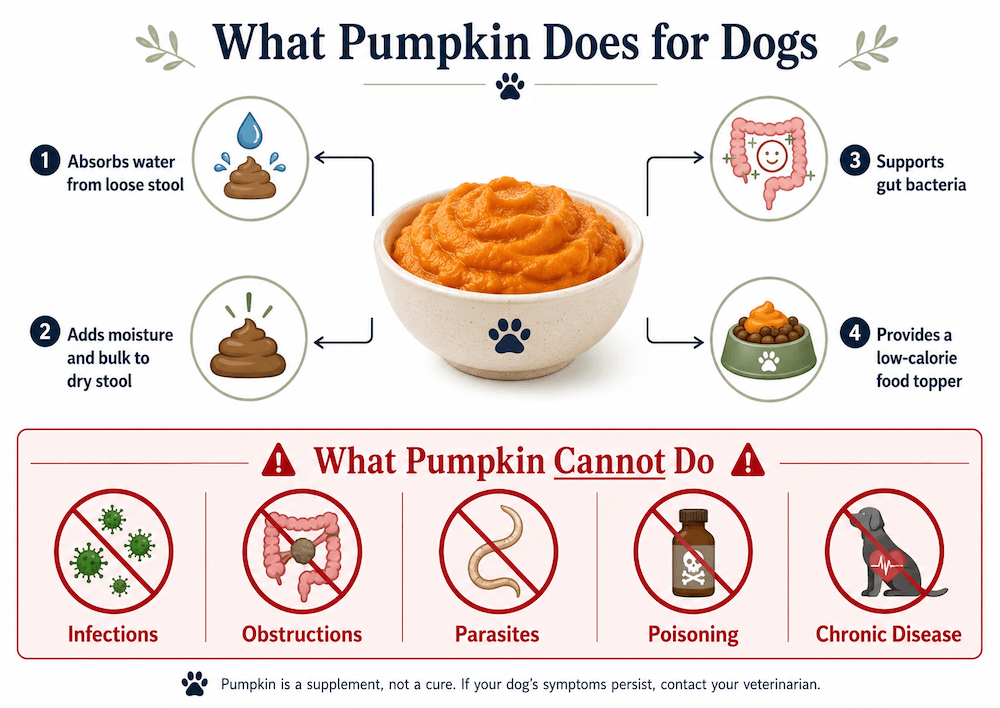
Pumpkin contains a mixture of fibers that pass through the small intestine without being fully digested. Some of this fiber holds water and forms a soft gel-like material, while other portions add physical bulk to the intestinal contents.
These actions explain why pumpkin appears to have opposite effects in different situations. With mild diarrhea, water-holding fiber may reduce excess liquid in the stool. With mild constipation, added bulk and moisture may help the colon move feces more comfortably.


Some fibers are also fermented by bacteria in the large intestine. This produces compounds that can support colon cells and influence the intestinal environment. The response is highly individual, however, because fiber sources differ in solubility, fermentability, particle size, and water-holding ability.
Pumpkin works more like a stool regulator than a medication
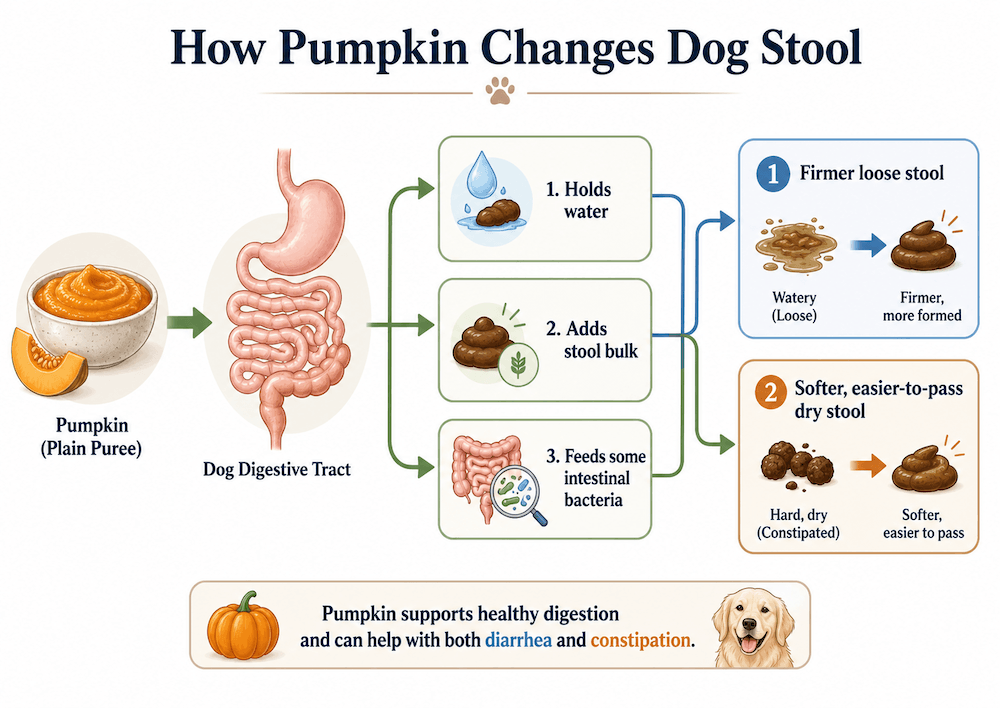
Pumpkin does not directly kill parasites, remove a foreign object, correct dehydration, treat pancreatitis, or resolve inflammatory bowel disease. It simply changes the physical and microbial environment inside the digestive tract.
This distinction matters because two dogs with identical-looking diarrhea may need very different care. One may have a brief food-related upset that improves with a minor dietary adjustment, while the other may have an infection, toxin exposure, intestinal obstruction, or systemic illness.
What Pumpkin May Help—and What It Cannot Fix
Pumpkin is most appropriate as a small dietary addition for an otherwise healthy adult dog with a mild, uncomplicated stool change. The table below separates reasonable uses from situations where pumpkin should not delay veterinary care.
| Situation | What Pumpkin May Do | Important Limitation | Owner Action |
|---|---|---|---|
| Mild loose stool | Water-holding fiber may improve stool shape. | It does not treat the underlying cause. | Monitor appetite, energy, and hydration closely. |
| Mild constipation | Fiber and moisture may support easier passage. | Fiber may worsen dehydration or obstruction. | Ensure water access and watch for straining. |
| Irregular stool | A consistent small amount may improve regularity. | Responses vary between individual dogs. | Change only one dietary factor at a time. |
| Weight management | Low-calorie bulk may improve meal satisfaction. | Adding it without reducing food adds calories. | Use it within a planned calorie allowance. |
| Anal gland support | Bulkier stool may improve natural gland emptying. | It cannot treat infection, pain, or impaction. | Seek care for scooting, swelling, or discharge. |
| Chronic symptoms | Pumpkin may temporarily change stool appearance. | It may conceal an unresolved health problem. | Arrange a veterinary examination and stool review. |
Does Pumpkin Help Dogs With Diarrhea?
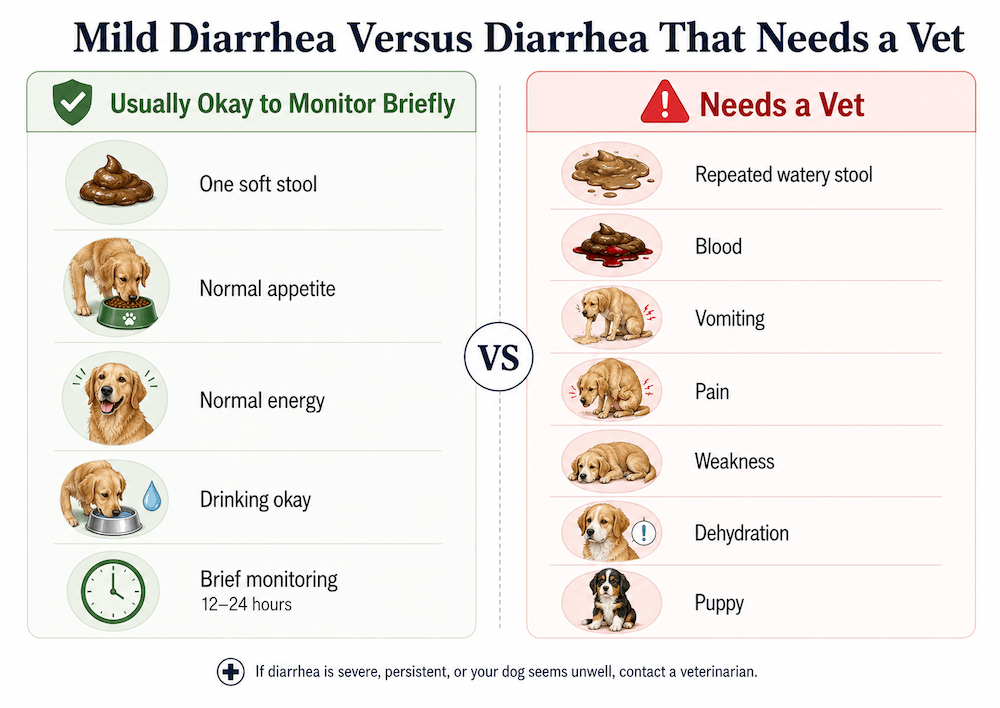
Pumpkin may help when diarrhea is mild, brief, and uncomplicated. Its water-holding fiber can absorb some liquid in the colon and add structure to stool, potentially making bowel movements less watery.
It is most reasonable to consider pumpkin when an adult dog has one or two loose stools but remains bright, comfortable, interested in food, able to drink, and free from vomiting or blood. Even then, the owner should consider what changed: a new treat, sudden food transition, scavenged food, stress, travel, medication, or access to garbage.
Pumpkin should not be used to repeatedly cover up diarrhea. Loose stool can result from parasites, infections, dietary intolerance, pancreatic disease, inflammatory conditions, medication effects, toxins, foreign objects, organ disease, or several other problems that require a specific diagnosis.
Does Pumpkin Help Constipated Dogs?
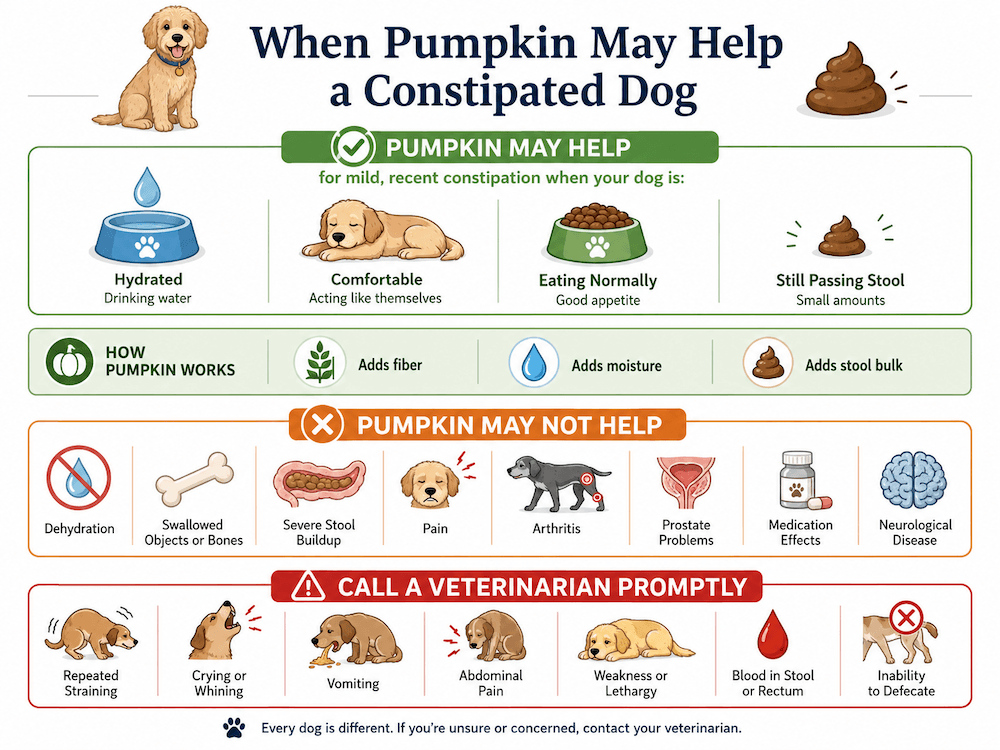
Pumpkin may help some dogs with mild constipation by adding water-holding fiber and bulk to the stool. The increased volume can stretch the colon and support normal contractions, while moisture may make feces easier to pass.
The dog must be adequately hydrated. Adding fiber to a dehydrated dog or to a colon already packed with hard feces may be ineffective and can sometimes make the situation worse. Dogs that repeatedly squat, cry, pass only tiny pieces, have a painful abdomen, or cannot defecate need an examination.
Constipation may be connected to swallowed bones or foreign material, dehydration, pain, arthritis, spinal disease, prostate enlargement, pelvic narrowing, perineal hernia, medication effects, metabolic disease, or neurological problems. Pumpkin cannot correct these causes.
Other Potential Benefits of Pumpkin for Dogs
Digestive support is pumpkin’s most practical use, but it can serve several secondary purposes when offered appropriately.
| Potential Benefit | How Pumpkin May Help | Important Consideration |
|---|---|---|
| Meal appeal | Its soft texture and aroma may encourage eating. | Persistent appetite loss requires veterinary attention. |
| Meal volume | It adds relatively low-calorie bulk to meals. | Include it within the dog’s total calorie allowance. |
| Enrichment | It can be used on lick mats or food toys. | Added ingredients can greatly increase calories. |
| Extra nutrients | It provides carotenoids and small amounts of nutrients. | It cannot replace complete and balanced dog food. |
Which Types of Pumpkin Are Safe for Dogs?
The word “pumpkin” appears on purées, powders, pies, drinks, biscuits, breads, spice blends, supplements, and seasonal treats. These products are not interchangeable.
For digestive use, the simplest option is usually plain canned pumpkin containing pumpkin only or plain cooked pumpkin flesh. Read the full ingredient list rather than relying on the color or front label.
| Pumpkin Form | Suitable for Dogs? | What to Check | Practical Use |
|---|---|---|---|
| Plain canned purée | Usually the simplest option. | The ingredient list should contain pumpkin only. | Mix a measured amount into regular food. |
| Fresh cooked flesh | Safe when plain and softened. | Remove skin, stem, and tough material. | Boil or roast, cool, then mash. |
| Pumpkin powder | Potentially suitable but more concentrated. | Follow the product directions and add water. | Use smaller amounts than canned purée. |
| Frozen plain pumpkin | Safe in small measured portions. | Avoid added yogurt, sugar, or sweeteners. | Use on a lick mat or food toy. |
| Pumpkin pie filling | Not recommended for dogs. | Often contains sugar, salt, and spices. | Choose plain pumpkin purée instead. |
| Pumpkin baked goods | Usually unsuitable for routine feeding. | Check fat, sugar, chocolate, raisins, and xylitol. | Keep human desserts away from dogs. |
| Raw rind or stem | Avoid feeding these tough parts. | Large pieces may cause choking or blockage. | Serve only soft, prepared pumpkin flesh. |
| Pumpkin seeds | Not equivalent to pumpkin purée. | They are calorie-dense and may be difficult to chew. | Do not use them for digestive treatment. |
How Much Pumpkin Can Dogs Have?
There is no single pumpkin amount that is appropriate for every dog. Body size matters, but so do the current diet’s fiber content, the pumpkin product’s concentration, the dog’s hydration, stool condition, and reason for using it.
The following amounts are conservative first servings for a healthy adult dog, not medical treatment doses. Begin at the lower end, offer it once with food, and observe the dog’s next bowel movements before increasing anything.
| Dog Size | Conservative First Serving | How to Offer It | Before Increasing |
|---|---|---|---|
| Toy dog | About ½ teaspoon of plain purée. | Mix thoroughly into one meal. | Check for gas or looser stool. |
| Small dog | About 1 teaspoon of plain purée. | Mix thoroughly into one meal. | Observe the next bowel movement. |
| Medium dog | About 2 teaspoons of plain purée. | Divide between meals if preferred. | Confirm stool is improving, not worsening. |
| Large dog | About 1 tablespoon of plain purée. | Serve with food and water access. | Increase only when clearly necessary. |
| Giant dog | About 1–2 tablespoons of plain purée. | Mix into the normal daily food. | Ask a veterinarian about ongoing use. |
These portions are intentionally modest. Larger therapeutic amounts are sometimes used under veterinary direction, particularly for constipation, but more is not automatically better. Fiber supplementation should be paired with adequate hydration and adjusted according to the dog’s response.
How to introduce pumpkin safely
Pumpkin and all other treats or toppers should remain a small part of the dog’s total food intake. The majority of calories and nutrients should continue to come from a complete and balanced diet.
When Pumpkin Can Make Digestive Problems Worse
Pumpkin is generally well tolerated in small amounts, but it can cause problems when the serving is too large, introduced too suddenly, or used for the wrong condition.
Excess fiber can cause gas, abdominal discomfort, more frequent bowel movements, diarrhea, or harder stool. Large amounts may also reduce the digestibility of the overall diet or displace nutritionally balanced food.
Pumpkin Myths Dog Owners Should Know
Pumpkin’s reputation as a universal digestive remedy has created several misleading assumptions. The most useful distinction is between a food that may support stool quality and a treatment that addresses the cause of illness.
| Common Belief | What Owners Should Know | Better Approach |
|---|---|---|
| Pumpkin cures diarrhea | It may only change stool consistency temporarily. | Investigate repeated or worsening diarrhea. |
| More pumpkin works faster | Excess fiber may worsen digestive upset. | Begin with a small measured serving. |
| All pumpkin products are equal | Purées, powders, desserts, and seeds differ greatly. | Choose plain pumpkin and read labels. |
| Pumpkin prevents anal gland disease | Bulkier stool may help only some dogs. | Address pain, allergies, infection, or anatomy. |
| Pumpkin replaces balanced food | It does not provide complete canine nutrition. | Keep regular dog food as the foundation. |
When to Call a Veterinarian About Giving Pumpkin
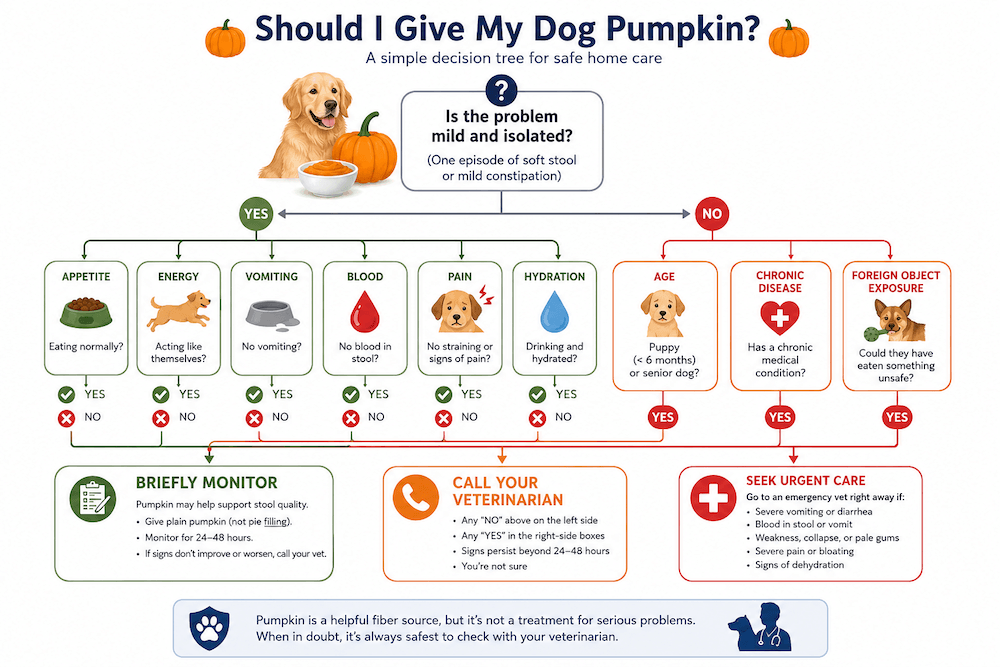
A single soft stool or mildly dry bowel movement may be monitored briefly when your dog remains comfortable, active, eating, drinking, and improving. Focus on the whole dog rather than stool appearance alone.
Book a veterinary visit if diarrhea or constipation lasts more than a day, keeps returning, worsens after pumpkin, or occurs with appetite loss, weight loss, scooting, mucus, unusual stool color, or behavior changes. Seek prompt advice sooner for puppies, frail seniors, pregnant dogs, diabetic dogs, pets taking medication, or dogs on prescription diets.
Seek urgent care for repeated vomiting, significant blood, black tar-like stool, dehydration, abdominal swelling or pain, weakness, collapse, or inability to pass stool or urine. Treat possible xylitol exposure as an emergency if your dog eats sugar-free pumpkin desserts or baked goods.
What Research Says About Pumpkin and Fiber in Dogs
A 2022 review published in the Journal of the American Veterinary Medical Association described dietary fiber as a diverse group of nondigestible carbohydrates rather than one uniform ingredient. The review explains that fiber can alter intestinal contents, affect appetite and digestion, supply energy to intestinal microbes, and influence gastrointestinal function. This supports an individualized approach because pumpkin, psyllium, cellulose, beet pulp, and other fibers do not behave identically.[1]
The Merck Veterinary Manual explains that bulk-forming fibers absorb water, soften feces, add stool volume, and support colonic contractions. It includes pumpkin among the fiber sources sometimes used for constipation but emphasizes that the animal should be adequately hydrated before fiber supplementation.
A study published in BMC Veterinary Research evaluated psyllium rather than pumpkin in dogs with chronic large-bowel diarrhea. Most dogs experienced improved stool consistency and reduced defecation frequency, showing that certain soluble fibers can be useful in selected canine digestive conditions. The results should not be interpreted as proof that every fiber source or every case of diarrhea will respond the same way.[2]
The University of California, Davis veterinary nutrition guidance explains that responses to fiber vary substantially between animals and that excessive supplementation may produce constipation, diarrhea, or reduced diet digestibility. This supports beginning with a small amount and reassessing rather than treating pumpkin as a fixed-dose remedy.
Frequently Asked Questions
The Bottom Line
Plain pumpkin can be a useful source of fiber and moisture for dogs, especially when mild diarrhea or constipation is short-lived. It may also add low-calorie meal volume, improve food appeal, and provide simple enrichment when served in small amounts. Choose plain canned or cooked pumpkin without sugar, spices, salt, or sweeteners, and introduce it gradually. Pumpkin should support, not replace, a complete and balanced diet or proper veterinary treatment. Stop using it and contact a veterinarian if digestive signs persist, recur, worsen, or appear with vomiting, blood, pain, weakness, dehydration, or appetite loss. Used thoughtfully, pumpkin can be a practical addition to a dog’s diet, but the dog’s overall health and the cause of the symptoms matter most.