How Much Wet Food to Feed a Dog: Calculator, Feeding Charts & Guidelines

Canine Bible is reader-supported. We receive affiliate commissions via some of our links. Learn more.
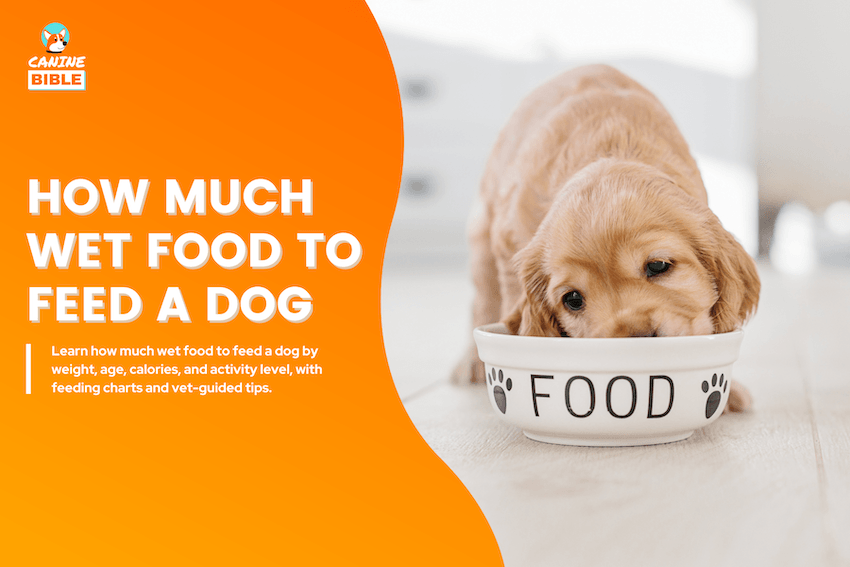
Most dogs should be fed wet food based on their daily calorie needs, not just by the number of cans. As a general guide, many adult dogs need about 25–30 calories per pound of body weight per day, including all meals and treats. The exact amount depends on your dog’s size, age, activity level, health, and the calorie content of the food. This is why one dog may need half a can while another may need several cans a day. Feeding too much can lead to weight gain, while feeding too little can leave your dog short on key nutrients. In this guide, you’ll learn how to read wet food labels, estimate portions, adjust for mixed feeding, and know when your dog’s amount needs changing.
Why Feeding a Dog the Right Amount of Wet Food Matters
| Feeding Reason | Why It Matters |
|---|---|
| Supports a healthy weight | The right wet food amount helps prevent gradual weight gain from extra calories. |
| Prevents underfeeding | Too little wet food can leave dogs short on energy and key nutrients. |
| Matches calorie needs | Wet foods vary in calories, so can size alone is not reliable. |
| Protects digestion | Consistent portions can reduce stomach upset, loose stool, and sudden feeding changes. |
| Balances mixed feeding | Wet food, kibble, treats, and toppers all count toward daily calories. |
| Supports life stage needs | Puppies, adults, seniors, and active dogs need different feeding amounts. |
| Helps manage health conditions | Dogs with obesity, diabetes, kidney disease, or pancreatitis may need precise portions. |
| Makes adjustments easier | Measured portions help owners notice when weight, appetite, or activity changes. |
How to Read a Wet Food Label
To know how much wet food to feed your dog, start with the Calorie Content section, not the front of the can. Look for “kcal per can,” “kcal per tray,” or “kcal per ounce,” then use that number to calculate your dog’s daily portion. A 13-ounce can from one brand may have 250 calories, while another may have 500 calories, so can size alone is not enough.
Next, check the nutritional adequacy statement. This tells you whether the food is complete and balanced for adult maintenance, growth, reproduction, all life stages, or only meant for intermittent or supplemental feeding. If the label says “supplemental feeding only,” it should not be used as your dog’s full daily diet unless your veterinarian directs it.
Then read the feeding directions, but treat them as a starting point. These guides are usually based on weight ranges, not your dog’s exact metabolism, activity level, body condition, or treat intake. After choosing a starting amount, monitor your dog’s weight, waistline, stool quality, appetite, and energy, then adjust the portion as needed.
How Many Cans of Wet Food Does a Dog Need?
As a starting point, many healthy adult dogs need roughly 20–35 calories per pound of body weight per day, but this varies widely. Smaller dogs often need more calories per pound than large dogs, which is why a calorie formula is more accurate than a flat “cups or cans” rule.
For a typical adult neutered dog, veterinary calorie estimates often use resting energy requirement multiplied by a life-stage factor. Merck Veterinary Manual lists adult dog maintenance estimates such as 1.6 × RER for neutered adults, 1.8 × RER for intact adults, and 1.4 × RER for obesity-prone dogs.


Use this chart only as a starting estimate. It assumes a 13-ounce can with about 350 kcal per can, but some wet foods have far fewer or far more calories.
| Dog Weight | Estimated Daily Calories | Approx. 350 kcal Cans/Day | Simple Feeding Note |
|---|---|---|---|
| 5 lb | About 205 kcal daily. | About 1/2 to 2/3 can. | Measure carefully to avoid overfeeding. |
| 10 lb | About 350 kcal daily. | About 1 can. | Split into two small meals. |
| 20 lb | About 585 kcal daily. | About 1 2/3 cans. | Round portions based on body condition. |
| 30 lb | About 795 kcal daily. | About 2 1/4 cans. | Adjust if treats are added. |
| 50 lb | About 1,165 kcal daily. | About 3 1/3 cans. | Large dogs may need several cans. |
| 70 lb | About 1,500 kcal daily. | About 4 1/4 cans. | Check cost and stool consistency. |
| 90 lb | About 1,810 kcal daily. | About 5 1/4 cans. | Mixed feeding may be more practical. |
Remember to always consult with your vet before making any changes that could affect your dog’s health, nutrition, or well-being. If you can’t reach your vet, you can chat live with a registered online veterinary professional via our online vet chat or video chat support (24 hours a day, 7 days a week). Or use Chewy’s online vet services (6 a.m. – midnight ET).
Why Wet Dog Food Amounts Vary So Much
Wet dog food is not standardized by can size. A small can may be calorie-dense, while a large can may be lower-calorie because of moisture, recipe style, fat content, or formulation.
The biggest factors include:
WSAVA’s Global Nutrition Guidelines emphasize that pets should be fed according to an individualized nutrition plan, not a one-size-fits-all amount.
Factors That Affect How Much Wet Food Your Dog Needs
A feeding guide on the can is a useful starting point, but it is not a final answer. Your dog’s actual portion should change when their weight, body condition, exercise, health, or diet mix changes.
| Factor | How It Changes Feeding | Owner Action |
|---|---|---|
| Puppy | Puppies need more calories for growth. | Use puppy food and ask your vet. |
| Senior Dog | Needs vary with muscle and activity. | Monitor weight and appetite closely. |
| Overweight Dog | Portions may need controlled calories. | Use a vet-supervised weight plan. |
| Active Dog | Exercise can increase calorie needs. | Adjust gradually based on body condition. |
| Mixed Feeding | Dry food and treats add calories. | Subtract those before adding wet food. |
| Medical Diet | Therapeutic foods have specific targets. | Follow your veterinarian’s exact plan. |
Feeding Wet Food Only vs Mixing Wet and Dry Food
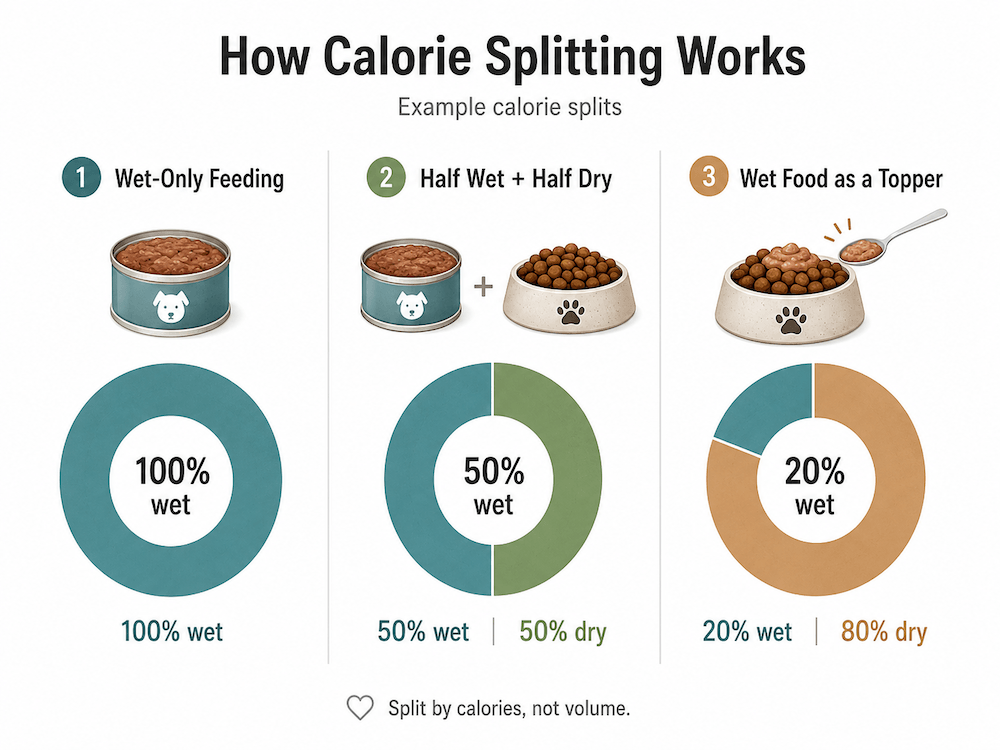
Wet food can be used as a dog’s full diet if it is complete and balanced for their life stage. It can also be mixed with kibble or used as a topper, but the dog’s total daily calories still need to stay within their recommended range.

The FDA explains that a pet food’s nutritional adequacy statement helps owners know whether the food is meant to meet a pet’s nutritional needs. This matters because some wet foods are complete diets, while others are intended only for supplemental feeding.
As a simple guide, feed wet food only when it provides the full daily calories, use half wet and half dry when dividing calories between both foods, and keep topper portions small. Wet food can also replace treats by counting those calories, while medical diets should always be fed exactly as your veterinarian instructs.
How Much Wet Food to Feed a Dog (By Life Stage)
How much wet food to feed a dog depends on four main things: age, body weight, activity level, and the calorie density of the food. There is no single “can per day” amount that works for every dog, because wet foods can vary widely in calories per can, tray, pouch, or ounce. The best way to size meals is to estimate your dog’s daily calorie needs first, then convert that number into the right amount of wet food using the feeding guide and calorie information on the label.
Veterinary guidance is clear that feeding amounts should be individualized and adjusted based on body condition, not just weight alone. You can use our dog calorie calculator to estimate your dog’s daily calorie needs, then divide that amount into the number of meals you feed each day.
Puppy Wet Food Feeding Chart
This is a starting point. Puppy calorie needs vary by breed size and growth stage, so owners should adjust using the label calories and vet guidance. Merck lists higher energy needs for puppies under 4 months than older puppies, and AAFCO notes that puppy food should be appropriate for growth or all life stages.
| Age | Typical Weight | Daily Wet Food Amount | Meals Per Day | Feeding Notes |
|---|---|---|---|---|
| 8–12 weeks | 3–10 lb | About 1/2 to 1 3/4 cans daily | 4 meals | Use puppy food and keep meals small. |
| 3–4 months | 5–20 lb | About 1 to 3 cans daily | 3–4 meals | Growth is fast, so monitor weight weekly. |
| 4–6 months | 8–35 lb | About 1 to 3 1/2 cans daily | 3 meals | Adjust portions as growth rate changes. |
| 6–9 months | 10–55 lb | About 1 1/4 to 4 1/2 cans daily | 2–3 meals | Large breeds may still need puppy formulas. |
| 9–12 months | 12–75 lb | About 1 1/2 to 5 1/2 cans daily | 2 meals | Small breeds may begin adult transition. |
| 12–18 months | Varies by breed | Feed by label and body condition | 2 meals | Large breeds often mature more slowly. |
| 18–24 months | Mostly large or giant breeds | Vet-guided adult transition amount | 2 meals | Confirm timing before switching foods. |
Adult Dog Wet Food Feeding Chart
Adult dog calorie needs vary by size, ideal weight, activity level, body condition, neuter status, and health, so owners should adjust using the food label’s calories and veterinary guidance. Dogs that are overweight, underweight, highly active, senior, pregnant, nursing, or on a medical diet may need a more specific feeding plan.
| Adult Dog Size | Typical Weight | Daily Wet Food Amount | Meals Per Day | Feeding Notes |
|---|---|---|---|---|
| Toy adult dog | 3–10 lb | About 1/3 to 1 can daily | 2 meals | Measure carefully because small dogs overfeed easily. |
| Small adult dog | 11–20 lb | About 1 to 1 3/4 cans daily | 2 meals | Adjust for treats, toppers, and activity level. |
| Medium adult dog | 21–40 lb | About 1 3/4 to 2 3/4 cans daily | 2 meals | Monitor weight and visible waist monthly. |
| Large adult dog | 41–60 lb | About 2 3/4 to 3 3/4 cans daily | 2 meals | Mixed feeding may be more practical and affordable. |
| Extra-large adult dog | 61–80 lb | About 3 3/4 to 4 3/4 cans daily | 2 meals | Base portions on ideal weight, not current weight. |
| Giant adult dog | 81–100 lb | About 4 3/4 to 5 3/4 cans daily | 2 meals | Large portions should be checked against calorie needs. |
| Very active adult dog | Varies by breed | May need more than standard amounts | 2–3 meals | Increase gradually and watch body condition. |
| Overweight adult dog | Varies by breed | Vet-guided reduced amount | 2 meals | Avoid severe calorie cuts without veterinary advice. |
Senior Dog Wet Food Feeding Chart
Foods for senior dogs should be fed based on ideal weight, body condition, activity level, muscle condition, and health, not age alone. They may need fewer calories if they are less active, but some need more support if they are losing weight or muscle. Dogs with kidney disease, heart disease, diabetes, dental pain, obesity, or unexplained appetite changes should have their wet food amount guided by a veterinarian.
| Senior Stage | Typical Weight | Daily Wet Food Amount | Meals Per Day | Feeding Notes |
|---|---|---|---|---|
| Small senior dog, 10–12+ years | 3–20 lb | About 1/3 to 1 1/2 cans daily | 2 meals | Monitor weight because small seniors overfeed easily. |
| Medium senior dog, 8–10+ years | 21–40 lb | About 1 1/2 to 2 1/2 cans daily | 2 meals | Adjust for activity, treats, and body condition. |
| Large senior dog, 6–8+ years | 41–60 lb | About 2 1/2 to 3 1/2 cans daily | 2 meals | Watch for weight gain as activity slows. |
| Extra-large senior dog, 6–8+ years | 61–80 lb | About 3 1/2 to 4 1/2 cans daily | 2 meals | Feed based on ideal weight, not current weight. |
| Giant senior dog, 5–7+ years | 81–100+ lb | About 4 1/2 to 5 1/2+ cans daily | 2 meals | Ask your vet if weight or mobility changes. |
| Less active senior dog | Varies by breed | May need less than standard amounts | 2 meals | Reduce gradually and track body condition. |
| Thin or muscle-losing senior dog | Varies by breed | Vet-guided increased amount | 2–3 meals | Do not ignore weight loss in seniors. |
| Senior dog with medical needs | Varies by breed | Follow veterinary diet instructions | 2–3 meals | Medical diets may have strict portions. |
Pregnant Dog Wet Food Feeding Chart
Pregnant dogs usually need about their normal adult maintenance amount during the first two-thirds of pregnancy, then roughly 20–30% more food in the last third, depending on litter size and body condition. Lactating dogs may need much more after birth, sometimes 2–4 times maintenance, so nursing dogs should be fed with close veterinary guidance.
| Pregnancy Stage | Typical Weight | Daily Wet Food Amount | Meals Per Day | Feeding Notes |
|---|---|---|---|---|
| Weeks 1–5 | 3–20 lb | About 1/3 to 1 3/4 cans daily | 2 meals | Feed normal adult amount unless underweight. |
| Weeks 1–5 | 21–60 lb | About 1 3/4 to 3 3/4 cans daily | 2 meals | Avoid overfeeding early pregnancy. |
| Weeks 6–7 | 3–20 lb | About 1/2 to 2 cans daily | 2–3 meals | Begin increasing gradually if body condition allows. |
| Weeks 6–7 | 21–60 lb | About 2 to 4 1/2 cans daily | 2–3 meals | Use a growth or reproduction formula. |
| Weeks 8–9 | 3–20 lb | About 1/2 to 2 1/2 cans daily | 3–4 meals | Small meals help when belly space is limited. |
| Weeks 8–9 | 21–60 lb | About 2 1/4 to 5 cans daily | 3–4 meals | Increase based on litter size and condition. |
| Final days before birth | Varies by breed | Offer small, frequent measured meals | 3–4 meals | Call your vet if appetite loss is prolonged. |
| After birth while nursing | Varies by litter size | Vet-guided increased amount | Free choice or several meals | Lactation can greatly increase calorie needs. |
Feeding Wet Food & Treats Correctly
Wet Food and Daily Calorie Balance
The right wet food amount depends on your dog’s total daily calories. Most calories should come from complete and balanced meals, while treats and extras should stay limited.
Balance
This includes your dog’s measured wet food, kibble, or other complete and balanced main diet.
Treats, toppers, chews, and table scraps should stay limited so they do not add excess calories.
Important: This is a general guideline, not a replacement for calculating your dog’s actual calorie needs. Puppies, pregnant dogs, seniors, overweight dogs, and dogs on veterinary diets may need a different feeding plan.
This feeding chart shows how daily calories can be divided between complete wet dog food and treats, so it is easier to estimate both cups per day and a reasonable treat limit for your dog.
| Dog Size or Stage | Activity Level | Daily Calories | Wet Food Calories Target (90%) |
Treat Calories Limit (10%) |
Approx. Wet Food Amount | Meals Per Day |
|---|---|---|---|---|---|---|
| Small Adult Dog | Low | 250–450 kcal | 225–405 kcal | 25–45 kcal | About 2/3–1 can/day | 2 meals |
| Small Adult Dog | Moderate | 450–650 kcal | 405–585 kcal | 45–65 kcal | About 1–1 2/3 cans/day | 2 meals |
| Medium Adult Dog | Low | 650–900 kcal | 585–810 kcal | 65–90 kcal | About 1 2/3–2 1/3 cans/day | 2 meals |
| Medium Adult Dog | Moderate | 900–1,200 kcal | 810–1,080 kcal | 90–120 kcal | About 2 1/3–3 cans/day | 2 meals |
| Large Adult Dog | Low | 1,200–1,500 kcal | 1,080–1,350 kcal | 120–150 kcal | About 3–4 cans/day | 2 meals |
| Large Adult Dog | Moderate | 1,500–1,900 kcal | 1,350–1,710 kcal | 150–190 kcal | About 4–5 cans/day | 2 meals |
| Senior Dog | Low | May need 10–20% fewer calories | Based on reduced calorie target | Keep treats very limited | Adjust by body condition | 2 meals |
| Puppy or Pregnant Dog | Growth or reproduction | Needs vary widely | Use growth-stage calorie needs | Limit extras carefully | Follow label and vet guidance | 3–4 meals |
Important: This chart assumes treats stay around 10% of daily calories and that the wet food averages roughly 350 calories per 13-oz can. If your dog’s wet food has more or fewer calories per can, adjust the number of cans using the label’s kcal amount.
How to Transition Your Dog to Wet Food
Transition your dog to wet food gradually over about 7 days by mixing small amounts of wet food into their current meals, then increasing the wet food portion every few days. This gives your dog’s digestive system time to adjust and helps reduce the risk of soft stool, gas, appetite changes, or stomach upset.
Dogs with sensitive stomachs may need a slower 10–14 day transition, while mixed feeding requires careful calorie tracking so you do not accidentally overfeed. If your dog is on a medical diet or develops worsening symptoms during the switch, follow your veterinarian’s instructions closely.
| Transition Stage | Food Mix | What to Do | What to Watch For |
|---|---|---|---|
| Days 1–2 | 75% old food, 25% wet food | Mix a small amount of wet food into the usual meal. | Watch for soft stool, gas, or reduced appetite. |
| Days 3–4 | 50% old food, 50% wet food | Increase wet food if digestion stays normal. | Slow down if stool becomes loose or watery. |
| Days 5–6 | 25% old food, 75% wet food | Keep portions measured by calories, not can size. | Check appetite, stool quality, and energy level. |
| Day 7+ | 100% wet food | Feed the full wet food portion based on daily calories. | Monitor weight and body condition over time. |
| Sensitive stomachs | Use a slower 10–14 day transition | Increase wet food in smaller amounts every few days. | Pause the transition if digestive upset appears. |
| Mixed feeding | Wet food plus kibble | Subtract kibble calories before adding wet food. | Avoid accidentally doubling daily calories. |
| Medical diets | Follow veterinary instructions | Use the exact food and portion your vet recommends. | Call your vet if symptoms worsen during the switch. |
Helpful Tips for Feeding Wet Dog Food Correctly
Wet food is easy to serve, but accurate portions matter. A spoonful here and a half-can there can quickly turn into overfeeding.
| Tip | Why It Helps | How to Apply It |
|---|---|---|
| Read Calories | Can size does not equal calories. | Find kcal per can before serving. |
| Use Ideal Weight | Current weight may be too high. | Ask your vet for target weight. |
| Measure Portions | Guessing often leads to overfeeding. | Use a kitchen scale or spoon. |
| Split Meals | Smaller meals support digestion. | Feed adults once or twice daily. |
| Track Treats | Extras can replace balanced calories. | Keep treats under 10% daily. |
| Review Monthly | Needs change with weight and activity. | Adjust portions after weigh-ins. |
Wet Food Storage and Food Safety Tips
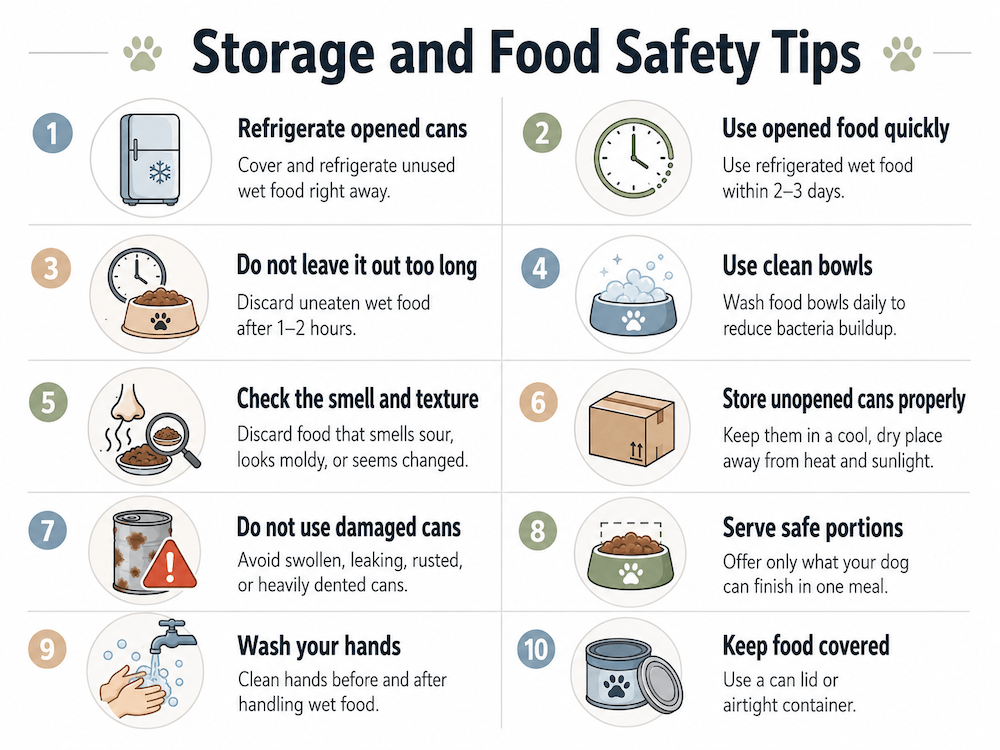
Wet food spoils faster than dry food because it contains more moisture, so safe storage matters. Once opened, cover and refrigerate unused wet food, follow the storage directions on the label, and discard food that smells off, looks unusual, or has been left out too long. Wash your dog’s bowl after meals, use clean utensils, and avoid mixing old and fresh food in the same container.
Mistakes That Can Lead to Overfeeding Wet Dog Food
The most common mistake is feeding by can size instead of calorie content. Another is adding wet food to kibble without reducing the kibble.
| Mistake | Why It Matters | Better Choice |
|---|---|---|
| Counting Cans Only | Different cans contain different calories. | Calculate portions using kcal per can. |
| Ignoring Kibble | Mixed feeding can double calories. | Subtract dry food before adding wet. |
| Free Feeding | Wet food spoils and portions blur. | Serve measured meals on schedule. |
| Using Topper Foods | Some toppers are not complete diets. | Check the nutritional adequacy statement. |
| Skipping Weigh-Ins | Weight changes can happen slowly. | Weigh your dog every few weeks. |
| Overusing Treats | Treats can unbalance daily intake. | Limit extras to small portions. |
What to Monitor After Changing Your Dog’s Wet Food Amount
After changing portions, monitor your dog for two to four weeks. The goal is steady weight, normal stool, comfortable digestion, and a healthy body condition.
Watch for signs that the amount is working:
Signs the amount may need adjustment include begging that worsens, loose stool, constipation, weight gain, weight loss, low energy, or leaving meals unfinished.
When to Call a Veterinarian About Wet Food Amounts
Call your veterinarian if your dog gains or loses weight quickly after changing wet food amounts, refuses meals for more than a day, vomits repeatedly, has diarrhea, has bloody stool, seems unusually hungry or weak, or shows signs of stomach pain.
You should also ask your vet before changing wet food portions if your dog is a puppy, senior, pregnant, nursing, overweight, underweight, or has a health condition such as diabetes, kidney disease, pancreatitis, heart disease, liver disease, or food allergies.
Vet guidance is also important if your dog eats a prescription diet or needs weight loss. Cutting wet food too sharply can leave dogs short on calories or key nutrients, while feeding too much can lead to weight gain and related health problems.
Your vet can help calculate a safe daily calorie target based on your dog’s ideal weight, body condition, age, activity level, and overall health.
What Veterinary Nutrition Guidance Says About Wet Food Portions
Veterinary calorie formulas support using energy needs rather than can count. Merck’s dog maintenance energy table shows different multipliers for neutered, intact, obesity-prone, and growing dogs, which explains why two dogs of the same weight may still need different portions.
Nutrition guidelines also emphasize individualized feeding. WSAVA states that nutrition planning should be tailored to the pet, which supports using weight, body condition, life stage, and diet history instead of a universal serving size.
Research on dog obesity shows why portion control matters. A PubMed-indexed study on feeding patterns and obesity in dogs examined relationships between dietary patterns, calorie intake, and obesity risk, reinforcing that total intake and feeding habits matter for weight control.[1]
Treat calories are also important. A 2025 study reviewing the 10% snack rule notes that veterinary nutrition organizations recommend keeping treats to no more than 10% of daily energy intake, because extras can affect nutritional balance and calorie control.[2]
Frequently Asked Questions
The Bottom Line
Feeding the right amount of wet food starts with your dog’s daily calorie needs, not the size of the can. Check the label for calories per can, then adjust the portion based on your dog’s ideal weight, age, activity level, and body condition. Puppies, seniors, pregnant dogs, overweight dogs, and dogs with medical conditions may need a more specific feeding plan. Treats, kibble, toppers, and table scraps should also be counted so your dog is not accidentally overfed. Watch your dog’s weight, waistline, appetite, stool quality, and energy to know whether the amount is working. If your dog is gaining weight, losing weight, refusing food, or having digestive issues, ask your veterinarian for guidance. With measured portions and regular check-ins, wet food can be a healthy, balanced part of your dog’s daily diet.