Dog Food Calculator: Estimate Feeding Amount by Weight, Age & Food Type

Canine Bible is reader-supported. We receive affiliate commissions via some of our links. Learn more.
Whether you feed kibble, wet food, fresh food, raw food, or a homemade diet, figuring out how much to feed your dog can be confusing. Feeding too much can lead to weight gain, while feeding too little may leave your dog short on energy or key nutrients. That’s why we created this Dog Food Calculator—to help you estimate your dog’s daily food needs based on weight, age, activity level, body condition, and food type. In this guide, you’ll also find feeding charts, portion tips, common mistakes, and answers to frequently asked questions to help you feed your dog more confidently.
How Much Food Should I Feed My Dog?
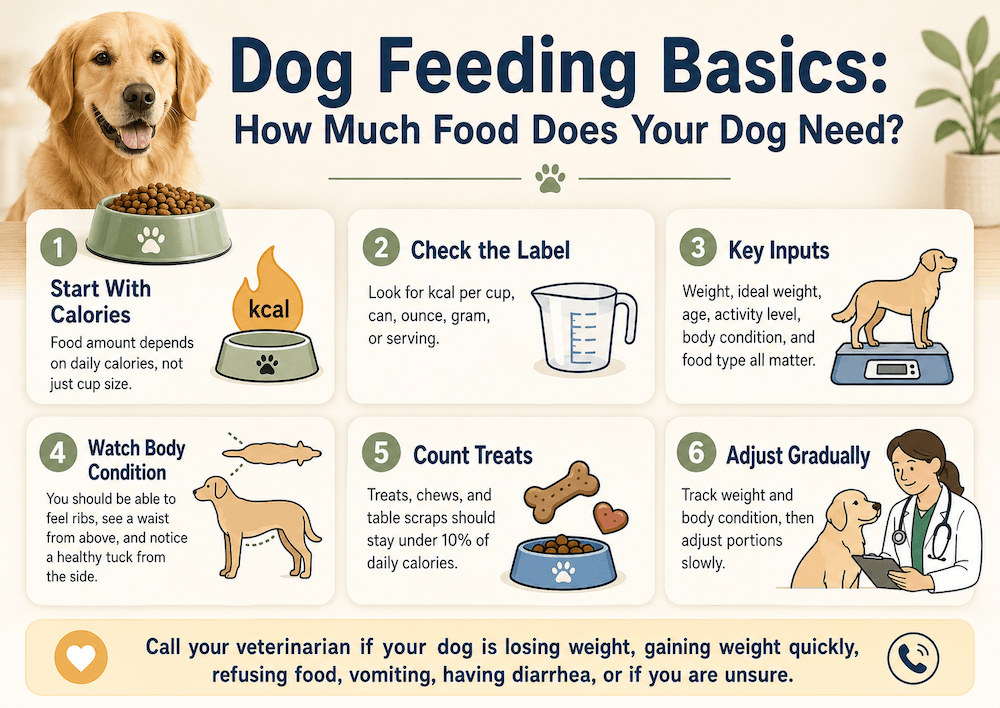
Most dogs should be fed based on daily calorie needs, not just the number of cups on the bag. Once you know your dog’s estimated calories per day, you can divide that number by the calories in your dog’s food.
For example, if your dog needs about 800 calories per day and the food has 400 calories per cup, your dog would need about 2 cups per day before treats. If the food has 320 calories per cup, that same dog would need about 2.5 cups per day.
The right amount depends on your dog’s weight, ideal weight, body condition, age, activity level, spay/neuter status, and food type. Puppies, pregnant or nursing dogs, overweight dogs, and dogs with medical conditions need extra care when estimating food portions.
Remember to ALWAYS consult with your vet before making any changes that could affect your dog’s health, nutrition, or well-being. If you can't reach your vet, you can chat live with a registered online veterinary professional via our online vet chat or video chat support (24 hours a day, 7 days a week). Or use Chewy's online vet services (6 a.m. - midnight ET). Additionally, at-home dog gut health tests can analyze your dog’s microbiome, offering insights into which nutrients their diet should include. Similarly, at-home dog allergy testing kits can identify ingredients that may not be suitable for your dog, enabling you to choose the right diet and care plan to support optimal digestion, nutrition, and health.


Dog Food Chart for Dogs
The charts below give practical starting points for common feeding questions. Use them as estimates, then adjust based on your dog’s weight trend and body condition.
Dog Food Chart by Weight
This chart shows approximate daily calorie needs for adult dogs by weight.
| Dog Weight | Lower-Calorie Adult | Average Neutered Adult | Active Adult |
|---|---|---|---|
| 5 lb | About 180 kcal/day | About 205 kcal/day | About 230 kcal/day |
| 10 lb | About 305 kcal/day | About 350 kcal/day | About 390 kcal/day |
| 20 lb | About 510 kcal/day | About 585 kcal/day | About 660 kcal/day |
| 30 lb | About 695 kcal/day | About 795 kcal/day | About 895 kcal/day |
| 50 lb | About 1,020 kcal/day | About 1,165 kcal/day | About 1,310 kcal/day |
| 70 lb | About 1,310 kcal/day | About 1,500 kcal/day | About 1,685 kcal/day |
| 100 lb | About 1,710 kcal/day | About 1,955 kcal/day | About 2,200 kcal/day |
These are starting estimates for healthy adult dogs. Dogs who are overweight, underweight, pregnant, nursing, growing, or medically fragile may need a different plan.
Dog Food Amount by Calories Per Cup
Use this chart to see why the calorie content on your dog food label matters.
| Daily Calories | 300 kcal/cup | 350 kcal/cup | 400 kcal/cup | 450 kcal/cup |
|---|---|---|---|---|
| 300 kcal/day | 1 cup/day | 0.85 cup/day | 0.75 cup/day | 0.65 cup/day |
| 500 kcal/day | 1.65 cups/day | 1.4 cups/day | 1.25 cups/day | 1.1 cups/day |
| 750 kcal/day | 2.5 cups/day | 2.15 cups/day | 1.9 cups/day | 1.65 cups/day |
| 1,000 kcal/day | 3.35 cups/day | 2.85 cups/day | 2.5 cups/day | 2.2 cups/day |
| 1,250 kcal/day | 4.15 cups/day | 3.55 cups/day | 3.1 cups/day | 2.8 cups/day |
| 1,500 kcal/day | 5 cups/day | 4.3 cups/day | 3.75 cups/day | 3.35 cups/day |
Always use the calorie content from your dog’s exact food label. “One cup” is not the same across all foods.

Dog Feeding Chart by Life Stage
Life stage can change calorie needs, meal frequency, and the type of food your dog should eat.
| Dog Type | Typical Starting Point | Feeding Note |
|---|---|---|
| Puppy under 4 months | Higher calorie needs | Needs growth food and frequent meals. |
| Puppy over 4 months | Still above adult needs | Recalculate often as weight changes. |
| Neutered adult | Moderate adult needs | Common baseline for many household dogs. |
| Intact adult | Slightly higher needs | May need more calories than neutered dogs. |
| Senior dog | Variable | Depends on muscle, disease, weight, and activity. |
| Pregnant or nursing | Special needs | Use veterinary guidance and proper life-stage food. |
Puppies and pregnant or nursing dogs should not be placed on calorie restriction unless a veterinarian specifically directs it.
Dog Feeding Chart by Food Type
Different dog food types can vary widely in calories, moisture, measuring accuracy, and feeding style. Use the label’s calorie content to calculate your dog’s daily portion.
| Food Type | How to Measure | What to Check | Feeding Note |
|---|---|---|---|
| Dry kibble | Cups or grams | kcal per cup or kg | Calorie density can vary a lot by brand and formula. |
| Wet food | Cans, trays, oz, or grams | kcal per can or oz | Higher moisture means larger-looking portions. |
| Fresh food | Grams, oz, or package portion | kcal per package or gram | Follow storage instructions and recalculate when recipes change. |
| Freeze-dried | Cups, pieces, or grams | kcal per cup or piece | Often calorie-dense, so small portions may add up quickly. |
| Raw food | Grams or oz | kcal per oz or gram | Use careful food handling and veterinary nutrition guidance. |
| Homemade food | Grams or recipe portions | Total recipe calories | Should be formulated to be complete and balanced. |
| Mixed feeding | Split by calories | Calories from each food | Add all foods together so daily calories stay on target. |
For mixed feeding, calculate the calories from each food separately instead of estimating by volume alone.
Dog Feeding Guidelines
A good feeding plan starts with calories, then converts those calories into a real-world portion. The most useful number on your dog food label is usually the calorie content, listed as kcal per cup, can, ounce, gram, or kilogram. Start with your dog’s estimated daily calories. Then subtract treat calories and divide the remaining calories by the food’s calorie density. This gives you a daily amount you can split across meals.
For many adult dogs, two meals per day works well. Puppies usually need more frequent meals, and some dogs with medical conditions may need a specific feeding schedule. Also, treats matter more than many owners realize. A few biscuits, chews, toppers, and table scraps can push a dog over their daily calorie needs quickly, especially small breeds.
A practical rule is to keep treats and extras to a small portion of the daily diet, often no more than about 10% of total calories. The rest should come from a complete and balanced food appropriate for your dog’s life stage.
Factors That Can Affect Your Dog’s Results
Several factors can change your dog’s feeding estimate. This table shows what matters most.
| Factor | Why It Matters | What Owners Should Check |
|---|---|---|
| Weight | Calories are usually estimated from body weight. | Use an accurate, recent weight. |
| Ideal weight | Overweight dogs may need portions based on a goal weight. | Ask your vet for a target weight. |
| Body condition | Rib feel and waist shape show if portions fit. | Check ribs, waist, and belly tuck. |
| Life stage | Puppies, adults, and seniors have different needs. | Choose food made for the right stage. |
| Activity level | Active dogs may burn far more calories. | Match portions to real daily exercise. |
| Food calories | Foods vary widely in calories per cup or can. | Read the calorie content on the label. |
| Health status | Medical issues can change nutrition needs. | Use vet guidance for chronic disease. |
Common Mistakes to Avoid
Small feeding mistakes can add up over time. These are the most common issues to watch for.
| Mistake | Why It Matters | Better Approach |
|---|---|---|
| Using cups only | Cup size does not show calorie density. | Use kcal per cup or gram. |
| Ignoring treats | Extras can cause weight gain. | Count treats in daily calories. |
| Guessing weight | A wrong weight gives a wrong estimate. | Use a recent scale weight. |
| Using old puppy results | Puppies grow and needs change fast. | Recalculate often during growth. |
| Forgetting food changes | New foods may have different calories. | Recheck the label every switch. |
| Treating estimates as exact | Dogs vary in metabolism and activity. | Adjust using body condition. |
| Ignoring symptoms | Appetite or weight changes may signal illness. | Call your vet when changes persist. |
Safety Guidelines for Dog Food Calculations
A dog food calculator is helpful for everyday feeding, but it should not replace veterinary care. This is especially important for dogs with weight problems, chronic disease, pregnancy, nursing, or unexplained appetite changes.
Call your veterinarian if your dog is losing weight, gaining weight quickly, refusing food, vomiting, having diarrhea, acting weak, drinking much more than usual, or seeming unusually hungry. These signs can be related to diet, but they can also point to medical issues.
Dogs with diabetes, kidney disease, heart disease, liver disease, pancreatitis, gastrointestinal disease, allergies, or prescription diets need more specific feeding guidance. In those cases, calories, ingredients, fat levels, protein levels, fiber, sodium, and meal timing may all matter.
Food safety matters too. Store dry food and unopened cans in a cool, dry place, keep bags sealed, and save the original label or lot number when possible. Keep food secure so your dog cannot overeat from the bag or access another pet’s diet.
What to Do If Your Dog Is Overweight, Underweight, or Always Hungry
If your dog is overweight, do not start a crash diet. Sudden or severe calorie restriction can be unsafe and frustrating. Track your dog’s current food, treats, chews, table scraps, and toppers, then ask your veterinarian for a safe target weight and calorie plan.
If your dog is underweight, do not simply double the food without knowing why weight is low. Poor appetite, dental pain, parasites, digestive disease, endocrine problems, or an unsuitable diet can all play a role.
If your dog always seems hungry, check meal timing, treat intake, activity level, and food volume. Some dogs benefit from measured meals, food puzzles, or lower-calorie high-fiber options, but persistent hunger with weight loss, vomiting, diarrhea, or increased thirst needs veterinary attention.
Use this table as a quick guide.
| Concern | What It May Mean | Next Step |
|---|---|---|
| Overweight | Calories may exceed daily needs. | Ask your vet for a safe weight-loss target. |
| Underweight | Food intake, absorption, or illness may be involved. | Schedule a veterinary checkup. |
| Always hungry | Portions, food type, habits, or illness may play a role. | Review calories and watch for symptoms. |
| Refusing food | Pain, nausea, stress, or illness may be possible. | Call your vet if it lasts or symptoms appear. |
| Rapid weight change | Sudden changes are not normal. | Contact your veterinarian promptly. |
Special Considerations for Certain Dogs
Some dogs need more careful feeding decisions than a standard adult maintenance estimate can provide. Puppies need enough calories and nutrients for safe growth. Large and giant breed puppies need especially careful portion control because rapid growth can increase stress on developing bones and joints.
Senior dogs vary widely. Some gain weight because activity drops, while others lose muscle or body condition and need a different approach. Small breeds can be affected by small calorie changes. A few extra treats may be a large percentage of a tiny dog’s daily calories.
Working, sporting, and highly athletic dogs may need more calories during active periods and fewer during rest periods. Their feeding plan should change with the season, workload, and body condition. Pregnant or nursing dogs should not be managed with a basic adult estimate. They need a diet and feeding plan that supports reproduction and milk production. Dogs with chronic disease should follow a veterinarian’s nutrition plan, especially if they eat a therapeutic diet.
How to Calculate Dog Food Manually
You can estimate your dog’s food amount manually if you know your dog’s weight and your food’s calorie content.
- Convert your dog’s weight from pounds to kilograms: Dog weight in pounds ÷ 2.2 = dog weight in kilograms
- Estimate resting energy requirement, often shortened to RER: RER = 70 × body weight in kg^0.75
- Multiply RER by a life-stage or activity factor to estimate daily calories. For example, many neutered adult dogs use a lower adult multiplier than intact or highly active dogs.
- Divide daily calories by the calories in the food: Daily cups = daily calories ÷ kcal per cup
If your dog eats two meals per day, divide the daily amount by two.
Example Calculation
A 30-lb neutered adult dog eats a food with 380 kcal per cup. The dog’s estimated RER is about 496 kcal/day. A common adult estimate for a neutered dog is about 794 kcal/day after applying an activity/life-stage multiplier.
- Convert weight: 30 ÷ 2.2 = 13.6 kg
- Convert calories to cups: 794 ÷ 380 = 2.1 cups per day
If fed twice daily, that is about 1.05 cups per meal before treats. If treats are included, reduce meal portions so the daily total stays appropriate.
Frequently Asked Questions
The Bottom Line
The Dog Food Calculator is designed to help you estimate your dog’s daily calorie needs and convert those calories into a practical feeding amount using your dog’s weight, age, activity level, body condition, and food label. It should not be used to replace your veterinarian’s guidance, ignore weight changes, or feed the same amount forever without adjusting as your dog’s needs change. If your dog is overweight, underweight, growing, pregnant, nursing, senior, very active, or dealing with a medical condition, use the result as a starting point and ask your veterinarian what feeding range is safest.
If you want to plan feeding more accurately, you may also find our Dog Food Cost Calculator helpful for estimating monthly food costs. For age-related feeding context, use our Dog Age Calculator. If your dog is vomiting, refusing food, losing weight, or has digestive discomfort, read our guide on what you can give your dog for an upset stomach. You can also check our poisonous foods for dogs guide before sharing human foods, but avoid major diet changes if your dog is sick, losing weight, or has a diagnosed health condition without veterinary guidance.