Dog Alcohol Toxicity Calculator 2026: Assess Risk and Poisoning

Canine Bible is reader-supported. We receive affiliate commissions via some of our links. Learn more.
Dogs should never intentionally drink alcohol, but accidental exposure can happen quickly: an unattended beer, a spilled cocktail, a liquor-filled dessert, mouthwash, hand sanitizer, liquid medication, or even raw yeast dough can all create a poisoning risk. The danger depends on what type of alcohol was involved, its concentration, how much your dog swallowed, your dog’s weight, and whether symptoms have started. Alcohols are absorbed rapidly, and signs of poisoning can begin within about 30–60 minutes after ingestion. This Dog Alcohol Toxicity Calculator estimates a dog’s alcohol exposure in grams per kilogram (g/kg) when the amount and alcohol concentration are known. The guide below also explains alcohol toxicity by weight, common exposure sources, warning signs, emergency steps, and how the calculation works.
Remember to ALWAYS contact your veterinarian or a pet poison control service immediately if your dog may have ingested alcohol, even if your dog appears normal or the amount seems small. If you can't reach your vet, you can chat live with a registered online veterinary professional via our online vet chat or video chat support (24 hours a day, 7 days a week). Or use Chewy's online vet services (6 a.m. - midnight ET). Additionally, at-home dog gut health tests can analyze your dog’s microbiome, offering insights into which nutrients their diet should include. Similarly, at-home dog allergy testing kits can identify ingredients that may not be suitable for your dog, enabling you to choose the right diet and care plan to support optimal digestion, nutrition, and health.
How Much Alcohol Is Toxic to Dogs?
There is no single amount of alcohol that can be considered safe for every dog. The clinically useful measurement is the amount of pure alcohol consumed relative to body weight, usually expressed as grams of ethanol per kilogram of body weight.
A published oral lethal dose in dogs is approximately 5.5–7.9 g/kg of 100% ethanol. That is a lethal-dose reference, not a threshold below which alcohol is safe. Intoxication and potentially serious complications can occur at considerably lower exposures. That distinction matters. A calculator result of 1 g/kg, for example, does not mean a dog is safe simply because it is below 5.5 g/kg.
The same volume can also affect dogs very differently. A tablespoon of liquor produces a much larger dose per kilogram in a 5-pound Chihuahua than in a 70-pound Labrador. Alcohol concentration matters just as much. A typical beer may contain around 5% alcohol by volume, table wine around 12%, and standard distilled spirits around 40%, although actual products can vary substantially.
Example
- Suppose a 20-pound dog drinks approximately 1 fluid ounce of a 12% ABV beverage.
- The dog weighs about 9.1 kg. One fluid ounce is about 29.6 mL, so a 12% beverage contains about 3.55 mL of pure alcohol.
- Because 1 mL of alcohol weighs approximately 0.789 g, that equals about 2.8 g of alcohol, or roughly:
- 2.8 g ÷ 9.1 kg = 0.31 g/kg
That number describes the estimated exposure. It does not tell you with certainty whether the dog will develop poisoning or whether veterinary treatment is unnecessary.
Dog Alcohol Toxicity Chart
The chart below shows how strongly body weight changes the calculated exposure from the same one-tablespoon amount.


Alcohol Exposure by Dog Weight
These examples compare one US tablespoon, approximately 14.8 mL, of beverages containing 5%, 12%, or 40% alcohol by volume.
| Dog Weight | 5% ABV | 12% ABV | 40% ABV |
|---|---|---|---|
| 5 lb | ~0.26 g/kg | ~0.62 g/kg | ~2.06 g/kg |
| 10 lb | ~0.13 g/kg | ~0.31 g/kg | ~1.03 g/kg |
| 20 lb | ~0.06 g/kg | ~0.15 g/kg | ~0.51 g/kg |
| 40 lb | ~0.03 g/kg | ~0.08 g/kg | ~0.26 g/kg |
| 60 lb | ~0.02 g/kg | ~0.05 g/kg | ~0.17 g/kg |
| 80 lb | ~0.02 g/kg | ~0.04 g/kg | ~0.13 g/kg |
Important: This is an exposure-comparison chart, not a safe-dose chart. Contact a veterinarian if symptoms appear, the amount is uncertain, or you are concerned about the exposure.
Alcohol Concentration and Product Type
The word "alcohol" can describe several different chemicals. Even among alcohol-containing drinks, concentrations vary enough that you should use the actual label ABV whenever possible.
| Product | Alcohol Example | Calculator Use | What to Check |
|---|---|---|---|
| Beer | Often around 5% ABV | Yes | Use the actual ABV on the container. |
| Wine | Often around 12% ABV | Yes | Check the label because strength varies. |
| Distilled spirits | Often around 40% ABV | Yes | Enter ABV, not proof. |
| Hand sanitizer | Ethanol or isopropanol | Only if confirmed ethanol | Check alcohol type and percentage. |
| Rubbing alcohol | Often isopropanol | No | Contact a veterinarian or poison expert. |
| Windshield fluid | May contain methanol | No | Treat as a separate poisoning emergency. |
| Raw yeast dough | Ethanol forms during fermentation | No fixed estimate | Seek veterinary guidance promptly. |
Typical 5% beer, 12% wine, and 40% spirits values are useful examples, but alcoholic beverages can be substantially stronger or weaker than these averages.
Ethanol vs. Isopropanol vs. Methanol
Ethanol is the drinking alcohol found in beer, wine, spirits, and some household products. Isopropanol is commonly found in rubbing alcohol and some sanitizers, while methanol may occur in products such as windshield washer fluid.
These substances should not be treated as interchangeable. Isopropanol is approximately twice as toxic as ethanol, and serious signs have been reported in dogs at oral isopropanol exposures of 0.5 mL/kg or greater. Methanol has a reported canine lethal oral range of 4–8 mL/kg, with clinically important effects possible below that amount.
Those figures are toxicology references, not do-it-yourself safety thresholds. If the product contains isopropanol, methanol, or an unidentified alcohol, contact a veterinarian or veterinary poison-control service instead of applying the ethanol calculator.
Signs of Alcohol Poisoning in Dogs
Alcohol affects the gastrointestinal tract, nervous system, metabolism, body temperature, and breathing. Common early signs include vomiting, loss of coordination, unusual sleepiness, weakness, disorientation, tremors, and changes in breathing.


More severe poisoning may cause hypothermia, low blood sugar, seizures, coma, slowed heart rate, respiratory depression, and death. Use symptoms as a reason to seek care, not as something to wait for before acting.
| Symptom Level | Signs You May See | What to Do |
|---|---|---|
| Possible early signs | Vomiting, sleepiness, drooling, stumbling, disorientation. | Contact your veterinarian or poison control promptly. |
| Concerning | Marked weakness, tremors, inability to walk normally, abnormal breathing. | Seek urgent veterinary assessment. |
| Emergency | Seizures, collapse, severe breathing depression, coma or unresponsiveness. | Go to an emergency veterinary hospital immediately. |
A dog's symptoms do not always line up neatly with a calculated dose. If your dog looks abnormal, treat the clinical signs as more important than a reassuring-looking calculator number.
Alcohol Toxicity Guidelines for Dogs
Alcohol is rapidly absorbed through the gastrointestinal tract. Peak blood concentrations can occur within roughly 1.5–2 hours, while clinical signs often begin within about 30–60 minutes.
Ethanol primarily acts as a central nervous system depressant. As intoxication worsens, dogs can lose coordination and alertness while also developing metabolic disturbances such as low blood sugar, metabolic acidosis, and hypothermia.
Alcohol can also irritate the stomach and cause vomiting. Once a dog becomes sedated or poorly coordinated, vomiting creates an additional concern because stomach contents can be aspirated into the lungs. There is no simple antidote for ordinary ethanol intoxication. Veterinary management focuses on monitoring and supportive care appropriate to the dog's clinical condition.
Why a Published Lethal Dose Is Not a "Safe Dose"
The published 5.5–7.9 g/kg oral lethal range describes doses associated with death from pure ethanol in canine toxicology literature. It does not establish a boundary between harmless and harmful exposure.
Real exposures involve uncertainty. Owners may not know exactly how much was swallowed, mixed drinks may contain more alcohol than expected, and an individual dog's age, health, food intake, or concurrent toxic ingredients can alter the clinical situation. For that reason, this calculator should be used to organize information for decision-making, not to decide that an exposure can safely be ignored.
Raw Yeast Dough Is a Different Type of Alcohol Exposure
Raw yeast dough deserves separate attention because the amount of ethanol present when a dog first eats the dough is not fixed. Warm conditions inside the stomach allow yeast fermentation to continue, producing ethanol after ingestion. At the same time, the dough may expand and produce gas, causing painful and potentially dangerous stomach distension. Do not attempt to assign raw dough a guessed ABV and run it through the calculator. Contact your veterinarian or a veterinary poison-control service for guidance.
Factors That Can Affect Your Dog's Results
Several variables can make the real exposure different from the calculator estimate.
| Factor | Why It Matters | What Owners Should Check |
|---|---|---|
| Body weight | The same drink produces a larger g/kg dose in a smaller dog. | Use a recent, reliable weight. |
| Alcohol strength | Higher ABV means more ethanol in the same volume. | Read the actual label. |
| Amount swallowed | Spills and missing liquid can make estimates inaccurate. | Estimate the maximum plausible amount. |
| Alcohol type | Ethanol, isopropanol, and methanol have different toxicology. | Check the ingredient list. |
| Other ingredients | A mixed product may contain additional dog toxins. | Look for medications, xylitol, caffeine, chocolate, or chemicals. |
| Time since exposure | Alcohol can be absorbed quickly after ingestion. | Record when exposure occurred. |
| Age and health | Young, frail, or medically compromised dogs may tolerate poisoning poorly. | Tell the veterinarian about health conditions and medications. |
When the amount swallowed is uncertain, it is usually more useful to calculate the largest realistic exposure rather than choosing an optimistic estimate.
Common Mistakes to Avoid
Small input errors can produce large differences in an alcohol calculation, especially for small dogs and concentrated products.
| Mistake | Why It Matters | Better Approach |
|---|---|---|
| Using proof as ABV | In the U.S., 80 proof generally means 40% ABV. | Enter the actual ABV percentage. |
| Guessing product strength | Alcohol content varies widely between products. | Check the bottle or package label. |
| Using the wrong alcohol | Isopropanol and methanol are not equivalent to ethanol. | Identify the alcohol before calculating. |
| Mixing up lb and kg | The final exposure calculation requires kilograms. | Convert lb to kg first. |
| Calling a “sip” exact | A sip is not a standardized volume. | Estimate a realistic volume range. |
| Ignoring symptoms | Clinical signs matter more than a reassuring estimate. | Seek veterinary help if your dog is abnormal. |
| Waiting too long | Alcohol can be absorbed rapidly. | Call promptly when exposure may be significant. |
| Treating the result as exact | The true swallowed amount is often uncertain. | Use the result as an estimate, not a diagnosis. |
Another serious mistake is trying to treat alcohol poisoning at home. Do not induce vomiting or give activated charcoal unless a veterinarian or veterinary toxicology professional specifically directs you to do so.
Safety Guidelines for Alcohol Exposure in Dogs
Alcohol exposure becomes more urgent when the amount is unknown, the product is concentrated, the dog is very small, another toxic ingredient may be present, or symptoms have already started. You should contact a veterinarian or veterinary poison-control professional promptly if:
When to Go to an Emergency Veterinarian Immediately
Do not spend time completing the calculator when your dog has severe clinical signs. Emergency signs include:
Severe alcohol poisoning can progress to respiratory depression, hypothermia, hypoglycemia, coma, and seizures.
Do Not Induce Vomiting on Your Own
Do not make your dog vomit unless a veterinarian or poison-control professional specifically instructs you to. Alcohol can impair coordination and protective airway reflexes relatively quickly. If an intoxicated dog vomits, there is a risk that stomach contents can enter the lungs.
Veterinary professionals may consider decontamination in carefully selected, very recent exposures when the patient is still asymptomatic, but that decision depends on timing and the individual dog.
U.S. Animal Poison-Control Contacts
For poison-specific guidance in the United States, owners can contact:
- ASPCA Animal Poison Control Center: (888) 426-4435.
- Pet Poison Helpline: (855) 764-7661.
Consultation fees may apply. If your dog is collapsing, seizing, struggling to breathe, or unresponsive, go directly to an emergency veterinary hospital.
What to Do If Your Dog Drinks Alcohol
If you discover that your dog has been drinking from a glass or has gotten into an alcohol-containing product, focus on gathering useful information without delaying veterinary care.
1. Remove Access: Move the drink, bottle, food, or chemical out of reach so your dog cannot consume more. Keep the original container rather than throwing it away. The label may contain information your veterinarian needs.
2. Check the Product:
- Product name.
- Type of alcohol.
- ABV or percentage.
- Container size.
- Other active ingredients.
- For a mixed drink, identify the ingredients separately whenever possible.
3. Estimate How Much Is Missing: Try to reconstruct the largest amount your dog could reasonably have swallowed. Account for liquid left in the glass, liquid spilled onto the floor, drinks shared between pets, and whether the container was full before the incident.
4. Record Your Dog's Weight: Use a recent veterinary or home scale weight if available. Because toxicity calculations are based on body weight, guessing a small dog's weight incorrectly can noticeably change the calculated dose.
5. Note the Time: Write down when the ingestion happened or, if you did not witness it, the last time you know the product was untouched. Alcohol can begin producing clinical effects fairly quickly, so timing is useful information for the veterinary team.
6. Watch Your Dog, but Do Not Wait for Symptoms: Observe your dog's coordination, alertness, breathing, and ability to stand normally while arranging professional advice. Do not use "still acting normal" as proof that a meaningful recent exposure is harmless.
7. Call Your Veterinarian or Poison Control: Have the product container, dog's weight, amount missing, estimated ingestion time, and calculator result available. Those details can help the professional assessing the exposure understand the situation more efficiently.
Special Considerations for Certain Dogs
How to Calculate Alcohol Exposure in Dogs Manually
The calculator estimates the alcohol dose in g/kg. You can perform the same basic calculation manually when the dog's weight, swallowed volume, and ABV are known. Remember that the calculation estimates exposure. It does not predict exactly how your dog will respond.
Step 1: Convert Your Dog's Weight to Kilograms
Use: Weight in kg = Weight in lb ÷ 2.2046
- For example:
- 20 lb ÷ 2.2046 = 9.07 kg
Step 2: Convert the Amount Swallowed to Milliliters
Useful approximate conversions include:
- 1 teaspoon = 4.93 mL
- 1 tablespoon = 14.79 mL
- 1 US fluid ounce = 29.57 mL
Whenever possible, start with the actual volume rather than vague descriptions such as "a gulp" or "a sip."
Step 3: Calculate the Volume of Pure Alcohol
Use: Pure alcohol (mL) = Product volume (mL) × ABV ÷ 100
- If a dog drank 29.57 mL of a 12% ABV beverage:
- 29.57 × 12 ÷ 100 = 3.55 mL pure alcohol
Step 4: Convert Alcohol Volume to Grams
One milliliter of alcohol weighs approximately 0.789 g. Use: Alcohol (g) = Pure alcohol (mL) × 0.789
- For the example:
- 3.55 × 0.789 = 2.80 g alcohol
Step 5: Calculate the Dose Per Kilogram
Use: Alcohol exposure (g/kg) = Alcohol consumed (g) ÷ Dog weight (kg)
- For a 9.07-kg dog:
- 2.80 ÷ 9.07 = 0.31 g/kg
Example Calculation: 20-lb Dog Drinking 1 oz of 12% Wine
Putting the calculation together:
- Dog weight:
- 20 lb ÷ 2.2046 = 9.07 kg
- Drink volume:
- 1 fl oz = 29.57 mL
- Pure alcohol:
- 29.57 × 0.12 = 3.55 mL
- Alcohol mass:
- 3.55 × 0.789 = 2.80 g
- Estimated exposure:
- 2.80 ÷ 9.07 = 0.31 g/kg
- The estimated exposure is therefore about 0.31 g/kg of alcohol.
Do not compare that number only with the published lethal-dose range and conclude that the exposure is safe. Veterinary advice may still be appropriate based on the actual circumstances.
Why Manual Calculations Can Be Inaccurate
The mathematics may be straightforward, but the inputs often are not. A cocktail may contain several pours. A dog may have spilled more liquid than it swallowed. Alcohol concentration may be unknown, and household products may contain a different alcohol entirely. When you are uncertain, tell the veterinarian what you know rather than creating false precision.
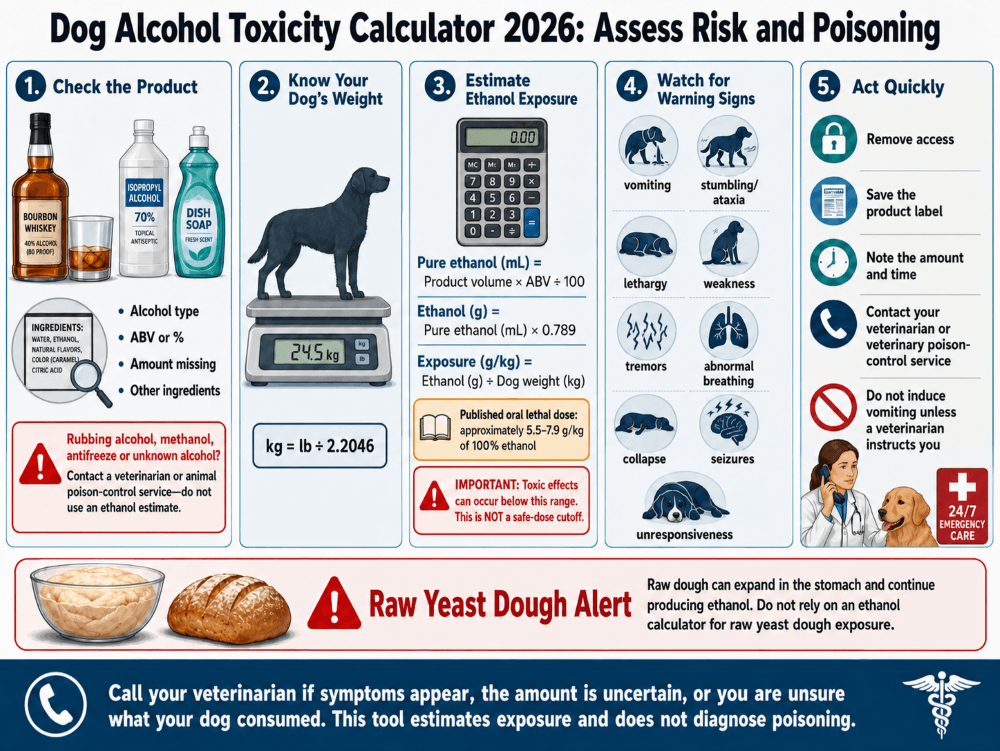
Dog Alcohol Toxicity Infographic
Frequently Asked Questions
The Bottom Line
A dog alcohol toxicity calculator is most useful for answering one question: approximately how much pure alcohol did this dog receive relative to body weight? That estimate can help you organize an exposure involving a known alcohol-containing product, but it should not be treated as a safe-or-toxic verdict. The product's alcohol type, true concentration, amount swallowed, dog size, other ingredients, time since exposure, and clinical signs all matter.
If your dog develops vomiting with significant sedation, severe weakness, stumbling, tremors, breathing changes, seizures, collapse, or loss of consciousness, seek veterinary care promptly. Unknown alcohols, rubbing alcohol, methanol-containing products, automotive fluids, and raw yeast dough also deserve professional assessment rather than an ordinary alcohol calculation.
If another ingredient may be involved, related Canine Bible resources such as the dog chocolate toxicity calculator, dog caffeine toxicity calculator, dog xylitol toxicity calculator, dog grape toxicity calculator, and dog toxicity calculator can help you identify additional concerns, but do not delay veterinary treatment while checking multiple tools.