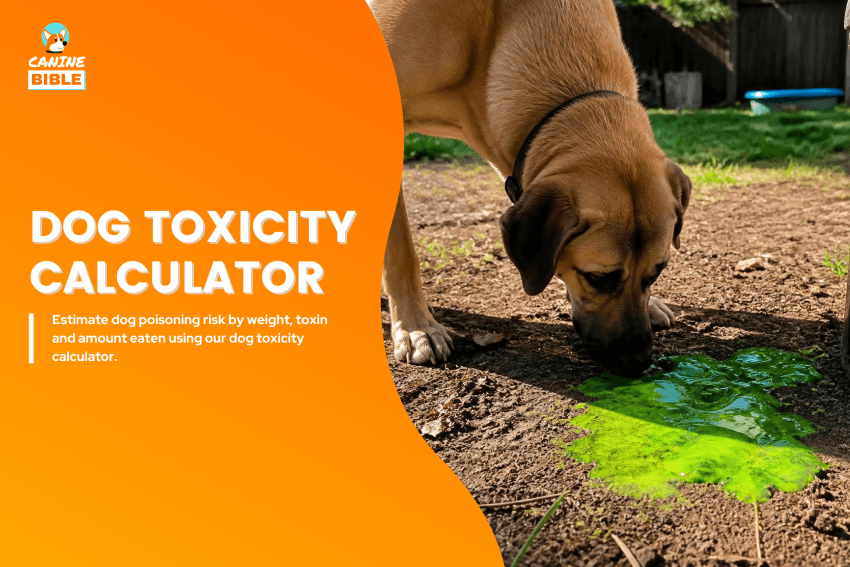
Dog Toxicity Calculator: Free Dog Poisoning Risk Tool

Canine Bible is reader-supported. We receive affiliate commissions via some of our links. Learn more.
Dogs explore the world with their mouths, which means a dropped medication, piece of chocolate, sugar-free snack, household chemical, plant, or mystery object can quickly become a poisoning concern. This Dog Toxicity Calculator can help estimate exposure when the substance, concentration, amount consumed, and your dog’s weight are known. However, there is no single toxic dose that applies to every poison, and some exposures cannot be safely assessed with a numerical calculator.
Remember to ALWAYS contact your veterinarian or a pet poison control service immediately if your dog may have ingested a potentially toxic substance, even if your dog appears normal or the calculator shows a low-risk result. If you can't reach your vet, you can chat live with a registered online veterinary professional via our online vet chat or video chat support (24 hours a day, 7 days a week). Or use Chewy's online vet services (6 a.m. - midnight ET). Additionally, at-home dog gut health tests can analyze your dog’s microbiome, offering insights into which nutrients their diet should include. Similarly, at-home dog allergy testing kits can identify ingredients that may not be suitable for your dog, enabling you to choose the right diet and care plan to support optimal digestion, nutrition, and health.
How Much of a Toxic Substance Is Dangerous to a Dog?
There is no universal toxic amount for dogs. A dose that causes little concern with one substance could be dangerous with another, which is why poisoning calculations must always be toxin-specific.
For many substances, exposure is assessed relative to body weight: Exposure (mg/kg) = Total toxicant consumed (mg) ÷ Dog's weight (kg). The resulting number only becomes useful when it is compared with veterinary toxicology data for the specific substance involved.
- For example, imagine a 10 kg dog swallowed a product containing 200 mg of a particular active ingredient:
- 200 mg ÷ 10 kg = 20 mg/kg
The calculated exposure is 20 mg/kg, but that number alone does not tell you whether the dog is safe or poisoned. The answer depends entirely on the active ingredient and what is known about that toxin in dogs. Important factors include:
A dog that appears normal immediately after an exposure may still require veterinary assessment because some poisons cause delayed effects.
Dog Toxicity Chart by Weight
This chart shows how a hypothetical mg/kg reference value converts to total milligrams for dogs of different weights.


| Dog Weight | Weight (kg) | 10 mg/kg | 25 mg/kg | 50 mg/kg | 100 mg/kg |
|---|---|---|---|---|---|
| 5 lb | 2.3 kg | 23 mg | 57 mg | 113 mg | 227 mg |
| 10 lb | 4.5 kg | 45 mg | 113 mg | 227 mg | 454 mg |
| 20 lb | 9.1 kg | 91 mg | 227 mg | 454 mg | 907 mg |
| 30 lb | 13.6 kg | 136 mg | 340 mg | 680 mg | 1,361 mg |
| 50 lb | 22.7 kg | 227 mg | 567 mg | 1,134 mg | 2,268 mg |
| 70 lb | 31.8 kg | 318 mg | 794 mg | 1,588 mg | 3,175 mg |
| 100 lb | 45.4 kg | 454 mg | 1,134 mg | 2,268 mg | 4,536 mg |
Important: These are mathematical examples, not universal toxicity thresholds. Only compare a calculated mg/kg dose with veterinary reference data for the exact toxin involved.
Common Toxic Substances for Dogs
The exact ingredient is usually more useful than a broad description such as “medicine,” “cleaner,” or “rat poison.”
| Category | Examples | What Matters Most |
|---|---|---|
| Foods | Chocolate, xylitol, grapes, onions, macadamias | Food type, concentration, amount, and dog weight can change risk. |
| Human medications | Ibuprofen, naproxen, acetaminophen, stimulants | The exact drug, strength, formulation, and amount missing are essential. |
| Household products | Cleaners, solvents, antifreeze, chemicals | Active ingredients and exposure route matter more than the product category. |
| Pesticides | Rodenticides, insecticides, garden products | Similar products may contain very different active ingredients. |
| Plants | Sago palm, oleander, azalea, yew | The exact plant species and part should be identified when possible. |
| Nicotine products | Cigarettes, e-liquids, nicotine pouches | Nicotine concentration varies widely among products. |
| Unknown products | Unlabeled pills, chemicals, mixed products | Risk cannot be reliably calculated without identifying the substance. |
Potentially dangerous items include chocolate, caffeine, alcohol, grapes and raisins, xylitol, onions, garlic, human medications, rodenticides, pesticides, antifreeze, household cleaners, and certain plants.
Dog Poisoning Symptoms by Risk Level
Symptoms vary by toxin, and some poisoned dogs initially look normal. Use this chart to judge urgency rather than to rule poisoning in or out.
| Urgency | Possible Signs | What to Do |
|---|---|---|
| No signs yet | Dog appears normal | Assess the exposure promptly because some effects are delayed. |
| Mild signs | Vomiting, diarrhea, drooling, reduced appetite | Contact a veterinarian or animal poison-control service. |
| Concerning signs | Weakness, stumbling, tremors, agitation, repeated vomiting | Seek urgent veterinary assessment. |
| Emergency signs | Seizure, collapse, unconsciousness, breathing trouble, severe bleeding | Go to an emergency veterinary hospital immediately. |
If symptoms appear after a known or suspected toxic exposure, contact a veterinarian promptly.
Which Dog Poisonings Can Be Estimated With a Calculator?
A calculator is most useful when the active toxicant and concentration are known, and veterinary reference data support a weight-based estimate.
| Exposure | Calculator Useful? | Main Caveat |
|---|---|---|
| Chocolate | Often | Cocoa type and methylxanthine content vary. |
| Xylitol | Often | The amount per piece or serving may be unknown. |
| Some medications | Sometimes | Exact drug, strength, formulation, and amount are required. |
| Alcohol | Sometimes | The alcohol type and concentration must be identified. |
| Grapes or raisins | Limited | A reassuring calculation should not be used to rule out risk. |
| Caustic cleaners | Usually no | Tissue injury can matter more than a weight-based dose. |
| Unknown plant or mushroom | No | Identification is needed before meaningful assessment. |
| Unknown or mixed product | No | Professional assessment is safer than guessing. |
Some exposures cannot be reduced to a reliable number. In those cases, professional toxicology assessment is safer than trying to force the exposure into a calculator.


Dog Toxicity Guidelines
A reliable dog poison calculator needs more than a dog's weight and a generic “toxic” label. Each supported substance should use its own calculation method and veterinary reference data.
Toxicity Depends on the Specific Substance
Two substances measured at the same mg/kg dose can have completely different effects. Some toxins mainly affect the gastrointestinal tract, while others may damage the kidneys, liver, nervous system, heart, blood cells, or blood sugar regulation.
Body Weight Changes the Exposure
When two dogs swallow the same amount of a toxin, the smaller dog usually receives a higher dose relative to body weight.
- For example:
- 100 mg ÷ 5 kg = 20 mg/kg
- The same amount in a 25 kg dog equals:
- 100 mg ÷ 25 kg = 4 mg/kg
This does not make larger dogs immune to poisoning. It simply shows why body weight matters.
Product Concentration Matters
Knowing that a dog ate “gum,” “chocolate,” “medicine,” or “rat poison” may not provide enough information. Different brands and formulations can contain very different concentrations or entirely different active ingredients. Whenever possible, check:
For pesticides and rodenticides, keep the product packaging because registration and ingredient information can help identify the exact toxicant.
Not Every Poison Has a Reliable Numeric Cutoff
A well-designed toxicity calculator should sometimes return “risk cannot be reliably calculated.” That may be appropriate for:
For these exposures, identifying the product and getting professional guidance is more important than calculating a generic mg/kg number.
Factors That Can Affect Your Dog's Results
Several details can change the risk estimate even when the arithmetic appears straightforward.
| Factor | Why It Matters | What Owners Should Check |
|---|---|---|
| Body weight | The same amount produces a higher mg/kg dose in a smaller dog. | Use a recent weight in lb or kg. |
| Active ingredient | Similar products may contain different toxicants. | Read the ingredient or medication label. |
| Amount consumed | Risk often increases as exposure increases. | Count missing pieces, tablets, or liquid volume. |
| Concentration | Similar products may contain different strengths. | Check mg, mg/mL, %, ABV, or other units. |
| Time elapsed | Absorption and treatment options can change with time. | Record the possible exposure window. |
| Symptoms | Clinical signs can increase urgency regardless of the estimate. | Note vomiting, weakness, tremors, or behavior changes. |
| Health history | Age, disease, and medications may affect susceptibility. | Have medical conditions and medications ready. |
If the product, amount, or concentration is uncertain, treat the calculated result as less reliable.
Common Mistakes to Avoid
Small input errors can create large differences in a toxicity calculation.
| Mistake | Why It Matters | Better Approach |
|---|---|---|
| Wrong product | Similar-looking products may contain different ingredients. | Use the exact label and formulation. |
| Wrong units | Confusing mg, g, mL, lb, or kg can greatly distort the dose. | Match each value to the unit shown. |
| Product amount = toxin amount | The active toxicant may be only part of the product. | Calculate the active ingredient when possible. |
| Guessing concentration | Strength can differ between brands and formulations. | Choose “unknown” rather than inventing a value. |
| Ignoring symptoms | A calculated number should not override a sick dog's condition. | Seek veterinary care for concerning signs. |
| Treating estimates as exact | Uncertain inputs and individual sensitivity affect risk. | Use results as screening estimates only. |
| Waiting too long | Some poisonings worsen before obvious symptoms develop. | Get prompt advice for potentially toxic exposures. |
A calculator should help organize the facts quickly—not delay veterinary care while you search for a perfectly precise number.
Safety Guidelines for Suspected Dog Poisoning
When poisoning is possible, the safest next step depends on the toxin, your dog's condition, and how long ago the exposure occurred.
When Should You Contact a Veterinarian?
Contact your veterinarian, an emergency veterinary hospital, or animal poison control when:
Do not wait for obvious symptoms after a potentially serious exposure because some poisons can cause delayed injury.
Dog Poisoning Emergency Signs
Go directly to an emergency veterinary hospital if your dog has:
If possible, have another person call the hospital while you travel so the veterinary team knows what happened.
Do Not Automatically Make Your Dog Vomit
Do not induce vomiting unless a veterinarian or animal poison-control professional specifically tells you to do so for your dog and that particular exposure. Vomiting may be dangerous with corrosive products, petroleum products, aspiration risk, impaired swallowing, seizures, unconsciousness, or certain other exposures.
Do not automatically give activated charcoal, salt, oil, milk, food, or another home remedy either. Decontamination should be matched to the toxin and your dog's condition.
What to Do If the Calculator Shows a High Poisoning Risk
A high-risk result means the calculated exposure, symptoms, or uncertainty warrants prompt professional assessment.
1. Prevent Any More Exposure: Move your dog away from the product, food, medication, plant, chemical, or contaminated area. Keep other pets away from the same hazard.
2. Check Your Dog's Condition: Check how your dog is breathing, standing, walking, responding, and behaving. If your dog is seizing, collapsing, unconscious, struggling to breathe, or severely bleeding, go directly to emergency veterinary care.
3. Save the Package/label or photograph:
4. Estimate the Maximum Amount Missing: If the exact amount is unknown, determine the largest amount that could realistically have been consumed. For example, if a bottle originally contained 30 tablets and 22 remain, up to eight tablets may be missing. If you only know a range, such as two to four tablets, report the range rather than pretending the amount is exact.
5. Record When It Happened: Write down the earliest and latest possible exposure times. If you were away from noon until 3 p.m., for example, the exposure may have happened at any point during that window.
6. Contact a Veterinary Professional and have the following ready:
In the United States, ASPCA Animal Poison Control and Pet Poison Helpline provide 24-hour poison consultation services; fees may apply. Outside the U.S., contact your veterinarian, emergency veterinary hospital, or the animal poison service available in your country.
Special Considerations for Certain Dogs
How to Calculate a Dog's Toxic Exposure Manually
Some dog toxicity calculations can be performed manually when the exact substance, concentration, and estimated amount consumed are known. The calculation does not determine whether the exposure is dangerous until the result is compared with reliable data for that specific toxin.
Step 1: Convert Your Dog's Weight to Kilograms
If you know the weight in pounds: Weight (kg) = Weight (lb) ÷ 2.2046
- For example:
- 22 lb ÷ 2.2046 ≈ 10 kg
Step 2: Calculate the Total Amount of Active Toxicant
- For a tablet or capsule: Total toxicant (mg) = Strength per unit (mg) × Number consumed
- For a liquid labeled in mg/mL: Total toxicant (mg) = Concentration (mg/mL) × Volume consumed (mL)
- For a solid with a known mg/g concentration: Total toxicant (mg) = Concentration (mg/g) × Amount consumed (g)
Products labeled using percentages, alcohol by volume, pieces, servings, or other concentration systems may require toxin-specific conversions.
Step 3: Calculate the Weight-Adjusted Exposure
Use: Exposure (mg/kg) = Total toxicant consumed (mg) ÷ Dog weight (kg)
Step 4: Use Only Substance-Specific Reference Data
Do not compare the result with a generic dog toxicity threshold. A value such as 5, 20, or 100 mg/kg has no universal meaning. The specific toxicant determines whether that exposure is expected to be low-risk, concerning, severe, or potentially life-threatening.
Example Calculation
Suppose a 22-pound dog may have swallowed three tablets containing 20 mg of an active ingredient per tablet.
- Convert the dog's weight:
- 22 lb ÷ 2.2046 ≈ 10 kg
- Calculate the total active ingredient:
- 20 mg × 3 tablets = 60 mg
- Calculate the exposure:
- 60 mg ÷ 10 kg = 6 mg/kg
- The estimated exposure is therefore 6 mg/kg.
That number is only the arithmetic. Whether 6 mg/kg is concerning depends on the substance, your dog's condition, the timing, and the veterinary toxicology data for that ingredient.
Dog Toxicity Infographic
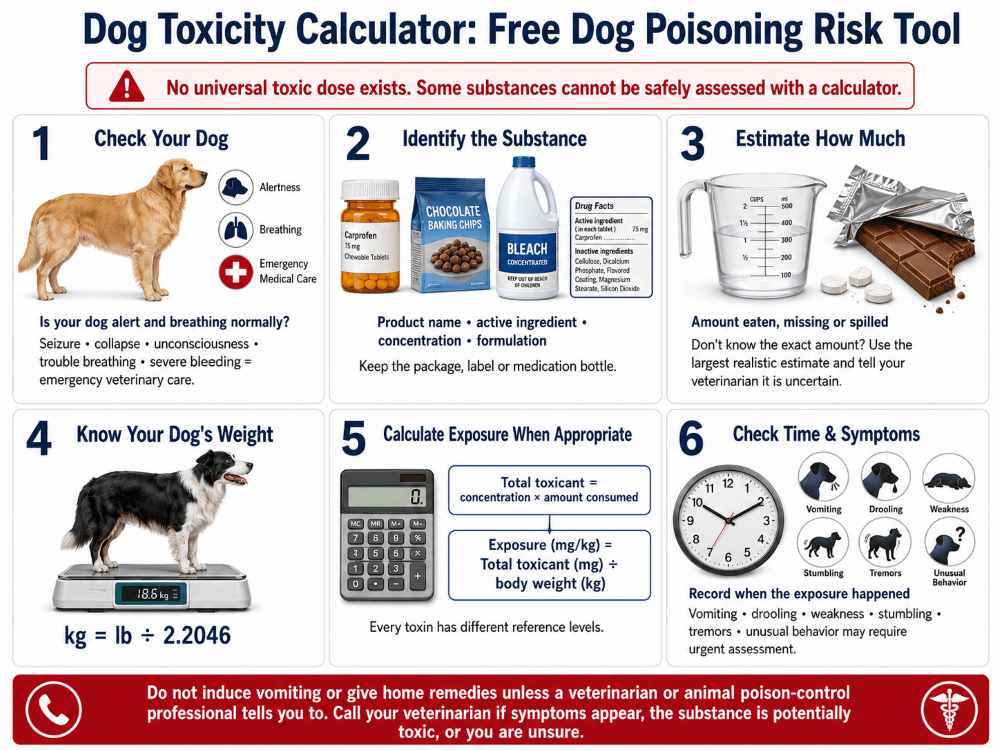
Frequently Asked Questions
The Bottom Line
A dog toxicity calculator can help when you know what your dog encountered, how much may have been consumed, the concentration or strength, and your dog's weight. For toxins that can be assessed numerically, the calculation often involves determining the total amount of active toxicant and dividing it by body weight in kilograms. However, there is no universal toxic dose for dogs, and an mg/kg value must always be interpreted using information for the exact substance involved. Do not let a calculator delay veterinary care. If your dog has symptoms, the product is unknown, the amount is uncertain, or the substance could cause serious poisoning, contact your veterinarian, an emergency veterinary hospital, or animal poison control.
For more specific exposure estimates, related Canine Bible tools such as a dog chocolate toxicity calculator, dog xylitol toxicity calculator, dog alcohol toxicity calculator, dog naproxen toxicity calculator, or dog Tylenol toxicity calculator can use calculations tailored to the individual toxin. Also, check out 50 poisonous and toxic dog foods for your dog's safety.