Dog Tylenol (Acetaminophen) Toxicity Calculator: Assess Risk & Poisoning

Canine Bible is reader-supported. We receive affiliate commissions via some of our links. Learn more.
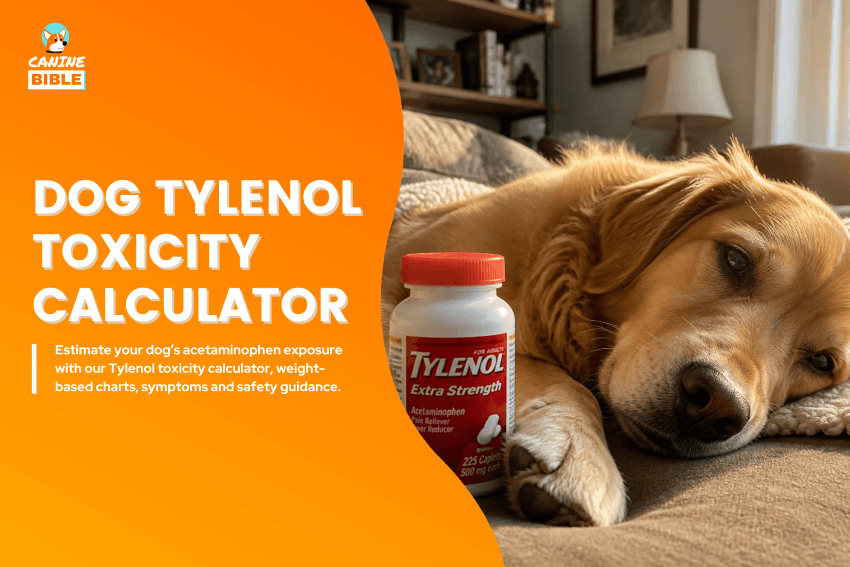
If your dog ate Tylenol (also known as acetaminophen), paracetamol, or a medication containing acetaminophen, the most important numbers are your dog’s weight, the amount swallowed, and the product’s Tylenol strength. Together, these can be used to estimate exposure in milligrams per kilogram of body weight, or mg/kg. The Dog Tylenol Toxicity Calculator below helps estimate that exposure and compare it with published veterinary toxicology reference ranges. It does not diagnose poisoning, determine whether your dog is safe, or replace advice from a veterinarian. If you know or suspect your dog swallowed Tylenol, contact your veterinarian or an animal poison-control professional promptly. Do not wait for symptoms before asking for help.
Remember to ALWAYS contact your veterinarian or a pet poison control service immediately if your dog may have ingested Tylenol. Do not wait for symptoms or rely on this calculator as a substitute for professional veterinary care. If you can't reach your vet, you can chat live with a registered online veterinary professional via our online vet chat or video chat support (24 hours a day, 7 days a week). Or use Chewy's online vet services (6 a.m. - midnight ET). Additionally, at-home dog gut health tests can analyze your dog’s microbiome, offering insights into which nutrients their diet should include. Similarly, at-home dog allergy testing kits can identify ingredients that may not be suitable for your dog, enabling you to choose the right diet and care plan to support optimal digestion, nutrition, and health.
How Much Tylenol Is Toxic to Dogs?
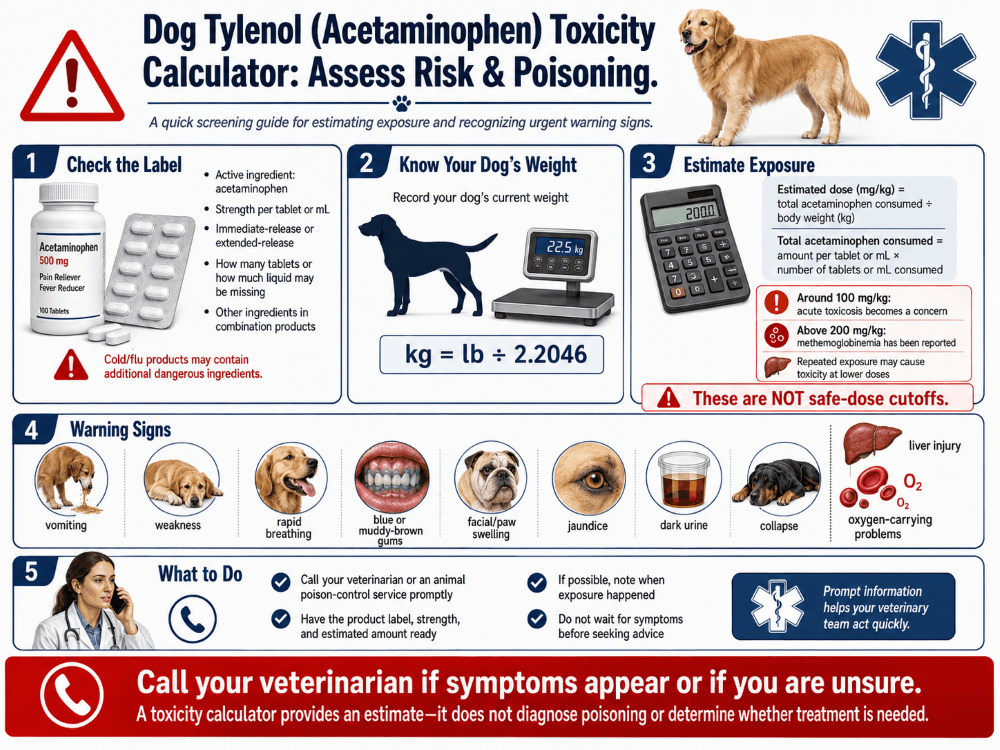
Published veterinary toxicology references report that acute clinical signs in dogs are generally associated with Tylenol exposures above about 100 mg/kg. At exposures above 200 mg/kg, dogs have been reported to develop methemoglobinemia, a dangerous blood abnormality that interferes with oxygen delivery.
Those numbers are toxicity reference points, not safe-dose cutoffs. Repeated exposure can cause toxicosis at lower individual doses, and a dog’s health, medication history, product formulation, and the accuracy of the estimated amount can all change the clinical picture.
Tylenol can damage a dog’s liver and, at higher exposures, red blood cells. A dog can appear normal soon after swallowing medication and still develop serious problems later.
Can One Tylenol Tablet Be Toxic to a Dog?
It can be, especially in a small dog. For example, if a 10-pound dog swallows one 500 mg Tylenol tablet:


- 10 lb is about 4.54 kg.
- 500 mg ÷ 4.54 kg = about 110 mg/kg.
That estimated exposure reaches a range associated with acute acetaminophen toxicosis concerns in dogs. A 500 mg tablet produces a much lower mg/kg exposure in a 50-pound dog, which is why body weight matters so much.
Even when the calculated exposure is below 100 mg/kg, do not assume the ingestion is harmless. Repeated doses, an uncertain amount, other active ingredients, or existing illness can make a simple threshold comparison unreliable.
Tylenol Toxicity Chart for Dogs
The chart below converts the 100 mg/kg and 200 mg/kg veterinary reference points into total Tylenol amounts at common dog weights.
| Dog Weight | Weight in kg | 100 mg/kg Equivalent | 200 mg/kg Equivalent |
|---|---|---|---|
| 5 lb | 2.27 kg | 227 mg | 454 mg |
| 10 lb | 4.54 kg | 454 mg | 907 mg |
| 20 lb | 9.07 kg | 907 mg | 1,814 mg |
| 30 lb | 13.61 kg | 1,361 mg | 2,722 mg |
| 50 lb | 22.68 kg | 2,268 mg | 4,536 mg |
| 70 lb | 31.75 kg | 3,175 mg | 6,350 mg |
| 100 lb | 45.36 kg | 4,536 mg | 9,072 mg |
Important: This is a toxicity-reference chart, not a Tylenol dosing chart. The listed amounts should never be interpreted as amounts that are safe to intentionally give to a dog.
Tylenol Product and Formulation Risk Chart
The medication name alone is not enough. Check the entire product label because concentration, release type, and additional active ingredients can change the risk.
| Product Type | What to Check | Why It Matters |
|---|---|---|
| Tablet or capsule | Mg per unit | Strength determines the total acetaminophen swallowed. |
| Liquid | Mg/mL and volume | Liquid concentrations can differ between products. |
| Extended release | Release type | Absorption may be delayed compared with standard formulations. |
| Cold or flu product | All active ingredients | Other drugs may create separate poisoning risks. |
| Unknown product | Package or label | An uncertain strength makes the exposure estimate unreliable. |
Acetaminophen appears in many products beyond plain Tylenol, including some cold, flu, allergy, fever, and prescription medications. Combination-product exposures cannot be evaluated by looking at acetaminophen alone.
Tylenol Poisoning Symptoms in Dogs
Signs can range from stomach upset to severe breathing problems or liver injury. Larger exposures may produce symptoms within hours, while some liver-related effects can become apparent over the following days.


| Symptom Group | Possible Signs | What to Do |
|---|---|---|
| Digestive | Vomiting, poor appetite, abdominal discomfort | Contact your veterinarian promptly. |
| General | Lethargy, trembling, weakness | Seek veterinary guidance without waiting for progression. |
| Breathing or blood | Rapid breathing, blue or muddy-brown gums | Seek emergency veterinary care. |
| Swelling | Facial or paw swelling | Arrange urgent veterinary assessment. |
| Liver-related | Yellow gums or eyes, dark urine | Seek urgent veterinary assessment. |
| Severe | Collapse or marked breathing difficulty | Go to an emergency veterinarian immediately. |
Do not use the absence of symptoms as proof that your dog is fine. Early treatment can matter, and liver damage may not be obvious immediately.
Tylenol Toxicity Guidelines for Dogs
Tylenol exposure in dogs is commonly expressed as milligrams of drug per kilogram of body weight. This allows the same ingestion to be compared across dogs of very different sizes. A 500 mg tablet represents about 220 mg/kg in a 5-pound dog but only about 22 mg/kg in a 50-pound dog. That is why “my dog ate one pill” is not enough information to estimate the exposure.
Veterinary toxicology references generally associate acute signs with exposures exceeding about 100 mg/kg in dogs, while methemoglobinemia has been reported above 200 mg/kg. Repeated administration can produce toxicosis at lower doses.
Why Tylenol Can Damage a Dog’s Liver
The liver processes Tylenol into compounds the body can eliminate. With excessive exposure, harmful metabolites can overwhelm the liver’s normal protective pathways and injure liver cells. Dogs are particularly prone to acetaminophen-related liver injury. Severe cases can progress to liver failure.
How Tylenol Can Affect Red Blood Cells
High Tylenol exposure can also change hemoglobin inside red blood cells, producing methemoglobinemia. When that happens, blood cannot deliver oxygen normally to the body’s tissues.
Possible signs include weakness, rapid breathing, excessive panting, and gums that look bluish, grayish, or muddy brown. These signs require emergency veterinary care.
Factors That Can Affect Your Dog’s Results
A calculator can estimate the arithmetic of an exposure, but several details determine how useful that estimate is.
| Factor | Why It Matters | What Owners Should Check |
|---|---|---|
| Dog weight | Smaller dogs receive more mg/kg from the same pill. | Use a recent weight when possible. |
| Drug strength | Tablet and liquid strengths vary. | Read the acetaminophen amount on the label. |
| Amount swallowed | The estimate depends directly on total milligrams consumed. | Count missing pills or estimate liquid volume carefully. |
| Repeated doses | Toxicosis may occur at lower doses after repeated exposure. | Include every dose and approximate time given. |
| Formulation | Extended-release products may absorb differently. | Check for ER, XR, or extended-release wording. |
| Other ingredients | Combination drugs may add separate poisoning risks. | Read the complete active-ingredient list. |
| Health conditions | Underlying disease can affect clinical decisions. | Tell the veterinarian about liver disease and other illnesses. |
| Symptoms | Clinical signs can make the situation urgent regardless of the estimate. | Report any breathing, gum-color, swelling, or liver-related changes. |
The calculator should never mathematically “correct” a toxicity threshold for age, breed, liver disease, or other health conditions unless validated veterinary data support that adjustment. Those factors are better handled through veterinary assessment.
Common Mistakes to Avoid
Tylenol exposure calculations are simple in principle, but small input errors can dramatically alter the mg/kg estimate.
| Mistake | Why It Matters | Better Approach |
|---|---|---|
| Using pill count only | Different pills contain different milligram strengths. | Enter the labeled mg per tablet. |
| Confusing mg and mL | Milligrams measure drug amount; milliliters measure liquid volume. | Use the product's mg/mL concentration. |
| Ignoring formulation | Extended-release products may not behave like standard tablets. | Check the full product name and label. |
| Missing other ingredients | Cold and flu products may contain additional toxic drugs. | Record every active ingredient. |
| Leaving out prior doses | Repeated exposure may be toxic at lower doses. | Include all known doses and times. |
| Ignoring symptoms | A symptomatic dog needs veterinary assessment regardless of the calculator. | Prioritize the dog's condition over the numeric result. |
| Treating the result as exact | The calculation cannot predict an individual dog's outcome. | Use it as an exposure estimate only. |
| Waiting too long | Treatment may be more effective when started early. | Contact a veterinarian promptly after suspected ingestion. |
Another serious mistake is trying to treat the exposure at home. Do not induce vomiting or give activated charcoal, antidotes, supplements, or other medications unless a veterinarian or veterinary poison-control expert specifically tells you to.
Safety Guidelines for Tylenol (Acetaminophen) Exposure in Dogs
Tylenol toxicity is not a situation where a calculator should decide whether veterinary care is necessary. The calculator’s job is to organize the exposure information and estimate mg/kg, not to diagnose poisoning.
When Should You Contact a Veterinarian?
Contact a veterinarian or animal poison-control professional promptly if your dog swallowed acetaminophen or you suspect an exposure. Professional advice is especially important when:
Keep the packaging nearby when you call. The exact product name, concentration, number of pills missing, and list of active ingredients can save valuable time.
Emergency Warning Signs
Seek emergency veterinary care immediately if your dog develops:
These signs can indicate serious effects on oxygen delivery, the liver, or other body systems.
Do Not Wait for Symptoms
A dog that seems normal immediately after eating Tylenol may still be at risk. Some effects can develop within hours, while liver injury may become more apparent over the next several days. If you already know an exposure occurred, calling early is safer than waiting for visible signs.
Never Give Tylenol Without Veterinary Direction
Acetaminophen is sometimes used by veterinarians in carefully selected dogs, but that does not mean human Tylenol should be dosed at home. The appropriate drug, dose, timing, and monitoring depend on the individual dog. Never use the toxicity numbers on this page to work backward and create a “safe” home dose.
What to Do If Your Dog Eats Tylenol
First, remove the medication so your dog cannot swallow any more. Then locate the bottle, blister pack, box, or prescription label. Write down or photograph:
- The product name.
- The acetaminophen strength.
- Whether it is a tablet, capsule, liquid, or extended-release product.
- The approximate number of tablets or the amount of liquid missing.
- Any other active ingredients.
- The earliest and latest possible time of ingestion.
- Your dog’s current weight.
- Any symptoms you have noticed.
Contact your veterinarian, an emergency veterinary hospital, or an animal poison-control service with this information. If your dog is having trouble breathing, collapsing, or showing severe weakness or abnormal gum color, go directly to emergency veterinary care.
Do not make your dog vomit unless a veterinary professional specifically instructs you to. Whether decontamination is appropriate depends on factors such as timing, formulation, the dog’s condition, and aspiration risk.
Veterinary treatment may include decontamination when appropriate, an antidote such as N-acetylcysteine, IV fluids, blood and liver monitoring, oxygen support, or other care based on the dog’s condition. Treatment decisions and antidote dosing belong in veterinary hands.
Special Considerations for Certain Dogs
How to Calculate Tylenol Exposure in Dogs Manually
The calculator uses a simple weight-based formula. A manual calculation can be useful when you want to double-check the inputs before speaking with your veterinarian.
Step 1: Convert Your Dog’s Weight to Kilograms
If your dog's weight is in pounds: Weight in kg = weight in lb ÷ 2.2046
- For a 20-pound dog:
- 20 ÷ 2.2046 = about 9.07 kg
Step 2: Calculate the Total Tylenol Consumed
For tablets or capsules: Total Tylenol in mg = mg per tablet × number of tablets swallowed
- If two 325 mg tablets are missing:
- 325 mg × 2 = 650 mg
For liquid medication: Total Tylenol in mg = concentration in mg/mL × volume swallowed in mL
Always use the concentration printed on that specific bottle.
Step 3: Calculate the Exposure in mg/kg
Use: Tylenol exposure in mg/kg = total Tylenol in mg ÷ dog weight in kg
- If a 9.07 kg dog swallowed 650 mg:
- 650 ÷ 9.07 = about 71.7 mg/kg
That number is an exposure estimate, not a prediction of whether the dog will become sick.
Step 4: Compare the Estimate With Veterinary Toxicology References
For a single acute exposure, published references commonly use:
- Above about 100 mg/kg, acute acetaminophen toxicosis becomes a concern.
- Above 200 mg/kg, methemoglobinemia has been reported in dogs.
- Repeated exposure: toxicosis may occur at lower individual doses.
These numbers help describe exposure. They do not establish a home-treatment threshold or prove that a smaller exposure is safe.
Example Calculation
Suppose a 10-pound dog may have swallowed one 500 mg Tylenol tablet.
- First, convert weight:
- 10 lb ÷ 2.2046 = 4.54 kg
- Then calculate exposure:
- 500 mg ÷ 4.54 kg = about 110 mg/kg
That estimate exceeds the approximately 100 mg/kg reference associated with acute toxicosis concerns. The appropriate next step is prompt veterinary assessment, not watching the dog at home to see whether symptoms develop. Manual calculations become much less useful when the amount swallowed is uncertain, more than one exposure has occurred, or the product contains additional active ingredients.
Dog Tylenol Toxicity Infographic
Frequently Asked Questions
The Bottom Line
The Dog Tylenol Toxicity Calculator converts your dog’s weight and estimated acetaminophen ingestion into mg/kg, making it easier to describe the exposure when you speak with a veterinarian. For dogs, acute toxicosis becomes a concern around published exposures above 100 mg/kg, and methemoglobinemia has been reported above 200 mg/kg. Those values are not safe-dose limits, and repeated exposure can cause toxicosis at lower doses.
If your dog ate Tylenol, acetaminophen, paracetamol, or a medication containing acetaminophen, contact your veterinarian or an animal poison-control professional promptly. Keep the package, note how much may be missing, and do not wait for symptoms before asking for help. For other accidental exposures, related Canine Bible resources such as a dog ibuprofen toxicity calculator, chocolate toxicity calculator, xylitol toxicity calculator, and dog poisoning symptoms guide, can help you gather useful information while arranging appropriate care.