Dog Aspirin Toxicity Calculator: Estimate Exposure and Poisoning Risk

Canine Bible is reader-supported. We receive affiliate commissions via some of our links. Learn more.
Aspirin can cause poisoning in dogs when too much is swallowed at once or when excessive doses are given repeatedly. Because the same tablet delivers a much higher dose in a small dog than in a large dog, aspirin exposure is usually expressed in milligrams per kilogram of body weight (mg/kg). The Dog Aspirin Toxicity Calculator below estimates how much aspirin your dog may have consumed and converts that amount to mg/kg. Use it alongside the weight charts, symptoms, calculation examples, and safety guidance in this article, not as a substitute for veterinary care.
Remember to ALWAYS contact your veterinarian or a pet poison control service immediately if your dog may have ingested aspirin, even if your dog appears normal or the calculator shows a low-risk result. If you can't reach your vet, you can chat live with a registered online veterinary professional via our online vet chat or video chat support (24 hours a day, 7 days a week). Or use Chewy's online vet services (6 a.m. - midnight ET). Additionally, at-home dog gut health tests can analyze your dog’s microbiome, offering insights into which nutrients their diet should include. Similarly, at-home dog allergy testing kits can identify ingredients that may not be suitable for your dog, enabling you to choose the right diet and care plan to support optimal digestion, nutrition, and health.
How Much Aspirin Is Toxic to Dogs?
There is no single aspirin dose below which every dog can be assumed safe. Risk depends on the mg/kg exposure, whether the exposure happened once or repeatedly, the formulation, the dog's health, other medications, and whether symptoms have developed.
Veterinary toxicology data show why relying on one cutoff can be misleading. In studies of repeated administration, plain aspirin at 25 mg/kg every eight hours produced stomach-lining erosions in some dogs after only two days, while repeated daily exposures of 100–300 mg/kg caused toxicosis. An acute ingestion of around 450 mg/kg can cause gastrointestinal problems, hyperthermia, panting, seizures, or coma. These values are toxicology reference points, not recommended doses and not boundaries between “safe” and “toxic.”
That distinction matters. A dog does not need to reach 450 mg/kg before aspirin can cause a problem, particularly when aspirin has been given repeatedly or the dog has kidney, liver, gastrointestinal, or clotting problems. For example, one 325 mg tablet equals about 143 mg/kg in a 5-pound dog, but only about 7 mg/kg in a 100-pound dog. Tablet count alone, therefore, tells you very little without the dog's weight.
Dog Aspirin Toxicity Chart
The charts below help put common aspirin exposures into context. They calculate exposure only; they do not determine whether an individual dog is safe.


Aspirin Exposure by Dog Weight
This chart shows approximately how much aspirin a dog receives in mg/kg from one 81 mg tablet or one 325 mg tablet.
| Dog Weight | Approx. Weight (kg) | One 81 mg Tablet | One 325 mg Tablet |
|---|---|---|---|
| 5 lb | 2.3 kg | 35.7 mg/kg | 143.3 mg/kg |
| 10 lb | 4.5 kg | 17.9 mg/kg | 71.6 mg/kg |
| 20 lb | 9.1 kg | 8.9 mg/kg | 35.8 mg/kg |
| 30 lb | 13.6 kg | 6.0 mg/kg | 23.9 mg/kg |
| 40 lb | 18.1 kg | 4.5 mg/kg | 17.9 mg/kg |
| 50 lb | 22.7 kg | 3.6 mg/kg | 14.3 mg/kg |
| 70 lb | 31.8 kg | 2.6 mg/kg | 10.2 mg/kg |
| 100 lb | 45.4 kg | 1.8 mg/kg | 7.2 mg/kg |
Important: This chart is an exposure calculator, not an aspirin dosing chart. Do not use it to decide how much aspirin to give a dog.
Aspirin Toxicity Reference Levels in Dogs
These veterinary reference findings help illustrate the difference between repeated exposure and a large single overdose.
| Exposure | Veterinary Context | Owner Takeaway |
|---|---|---|
| 25 mg/kg every 8 hours | Stomach erosions occurred in some dogs after repeated dosing. | Repeated lower doses can still cause injury. |
| 100–300 mg/kg daily | Toxicosis has occurred after repeated exposure for 1–4 weeks. | Frequency and duration matter. |
| About 450 mg/kg once | Severe acute signs can occur. | Major poisoning concern. |
| Any amount with symptoms | The number alone cannot determine severity. | Contact a veterinarian promptly. |
These values are not safe-dose cutoffs. A dog can require veterinary attention at a lower calculated exposure depending on repeated dosing, health status, formulation, concurrent medications, and symptoms.
Common Aspirin Products and Formulations
Always check the actual package instead of identifying the medication by tablet appearance alone.
| Product Type | What to Check | Important Detail |
|---|---|---|
| Low-dose aspirin | Usually labeled 81 mg. | Do not assume it is harmless to small dogs. |
| Regular aspirin | Often labeled 325 mg. | One tablet can be substantial for a small dog. |
| Enteric-coated | Check strength and coating. | Absorption can be less predictable. |
| Combination medicine | Check every active ingredient. | Other drugs may add separate poisoning risks. |
| Other salicylate | Identify the exact chemical. | Do not calculate it as plain aspirin. |
| Unknown product | Save the package or label. | Contact a veterinarian or poison-control service. |
Aspirin can also appear in combination medicines and is only one member of the broader salicylate family. Products containing ingredients such as methyl salicylate or bismuth subsalicylate should not automatically be assessed as if they were plain aspirin tablets.


Aspirin Toxicity Guidelines for Dogs
Aspirin, or acetylsalicylic acid, is a nonsteroidal anti-inflammatory drug (NSAID). It changes the production of compounds involved in pain and inflammation, but those same pathways also help protect the stomach lining, support kidney function, and contribute to normal blood clotting. When too much aspirin is present, the gastrointestinal tract is often affected first. More serious poisoning can disrupt acid-base balance and affect the kidneys, liver, nervous system, breathing, body temperature, and clotting.
Aspirin has been used in veterinary medicine in selected situations, but that does not mean owners should choose a dose on their own. Aspirin can cause gastrointestinal injury even at amounts used therapeutically, and other veterinary pain medications may be more appropriate for an individual dog. This calculator is therefore designed to assess an accidental or suspected exposure, not to recommend an aspirin dose for pain, arthritis, fever, or any other condition.
Factors That Can Affect Your Dog's Results
The calculated mg/kg exposure is important, but it is only one part of assessing aspirin poisoning.
| Factor | Why It Matters | What Owners Should Check |
|---|---|---|
| Body weight | Smaller dogs receive more mg/kg from the same tablet. | Use a recent, accurate weight. |
| Amount swallowed | More aspirin increases total exposure. | Count all tablets that could be missing. |
| Repeated doses | Repeated exposure can cause injury at lower amounts. | Record every dose and time given. |
| Formulation | Absorption may differ between products. | Check plain, buffered, or enteric-coated. |
| Other ingredients | Combination drugs may create additional toxicity. | Read the full active-ingredient list. |
| Health conditions | Kidney, liver, GI, or clotting disease can increase concern. | Report existing diagnoses to your veterinarian. |
| Other medications | NSAIDs and steroids may increase adverse-effect risk. | List all medications and supplements. |
| Symptoms | Clinical signs can make the exposure more urgent. | Note vomiting, bleeding, weakness, breathing changes, or neurologic signs. |
If you do not know the exact amount swallowed, do not automatically use the smallest possible estimate. Tell your veterinarian how many tablets are missing and the maximum realistic amount your dog could have consumed.
Common Mistakes to Avoid
Aspirin toxicity calculations are mathematically simple, but small input errors can produce a very misleading result.
| Mistake | Why It Matters | Better Approach |
|---|---|---|
| Using pounds as kg | This produces an incorrect mg/kg result. | Convert lb to kg before calculating. |
| Guessing tablet strength | Aspirin products come in different strengths. | Read the package label. |
| Ignoring formulation | Product type can affect assessment. | Record whether it is coated, buffered, or combined. |
| Ignoring repeat doses | Chronic exposure can cause injury at lower amounts. | Report the full dosing history. |
| Ignoring symptoms | A calculator cannot evaluate a sick dog. | Seek veterinary care when signs appear. |
| Calling a number “safe” | Toxicity varies between dogs and situations. | Treat the result as an exposure estimate. |
| Waiting too long | Early veterinary assessment can affect treatment options. | Call promptly after a concerning exposure. |
| Using the tool to dose aspirin | A toxicity calculator is not a treatment guide. | Use aspirin only under veterinary direction. |
Another common mistake is assuming “baby aspirin” must be safe because the tablet is small. Low-dose aspirin typically contains less drug per tablet, but the relevant question is still how many milligrams the dog received per kilogram of body weight.
Safety Guidelines for Aspirin Exposure in Dogs
Contact a veterinarian or animal poison-control professional promptly when:
Do not wait for obvious illness if the exposure may be significant. Signs can begin within several hours, and serious poisoning may continue or progress after the original ingestion.
Signs of Aspirin Poisoning in Dogs
Possible signs range from gastrointestinal upset to severe neurologic or organ-related problems.
| Symptom Level | Possible Signs | What to Do |
|---|---|---|
| GI signs | Vomiting, poor appetite, diarrhea, abdominal discomfort. | Contact a veterinarian after aspirin exposure. |
| Bleeding signs | Bloody vomit or black, tarry stool. | Seek prompt veterinary care. |
| Systemic signs | Weakness, lethargy, rapid breathing, high temperature. | Urgent veterinary assessment is appropriate. |
| Neurologic signs | Tremors, seizures, altered awareness. | Emergency veterinary care. |
| Critical signs | Collapse, unconsciousness, severe bleeding, breathing difficulty. | Go to an emergency veterinary hospital immediately. |
Gastrointestinal upset and bleeding are important aspirin toxicity signs, while larger exposures can also affect the kidneys, liver, temperature regulation, respiratory system, and central nervous system.
What to Do If Your Dog Ate Aspirin
If you discover an open aspirin bottle or know your dog swallowed tablets, focus first on gathering accurate information and getting professional guidance.
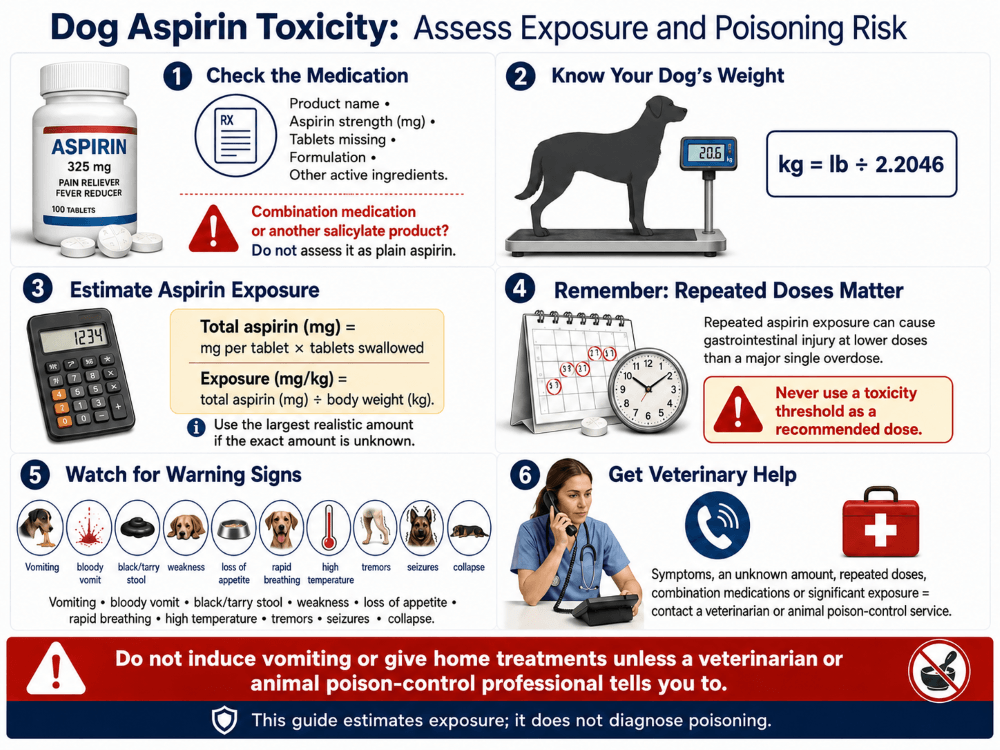
1. Check Your Dog: Look at your dog before doing any calculations. Determine whether they are alert and breathing normally and whether vomiting, severe weakness, bleeding, tremors, seizures, or collapse are present. A dog with severe symptoms needs emergency veterinary care regardless of the estimated dose.
2. Find the Medication Package and Record:
3. Estimate the Maximum Realistic Amount: If six tablets are missing and you cannot find them, tell the veterinarian that up to six tablets may have been swallowed. Do not assume your dog ate only the amount you personally witnessed. If part of a tablet remains, estimate the missing fraction as accurately as you can.
4. Record Your Dog's Weight: Use a recent veterinary weight whenever possible. Because exposure is calculated in mg/kg, even a few pounds of difference can matter more in very small dogs.
5. Record the Timing: Note the earliest and latest times the exposure could have happened. If aspirin was intentionally given over several days, write down every dose you remember and approximately when it was administered.
6. Contact a Veterinarian or Animal Poison-Control Service: Have the package and your dog's weight available when you call. The professional assessing the exposure may also ask about current medications, health conditions, symptoms, and when your dog last ate.
7. Do Not Improvise Home Treatment: Do not induce vomiting or give hydrogen peroxide, activated charcoal, antacids, milk, oil, food, or another medication unless a veterinarian or animal poison-control professional specifically instructs you to do so. Whether decontamination is appropriate depends on factors such as timing, formulation, dose, symptoms, and the dog's medical condition. Veterinary treatment may include decontamination, gastrointestinal protection, IV fluids, blood testing, and supportive care when clinically appropriate.
Special Considerations for Certain Dogs
How to Calculate Aspirin Exposure in Dogs Manually
The calculator uses a straightforward dose-per-body-weight calculation.
Step 1: Convert Your Dog's Weight to Kilograms
If your dog's weight is in pounds: Dog weight (kg) = dog weight (lb) ÷ 2.2046
- For example:
- 20 lb ÷ 2.2046 = about 9.07 kg
Step 2: Calculate the Total Aspirin Consumed
For tablets: Total aspirin (mg) = aspirin per tablet (mg) × number of tablets consumed
- If a dog swallowed two 325 mg tablets:
- 325 mg × 2 = 650 mg total aspirin
For a liquid product containing aspirin: Total aspirin (mg) = concentration (mg/mL) × amount swallowed (mL)
Only use this formula when the product actually lists aspirin in mg/mL. Other salicylates may require a different toxicology assessment.
Step 3: Calculate the Exposure in mg/kg
Use: Aspirin exposure (mg/kg) = total aspirin consumed (mg) ÷ dog weight (kg)
This number expresses the exposure relative to body size.
Example Calculation
Suppose a 20-pound dog may have swallowed one 325 mg aspirin tablet.
- First, convert the weight:
- 20 lb ÷ 2.2046 = 9.07 kg
- Next, calculate the total aspirin:
- 325 mg × 1 tablet = 325 mg
- Then calculate exposure:
- 325 mg ÷ 9.07 kg = approximately 35.8 mg/kg
- The estimated exposure is therefore 35.8 mg/kg.
That calculation does not by itself tell you whether the dog will develop poisoning. Whether the dose happened once or repeatedly, the formulation, current symptoms, other medications, and the dog's health all affect the clinical assessment.
Dog Aspirin Toxicity Infographic
Frequently Asked Questions
The Bottom Line
A dog aspirin toxicity calculator is most useful for answering one important question: how many milligrams of aspirin did your dog receive per kilogram of body weight? That is much more informative than simply knowing the number of tablets swallowed. But mg/kg is only part of the picture. Repeated doses can cause problems at lower amounts than a major one-time overdose, and factors such as kidney or liver disease, gastrointestinal problems, other NSAIDs, steroids, combination medications, and current symptoms can significantly change the concern. Use the calculator to organize the exposure information, not to prove that an ingestion is safe. If your dog has symptoms, the amount is uncertain, repeated doses occurred, or you are unsure about the product, contact your veterinarian or an animal poison-control professional.
If the exposure involved a different human medication, related Canine Bible resources such as the dog toxicity calculator, dog ibuprofen toxicity calculator, dog naproxen toxicity calculator, and dog Tylenol toxicity calculator can help you gather the right information while you arrange professional guidance.