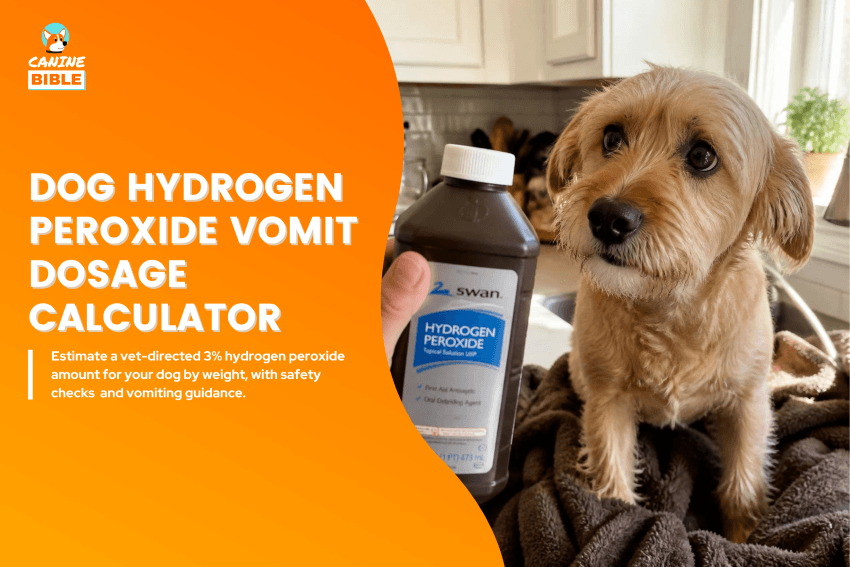
Dog Hydrogen Peroxide Vomit Dosage Calculator: Safe Induction Dosage Guide

Canine Bible is reader-supported. We receive affiliate commissions via some of our links. Learn more.
When a dog swallows something potentially toxic, it is natural to want it out of their stomach as quickly as possible. But making a dog vomit is not appropriate for every poisoning, and using hydrogen peroxide in the wrong situation can cause additional injury. This Dog Hydrogen Peroxide Vomit Dosage Calculator is designed as a vet-directed reference and safety checker, not a substitute for veterinary care. It can convert your dog’s weight and estimate a published veterinary reference amount for 3% hydrogen peroxide only when a veterinarian or animal poison-control professional has specifically told you to induce vomiting. You will also find a hydrogen peroxide chart by weight, situations where vomiting should not be induced, warning signs, calculation methodology, and practical steps to take after a suspected poisoning.
Remember to ALWAYS contact your veterinarian or a pet poison control service before giving your dog hydrogen peroxide to induce vomiting, as it may be unsafe in some situations. If you can't reach your vet, you can chat live with a registered online veterinary professional via our online vet chat or video chat support (24 hours a day, 7 days a week). Or use Chewy's online vet services (6 a.m. - midnight ET). Additionally, at-home dog gut health tests can analyze your dog’s microbiome, offering insights into which nutrients their diet should include. Similarly, at-home dog allergy testing kits can identify ingredients that may not be suitable for your dog, enabling you to choose the right diet and care plan to support optimal digestion, nutrition, and health.
How Much Hydrogen Peroxide Can I Give My Dog to Make Them Vomit?
You should not give your dog hydrogen peroxide unless a veterinarian or animal poison-control expert has first told you to induce vomiting. When home induction of vomiting is considered appropriate for a dog and veterinary care or prescription emetics are not immediately available, a published veterinary reference for 3% hydrogen peroxide is 1–2 mL per kilogram of body weight by mouth, with a maximum of 45 mL. That number is a veterinary reference, not a universal home-treatment dose.
Whether vomiting should be induced depends on much more than weight. The substance swallowed, amount consumed, time since exposure, your dog's symptoms, ability to protect their airway, medical history, and hydrogen peroxide concentration can completely change what should be done.
Important Consideration
A mathematically correct amount does not mean hydrogen peroxide is medically appropriate. For example, a 20-pound dog weighs about 9.1 kg. Although that weight can be converted into a reference range, the calculation should only be used after a veterinary professional has decided that making that particular dog vomit after that particular exposure is appropriate.


Veterinary clinics may also use prescription emetics that are more reliable and controllable than hydrogen peroxide. When prompt veterinary treatment is available, professional emetic options are generally preferred.
Hydrogen Peroxide Dosage Chart for Dogs
The chart below converts common dog weights using the published 1–2 mL/kg reference for 3% hydrogen peroxide, capped at 45 mL. It is intended only for cases in which a veterinarian or poison-control professional has already directed the owner to induce vomiting.
| Dog Weight | Weight in kg | 3% Peroxide Reference* |
|---|---|---|
| 5 lb | 2.3 kg | 2.3–4.5 mL |
| 10 lb | 4.5 kg | 4.5–9.1 mL |
| 20 lb | 9.1 kg | 9.1–18.1 mL |
| 30 lb | 13.6 kg | 13.6–27.2 mL |
| 40 lb | 18.1 kg | 18.1–36.3 mL |
| 50 lb | 22.7 kg | 22.7–45 mL |
| 60 lb | 27.2 kg | Maximum 45 mL |
| 80+ lb | 36.3+ kg | Maximum 45 mL |
Published veterinary reference for 3% hydrogen peroxide only. This chart does not mean hydrogen peroxide should be given after every ingestion. Contact a veterinarian or animal poison-control professional first.
When Should You Not Make a Dog Vomit?
Some substances can cause considerably more damage when brought back through the esophagus. Vomiting is also dangerous when a dog cannot adequately protect its airway.
| Situation | Why It Matters | Next Step |
|---|---|---|
| Corrosive substance | Acids or alkalis can injure the esophagus again on the way up. | Do not induce vomiting; contact a vet immediately. |
| Petroleum product | Fuel and similar liquids can be aspirated into the lungs. | Seek professional guidance. |
| Sharp object | Vomiting may cause additional internal injury. | Arrange veterinary assessment. |
| Seizure or severe depression | The dog may not protect the airway normally. | Seek emergency veterinary care. |
| Trouble swallowing | Anything given orally can increase aspiration risk. | Do not give anything by mouth. |
| Already vomiting | Additional emetic treatment may be unnecessary or harmful. | Call your veterinarian for direction. |
| Unknown substance | The exposure may be one for which vomiting is unsafe. | Identify the product and call for help. |
Corrosives, volatile hydrocarbons, an absent swallowing reflex, neurologic instability, and high aspiration risk are recognized reasons not to induce vomiting.
Hydrogen Peroxide Side Effects and Emergency Signs
Hydrogen peroxide works by irritating the stomach. Even 3% household peroxide can cause gastrointestinal injury, and excessive exposure can produce serious complications. A controlled veterinary study found visible gastric lesions in all dogs evaluated after 3% hydrogen peroxide administration. Use the following signs as reasons to seek veterinary advice promptly after hydrogen peroxide has been given.


| Sign | Concern | What to Do |
|---|---|---|
| Repeated vomiting | Continued stomach irritation or toxicity may be present. | Contact a veterinarian. |
| Blood in vomit | Bleeding or significant GI irritation is possible. | Seek urgent veterinary care. |
| Coughing | Vomited material may have entered the airway. | Call a veterinarian promptly. |
| Trouble breathing | Aspiration or another serious complication is possible. | Seek emergency care. |
| Severe abdominal pain | Significant GI injury may be present. | Seek urgent veterinary evaluation. |
| Weakness or collapse | The poisoning or treatment may be causing systemic illness. | Go to an emergency veterinarian. |
A severe reaction after hydrogen peroxide should not be managed by giving more peroxide or waiting for the symptoms to pass.
Hydrogen Peroxide Guidelines for Dogs
Hydrogen peroxide should be viewed as an emergency emetic with specific veterinary uses, not a routine household remedy.
1. Use Only 3% Hydrogen Peroxide When Professionally Directed: Veterinary references describing hydrogen peroxide as an oral emetic refer to a 3% solution. Concentrations stronger than 3% can cause more severe tissue damage and should not be substituted. If the concentration is unknown, do not guess. Check the bottle label and contact a veterinarian or poison-control service.
2. Do Not Assume Every Poison Should Be Vomited: The goal of inducing vomiting is to remove an appropriate substance from the stomach before more is absorbed. But some materials can burn the esophagus, enter the lungs, damage tissue during vomiting, or pose other risks. That is why identifying what your dog swallowed is more important than simply finding a dose based on body weight.
3. Do Not Substitute Other Home Remedies: Do not use salt, mustard, syrup of ipecac, cooking oil, dish soap, or physical gagging as substitutes for veterinary-directed emesis. Some of these methods can cause poisoning or aspiration themselves.
4. Do Not Automatically Give Another Dose: If your dog does not vomit after hydrogen peroxide that was specifically recommended by a veterinary professional, contact that professional again. Do not assume another dose is necessary or safe.
5. Do Not Use Hydrogen Peroxide to Make a Cat Vomit: Hydrogen peroxide is not considered an appropriate home emetic for cats because it can cause severe gastrointestinal irritation and is not reliably effective.
Factors That Can Affect Your Dog's Results
A weight-based calculation is only one part of an exposure assessment. These factors can change whether inducing vomiting is useful, unnecessary, or dangerous.
| Factor | Why It Matters | What Owners Should Check |
|---|---|---|
| Body weight | The published reference amount is weight-based. | Use a recent, accurate weight. |
| Substance swallowed | Some exposures should not be vomited. | Save the package or ingredient label. |
| Amount consumed | Exposure severity depends partly on dose. | Estimate how much is missing. |
| Time since ingestion | The usefulness of stomach decontamination changes with time. | Record the earliest possible exposure time. |
| Current symptoms | Neurologic or breathing signs may make vomiting unsafe. | Check alertness, breathing, swallowing, and vomiting. |
| Medical history | Some conditions increase aspiration or treatment risk. | Mention airway, neurologic, and swallowing disorders. |
| Peroxide strength | Stronger concentrations can cause more severe injury. | Confirm the label says 3%. |
If you cannot identify the product, amount, concentration, or your dog's condition clearly, contact a veterinarian rather than filling in the missing information with guesses.
Common Mistakes to Avoid
Poisoning emergencies move quickly, but rushing into the wrong treatment can create a second problem. Avoid these common hydrogen peroxide calculator and first-aid mistakes.
| Mistake | Why It Matters | Better Approach |
|---|---|---|
| Using the wrong concentration | Peroxide stronger than 3% can cause greater tissue injury. | Verify the concentration before doing anything. |
| Mixing up lb and kg | A unit error can produce a major calculation error. | Confirm both weight and unit. |
| Using kitchen spoon estimates | Household spoons are not precise measuring devices. | Follow the measuring method provided by your vet. |
| Ignoring the substance | Some swallowed materials should never be vomited. | Identify the product before treating. |
| Ignoring symptoms | A symptomatic dog may need immediate stabilization instead. | Prioritize the dog's condition over the calculation. |
| Treating the result as exact advice | A calculator cannot assess the entire poisoning case. | Use results only with veterinary direction. |
| Waiting too long to call | Delays can reduce treatment options. | Contact a vet or poison expert promptly. |
| Automatically redosing | More peroxide can increase GI injury and other complications. | Ask a professional what to do next. |
Safety Guidelines for Inducing Vomiting in Dogs
The safest first step after a suspected poisoning is usually not to reach for hydrogen peroxide; it is to identify the exposure and get case-specific veterinary guidance. Have the product container, medication bottle, ingredient list, or a clear photo of the label available when you call. The professional helping you will usually need your dog's weight, the amount that may have been swallowed, the approximate time of exposure, and any symptoms.
When to Call a Veterinarian Immediately
Contact a veterinarian or animal poison-control service promptly if your dog may have swallowed:
The exact treatment varies widely among these exposures. A hydrogen peroxide calculator cannot determine toxicity from the dog's weight alone.
Emergency Warning Signs
Skip home treatment and seek emergency veterinary care if your dog has:
A dog showing these signs may need stabilization, airway protection, medications, IV treatment, diagnostic testing, or other veterinary care rather than induced vomiting.
Who to Call for a Poisoning Emergency
In the United States, two 24-hour options are:
- ASPCA Animal Poison Control: (888) 426-4435
- Pet Poison Helpline: (855) 764-7661
Both services provide case-specific poisoning guidance, and consultation fees may apply. If your dog is unstable, go directly to an emergency veterinary hospital while arranging professional guidance.
What to Do If Your Dog Ate Something Toxic
The actions you take during the first few minutes should focus on preventing more exposure and getting accurate information, not trying multiple home remedies.
- Move your dog away from the substance. Prevent them from eating or licking any more.
- Check for emergency signs. Breathing difficulty, seizures, collapse, severe weakness, or inability to swallow requires urgent veterinary care.
- Save the packaging. Keep the bottle, wrapper, medication container, ingredient panel, or product label.
- Estimate the exposure. Note what was swallowed, how much may be missing, and when it happened.
- Get your dog's current weight. An accurate recent weight helps with toxicology calculations.
- Call a veterinarian or animal poison-control service.
- Follow the instructions you are given. Do not add peroxide, food, milk, activated charcoal, salt, oil, medication, or another remedy unless specifically directed.
Do not delay an emergency trip while trying to make the calculation perfect. The veterinarian can work with an estimate if the exact amount swallowed is unknown. If you know the toxin involved, a substance-specific calculator, such as a dog chocolate toxicity calculator, dog xylitol toxicity calculator, or dog medication toxicity calculator, can help you organize exposure information while you contact veterinary care.
Special Considerations for Certain Dogs
How to Calculate a Vet-Directed Hydrogen Peroxide Amount Manually
The calculator uses a straightforward weight conversion, but the medical decision must come first. These formulas explain the mathematics behind a professionally directed calculation; they do not determine whether vomiting should be induced.
Step 1: Convert Pounds to Kilograms
Use: Body weight (kg) = body weight (lb) ÷ 2.2046
- For a 20-pound dog:
- 20 ÷ 2.2046 ≈ 9.1 kg
Step 2: Apply the Veterinarian-Directed mL/kg Amount
- The general calculation is: Hydrogen peroxide amount (mL) = body weight (kg) × instructed mL/kg
- A commonly cited veterinary reference for 3% hydrogen peroxide: 1–2 mL/kg, with a maximum of 45 mL.
Step 3: Apply the Maximum
Regardless of the dog's weight, the published Merck Veterinary Manual reference caps the amount at 45 mL. The calculator should never exceed the medically reviewed maximum.
Example Calculation
Suppose a dog weighs 20 lb and a veterinary professional has already confirmed that inducing vomiting with 3% hydrogen peroxide is appropriate.
- First, convert the weight:
- 20 lb ÷ 2.2046 = approximately 9.1 kg
- Using the published veterinary reference:
- 9.1 kg × 1–2 mL/kg = approximately 9.1–18.2 mL
This example illustrates the mathematics only. It does not mean every 20-pound dog that eats something questionable should receive hydrogen peroxide. The swallowed substance, symptoms, timing, medical history, and professional treatment plan remain more important than the number itself.
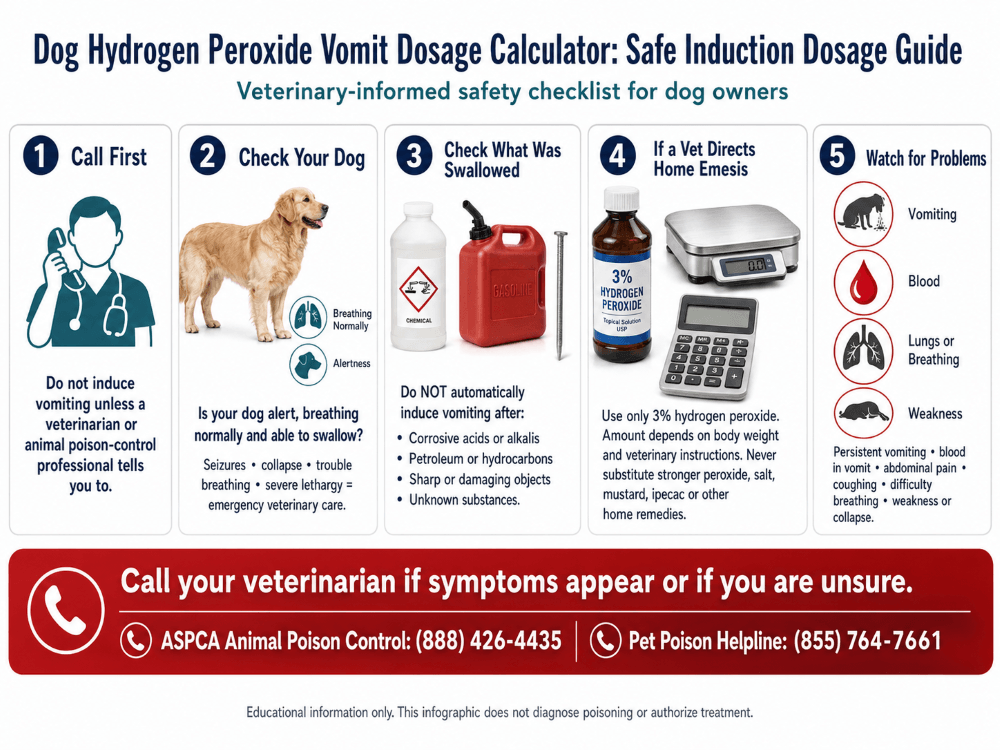
Dog Hydrogen Peroxide for Vomiting Infographic
Frequently Asked Questions
The Bottom Line
A dog hydrogen peroxide vomit dosage calculator can make the weight conversion easier, but it cannot decide whether making your dog vomit is safe. If your dog swallowed something potentially harmful, identify the product, estimate how much was consumed, note when it happened, check your dog for symptoms, and contact a veterinarian or animal poison-control service promptly. When a veterinary professional specifically recommends home emesis, confirm that the product is 3% hydrogen peroxide and follow their instructions. Do not substitute stronger peroxide or another home remedy, and do not automatically give an additional dose if your dog does not vomit.
For substance-specific exposures, related tools such as a dog chocolate toxicity calculator, dog xylitol toxicity calculator, dog ibuprofen toxicity calculator, dog Tylenol toxicity calculator, dog naproxen toxicity calculator, or 50 poisonous dog food guide can help organize the information your veterinarian may need.