
What Dog Is Right for Me? How to Choose A Breed for Your Lifestyle


Canine Bible is reader-supported. We receive affiliate commissions via some of our links. Learn more.
The right dog for you is one whose size, energy level, temperament, grooming needs, and care requirements fit your lifestyle and experience. A good match should suit your home, daily schedule, activity level, budget, and the amount of training and attention you can realistically provide. Breed matters, but age, personality, health, and individual behavior can be just as important. A high-energy working dog may thrive with an active owner but struggle in a low-activity household, while a smaller dog is not automatically easier to care for. Families with children, other pets, allergies, limited space, or long workdays also need to weigh different factors. Even popular breeds can be a poor fit when their exercise, grooming, or behavioral needs are underestimated. Understanding these differences can help you narrow your choices and find a dog that is more likely to fit comfortably into your life for years to come.
The Importance of Choosing the Right Dog
| Key Consideration | Why It Matters |
|---|---|
| Energy match | A compatible activity level makes daily exercise and enrichment easier to maintain. |
| Temperament fit | The dog’s individual personality should suit your household, experience, and expectations. |
| Age choice | Puppies, adults, and seniors require very different levels of training, supervision, and care. |
| Household compatibility | Children, cats, other dogs, housing, and noise tolerance can affect whether a match succeeds. |
| Care demands | Grooming, training, exercise, feeding, and veterinary needs must fit your available time. |
| Long-term cost | Size, health, grooming, boarding, food, and medical care can significantly affect lifetime expenses. |
| Health considerations | Body type, inherited conditions, and existing medical needs can shape everyday management. |
| Long-term compatibility | The best choice should remain practical as your work, housing, family, and lifestyle change. |
How to Choose the Right Dog for Your Lifestyle
Before looking at breeds, puppies, or adoption listings, start with an honest picture of your normal week. Think about an ordinary rainy Tuesday rather than your ideal Saturday. A dog that fits your everyday routine is much more likely to remain manageable when work becomes busy, the weather is bad, or your enthusiasm for three-mile morning walks temporarily drops.
Daily time is one of the biggest considerations. Dogs need opportunities to eliminate, exercise, sniff, interact, train, rest, and receive social attention. Some are satisfied with relatively moderate activity, while others become frustrated without substantial physical exercise and mentally challenging activities.
Your home matters too, but square footage is usually less important than the dog’s behavior and needs. A calm, larger adult dog may adapt to an apartment better than a small but highly vocal, energetic terrier. A large yard is useful, but it does not automatically meet a dog’s need for walks, exploration, training, and interaction.
The following factors provide a practical starting point.
| Factor | Ask Yourself | Why It Matters |
|---|---|---|
| Energy | How active am I on an ordinary weekday? | Exercise mismatches can create frustration for dogs and owners. |
| Time | How long will the dog regularly be alone? | Puppies and socially dependent dogs require substantial daily availability. |
| Size | Can I safely handle the dog’s adult weight? | Size affects transport, control, food costs, and housing. |
| Temperament | Do I want outgoing, reserved, playful, or calm? | Temperament strongly shapes everyday compatibility. |
| Grooming | Will I brush, trim, bathe, or pay groomers? | High-maintenance coats require continuing time and expense. |
| Noise | Can my household tolerate frequent barking? | Vocal dogs can be difficult in close housing. |
| Household | Are there children, cats, dogs, or vulnerable adults? | Every household member affects the suitability of a dog. |
| Budget | Can I manage routine and unexpected expenses? | Food, grooming, training, boarding, and veterinary care accumulate. |
Match the Dog’s Energy Level Before Worrying About Size
Energy level is one of the most important—and frequently underestimated—parts of choosing the right dog. A high-drive dog does not simply need a longer walk. Some dogs were developed to retrieve, hunt, herd, patrol, chase, or work closely with people for extended periods, and they may need structured exercise, training, problem-solving, and outlets for those behaviors.


Consider a person who runs several times a week, hikes on weekends, enjoys training, and wants a dog involved in those activities. An athletic sporting or working-type dog may fit well. The same dog could become extremely demanding in a household hoping for two short neighborhood walks followed by a quiet evening.
The opposite mismatch happens too. Someone may envision taking their dog running but choose an individual that prefers leisurely activity or has a body type poorly suited to prolonged exercise. Choose the dog for the activity level you already maintain—not the one you hope a dog will motivate you to develop.
What Dog Fits Different Activity Levels?
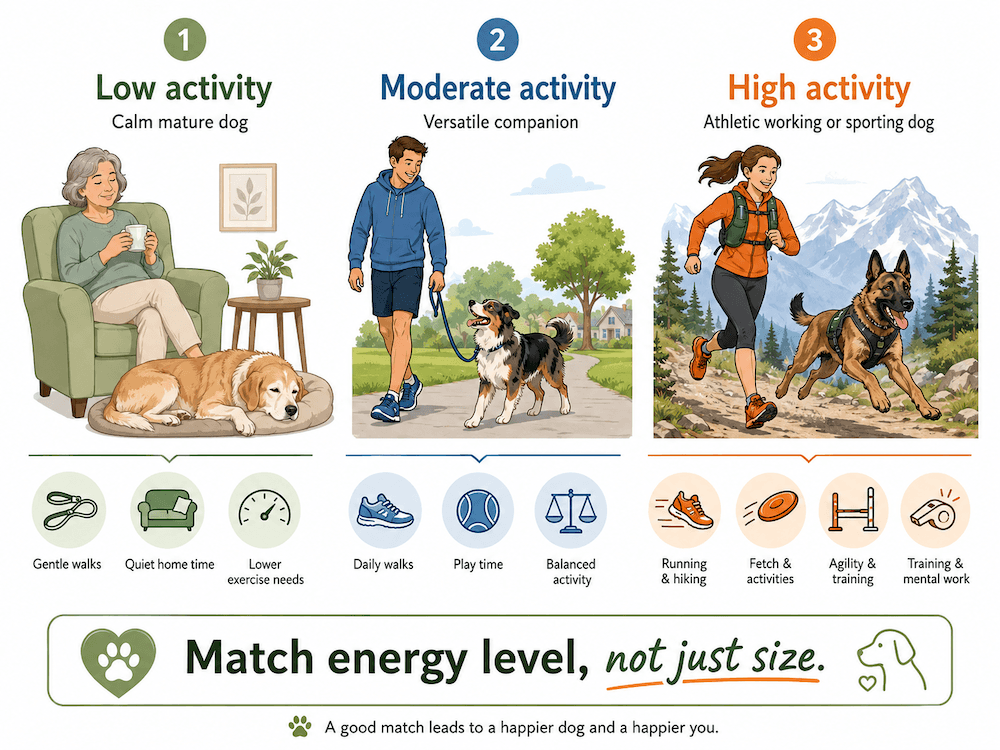
The right dog should fit the amount and type of activity you realistically enjoy. Low-activity dogs may be happiest with gentle walks and plenty of downtime, while moderate-energy dogs usually enjoy daily walks, play, and varied activities. High-energy dogs often need more demanding outlets such as running, hiking, training, fetch, or dog sports. Matching these needs to your routine can make everyday life easier and more enjoyable for both you and your dog.
Temperament and Behavior Matter More Than a Breed Stereotype
Two dogs of the same breed can behave very differently because temperament is shaped by genetics, socialization, learning, health, age, environment, and individual personality. Breed alone cannot reliably predict behavior, so focus on the dog in front of you rather than relying only on breed stereotypes.
Consider traits such as sociability, confidence, trainability, independence, prey drive, vocal behavior, sensitivity to noise, comfort with handling, and ability to relax indoors. Choose behavioral characteristics that match your household and preferences, whether you want an outgoing companion, a calmer dog, or one that is more independent.
This is especially helpful when choosing an adult rescue dog, whose temperament may already be easier to assess. Foster-home observations can reveal how the dog responds to strangers, other pets, handling, exercise, and time alone, making known behavior particularly valuable when judging compatibility.


Puppy, Adult, or Senior: Which Dog Is Right for You?
Age can dramatically change what dog ownership feels like. Many people automatically picture a puppy, but an adult or senior dog may actually fit their lifestyle better.
Puppies are not blank slates. Early experiences matter greatly, but genetics and prenatal and early developmental factors also contribute to future behavior. Even excellent socialization cannot guarantee a particular adult personality.
Young dogs also pass through adolescence, which can involve increased independence, excitement, pulling, chewing, difficulty concentrating, or new reactions to situations. Adolescence can sometimes be more challenging than puppyhood, especially for owners who are not prepared for those behavioral changes.
Grooming, Shedding, Drool, Noise, and Mess Are Part of the Match
Owners frequently underestimate everyday maintenance. Coat care can range from occasional brushing to daily maintenance and professional grooming every few weeks. Low-shedding does not always mean low-maintenance.
Long coats can mat, double coats can shed heavily, and facial folds or heavily coated ears may require extra care. Some dogs also drool substantially, track mud indoors, or leave noticeable hair and mess throughout the home.
Noise tolerance matters just as much. Dogs that frequently bark at people, animals, doors, hallway sounds, or outdoor movement may be difficult in certain households, so consider how much barking your living situation can realistically tolerate.
What About Allergies and “Hypoallergenic” Dogs?
No dog breed can be guaranteed to be allergen-free. People may react to proteins found in dog dander, saliva, and other secretions, so shed hair is not the only source of dog allergens.
A lower-shedding dog may reduce loose hair around the house, but it does not guarantee that someone with allergies will tolerate the dog. Anyone with significant dog allergies should speak with a medical professional and ideally spend meaningful time around the individual dog before bringing it home permanently.
Consider Health & Body Type Before Choosing by Appearance
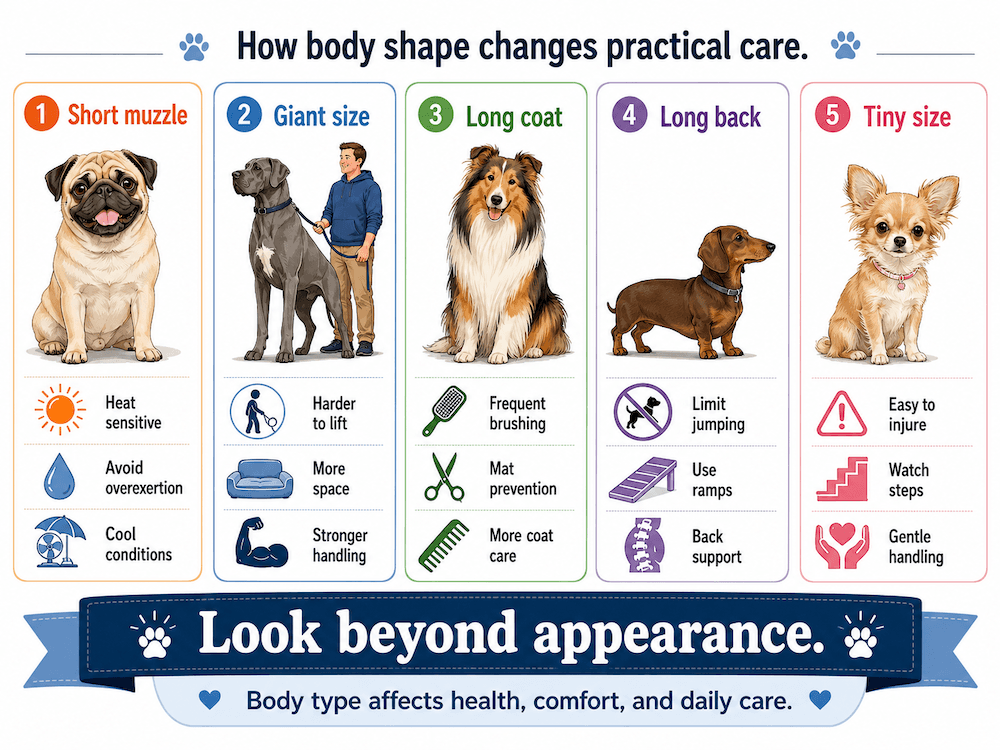
A dog’s body type can affect much more than appearance—it can shape exercise tolerance, handling, grooming, mobility, and injury risk. Short-muzzled dogs may struggle more in heat, giant breeds can be harder to lift and control, and long-coated dogs require regular coat maintenance. Long-backed and very small dogs may also need extra care around jumping, stairs, and rough handling. Choosing a dog means considering these practical needs alongside looks and personality.
Consider the Cost of Dog Ownership Before Choosing a Dog
Dog ownership costs vary widely by size, age, health, location, and lifestyle. A larger dog generally costs more to feed, medicate, board, and equip, while breeds requiring professional grooming or managing inherited health problems can carry higher lifetime expenses. The ranges below are practical U.S. estimates for budgeting rather than guaranteed prices.
| Expense | Typical Cost | What Can Increase the Cost |
|---|---|---|
| Purchase or adoption | Adoption: $50–$500; breeder: $800–$4,000+ | Rare breeds, health testing, pedigree, and breeder reputation. |
| Food | $300–$1,800+ per year | Large size, specialty diets, and higher-calorie needs. |
| Routine veterinary care | $250–$700+ per year | Vaccines, exams, bloodwork, dental care, and regional pricing. |
| Emergency veterinary care | $500–$5,000+ per event | Surgery, hospitalization, imaging, and intensive care. |
| Preventive medications | $150–$600+ per year | Larger dogs often require more expensive weight-based doses. |
| Grooming | $40–$150+ per professional visit | Long, curly, dense, or continuously growing coats. |
| Training | $100–$600 for basics; $500–$2,000+ for extensive help | Private sessions and behavior problems increase costs. |
| Pet insurance | $30–$100+ per month | Age, breed, location, coverage level, and deductible. |
| Boarding or pet sitting | $30–$100+ per day | Large dogs, holidays, medications, and specialized care. |
| Equipment and supplies | $200–$800+ initially | Large crates, beds, harnesses, gates, and travel equipment. |
| Ongoing medications | $10–$300+ per month | Chronic illness and weight-based dosing can raise expenses. |
| Breed-related healthcare | Hundreds to several thousand dollars annually when needed | Inherited orthopedic, airway, skin, heart, or eye conditions. |
Best Dog Breeds for Different Lifestyles and Situations
Breed tendencies can help narrow your choices, but they cannot guarantee how an individual dog will behave. Age, health, breeding, socialization, training, previous experiences, and individual temperament should always be considered before bringing a dog home.
Best Dog Breeds for Apartment Living
Apartment dogs benefit from manageable indoor energy, moderate exercise needs, and an ability to settle around everyday building noise. Size alone is not a reliable predictor of apartment suitability.
| Breed | Why It May Fit | Important Consideration |
|---|---|---|
| Havanese | Small, adaptable, social, and generally manageable with daily walks. | Needs companionship and regular coat care. |
| Whippet | Often quiet and relaxed indoors after appropriate exercise. | Needs secure areas because chasing instincts can be strong. |
| Bichon Frise | Compact, sociable, and adaptable to smaller living spaces. | Professional grooming and companionship are ongoing needs. |
| French Bulldog | Compact with relatively modest exercise requirements. | Breathing problems and heat intolerance require careful consideration. |
| Cavalier King Charles Spaniel | Affectionate, adaptable, and usually comfortable with moderate exercise. | Breed-specific heart and neurological conditions are important concerns. |
Best Dog Breeds for First-Time Owners
First-time owners often do best with dogs that are responsive to positive training, socially adaptable, and manageable in everyday situations. Individual temperament still matters more than simply choosing a breed labeled “easy.”
| Breed | Why It May Fit | Important Consideration |
|---|---|---|
| Labrador Retriever | Trainable, social, and generally eager to work with people. | Young Labs can be powerful, energetic, and highly exuberant. |
| Golden Retriever | Often sociable, responsive, and forgiving of novice handling. | Needs substantial exercise, grooming, and responsible health screening. |
| Poodle | Highly trainable with several sizes suited to different households. | Requires regular mental stimulation and professional coat maintenance. |
| Papillon | Small, intelligent, athletic, and highly responsive to training. | Can be energetic, vocal, and physically delicate. |
| Boston Terrier | Compact, sociable, playful, and adaptable to many homes. | Short-muzzled anatomy can increase breathing and heat-related risks. |
Best Dog Breeds for Active Lifestyles
Active owners who regularly run, hike, train, or participate in dog sports may prefer athletic breeds with substantial physical and mental needs. These dogs generally need more than occasional weekend exercise.
| Breed | Why It May Fit | Important Consideration |
|---|---|---|
| Border Collie | Exceptional stamina, trainability, and enthusiasm for challenging activities. | Needs intensive mental work as well as physical exercise. |
| Australian Shepherd | Athletic and versatile for hiking, training, and dog sports. | Herding drive and high stimulation needs can be demanding. |
| German Shorthaired Pointer | Built for endurance and vigorous outdoor activity. | Usually needs substantial daily exercise and structured outlets. |
| Vizsla | Athletic, trainable, and strongly oriented toward active owners. | Often struggles with insufficient exercise or prolonged isolation. |
| Siberian Husky | High endurance suits experienced owners who enjoy sustained activity. | Escape behavior, prey drive, shedding, and heat require management. |
Best Dog Breeds for Sedentary Lifestyles
A more relaxed lifestyle calls for dogs with relatively modest exercise demands and a good ability to settle indoors. Low-energy does not mean no exercise; every dog still needs appropriate walks, enrichment, social interaction, and weight management.
| Breed | Why It May Fit | Important Consideration |
|---|---|---|
| Greyhound | Many adults are surprisingly calm and relaxed indoors. | Still needs walks and secure opportunities for safe exercise. |
| Shih Tzu | Companion-oriented with relatively modest daily exercise requirements. | Coat, eye, dental, and breathing care may be significant. |
| Pekingese | Typically prefers gentle activity and relaxed indoor companionship. | Heat sensitivity, grooming, and airway health require attention. |
| Bulldog | Usually has lower exercise needs and enjoys relaxed routines. | Significant respiratory, orthopedic, skin, and heat concerns exist. |
| Basset Hound | Generally easygoing and content with moderate daily activity. | Weight control, ears, joints, and scent-driven wandering need management. |
Best Dog Breeds for Families
Family suitability depends on far more than a reputation for being “good with kids.” Look for an individual dog with a stable temperament, appropriate play style, suitable energy, and positive experiences around children.
| Breed | Why It May Fit | Important Consideration |
|---|---|---|
| Boxer | Playful, affectionate, and strongly bonded to family life. | Young Boxers can be exuberant around small children. |
| Newfoundland | Often gentle, patient, and highly people-oriented. | Giant size increases grooming, food, handling, and veterinary costs. |
| Collie | Typically responsive, sensitive, trainable, and family-focused. | May herd, bark, or become overwhelmed by chaotic environments. |
| Beagle | Social, sturdy, playful, and often comfortable with family activity. | Scent drive, vocalizing, and independent behavior require training. |
| Bernese Mountain Dog | Often affectionate, patient, and devoted to household members. | Large size, shedding, heat sensitivity, and health risks matter. |
Best Dog Breeds for Homes With Cats
Breed tendencies can offer clues, but an individual dog’s previous behavior around cats is far more useful than its breed name alone. Gradual introductions, escape routes for the cat, and preventing chasing remain important with every breed.
| Breed | Why It May Fit | Important Consideration |
|---|---|---|
| Cocker Spaniel | Often sociable, gentle, and adaptable in multi-pet households. | Individual prey interest and early experiences still vary. |
| Maltese | Companion-oriented and generally less physically intimidating to cats. | Small size requires protection from rough interactions. |
| Shetland Sheepdog | Trainable and often capable of living peacefully with cats. | Herding behavior may include stalking or chasing movement. |
| Japanese Chin | Small companion breed often suited to calm indoor households. | Compatibility still depends on socialization and individual temperament. |
| Tibetan Spaniel | Compact, adaptable, and often comfortable sharing indoor space. | Some individuals can be territorial or reserved around newcomers. |
Best Dog Breeds for Seniors
For many seniors, manageable size, moderate exercise, companionship, trainability, and ease of physical handling matter more than breed popularity. The owner’s mobility, grooming preferences, housing, and ability to manage future veterinary care should guide the final choice.
| Breed | Why It May Fit | Important Consideration |
|---|---|---|
| Chinese Crested | Small, affectionate, portable, and generally moderate in exercise needs. | Skin, dental, and temperature protection may require extra care. |
| Miniature Schnauzer | Manageable size, intelligent temperament, and strong companionship. | Can be energetic and vocal and needs regular grooming. |
| Chihuahua | Very small and manageable with modest space requirements. | Fragility, dental disease, and reactivity require careful management. |
| Yorkshire Terrier | Portable, affectionate, and adaptable to smaller homes. | Grooming, dental care, barking, and fragility deserve consideration. |
| Lhasa Apso | Small, sturdy, companionable, and comfortable with moderate exercise. | Regular grooming and patient training are usually necessary. |
Purebred, Mixed Breed, or Rescue Dog?
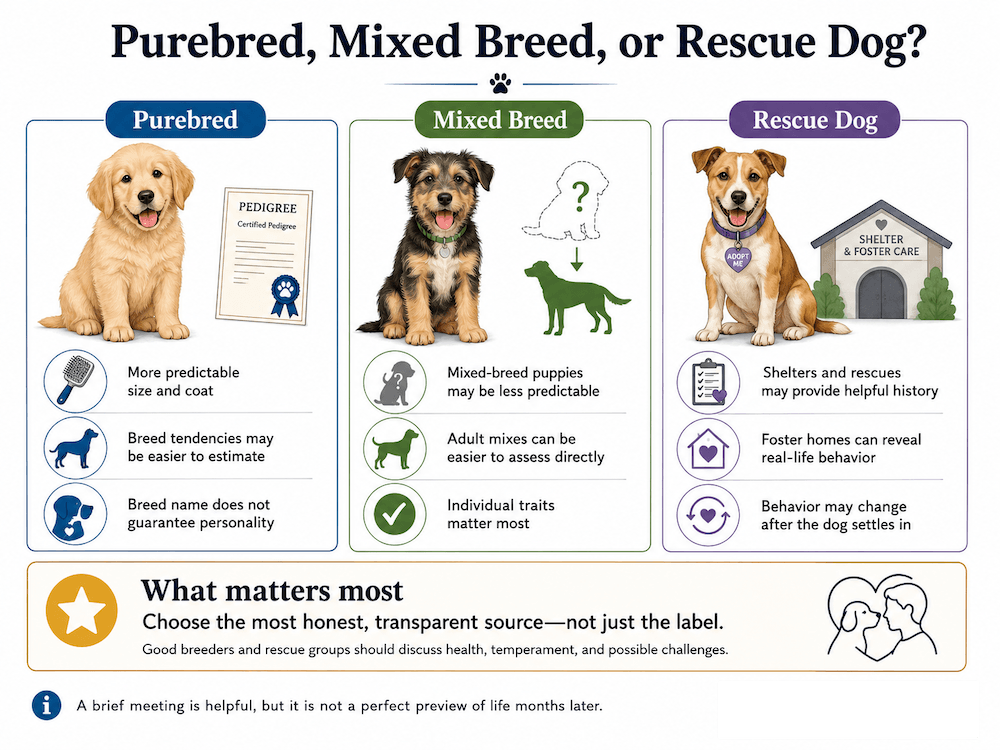
Purebred, mixed-breed, and rescue dogs can all be excellent companions, but each option comes with different levels of predictability and background information. Purebred dogs may offer more predictable physical traits, while adult mixed breeds and fostered rescue dogs can sometimes be easier to assess based on observed behavior. No category guarantees a specific personality, health outcome, or temperament. The most important factor is choosing an individual dog from a transparent source that fits your lifestyle and household.
How to Evaluate a Specific Dog Before Bringing It Home
Once you have narrowed the search, stop asking whether the breed is right and start asking whether this individual dog is right.
Whenever possible, meet an adult dog more than once and involve everyone who will regularly live with or care for it. Avoid judging compatibility from a single brief interaction, since behavior can change as a dog becomes more comfortable. Instead, consider behavioral and health history, foster observations, parent temperament when relevant, and your own observations across multiple interactions.
Think About the Next 10–15 Years, Not Just Today
Dogs can remain part of the family for well over a decade, so think beyond your current lifestyle and consider reasonably foreseeable changes in housing, work, relationships, and daily routines.
A college student expecting several moves may prioritize rental flexibility, while someone planning children should consider how a dog could fit into future family life. Older owners may also want to think about whether they can safely manage the dog long term if their mobility changes.
Travel matters too. Large dogs can be harder and more expensive to transport, while dogs with medical needs or discomfort around unfamiliar people may make boarding and pet-sitting more complicated.
Financial planning should include more than food. Veterinary care, preventive medications, emergency treatment, training, grooming, boarding, insurance, dental care, and medications can all add up, so lifetime costs should be part of the decision.
When to Involve a Vet or Behavior Professional Before Choosing a Dog
Professional input can be especially useful when the decision involves a dog’s existing health condition, a breed with significant inherited health concerns, or a behavioral history that could create safety challenges.
Choosing such a dog is not automatically wrong. The important question is whether your household has the experience, resources, environment, and professional support needed to manage that dog’s particular needs safely.
What Research Says About Choosing the Right Dog
A 2022 study published in Science analyzed owner-reported behavior from 18,385 dogs and genetic data from 2,155 dogs. Breed ancestry was associated with some behavioral tendencies, but breed explained only about 9% of behavioral variation among individual dogs. That finding supports using breed as one piece of the matching process rather than assuming that every member of a breed will have the same personality.[1]
A 2018 PLOS ONE study examining prospective dog adopters found that people enter dog ownership with expectations about both the benefits and challenges of having a dog. Expectation mismatches can affect the ownership experience because the real demands of behavior, responsibility, and lifestyle changes may differ from what an owner imagined beforehand. This reinforces the value of choosing around realistic daily compatibility rather than an idealized image of dog ownership.[2]
A later study of shelter adoptions found that adopters who returned dogs within three months had entered ownership with higher expectations regarding dog behavior, health, and the human-dog bond than adopters who kept their dogs. Behavioral difficulties were common early after adoption, while some problems improved as dogs adjusted, highlighting the importance of realistic expectations and an adjustment period.[3]
For allergy concerns, a study published in the Journal of Allergy and Clinical Immunology compared major dog allergen levels among breeds commonly described as hypoallergenic and other dogs. It found no evidence that certain breeds are truly hypoallergenic, which is why low shedding should not be interpreted as a guarantee that an allergic person will tolerate an individual dog.[4]
Frequently Asked Questions
The Bottom Line
The right dog for you is the one whose energy, temperament, size, age, and care needs fit your everyday lifestyle. Breed can provide useful clues, but it should never replace evaluating the individual dog’s personality, health, behavior, and background. Think realistically about your available time, activity level, housing, budget, grooming tolerance, children, and other pets before making a decision. Puppies can offer a fresh start but require intensive training and supervision, while adult dogs often provide greater predictability. Physical appearance should also come second to practical considerations such as exercise tolerance, handling, grooming, and inherited health risks. Taking time to choose carefully can reduce stress for both you and your dog and improve the chances of a successful long-term match. Ultimately, the best dog is not the most popular breed—it is the dog whose needs you can comfortably and consistently meet throughout its life.
If you are still narrowing down your options, explore our guides to the best dog breeds for apartments, best dogs for first-time owners, and best family dog breeds. Families with younger children may also find our guide to the best dog breeds for kids helpful when comparing temperament, size, energy level, and household compatibility.
Sources
- Ancestry-inclusive dog genomics challenges popular breed stereotypes
- Expectations for dog ownership: Perceived physical, mental and psychosocial health consequences among prospective adopters
- Returning a Shelter Dog: The Role of Owner Expectations and Dog Behavior
- Can f 1 levels in hair and homes of different dog breeds: lack of evidence to describe any dog breed as hypoallergenic