
Dog Breed Quiz Selector: What Dog Should I Get? [Best Breed Finder]


Canine Bible is reader-supported. We receive affiliate commissions via some of our links. Learn more.
The best dog for you is one whose energy level, size, temperament, grooming needs, and care requirements match your lifestyle. A dog breed quiz or selector can narrow the choices by comparing your home, schedule, experience, and activity level with common breed traits. However, breed alone cannot predict every dog’s personality or behavior. Age, health, training history, socialization, and individual temperament matter just as much. A breed that looks perfect online may be unsuitable if it needs more exercise, attention, or grooming than you can provide. Mixed-breed dogs and rescue dogs may also offer excellent matches that a traditional breed quiz could overlook. This guide will help you use the selector wisely, compare realistic options, and choose a dog you can care for confidently for years to come.
Why Choosing the Right Dog Matters
| Why It Matters | Practical Meaning for Dog Owners |
|---|---|
| Improves compatibility | A suitable dog is more likely to fit your household, routine, and long-term abilities. |
| Protects welfare | Matching the dog’s needs helps prevent chronic frustration, stress, and unmet care requirements. |
| Improves safety | Considering strength, instincts, behavior history, and handling needs reduces avoidable household risks. |
| Limits surprises | Reviewing age, health, temperament, and upbringing reveals details a breed quiz cannot predict. |
| Controls costs | Understanding grooming, veterinary, training, feeding, and backup-care needs supports realistic budgeting. |
| Supports stability | A carefully verified match is less likely to result in conflict, surrender, or repeated rehoming. |
| Builds confidence | Clear evidence about the individual dog helps owners make decisions without relying on appearance alone. |
What Dog Should I Get After Using a Dog Breed Quiz Selector?
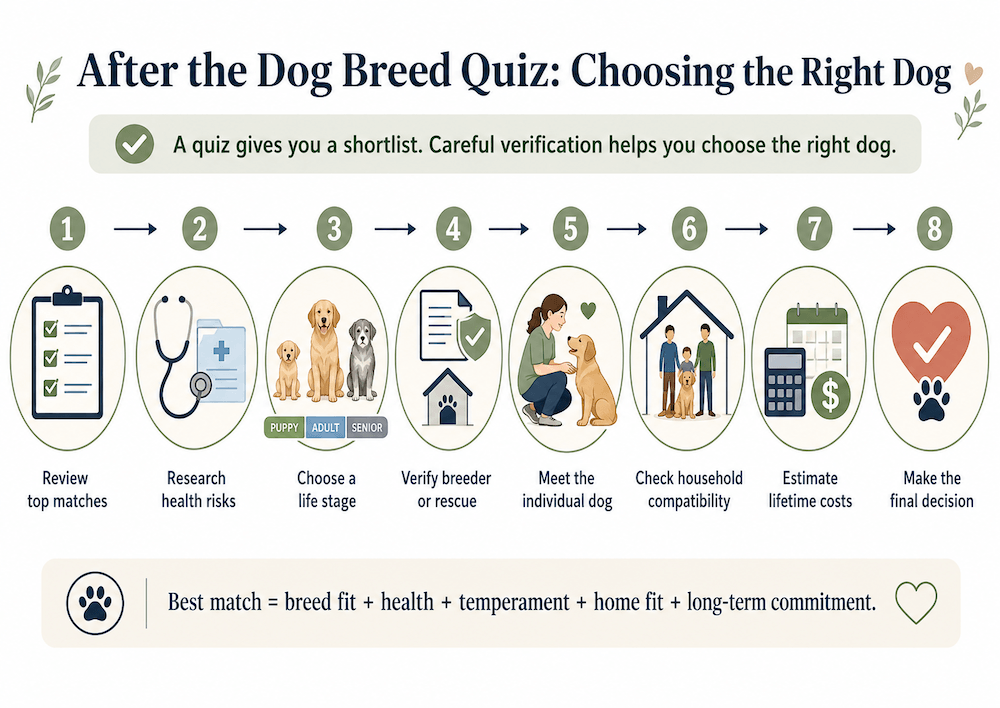
Our dog breed quiz selector gives you a shortlist to investigate, not a dog to choose automatically. Once you receive your matches, the next step is to verify each option against factors the quiz cannot fully measure, including the individual dog’s health, age, behavior history, physical structure, early experiences, and source.
The best final choice may be your first-ranked breed, a lower-ranked breed, a mixed-breed dog with similar characteristics, or an adult dog whose known temperament fits your household better than an unpredictable puppy. The goal is not to prove that a quiz result is correct. It is to determine whether a real dog can live safely and comfortably in your home for the rest of its life.
What Your Dog Breed Quiz Results Cannot Tell You
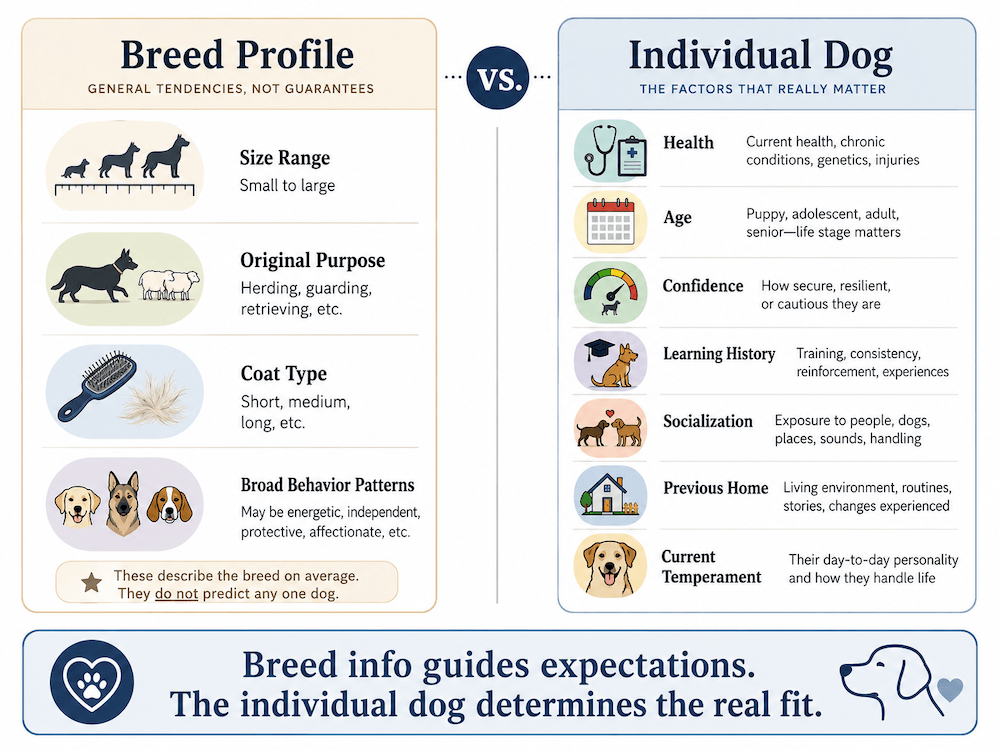
A breed selector works with broad patterns. It can compare typical characteristics, but it cannot see the exact dog you may eventually bring home. Two dogs of the same breed, age, and sex may differ noticeably in confidence, sociability, frustration tolerance, sensitivity, trainability, and reactions to unfamiliar people or animals.
The quiz also cannot know how responsibly a puppy was bred or raised. Early handling, maternal health, social experiences, housing conditions, nutrition, medical care, and exposure to normal household life can all influence development. A puppy from a poorly managed environment may present very different challenges from one raised carefully, even when both have the same pedigree.


Adult dogs add another layer of information because more of their size, personality, and behavior can be observed. Their conduct may still change after adoption as they settle into a new environment, but a detailed foster history can often provide useful evidence about daily life that no breed profile can supply.
A Match Is a Hypothesis, Not a Verdict
Treat each suggested breed as a hypothesis: “This type of dog may suit me, so what evidence would confirm or disprove that?” This mindset helps prevent emotional attachment to a result before you understand its limitations.
A match should be reconsidered when the available dogs have serious health concerns, incompatible behavior histories, extreme physical features, or needs that were not apparent from the general breed description. It is better to reject a theoretically good match than to force the wrong individual dog into your household.
Turn Your Quiz Results Into a Practical Shortlist
Start with several promising results rather than focusing exclusively on the first one. Compare those breeds using information that was not captured by the quiz, particularly health burden, responsible availability, individual-dog evidence, and the practical consequences of ownership.
A useful shortlist normally contains only breeds or dogs that pass every non-negotiable requirement. Preferences can be flexible, but safety, housing permission, medical affordability, and physical handling ability should not be treated as minor compromises.


| Reality Check | What to Verify | Reason to Pause |
|---|---|---|
| Permission | Confirm housing, insurance, and local ownership rules in writing. | Approval depends on assumptions, exceptions, or verbal promises. |
| Health burden | Research inherited disease, lifespan, breathing, mobility, and skin risks. | Likely care exceeds your medical or financial capacity. |
| Physical handling | Consider restraint, transport, bathing, lifting, and emergency movement. | You could not safely control or move the adult dog. |
| Life stage | Compare puppy, adolescent, adult, and senior ownership demands. | The available age requires more supervision than you can provide. |
| Source quality | Verify records, history, transparency, support, and return policies. | The seller or organization hides information or pressures you. |
| Individual behavior | Ask about handling, visitors, animals, food, toys, and time alone. | Known behavior conflicts with your household’s safety needs. |
| Backup care | Identify help for illness, travel, hospitalization, or schedule disruption. | One unavailable person would leave the dog without care. |
| Long-term support | Confirm access to veterinary care, training, grooming, and transport. | Essential services are unavailable, unaffordable, or impractical. |
Do not remove a concern from your shortlist simply because you love the dog’s appearance or have already paid a deposit. Deposits, travel arrangements, family excitement, and emotional attachment can make owners feel committed before the decision is complete. A responsible source should allow enough time for questions and should care whether the placement is appropriate.
Choose the Right Life Stage Before Choosing the Dog
A suitable breed at the wrong life stage can still create a difficult match. Puppies, adolescents, adults, and seniors require different levels of supervision, predictability, training, and medical support.
| Life Stage | What You Can Evaluate | What Remains Uncertain | Best Suited to Owners Who |
|---|---|---|---|
| Puppy | Current health, confidence, recovery, and early rearing conditions. | Adult size, temperament, medical outcomes, and mature behavior. | Can provide intensive supervision and patient developmental training. |
| Adolescent | Emerging drives, physical ability, sociability, and learning style. | Behavior may continue changing through social maturity. | Can manage energy, impulsiveness, and inconsistent responses. |
| Adult | Established size, handling needs, activity patterns, and temperament. | Behavior may shift after decompression in a new home. | Prefer more behavioral information before making a commitment. |
| Senior | Current personality, mobility, habits, and companionship style. | Future medical and accessibility needs may change quickly. | Can support veterinary care and a gentler daily routine. |
Where to Buy or Adopt a Dog Responsibly
Use established adoption directories, rescue networks, and breeder-referral services as starting points, but independently verify health records, behavior history, living conditions, contracts, and return policies before committing.
| Website | Best For | What to Verify |
|---|---|---|
| Petfinder | Searching dogs from participating shelters and rescue organizations. | Confirm details directly with the organization holding the dog. |
| Adopt a Pet | Browsing adoptable dogs from shelters and rescues by location. | Review medical history, behavior observations, and adoption terms. |
| ASPCA Shelter Search | Finding dogs listed by shelters and rescues across the country. | Contact the listed organization about availability and assessment history. |
| Best Friends Network | Locating animal shelters and rescue partners in your area. | Check each organization’s process, records, contract, and support. |
| AKC Rescue Network | Finding breed-specific rescue groups and available purebred dogs. | Ask how the individual dog was evaluated in real situations. |
| AKC Breeder Referral | Contacting breed-club referral representatives when buying a puppy. | Verify health testing, parent dogs, upbringing, and return policies. |
| AKC Marketplace | Browsing puppies produced by breeders of AKC-registered parents. | Registration alone does not replace independent breeder evaluation. |
How to Evaluate an Individual Rescue Dog
A rescue listing often summarizes a dog in a few positive sentences, but your decision needs more detailed information. Ask what has been directly observed, what was reported by a previous owner, and what remains unknown. “Has not shown a problem” is different from “has been safely tested in that situation over time.”
A dog living in a foster home may have an observable routine involving sleep, house training, visitors, walks, handling, meals, and periods alone. That information can be especially useful when your household has children, cats, other dogs, or limited management options.
Shelter behavior can still provide valuable clues, but kennels are unusual and sometimes stressful environments. A dog that appears withdrawn may become more active after adoption, while a restless dog may settle substantially in a quiet home. Neither change necessarily means the shelter assessment was dishonest.
Questions That Produce Useful Answers
Do not ask only whether a dog is “good with” children, cats, or other dogs; ask about the setting, duration, supervision, distance, and body language observed. When possible, arrange more than one calm meeting with the household members who will live with the dog, as a quiet walk or controlled interaction may reveal more than an excited greeting in a small room.
How to Evaluate a Breeder and Puppy
A responsible breeder does more than produce registered puppies. Registration verifies ancestry within a registry; it does not by itself confirm health, comfortable physical structure, stable temperament, appropriate socialization, or ethical breeding practices.
| Source Check | Reassuring Evidence | Warning Sign |
|---|---|---|
| Health records | Complete records and independently verifiable screening results. | Vague claims, screenshots only, or unverifiable certificates. |
| Behavior history | Specific observations, limitations, triggers, and management details. | Only flattering labels or refusal to discuss concerns. |
| Living conditions | Clean, appropriate housing with normal care and enrichment. | Secretive handoffs or no credible information about upbringing. |
| Matching process | The source asks detailed questions and may decline unsuitable homes. | Immediate availability to anyone who can pay. |
| Contract | Clear medical disclosures, responsibilities, and return provisions. | Missing paperwork or pressure to sign without review. |
| Ongoing support | Questions are welcomed before and after placement. | Communication stops once payment or adoption is completed. |
| Return policy | The dog can be returned if the placement fails. | You are told to resell, surrender, or abandon responsibility. |
A breeder or rescue asking you many questions is generally a positive sign. Responsible placement involves evaluating both sides of the match. Someone who agrees instantly with everything you say may be more interested in completing the transaction than protecting the dog.
Put Health and Physical Function Ahead of Appearance
A dog should be able to breathe comfortably, move freely, regulate body temperature, and participate in normal daily activities without its body shape creating avoidable limitations. Features that look distinctive or fashionable may also increase the likelihood of chronic medical care.
Watch the dog at rest and during gentle movement. Persistent noisy breathing, exaggerated effort, fainting, blue or grey gums, obvious lameness, repeated skin irritation, inability to close the eyes normally, or severe exercise intolerance should not be dismissed as normal breed traits.
Extreme size can also affect welfare and ownership. Very small dogs may be vulnerable to accidental injury, dental crowding, temperature changes, and handling problems, while giant dogs may require specialized transport, stronger equipment, supportive flooring, and extra help during mobility emergencies.
What Health Screening Can and Cannot Prove
Health screening can reduce uncertainty but cannot guarantee lifelong health. A normal result applies only to the condition and time tested, so owners should also consider breed-related risks, family history, physical structure, temperament, and a veterinary examination.
Ask which diseases are common, which tests are available, what the results mean, and whether relatives have developed conditions that cannot yet be predicted reliably. Mixed-breed dogs still need health assessment, as they can inherit genetic, orthopedic, cardiac, eye, skin, or structural problems from any part of their ancestry.
Assess Temperament Without Provoking the Dog
Observe the dog calmly and respectfully, focusing on natural behavior, recovery from mild stress, discomfort signals, and tolerance of routine handling.
Compatibility With Children & Other Animals Needs Direct Evidence
A breed selector can consider children or other pets, but individual history provides the strongest evidence of compatibility. For children, ask how the dog responds to noise, fast movement, food, toys, accidental contact, resting interruptions, and crowded spaces. Experience with calm teenagers does not automatically mean the dog is safe with toddlers.
For cats, clarify whether the dog has lived freely with them, met one briefly, or only ignored a distant cat outdoors. Chasing, stalking, fixation, whining, lunging, or an inability to disengage may indicate risk. Dog-to-dog compatibility is also individual, as a dog may enjoy selected companions but dislike unfamiliar dogs, shared resources, or crowded parks.
Safe introductions require controlled distance, close supervision, escape options, and reliable separation. A household should not adopt a dog when success depends on perfect behavior from children, cats, resident dogs, or inexperienced caregivers.
Calculate the Cost of the Real Dog, Not the Purchase Price
The purchase or adoption fee is only a small part of lifetime dog ownership. Regular expenses may include food, preventive care, veterinary visits, training, dental care, equipment, identification, grooming, and replacement supplies.
Dog costs can rise with the dog’s size, coat, health, behavior, exercise needs, and care arrangements. Pet insurance may help with some unexpected bills, but owners should review exclusions, deductibles, reimbursement limits, waiting periods, and pre-existing-condition rules carefully.
| Cost Category | Possible Expenses | What May Increase the Cost |
|---|---|---|
| Food | Complete dog food, treats, and approved supplements. | Large size, prescription diets, or food sensitivities. |
| Routine veterinary care | Examinations, vaccinations, screening, and preventive tests. | Age, chronic disease risk, and local clinic fees. |
| Preventive medication | Parasite prevention and other prescribed routine medication. | Body weight, regional risks, and product choice. |
| Dental care | Home-care products, examinations, and professional cleanings. | Crowding, dental disease, age, and extractions. |
| Equipment | Bed, crate, bowls, leash, harness, collar, and toys. | Large sizing, durability needs, and frequent replacement. |
| Training | Classes, private sessions, behavior support, and training tools. | Fear, reactivity, aggression, or advanced working needs. |
| Grooming | Bathing, brushing, trimming, nail care, and professional grooming. | Long coats, matting, skin disease, or handling sensitivity. |
| Daily care | Dog walking, daycare, pet sitting, and boarding. | Long workdays, travel, separation distress, or high energy. |
| Home and transport | Fencing, gates, flooring, ramps, restraints, and vehicle space. | Escape risk, mobility limits, strength, or giant size. |
| Insurance | Monthly premiums, deductibles, and uncovered expenses. | Breed, age, coverage level, and medical history. |
| Unexpected care | Emergency treatment, surgery, specialists, medication, and rehabilitation. | Injury, poisoning, chronic illness, or inherited conditions. |
| Identification and fees | Microchipping, registration, licensing, and required permits. | Local regulations and renewal requirements. |
Common Reasons to Pause Before Choosing a Dog
Compassion is important, but it does not create the skills, environment, or resources required for every dog. Declining an unsuitable placement can prevent a later crisis and allow the dog to reach a home better equipped for its needs.
When to Ask a Veterinarian or Behavior Professional Before Choosing a Dog
A professional consultation can help interpret medical records, screening results, structural concerns, and behavior history before adoption or purchase. This is especially useful when a dog has known health problems, extreme physical features, aggression, severe fear, guarding, or complex care needs.
Ask a veterinarian about inherited risks, expected medical costs, mobility, lifespan, temperature tolerance, and incomplete health records. Seek qualified behavior support when the history includes biting, snapping, severe reactivity, predatory behavior, panic, resource guarding, or unsafe handling.
Arrange an independent veterinary examination when possible, but remember that no professional can guarantee future health or behavior. The goal is to clarify likely risks, treatment needs, management demands, and uncertainty; a dog showing breathing difficulty, collapse, severe pain, seizures, repeated vomiting, uncontrolled bleeding, or major trauma needs prompt veterinary care rather than continued adoption evaluation.
Frequently Asked Questions
The Bottom Line
The best dog for you is one whose energy level, size, temperament, grooming needs, and care requirements fit your everyday life. A dog breed quiz selector can help narrow your options, but it cannot guarantee how an individual dog will behave. Age, health, training history, socialization, and previous experiences should also influence your decision. Consider your normal schedule, housing, budget, physical ability, children, and other pets before committing. Meeting the dog, reviewing medical information, and asking detailed questions can reveal whether the match works in real life. Choosing carefully may take longer, but it reduces the risk of frustration, unsafe situations, or rehoming. The right match should allow both you and your dog to live comfortably and thrive together.
Continue your research with our guides on how to adopt a dog, where to find dogs and puppies for sale, and how much dog ownership costs. You can also explore the best dogs for first-time owners, best family dog breeds, and best dog breeds for apartments before making your final decision.