What Dog Has the Strongest Bite? 30 Breeds With the Strongest Bite Force

Canine Bible is reader-supported. We receive affiliate commissions via some of our links. Learn more.
The Kangal is widely cited as the dog breed with the strongest bite, with commonly reported estimates reaching about 700 PSI or more. However, there is no universally accepted scientific ranking because bite-force results vary by testing method, individual dog, size, and motivation. Other powerful breeds, including mastiffs, Rottweilers, and large guardian dogs, may also produce exceptionally strong bites. Bite strength alone does not determine whether a dog is dangerous, aggressive, or suitable as a family pet. Training, socialization, temperament, health, and responsible ownership usually matter far more than jaw power. This article compares the breeds most often associated with powerful bites, explains why PSI claims can be misleading, and explores what bite force really means in everyday situations.
What to Know About the Strongest Dog Bite
| Key Concept | What Dog Owners Should Know |
|---|---|
| Kangal ranking | The Kangal is most often named as the strongest-biting dog breed. |
| PSI uncertainty | Popular PSI figures are estimates rather than universally verified breed records. |
| Physical factors | Body size, skull shape, jaw muscles, and tooth position affect force. |
| Individual variation | Age, health, conditioning, motivation, and testing method change results. |
| Aggression risk | A powerful bite does not automatically make a dog aggressive or unsafe. |
| Owner responsibility | Training, socialization, secure handling, and supervision matter more than rankings. |
| Home suitability | Powerful breeds require realistic planning for space, control, visitors, and daily care. |
What Dog Has the Strongest Bite?
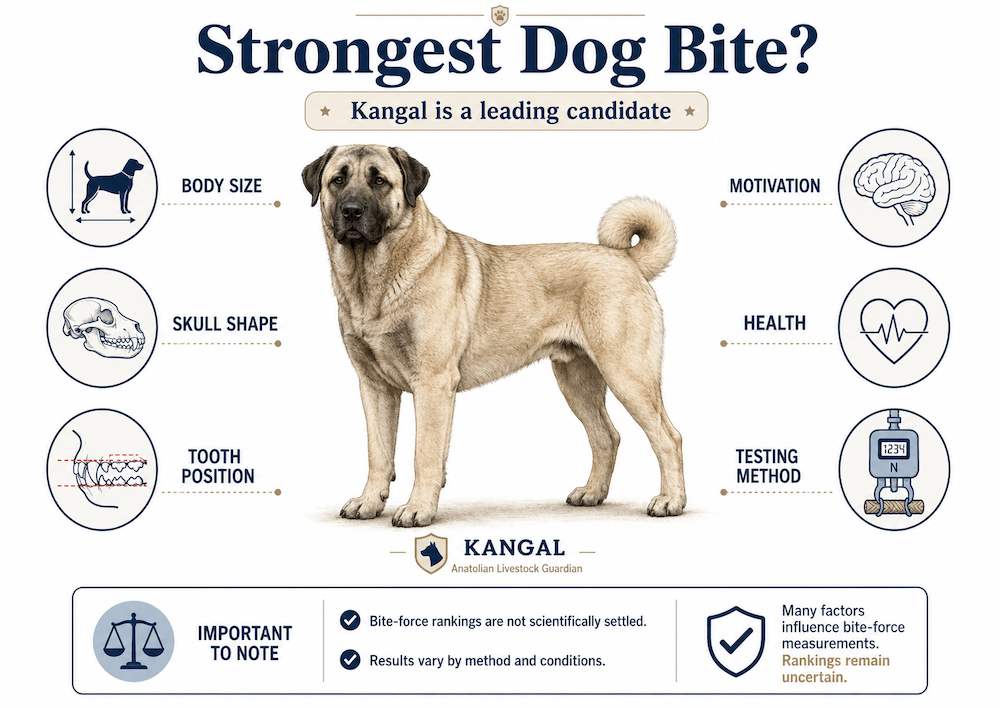
The Kangal is most often named as the dog breed with the strongest bite. However, the frequently repeated figure of about 743 pounds per square inch is not a universally verified scientific record, and no standardized study has tested every breed under identical conditions.
The most accurate answer is therefore that the Kangal is a leading candidate rather than an undisputed laboratory-confirmed champion. Large mastiffs, livestock guardians, Rottweilers, Cane Corsos, and other heavily built working dogs can also generate tremendous force. More importantly, bite strength does not tell owners whether a dog is aggressive, safe, trainable, or suitable for a particular home.
Why the Kangal Is Usually Named First
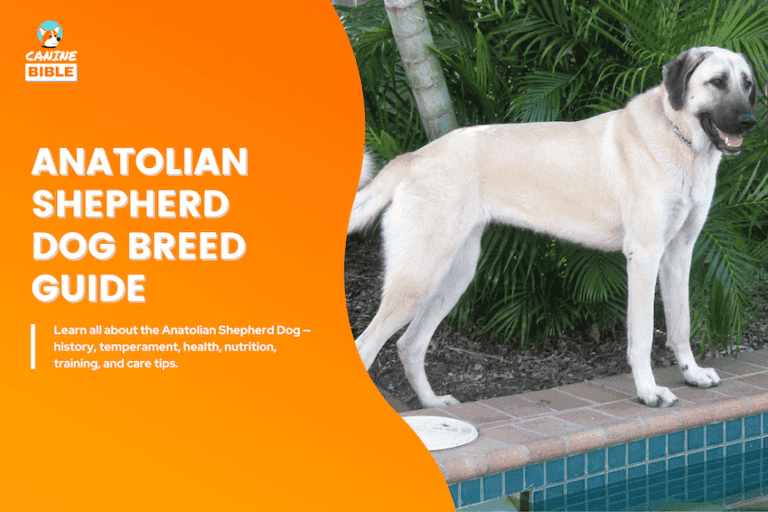
The Kangal is a large Turkish livestock guardian developed to watch over sheep and goats in open country. It has a broad head, a deep muzzle, substantial jaw muscles, a powerful neck, and the body strength needed to confront threats. These physical characteristics make it reasonable to place the Kangal among the most powerful biting domestic dogs.
The breed’s traditional work also contributes to its reputation. Livestock guardians were expected to deter predators independently, sometimes without immediate human direction. A capable guardian needed physical strength, courage, endurance, awareness, and the ability to defend the flock when intimidation failed.


That does not prove that every Kangal produces more force than every mastiff, Boerboel, Cane Corso, or other large guardian. Individual size, conditioning, age, oral health, excitement, and willingness to bite a measuring device can create large differences between two dogs of the same breed.
Is the Kangal’s 743-PSI Bite Force Accurate?
The figure of 743 PSI appears repeatedly in online breed rankings, but it should be treated as an estimate rather than a settled scientific record. A reliable record would require multiple representative dogs from each breed to be tested using the same calibrated equipment, tooth position, mouth opening, instructions, and statistical method.
That type of comprehensive breed competition has not been established. Some figures may come from demonstrations, mathematical estimates, conversions from force measurements, or values repeated from one article to another without an identifiable original test.
Breed terminology adds another complication. The Kangal is recognized as a distinct Turkish livestock guardian in some classification systems, while other systems use the broader Anatolian Shepherd name. Online rankings may therefore compare overlapping populations as though they were completely separate breeds.
What Dog’s Bite Force Really Measures
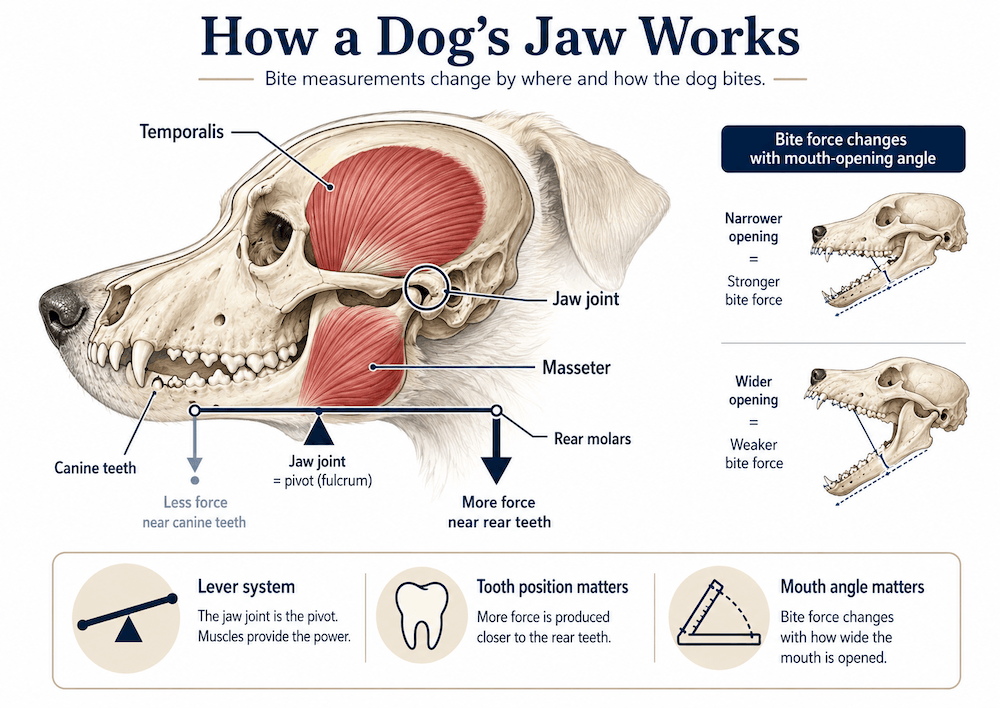
A dog’s bite is produced when the jaw-closing muscles pull the lower jaw upward and transfer force through the teeth. The temporalis, masseter, and pterygoid muscles all contribute, while the temporomandibular joint acts as the jaw’s pivot point.
Bite force is commonly expressed in Newtons, a unit measuring force. PSI means pounds per square inch and describes pressure over a particular surface area. The terms are often treated as interchangeable in popular rankings, even though force and pressure are not the same measurement.
Tooth contact area matters when discussing pressure. A narrow canine tooth concentrates force into a small point, helping it puncture. A molar or carnassial bite uses a different location and mechanical advantage, often allowing a higher total force nearer the back of the jaw.
Why Tooth Position Changes the Result
A dog does not produce the same bite force at every tooth. The rear teeth sit closer to the jaw joint and usually have greater mechanical leverage. A reading taken at the molars therefore cannot be fairly compared with another dog tested at the canine teeth.
Mouth opening also matters. Jaw muscles work differently when the mouth is barely open than when the dog is biting a thick object. Tests using bite sleeves, rigid transducers, food, toys, or anesthetized muscle stimulation may produce very different results.
What Determines How Hard a Dog Can Bite?
Body and skull size are major influences, but they are not the only ones. A larger head can provide more room for jaw-closing muscles, while a shorter or broader jaw may create different leverage than a long, narrow muzzle. This helps explain why many large guardian and mastiff-type dogs are associated with powerful bites.
The dog must also choose to apply force. A relaxed dog chewing a sensor may produce a fraction of its physical capacity, while a highly aroused or determined dog may bite much harder. Training, confidence, fear, play, prey behavior, defensive behavior, and the object being bitten can all influence effort.
Health changes the result as well. Dental pain, broken teeth, jaw injuries, temporomandibular joint disease, nerve problems, and loss of chewing muscle can reduce bite strength. Age and physical condition may also affect how forcefully an individual dog closes its jaw.
The Main Bite-Force Variables
20 Dog Breeds With Strongest Bite Force
Several breeds have the size, head structure, muscle, and working background associated with substantial bite capacity. However, it is more accurate to describe them as a group of powerful dogs than to assign them a precise numbered order.
PSI values below are commonly circulated estimates rather than verified breed records. Bite force changes with skull structure, tooth position, mouth opening, health, motivation, and testing method; published online claims can also conflict substantially.
| Breed | Commonly Cited PSI* | Physical Build | Original Role | Independence | Owner Consideration |
|---|---|---|---|---|---|
| Kangal | 700–750 PSI | Giant guardian | Livestock protection | High | Secure containment and experienced handling. |
| Boerboel | 450–600 PSI | Heavy mastiff | Farm and estate guarding | High | Early training and firm physical control. |
| Cane Corso | 300–700 PSI | Large, muscular mastiff | Property and farm guarding | High | Structured socialization and visitor control. |
| English Mastiff | 550–560 PSI | Giant, heavy mastiff | Estate and property guarding | Moderate | Reliable leash and doorway control. |
| Rottweiler | 328 PSI | Powerful working build | Driving, guarding, and protection | Moderate | Calm training and impulse control. |
| Dogo Argentino | 500–600 PSI | Large and athletic | Large-game hunting | Moderate | Supervised prey drive and dog interactions. |
| Caucasian Shepherd | 500–700 PSI | Giant guardian | Livestock and territory protection | High | Strong fencing and visitor management. |
| German Shepherd | 238–290 PSI | Large and athletic | Herding, police, and service work | Moderate | Daily training and mental outlets. |
| Presa Canario | 500–540 PSI | Heavy, muscular guardian | Farm guarding and livestock control | High | Secure handling and early socialization. |
| American Bulldog | 300–305 PSI | Muscular working build | Farm work and livestock catching | Moderate | Impulse control and supervised interactions. |
| Bullmastiff | 500–550 PSI | Large, heavy mastiff | Estate guarding and restraint | Moderate | Reliable leash and household manners. |
| Dogue de Bordeaux | 550–560 PSI | Heavy head and short muzzle | Guarding, hauling, and estate work | Moderate | Calm training from puppyhood. |
| Tibetan Mastiff | 500–550 PSI | Large guardian build | Livestock and property protection | High | Best suited to experienced owners. |
| Central Asian Shepherd | 500–650 PSI | Massive guardian build | Flock and territory protection | High | Secure fencing and controlled introductions. |
| Akita | 350–400 PSI | Powerful, compact guardian | Hunting and household guarding | High | Careful supervision around other dogs. |
| Belgian Malinois | 195–250 PSI | Lean, highly athletic | Herding, police, and military work | Moderate | Skilled training and daily work. |
| Tosa Inu | 500–556 PSI | Large, muscular mastiff | Guarding and traditional dog sport | High | Experienced handling and controlled socialization. |
| Doberman Pinscher | 228–245 PSI | Lean, powerful working build | Personal and property protection | Moderate | Consistent training and mental stimulation. |
| Great Dane | 230–238 PSI | Giant, athletic build | Large-game hunting and guarding | Moderate | Early leash and household manners. |
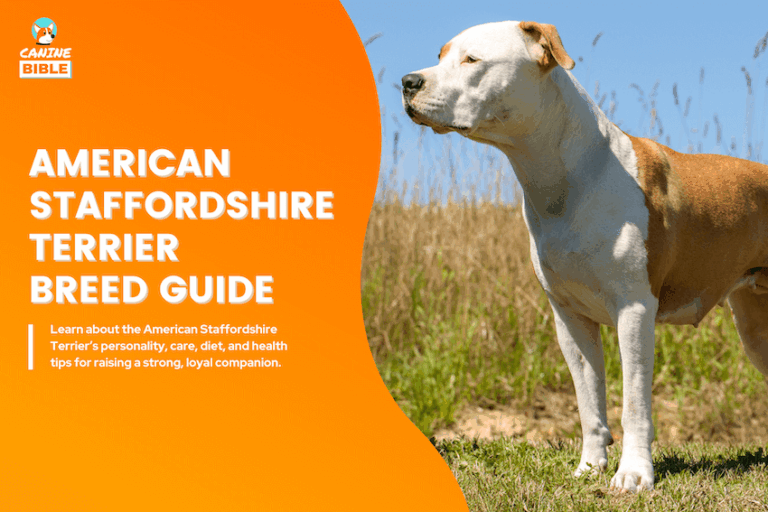
| American Pit Bull Terrier | 225–235 PSI | Medium, muscular build | Farm work and companion roles | Moderate | Socialization and supervised dog interactions. |
Does the Strongest Bite Mean the Most Dangerous Dog?
A strong bite describes capacity, not intent. It tells us something about what a dog may be physically capable of doing, but it does not tell us whether that dog is likely to bite. A dog can have powerful jaws and remain calm throughout its life, while a much smaller dog may bite frequently because it is fearful, painful, poorly handled, or repeatedly placed in stressful situations.
Risk depends on the entire situation. Temperament, breeding, early experiences, socialization, pain, training, supervision, containment, previous behavior, and owner decisions all matter. The presence of vulnerable people or animals also changes the potential consequences.
A large dog may cause greater injury simply because it has more size and strength. That makes responsible control particularly important, but it does not justify assuming that every individual of a powerful breed is aggressive.
Myths and Facts About Strong Dog Bites
Bite-force discussions frequently mix anatomy, breed reputation, online estimates, and claims of aggression. Separating these ideas helps owners make safer decisions.
| Claim | Fact | Practical Meaning |
|---|---|---|
| “743 PSI is proven.” | The popular Kangal figure lacks a universal breed-wide test. | Treat exact online rankings cautiously. |
| “Strongest means most aggressive.” | Physical capacity and willingness to bite are different traits. | Evaluate behavior, history, context, and management. |
| “Some dogs lock their jaws.” | Domestic dogs do not have a special jaw-locking mechanism. | A sustained grip is behavior, not anatomical locking. |
| “Small bites are harmless.” | Small teeth can puncture skin and introduce infection. | Judge the wound, not only the dog’s size. |
| “Breed predicts every bite.” | Individuals and circumstances vary substantially within breeds. | Prevention requires supervision and responsible ownership. |
What to Consider Before Choosing a Powerful Dog Breed
The question should not be whether a dog has the strongest bite. A better question is whether the owner can meet the breed’s behavioral, physical, and management needs for the dog’s entire life.
| Consideration | What Owners Should Assess | Warning Sign |
|---|---|---|
| Independence | Ability to manage guarding instincts and independent decisions. | Expecting obedience to erase inherited behavior. |
| Physical control | Safe handling at doors, gates, walks, and introductions. | The dog can overpower its usual handler. |
| Secure property | Strong fencing, locked gates, and safe separation areas. | Weak barriers or frequent uncontrolled access. |
| Daily routine | Structured exercise, mental work, and supervised social exposure. | Relying on yard access for all activity. |
| Visitor management | A clear plan for guests, workers, deliveries, and children. | No secure area during busy household activity. |
| Support services | Access to trainers, veterinarians, boarding, and capable sitters. | Few professionals willing to handle the dog. |
| Housing and rules | Insurance, rental policies, and local dog regulations. | Restrictions discovered after the dog matures. |
| Breeder or rescue | Temperament, health, history, working traits, and home suitability. | Marketing based on aggression or extreme bite claims. |
How Dog Owners Can Reduce Bite Risk
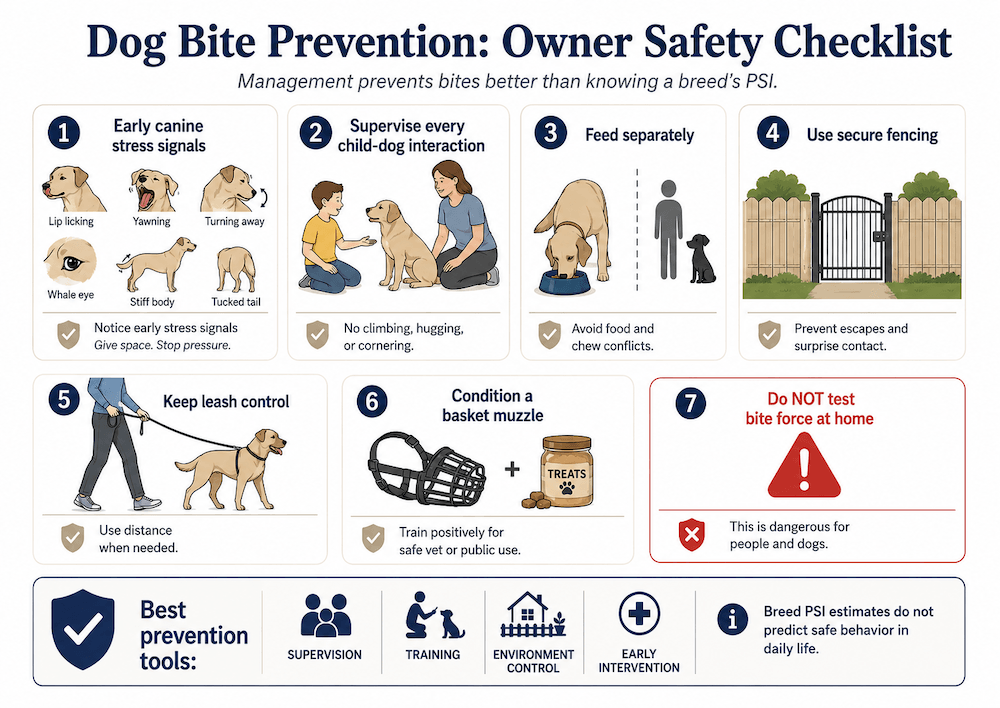
Most owners never need to know their dog’s maximum bite force. They do need to know how to recognize discomfort, prevent avoidable conflict, and maintain physical control when their dog is frightened or excited.
A growl should be treated as information rather than disobedience. Punishing the growl may stop the warning without resolving the fear, pain, or discomfort underneath it. Creating distance and identifying the trigger is usually safer than forcing the interaction.
Do Not Test Your Dog’s Bite Force at Home
You should not offer homemade bite devices, hanging scales, hard metal objects, or improvised pressure sensors. These tests can damage teeth, provoke arousal, create guarding behavior, or cause the dog to redirect a bite toward a person.
Protection-sport bite work also should not be copied from online videos. Properly conducted sport training requires controlled dogs, specialized decoys, suitable equipment, clear release behavior, and experienced supervision. Encouraging an untrained household dog to attack sleeves, strangers, or moving targets can create serious safety and legal consequences.
When Bite Risk or a Bite Needs Professional Attention
Sudden irritability or aggression can be associated with pain, illness, fear, sensory decline, or neurological change. A dog that unexpectedly resists touch, avoids chewing, drops food, cries when opening its mouth, or reacts when its face is handled should receive a veterinary examination.
Behavior support may also be appropriate when a dog repeatedly freezes, lunges, guards objects, snaps, bites, or becomes difficult to control around predictable triggers. Management should begin immediately rather than waiting for another incident.
You should not place your hands between fighting dogs or grab collars near actively biting mouths. Use distance, barriers, and emergency assistance whenever possible rather than risking an additional victim.
What Veterinary Research Says About Dog Bite Force
A review published in Frontiers in Veterinary Science found that canine bite measurements vary substantially with the testing method, the dog’s willingness to bite, body and skull size, tooth position, mouth opening, and oral health. The review also explains that measurements from awake dogs, anesthetized muscle stimulation, dry skull calculations, and computer models should not be treated as directly interchangeable. This supports using caution with precise breed-by-breed PSI rankings.[1]
In a pilot study involving 22 dogs, recorded bites ranged from 13 to 1,394 Newtons, with a mean of 256 Newtons. The dogs’ enthusiasm for biting the covered measuring device strongly affected the results, illustrating why a single test may not reveal an animal’s true maximum capacity.[2]
A 2020 study on jaw shape found considerable variation in dog bite force and reported that dogs produced greater force at the molars and at smaller mouth-opening angles. The work also identified the temporalis muscle as a major contributor, reinforcing that skull mechanics and testing position matter more than a simple breed label.[3]
The American Veterinary Medical Association’s review of breed and bite risk cautions against treating breed alone as an adequate predictor of dangerous behavior. A related analysis of fatal incidents found that multiple preventable human, environmental, and management factors commonly occurred together, supporting prevention strategies based on supervision, containment, socialization, and individual behavior rather than bite-force reputation alone.[4]
Frequently Asked Questions
The Bottom Line
The Kangal is most often named as the dog with the strongest bite, but its widely repeated PSI figure is not a universally confirmed scientific record. Bite force varies with skull structure, body size, tooth position, health, motivation, and testing method. Other large guardians and mastiff-type breeds may also generate exceptionally powerful bites. However, jaw strength alone does not determine whether a dog is aggressive or dangerous. Temperament, training, socialization, supervision, and secure management are far more useful when assessing real-world risk. Owners considering a powerful breed should focus on stable behavior, responsible breeding, physical control, and a realistic match for their home and lifestyle.