How to Train an Aggressive Dog: Complete Guide (From Vicious to Obedient)

Canine Bible is reader-supported. We receive affiliate commissions via some of our links. Learn more.
Training an aggressive dog starts with identifying the cause of the behavior and using consistent, reward-based techniques to change how your dog responds to triggers. It requires patience, structure, and often guidance from a qualified trainer or behaviorist—punishment alone will not fix aggression and can make it worse. Aggression can stem from fear, territorial instincts, poor socialization, pain, or past experiences, and each case requires a slightly different approach. Some dogs react only in specific situations, while others may show more generalized aggression, making it harder to predict. You may be wondering whether it’s safe to train your dog at home, when to involve a professional, or how long progress typically takes. There are also common mistakes—like reinforcing fear or moving too fast—that can set training back. In this guide, we’ll break down exactly how to approach aggressive behavior safely, effectively, and step by step.
Key Training Principles for Aggressive Dogs
| Training Focus | Why It Matters |
|---|---|
| Safety first | Use distance, barriers, and a leash when needed so training can happen without putting people or other dogs at risk. |
| Know the trigger | You need to identify what sets your dog off, such as strangers, dogs, food, or handling, before training can be effective. |
| Rule out pain | Medical issues can make a dog more irritable or reactive, so a vet check is often an important first step. |
| Start below threshold | Training works best when your dog notices the trigger without exploding, because that is when learning can still happen. |
| Reward calm behavior | Consistently reinforcing calm responses helps your dog build a better emotional association over time. |
| Avoid punishment | Harsh corrections can increase fear and make aggressive behavior more intense or less predictable. |
| Keep sessions short | Short, controlled practice sessions are easier for your dog to handle and help prevent setbacks. |
| Get expert help | Serious aggression cases are safer and easier to manage when a qualified trainer or behaviorist guides the plan. |
What Aggressive Dog Behavior Can Look Like
Aggressive behavior in dogs often starts with earlier warning signs before it escalates to a snap or bite. These signs can include hard staring, freezing, a stiff body, lifted lips, growling, snapping, lunging, and biting. Some dogs also show more subtle signals first, such as turning tense, closing their mouth suddenly, leaning forward, or becoming very still around a trigger.
These early signals matter because they are often the dog’s way of saying it feels threatened, overwhelmed, uncomfortable, or ready to defend itself. When those warnings are ignored, punished, or repeatedly pushed past, the dog may feel it has to escalate further. Learning to notice these signs early can help owners step in sooner, create distance, and reduce the risk of a more serious incident.
Aggression vs. Reactivity in Dogs
| Comparison Point | Reactivity | Aggression |
|---|---|---|
| Basic meaning | An intense response to something upsetting or overstimulating. | Behavior meant to warn, threaten, or cause harm. |
| Common appearance | May look like barking, lunging, or overreacting. | May look like growling, snapping, lunging, or biting. |
| Intent | Can look intense without always meaning the dog wants to bite. | Usually involves a stronger threat or higher risk of harm. |
| What may drive it | Often linked to fear, frustration, or feeling trapped. | Often linked to fear, pain, guarding, territory, or handling discomfort. |
| Real-life overlap | Can escalate and overlap with aggression in some situations. | Can include reactive-looking behavior before clearer aggression appears. |
| Why the difference matters | The plan may depend on why the dog is reacting. | The plan may depend on what the dog is trying to protect or avoid. |
| What to do next | Treat it as a behavior and safety concern until evaluated. | Treat it as a behavior and safety concern until evaluated. |
Reactivity usually describes an intense response to a trigger, such as barking and lunging at dogs, people, noises, or movement. It can look dramatic and alarming, but it does not always mean the dog intends to bite or cause harm. Aggression, on the other hand, more often involves behavior intended to threaten, drive something away, or defend against something the dog perceives as a threat.


The distinction is important, but owners should be careful not to self-diagnose too confidently. A reactive dog may not be aggressive in every situation, and an aggressive dog may also show reactive behavior around certain triggers. Because the two can overlap in real life, it is safest to treat both as behavior and safety concerns until a veterinarian or qualified behavior professional can assess what is going on.
Common Reasons Dogs Act Aggressively
Dogs can act aggressively for many different reasons, and the behavior is often rooted in discomfort rather than “badness.” Common causes include fear-based aggression, pain or illness, handling sensitivity, resource guarding, territorial behavior, frustration, and negative past experiences. Some dogs react because they feel trapped, while others are trying to protect food, space, toys, resting areas, or themselves.
Context matters. A dog that growls when touched may be in pain, a dog that lunges at strangers may be fearful, and a dog that reacts near food may be guarding a valued resource. Sudden aggression is especially important to take seriously because medical problems, sensory changes, or physical discomfort can be major drivers. Understanding why the behavior is happening helps shape what to do next, including how to approach training more safely and realistically.
Step-by-Step Guide to Training an Aggressive Dog
Here is a step-by-step guide to training an aggressive dog.


Step 1: Rule Out Medical Causes of Aggression in Dogs
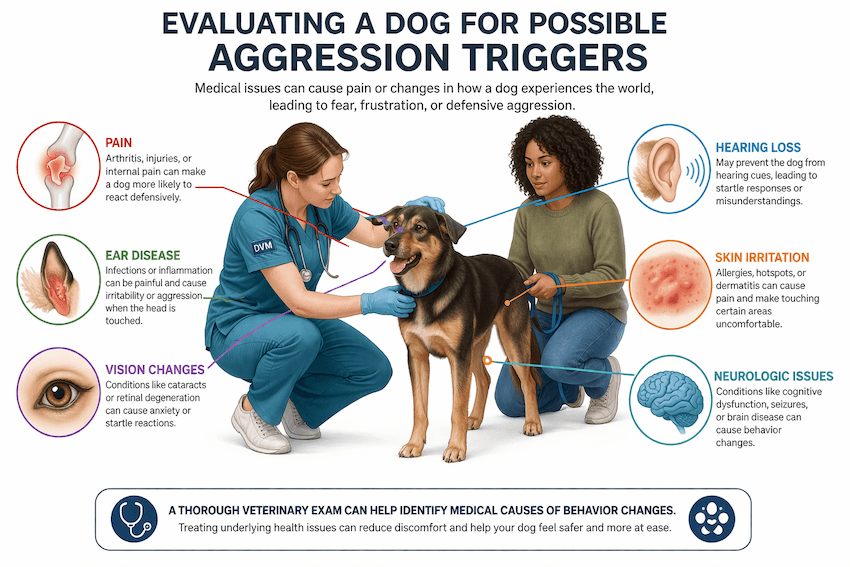
Schedule a veterinary exam before starting behavior work. Pain, skin disease, ear infection, neurologic problems, nausea, sensory decline, and other health issues can make a dog more irritable or defensive, and behavior treatment is less likely to work if the medical problem is missed.
Step 2: Put Immediate Safety Measures in Place at Home
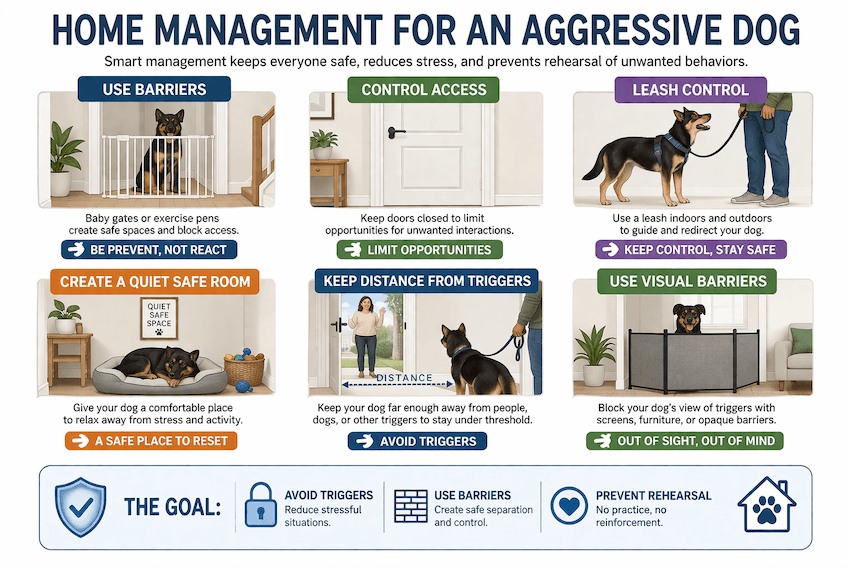
Stop putting your dog in situations where aggression is likely. Avoid known triggers when possible, increase distance, use gates, pens, doors, leashes, and visual barriers, and stop forced greetings, crowding, hugging, or hands-on handling that your dog does not tolerate well. The goal is to prevent rehearsal, because every repeated outburst can strengthen the behavior pattern.
Step 3: Learn Your Dog’s Triggers and Early Warning Signs
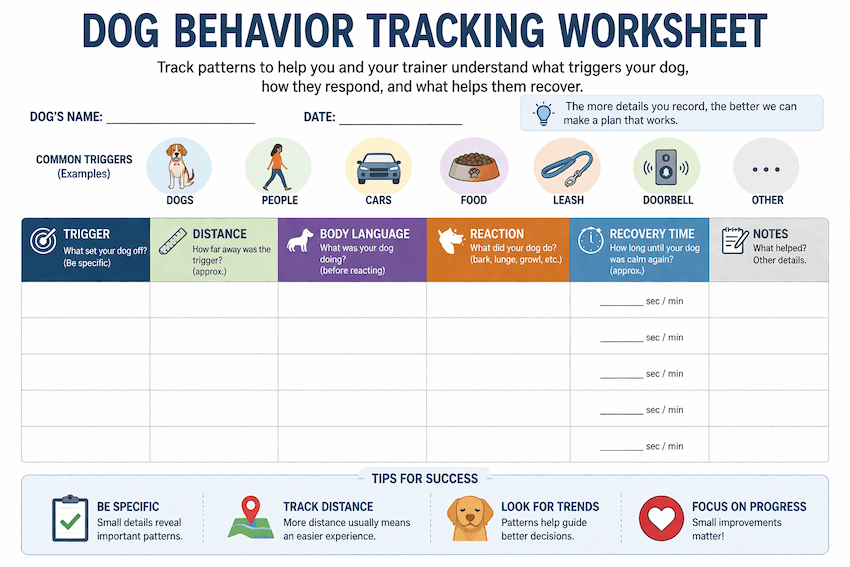
Write down what happened before each incident. Note the trigger, distance, body language, location, time of day, who was present, and what your dog did first. This helps you see patterns and find the point where your dog first notices the trigger but is still able to think, eat, and respond.
Step 4: Stop Using Punishment to Train an Aggressive Dog
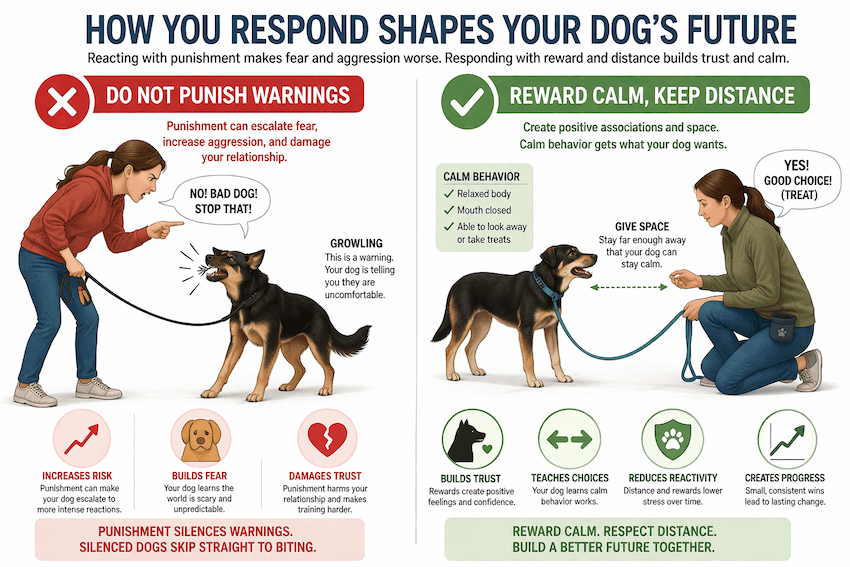
Do not punish growling, barking, or warning signals. Aversive methods can suppress signals without changing the underlying fear or discomfort, which can make a dog more unpredictable and increase the risk of escalation. Humane, reward-based dog training is the standard recommended by veterinary behavior groups, including for aggressive dogs.
Step 5: Start Desensitization Below Your Dog’s Threshold
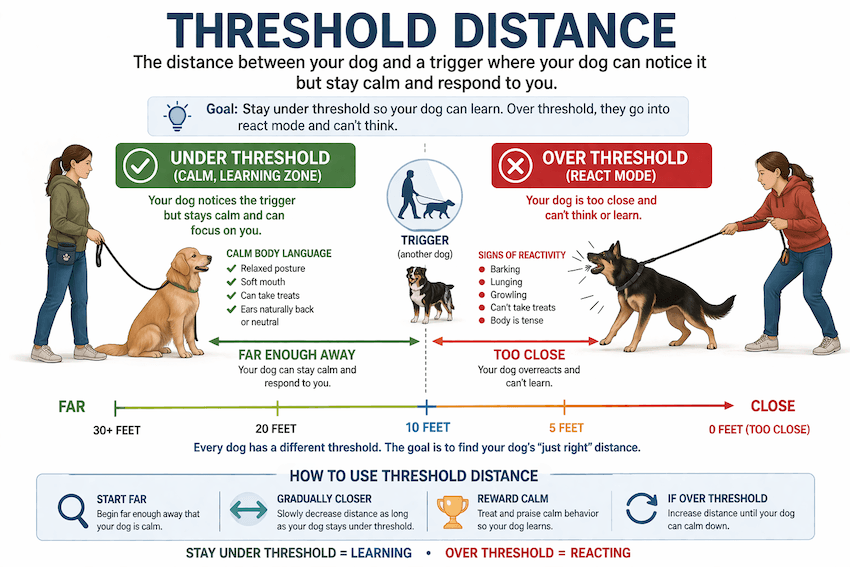
Desensitization means exposing your dog to a trigger at a low enough intensity that your dog can stay under threshold. That usually means more distance, shorter duration, lower movement, fewer people, or a less intense version of the trigger. If your dog is barking, lunging, refusing food, or unable to disengage, the setup is too hard and needs to be made easier.
Step 6: Use Counterconditioning to Change the Emotional Response
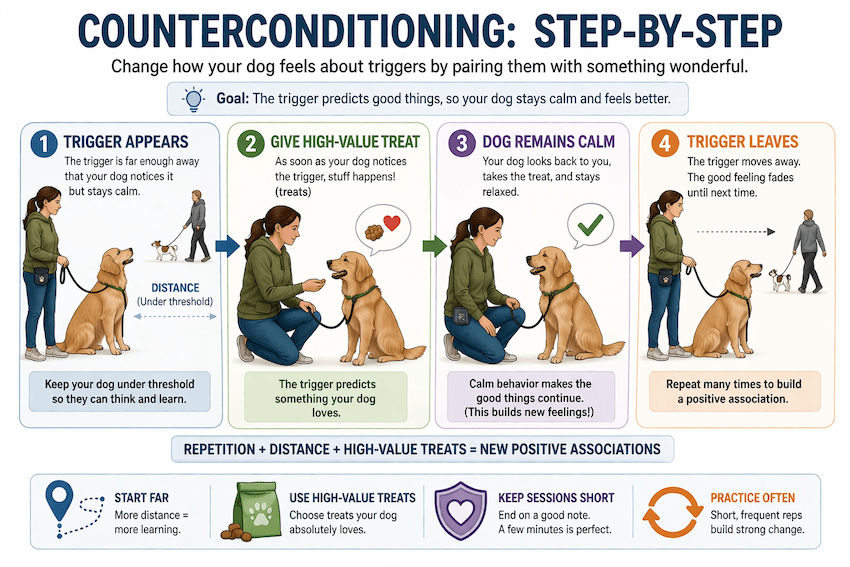
Counterconditioning means pairing the trigger with something your dog loves, usually best dog treats, at the moment the trigger appears and while the dog remains calm enough to eat. Over repeated sessions, the dog begins to predict something positive instead of reacting defensively. This is one of the core humane strategies used in behavior modification plans.
Step 7: Practice Management Every Day, Not Just During Training Sessions
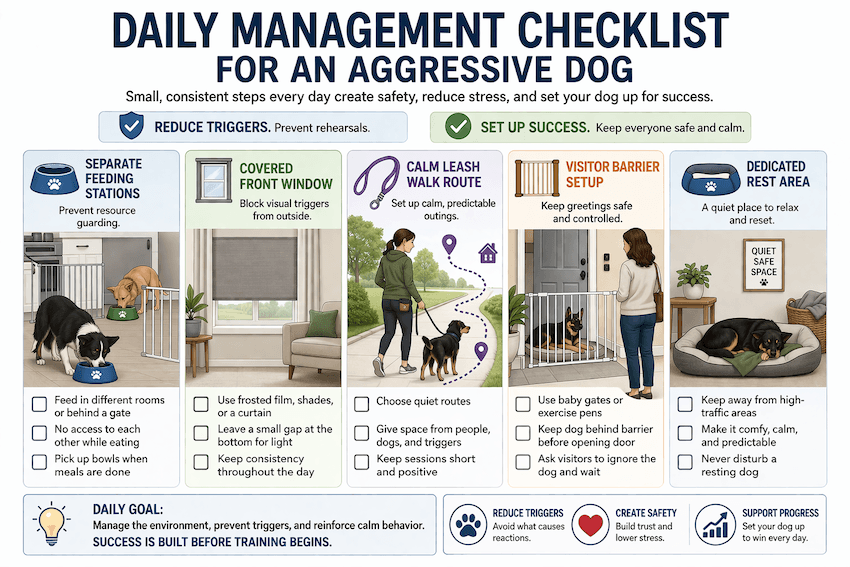
Management is part of treatment, not a shortcut. It means adjusting the environment so your dog does not keep practicing the unwanted response: feeding separately, limiting access to windows, using structured leash routes, avoiding crowded areas, and setting up calm routines around food, handling, confinement, and visitors.
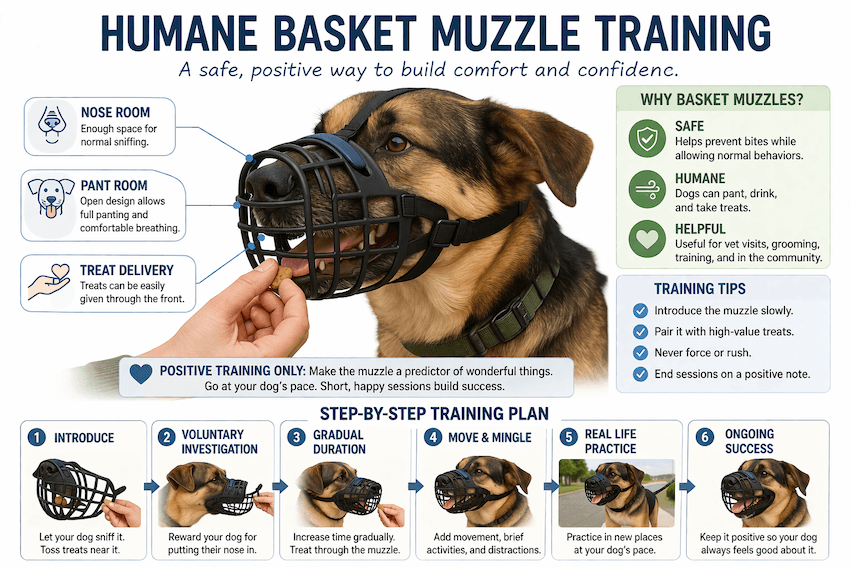
Step 8: Consider Basket Muzzle Training With Professional Guidance
A properly fitted basket muzzle can add safety during assessment and training, but it should be introduced gradually and positively, not forced on in stressful moments. The muzzle is a management tool, not the treatment itself, and professional guidance is especially important when the dog has a bite history or multiple triggers.
Step 9: Know When You Need a Professional for Dog Aggression
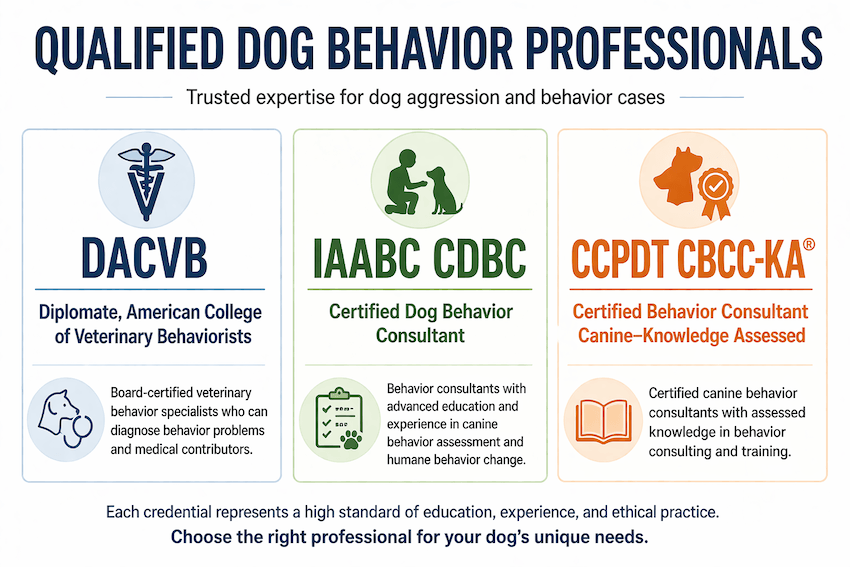
Get professional help early if your dog has bitten, injured someone, shows aggression toward household members, guards food or space intensely, reacts in several different situations, or behaves unpredictably. Look for a board-certified veterinary behaviorist or a credentialed behavior professional who uses humane, science-based methods, such as a DACVB, IAABC-certified consultant, or CCPDT behavior credential holder.
Step 10: Know What to Do After a Bite or Near-Bite
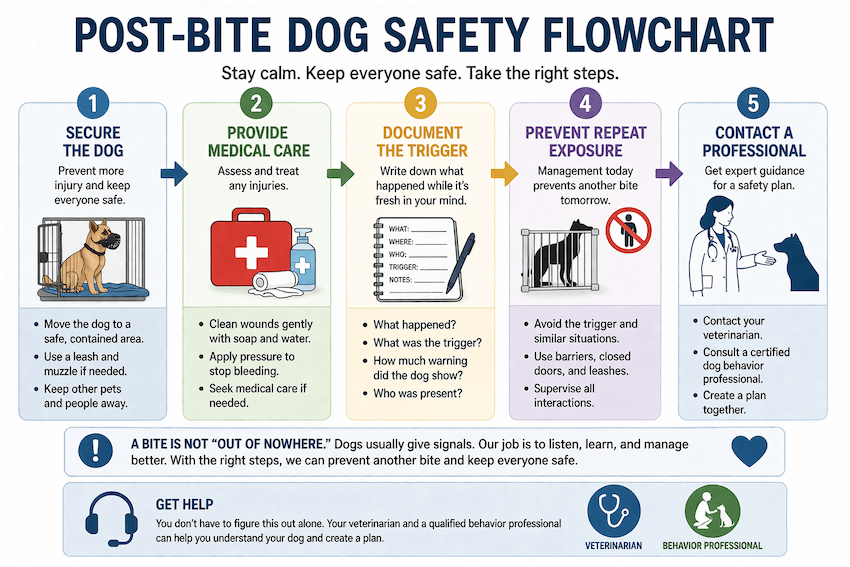
Secure the dog safely first. Get medical care for any person or animal who was injured, document what happened, note the trigger and body language if known, and stop guessing about the cause. After a bite, the case should be treated as a serious safety and behavior issue that needs veterinary and professional follow-up.
Evidence-Based Guidance on How to Train an Aggressive Dog
Veterinary and behavior literature supports a humane, assessment-first approach. The AVSAB position statement says reward-based methods should be used for all dog training, including behavior problems, and warns against aversive techniques because of their welfare and behavior risks. That matters here because many aggressive dogs are already acting from fear, pain, or distress, and adding punishment can worsen those states.
A 2021 review in Frontiers in Veterinary Science explains that fear and pain are major causes of aggression in veterinary settings and emphasizes creating positive associations and reducing threatening interactions. Clinically, that supports using distance, low-stress handling, and careful trigger management rather than confrontation.[1]
A 2024 review of counterconditioning-based interventions found support for counterconditioning as a core behavior-modification tool, while also noting that protocols must be applied carefully and consistently. That is why owners should work below threshold and avoid making setups too difficult too soon.[2]
Recent veterinary sources also note that pain and medical disease can be a major hidden factor in behavior problems, including aggression. That is clinically important because sudden or worsening aggression should trigger a veterinary workup before anyone assumes the issue is purely training-related.
Additional Tips for How to Train an Aggressive Dog
| Tip | Why It Helps | How to Apply It |
|---|---|---|
| Use better distance | Distance lowers pressure and reduces explosive reactions. | Start farther away from triggers than you think. |
| Train before meals | Food is often more valuable when hunger is mild. | Run short sessions before regular feeding times. |
| Keep sessions brief | Short sessions prevent overload and preserve learning. | Stop after a few calm repetitions. |
| Upgrade rewards | High-value food improves focus around hard triggers. | Use chicken, cheese, or another favorite treat. |
| Track every incident | Patterns become clearer when details are recorded. | Log triggers, distance, body language, and recovery. |
| Protect rest time | Fatigue and stress can lower coping ability. | Give your dog quiet, predictable downtime daily. |
| Separate when needed | Management prevents rehearsing dangerous behavior. | Use gates, pens, or closed doors early. |
Common Mistakes When Training an Aggressive Dog
| Mistake | Why It’s a Problem |
|---|---|
| Punishing growls | It can suppress warnings without fixing the cause. |
| Moving too close | Threshold is crossed before learning can happen. |
| Forcing interactions | Cornered dogs are more likely to escalate. |
| Skipping the vet | Medical pain can be missed and worsen risk. |
| Ignoring early signs | Staring and stiffness often come before bites. |
| Letting kids test limits | Children can trigger bites without recognizing warnings. |
| Using bad advice | Dominance-based methods can increase fear and conflict. |
What Comes After the Training Session
After each session, give your dog time to decompress in a quiet, predictable space. Keep using management even when things improve, because fewer outbursts do not mean the problem is fully resolved yet. Signs of progress include faster recovery, softer body language, better ability to eat and respond around triggers, and fewer reactions at the same distance.
Keep monitoring for setbacks, especially after stressful events, pain flare-ups, changes at home, or exposure to new triggers. Seek prompt professional help if your dog bites, becomes less predictable, shows aggression toward household members, or stops improving despite careful training and management.
Frequently Asked Questions
The Bottom Line
Training an aggressive dog is about safety, understanding, and changing emotional responses—not quick fixes or strict obedience drills. With the right approach, many dogs can learn to feel more secure and react more calmly over time. Progress often depends on identifying triggers, preventing repeated outbursts, and using consistent, reward-based training methods. Some cases improve significantly, while others require ongoing management to keep everyone safe. What matters most is recognizing the limits of DIY training and knowing when to bring in a qualified professional. With patience, structure, and the right support, you can reduce risk, build trust, and create a more stable, predictable environment for both you and your dog.