Dog Naproxen Toxicity Calculator 2026: Assess Risk & Poisoning

Canine Bible is reader-supported. We receive affiliate commissions via some of our links. Learn more.
Naproxen is a human nonsteroidal anti-inflammatory drug (NSAID) found in products such as Aleve and some prescription pain medicines. Dogs process naproxen very differently from people, and even a seemingly small amount can cause serious gastrointestinal or kidney problems. If your dog may have swallowed naproxen, the Dog Naproxen Toxicity Calculator below can estimate the amount consumed in milligrams per kilogram of body weight (mg/kg). That number can help you communicate the exposure clearly to your veterinarian or an animal poison-control professional. The result is an exposure estimate, not a diagnosis or a safe-dose determination. If naproxen ingestion is known or suspected, contact a veterinarian or pet poison expert promptly rather than waiting for symptoms to appear.
Remember to ALWAYS contact your veterinarian or a pet poison control service immediately if your dog may have ingested naproxen, even if your dog appears normal or the amount seems small. If you can't reach your vet, you can chat live with a registered online veterinary professional via our online vet chat or video chat support (24 hours a day, 7 days a week). Or use Chewy's online vet services (6 a.m. - midnight ET). Additionally, at-home dog gut health tests can analyze your dog’s microbiome, offering insights into which nutrients their diet should include. Similarly, at-home dog allergy testing kits can identify ingredients that may not be suitable for your dog, enabling you to choose the right diet and care plan to support optimal digestion, nutrition, and health.
How Much Naproxen Is Toxic to Dogs?
There is no owner-administered naproxen dose that should be treated as a safe amount for dogs. Human naproxen has a narrow margin of safety in pets, and a single 220 mg tablet can potentially cause serious poisoning.
The risk depends on more than the calculated mg/kg number. Your dog's weight, the amount swallowed, whether more than one dose was given, the formulation, existing kidney or gastrointestinal disease, other medications, and time since exposure can all affect the situation.
Veterinary reports have documented gastrointestinal toxicity after repeated exposures of 5.6 mg/kg once daily for seven days and 11.1 mg/kg once daily for three days. A single 35 mg/kg exposure has also produced marked gastrointestinal illness. These figures are reported toxic exposures, not boundaries between “safe” and “unsafe.”
One reason naproxen is especially concerning is how long it remains in a dog's body. Its reported elimination half-life in dogs is approximately 74 hours, partly because the drug can undergo extensive enterohepatic recirculation. That means repeated doses can accumulate rather than clear rapidly between administrations.


Can One 220 mg Aleve Tablet Hurt a Dog?
Yes. One standard 220 mg naproxen sodium tablet can represent a substantial exposure, especially in a small or medium-sized dog. Serious effects are possible even in larger dogs. For example, consider a 50-pound dog:
- 50 lb ÷ 2.2046 = approximately 22.7 kg
- 220 mg ÷ 22.7 kg = approximately 9.7 mg/kg
That 9.7 mg/kg figure describes the estimated exposure. It does not mean that 9.7 mg/kg is a treatment threshold, a guaranteed toxic dose, or a level that is safe to watch at home. If your dog swallowed one Aleve tablet, or you cannot be certain how many tablets are missing, contact your veterinarian or an animal poison-control professional promptly.
Naproxen Toxicity Chart for Dogs
The chart below shows the approximate exposure produced by one 220 mg tablet at different dog weights.
| Dog Weight | Weight in kg | One 220 mg Tablet | What to Do |
|---|---|---|---|
| 5 lb | 2.3 kg | ≈ 97.0 mg/kg | Contact a veterinarian or poison expert promptly. |
| 10 lb | 4.5 kg | ≈ 48.5 mg/kg | Contact a veterinarian or poison expert promptly. |
| 20 lb | 9.1 kg | ≈ 24.3 mg/kg | Contact a veterinarian or poison expert promptly. |
| 30 lb | 13.6 kg | ≈ 16.2 mg/kg | Contact a veterinarian or poison expert promptly. |
| 40 lb | 18.1 kg | ≈ 12.1 mg/kg | Contact a veterinarian or poison expert promptly. |
| 50 lb | 22.7 kg | ≈ 9.7 mg/kg | Contact a veterinarian or poison expert promptly. |
| 60 lb | 27.2 kg | ≈ 8.1 mg/kg | Contact a veterinarian or poison expert promptly. |
| 70 lb | 31.8 kg | ≈ 6.9 mg/kg | Contact a veterinarian or poison expert promptly. |
| 80 lb | 36.3 kg | ≈ 6.1 mg/kg | Contact a veterinarian or poison expert promptly. |
| 100 lb | 45.4 kg | ≈ 4.9 mg/kg | Contact a veterinarian or poison expert promptly. |
Important: This chart demonstrates how dog size changes the calculated exposure. It is not a safe-dose chart, and a lower number should not be used as a reason to delay veterinary advice. A 220 mg naproxen product can cause serious poisoning in dogs.
Naproxen Product and Formulation Chart
Before calculating an exposure, check the medication packaging carefully. Brand names alone are not enough because products and formulations can differ.
| Product Type | What to Check | Calculator Input |
|---|---|---|
| Tablet or caplet | Strength printed per tablet. | mg per tablet + number swallowed. |
| Capsule or gelcap | Strength printed per capsule. | mg per capsule + number swallowed. |
| Liquid | Concentration on the label. | mg/mL + estimated mL swallowed. |
| Prescription product | Exact pharmacy-label strength. | Enter the labeled strength. |
| Combination medicine | Every active ingredient. | Calculate naproxen, then report all ingredients. |
| Unknown product | Package, bottle, or pill imprint. | Do not guess the strength. |
If the product contains another active ingredient, calculating the naproxen component does not evaluate the risk from that ingredient. Keep the packaging available when you call your veterinarian.


Naproxen Poisoning Symptoms in Dogs
Naproxen toxicity commonly affects the gastrointestinal tract and kidneys. Signs can vary with the amount swallowed, timing, repeated exposure, and the dog's underlying health.
| Concern | Signs You May Notice | Why It Matters |
|---|---|---|
| Stomach irritation | Vomiting, poor appetite, abdominal pain. | NSAIDs can damage the stomach and intestines. |
| GI bleeding | Bloody vomit, black or tarry stool, pale gums. | Ulcers may cause significant blood loss. |
| Kidney injury | Thirst or urination changes, weakness. | NSAID poisoning can impair kidney function. |
| General illness | Lethargy, weakness, dehydration. | These can accompany significant toxicity. |
| Severe illness | Collapse, seizures, marked weakness. | Seek emergency veterinary care immediately. |
Vomiting, gastrointestinal bleeding, abdominal pain, weakness, pale gums, lethargy, kidney injury, and severe ulceration are among the documented concerns with naproxen and other NSAID poisoning. Do not wait for symptoms before seeking advice. Gastrointestinal or kidney injury may begin before the problem is obvious at home.
Naproxen Toxicity Guidelines for Dogs
Naproxen belongs to the NSAID family. These medications decrease inflammation and pain by altering prostaglandin activity, but prostaglandins also help protect the gastrointestinal tract and support normal kidney blood flow. That is why excessive NSAID exposure can lead to stomach or intestinal ulcers, bleeding, perforation, and kidney injury. Human NSAIDs should not be substituted for veterinary pain medications unless a veterinarian has specifically prescribed and directed their use.
Naproxen is particularly problematic in dogs because it remains in their bodies for a long time. Oral absorption is rapid, with reported peak plasma concentrations occurring within roughly 0.5 to 3 hours, while the elimination half-life has been measured at about 74 hours. That long persistence also makes repeated exposure important. A dog that received naproxen yesterday and again today may have a very different risk profile than a dog with a single known exposure, even when each individual amount appears small. The calculator uses a simple exposure formula:
Naproxen exposure (mg/kg) = Total naproxen consumed (mg) ÷ Dog's body weight (kg)
The calculation is useful because veterinarians commonly evaluate toxic exposures relative to body weight. However, mg/kg is only one part of a toxicology assessment; it does not predict an individual dog's outcome.
Factors That Can Affect Your Dog's Results
Several details can change how a calculated naproxen exposure should be interpreted.
| Factor | Why It Matters | What Owners Should Check |
|---|---|---|
| Body weight | Smaller dogs receive more mg/kg from the same tablet. | Use a recent weight when possible. |
| Amount swallowed | More medication means greater exposure. | Count missing or damaged pills. |
| Product strength | Different products may contain different amounts. | Read the active-ingredient label. |
| Repeated doses | Naproxen remains in dogs for a long time. | Report every possible dose and time. |
| Time since exposure | Timing affects veterinary treatment decisions. | Estimate when ingestion occurred. |
| Health conditions | Kidney or GI disease may increase concern. | Share relevant medical history. |
| Other medications | Other NSAIDs or steroids can add risk. | List all drugs and supplements. |
| Symptoms | Clinical signs may indicate active toxicity. | Report vomiting, bleeding, weakness, or urine changes. |
A calculator cannot incorporate every clinical factor a veterinarian considers. If the amount, timing, formulation, or your dog's health history is uncertain, tell the veterinary professional exactly what is known and what is not.
Common Mistakes to Avoid
Small input errors can significantly change a toxicity calculation. More importantly, some mistakes can delay care when time matters.
| Mistake | Why It Matters | Better Approach |
|---|---|---|
| Wrong units | Mixing pounds and kilograms changes the result. | Confirm the weight unit before calculating. |
| Wrong product | Ibuprofen and naproxen are different drugs. | Check the active ingredient, not just the brand. |
| Wrong strength | mg per tablet is not the total amount eaten. | Multiply strength by units swallowed. |
| Guessing low | Missing pills may make exposure uncertain. | Report the maximum plausible amount. |
| Ignoring symptoms | Vomiting or GI bleeding can signal toxicity. | Seek veterinary care promptly. |
| Treating mg/kg as exact advice | Dogs can respond differently to the same exposure. | Use the number for veterinary triage. |
| Missing other ingredients | Combination products may add another poisoning risk. | Read and report every active ingredient. |
| Waiting for signs | Injury can develop before symptoms are obvious. | Call after suspected ingestion. |
The most important mistake to avoid is treating a calculator result as permission to wait at home. Naproxen exposure should be evaluated based on the full circumstances, not one number.
Safety Guidelines for Naproxen Toxicity in Dogs
When Should You Contact a Veterinarian?
Contact your veterinarian, an emergency veterinary clinic, or an animal poison-control professional whenever you know or reasonably suspect that your dog swallowed naproxen. You do not need to wait until your dog vomits, stops eating, or develops black stool. Early professional guidance is valuable because veterinarians may make different decisions depending on the amount swallowed and how recently it happened. If your dog is already showing symptoms, treat the situation as more urgent.
Emergency Warning Signs
Seek urgent veterinary attention if your dog develops:
Do Not Try to Treat Naproxen Poisoning at Home
Do not induce vomiting unless a veterinarian or animal poison-control professional specifically tells you to. Trying to make a dog vomit without professional guidance can create additional risks.
Do not give activated charcoal, antacids, milk, oils, food, hydrogen peroxide, another pain medication, or a supposed home antidote in an attempt to neutralize naproxen unless a veterinary professional has instructed you to do so. The appropriate response depends on the individual exposure, timing, symptoms, health history, and other medications your dog may have received.
What to Do If Your Dog Eats Naproxen or Aleve
If you discover a chewed bottle, missing tablets, or an accidental dose, focus on gathering useful information and getting professional help.
1. Prevent Any More Exposure: Move the medication and any spilled tablets out of reach. Check your dog's mouth and the surrounding area for intact pills, but do not put yourself at risk of being bitten.
2. Find the Medication Package: Keep the original bottle, blister pack, box, or pharmacy label. Look for the active ingredient, tablet strength, formulation, and any additional active ingredients. Do not identify a medication based on package color or brand recognition alone. Some brand families contain multiple formulations.
3. Work Out How Much Could Be Missing: Count the tablets that remain, if possible. If you cannot tell whether your dog swallowed two tablets or four, report four as the maximum possible amount and explain that the exact quantity is unknown. Uncertainty is useful information. It is better to tell the veterinarian that an estimate is uncertain than to create false precision.
4. Get Your Dog's Current Weight: A recent veterinary weight is ideal. If that is not available, use the best reliable weight you have rather than estimating by breed appearance. Weight matters because toxic exposures are commonly expressed in mg/kg.
5. Note the Time: Record when you last saw the medication intact and when you discovered the possible ingestion. If you do not know exactly when it happened, provide the likely time window. Do not assume that several hours passing means veterinary care is no longer useful.
6. Contact Veterinary Help: Call your veterinarian or your nearest emergency veterinary hospital. In the United States, animal poison-control services are also available around the clock.
- ASPCA Poison Control: (888) 426-4435, available 24/7; a consultation fee may apply.
- Pet Poison Helpline: (855) 764-7661, available 24/7; consultation fees may apply.
- Outside the United States, contact a local emergency veterinarian or animal poison information service.
7. Take the Package With You: If your veterinarian recommends an examination, bring the medication package or a clear photo of both the front and active-ingredient label. This is especially important when the product contains more than one drug.
Special Considerations for Certain Dogs
How to Calculate Naproxen Exposure in Dogs Manually
The calculator performs the same basic arithmetic that a dog owner can use to describe an exposure in mg/kg. Manual calculation is useful when you want to double-check your inputs before speaking with a veterinarian.
Step 1: Convert Pounds to Kilograms
If your dog's weight is in pounds: Weight in kg = Weight in lb ÷ 2.2046
- For example:
- 50 lb ÷ 2.2046 = approximately 22.7 kg
Step 2: Calculate the Total Amount Swallowed
For tablets or capsules: Total mg = Strength per tablet × Number of tablets swallowed
- If a product contains 220 mg per tablet and the dog swallowed two:
- 220 mg × 2 = 440 mg total
- For a liquid product:
- Total mg = Concentration in mg/mL × Amount swallowed in mL
Use the concentration exactly as printed on the product label. Do not convert between formulations or active ingredients unless a veterinary professional tells you to.
Step 3: Calculate the mg/kg Exposure
Divide the total amount swallowed by the dog's body weight in kilograms: Exposure (mg/kg) = Total mg ÷ Body weight (kg)
Step 4: Account for Uncertainty
If you know that between two and four pills could be missing, calculate a range using both values. A veterinarian would rather know that the exposure could be X–Y mg/kg than receive an artificially exact number based on a guess.
Example Calculation
Suppose a 50-pound dog may have swallowed one 220 mg naproxen tablet.
- First, convert the dog's weight:
- 50 ÷ 2.2046 = 22.7 kg
- Then calculate exposure:
- 220 mg ÷ 22.7 kg = approximately 9.7 mg/kg
- The result is therefore:
- Estimated naproxen exposure: 9.7 mg/kg
That calculation does not predict whether the dog will develop an ulcer, kidney injury, or other complications. It is a number to report promptly to your veterinarian or poison-control professional.
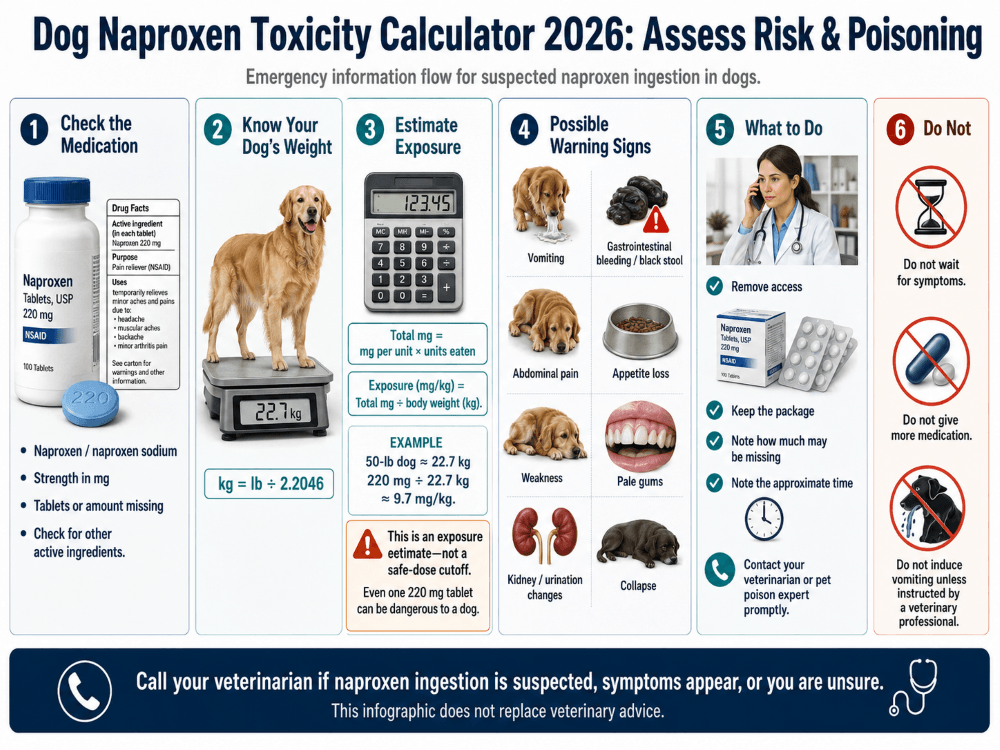
Dog Naproxen Toxicity Infographic
Frequently Asked Questions
The Bottom Line
The dog naproxen toxicity calculator is designed to answer one practical question: approximately how much naproxen was your dog exposed to per kilogram of body weight? That number can make a conversation with your veterinarian or animal poison-control professional faster and clearer, but it cannot diagnose poisoning or establish that an exposure is safe. Naproxen persists much longer in dogs than it does in people and can cause gastrointestinal ulceration, bleeding, kidney injury, and other serious complications.
If your dog has swallowed naproxen or Aleve, keep the package, estimate the maximum amount that could be missing, note when the exposure occurred, and contact veterinary help promptly. Do not wait for symptoms or attempt home treatment unless a veterinary professional specifically directs you.
For other accidental medication exposures, related Canine Bible resources such as a dog ibuprofen toxicity calculator, dog Tylenol toxicity calculator, dog aspirin toxicity calculator, dog symptom checker, and dog toxicity calculator can help owners gather the right information while seeking professional care.