Raw Dog Food Calculator: Estimate Portions & Feeding Amounts (Free Tool)

Canine Bible is reader-supported. We receive affiliate commissions via some of our links. Learn more.
Feeding raw food is not as simple as choosing a percentage of your dog’s body weight. Raw diets can differ considerably in calories, fat, moisture, ingredients, and nutritional balance, so two dogs that weigh the same may need very different portions. This Raw Dog Food Calculator estimates your dog’s daily calorie needs and converts them into a practical amount of raw food based on the calorie density of the food you actually feed. You can use the result as a starting point, then adjust it based on your dog’s weight trend and body condition.
Remember to ALWAYS consult your veterinarian before starting or adjusting a raw diet, especially if your dog is growing, pregnant, nursing, underweight, overweight, or has a health condition. If you can't reach your vet, you can chat live with a registered online veterinary professional via our online vet chat or video chat support (24 hours a day, 7 days a week). Or use Chewy's online vet services (6 a.m. - midnight ET). Additionally, at-home dog gut health tests can analyze your dog’s microbiome, offering insights into which nutrients their diet should include. Similarly, at-home dog allergy testing kits can identify ingredients that may not be suitable for your dog, enabling you to choose the right diet and care plan to support optimal digestion, nutrition, and health.
How Much Raw Food Should I Feed My Dog?
The most useful way to estimate how much raw food to feed a dog is to first calculate the dog's energy requirement, then divide those calories by the calorie density of the specific food. In simple terms:
- Daily raw food = Estimated daily calories ÷ Calories per gram of food
That is more individualized than assuming every adult dog should eat a fixed percentage of body weight. For example, imagine a dog needs about 900 kcal per day.
- If one raw food contains 1.2 kcal per gram:
- 900 ÷ 1.2 = 750 grams per day
- If another contains 1.8 kcal per gram:
- 900 ÷ 1.8 = 500 grams per day
- Both portions provide the same 900 calories, yet the difference is 250 grams of food per day.
Is the 2%–3% Body Weight Rule Accurate?
You will often see raw-feeding recommendations such as “feed 2% to 3% of your dog's body weight per day.” That can provide a rough reference point, but it should not be treated as a precise feeding prescription.
A percentage-only method does not account well for differences in calorie density, body condition, neuter status, age, activity, or individual metabolism. It can also make two very different raw foods appear interchangeable simply because their portions weigh the same. A calorie-based estimate is generally a better starting point because it connects the dog's expected energy requirement with the actual food being fed.
Why Calories Matter More Than Food Weight Alone
Fat provides more calories per gram than protein or carbohydrate, so higher-fat raw formulas can be much more energy-dense than leaner formulas. Moisture content also changes how many calories fit into a given weight of food. That is why the most important number on the food for this calculation is its calorie content, such as kcal/kg, kcal/oz, kcal/patty, or kcal/serving. The following example shows how much the portion can change for a dog needing 900 kcal per day.


| Food Calories | Food Needed for 900 kcal | Approx. Ounces |
|---|---|---|
| 1.0 kcal/g | 900 g/day | 31.7 oz |
| 1.2 kcal/g | 750 g/day | 26.5 oz |
| 1.5 kcal/g | 600 g/day | 21.2 oz |
| 1.8 kcal/g | 500 g/day | 17.6 oz |
| 2.0 kcal/g | 450 g/day | 15.9 oz |
This is why a raw dog food calculator should ask for the food's calorie density instead of assuming that one ounce of every raw food provides the same amount of energy.
Raw Dog Food Feeding Chart for Dogs
The chart below gives calorie ranges for healthy adult dogs in ideal body condition and shows what those calories would equal if the food contained 1.5 kcal per gram. The food amounts are examples, not universal raw-feeding recommendations.
| Dog Weight | Healthy Adult Calories/Day | Example at 1.5 kcal/g |
|---|---|---|
| 11 lb / 5 kg | 280–351 kcal | 187–234 g/day |
| 22 lb / 10 kg | 470–590 kcal | 313–393 g/day |
| 33 lb / 15 kg | 640–800 kcal | 427–533 g/day |
| 44 lb / 20 kg | 790–993 kcal | 527–662 g/day |
| 55 lb / 25 kg | 940–1,174 kcal | 627–783 g/day |
| 66 lb / 30 kg | 1,080–1,346 kcal | 720–897 g/day |
| 88 lb / 40 kg | 1,340–1,670 kcal | 893–1,113 g/day |
Your dog's actual amount can fall above or below these examples. Replace the hypothetical 1.5 kcal/g value with the calorie density of the food you actually feed.
Raw Feeding Factors by Life Stage and Activity
Veterinary energy calculations often begin with resting energy requirement, or RER, and then apply a factor based on life stage or activity. These factors are starting estimates rather than guaranteed calorie requirements.
| Dog Status | Starting Factor | Practical Note |
|---|---|---|
| Inactive/obesity-prone adult | 1.0–1.2 × RER | Monitor body condition closely. |
| Neutered adult | 1.4–1.6 × RER | Common adult starting range. |
| Intact adult | 1.6–1.8 × RER | Needs still vary individually. |
| Puppy under 4 months | 3.0 × RER | Growth nutrition needs careful oversight. |
| Puppy 4+ months | 2.0 × RER | Recalculate as the puppy grows. |
| Working dog | 1.6–11 × RER | Workload determines where in the range. |
| Late gestation/lactation | About 3 to ≥6 × RER | Veterinary guidance is recommended. |
Large working-dog ranges are intentionally broad. A dog doing an occasional weekend hike does not have the same energy demands as a dog performing sustained endurance work.
Raw Diet Type and Calculator Reliability
The calculator can estimate food quantity most confidently when you know exactly how many calories the food contains. It cannot turn an incomplete recipe into a balanced diet.


| Raw Diet Type | Portion Estimate? | What to Check |
|---|---|---|
| Complete commercial raw | Yes | Use the label's calorie and life-stage information. |
| Supplemental raw food | Calories only | Do not use as the sole diet unless appropriately labeled. |
| Vet-formulated homemade | Yes | Follow the recipe and calorie specification exactly. |
| DIY/BARF mixture | Calories only | A portion calculator cannot verify nutrient balance. |
| Raw bones | Not recommended as a calculator target | Bones carry dental and gastrointestinal risks. |
A product intended for “intermittent or supplemental feeding only” is not equivalent to a food labeled complete and balanced for the appropriate life stage. The nutritional adequacy statement on the package is one of the most important label details to check.
Raw Feeding Guidelines for Dogs
A useful raw-feeding estimate starts with the dog's calorie needs, incorporates the energy density of the food, and then gets refined over time based on the dog in front of you.
Start With Calories, Not a Fixed Percentage
One commonly used veterinary starting formula is: RER = 70 × body weight in kilograms^0.75
RER stands for resting energy requirement. It estimates the energy a healthy animal needs at rest; it is not automatically the number of calories your dog should eat every day. A life-stage or activity factor is then used to estimate maintenance energy requirement:
Estimated daily calories = RER × life-stage factor
These equations are best treated as starting points. Dogs with identical body weights can still differ substantially in their actual calorie requirements.
Check the Food's Calorie Content
Look for a calorie statement such as:
- kcal/kg
- kcal/oz
- kcal/cup
- kcal/patty
- kcal/nugget
- kcal/serving
If the label provides kcal/kg, convert it to kcal/g by dividing by 1,000.
- For example:
- 1,500 kcal/kg ÷ 1,000 = 1.5 kcal/g
- If your dog needs 750 kcal:
- 750 ÷ 1.5 = 500 g of food per day
For most raw foods, weighing portions in grams on a digital kitchen scale is more repeatable than estimating irregular pieces or patties by eye.
Check the Nutritional Adequacy Statement
Feeding the correct number of calories does not guarantee that a diet supplies the right amounts and ratios of protein, essential fatty acids, vitamins, minerals, and other nutrients. For a commercial food used as the main diet, look for a nutritional adequacy statement showing that the food is complete and balanced for the dog's appropriate life stage. “Adult maintenance,” “growth,” and “all life stages” have different implications. AAFCO establishes nutrient profiles and feeding-test protocols used for nutritional adequacy claims, but it does not individually approve or certify every pet food sold.
Treats and Extras Still Count
Treats, chews, toppers, table food, oils, and other extras can add enough calories to change the feeding calculation. They can also dilute the nutrient balance of a complete diet when they make up a large share of daily intake. As a practical guideline, keep treats and nutritionally incomplete extras to about 10% or less of daily calories, unless your veterinarian has recommended otherwise.
If you feed a commercial raw diet that is already complete and balanced, avoid casually adding large amounts of extra meat, organs, supplements, or bone. More ingredients do not automatically make a diet more complete.
Factors That Can Affect Your Dog's Results
Weight is only one piece of the feeding calculation. These factors can move a dog's real calorie requirement above or below the initial estimate.
| Factor | Why It Matters | What Owners Should Check |
|---|---|---|
| Body weight | Energy needs rise with body size. | Use a recent, accurate weight. |
| Body condition | Current weight may not be ideal weight. | Check ribs, waist, and abdominal tuck. |
| Life stage | Puppies and reproductive dogs need different nutrition. | Select the correct life stage. |
| Activity | Working dogs may burn far more energy. | Base activity on the dog's normal routine. |
| Neuter status | Average energy needs can differ after neutering. | Use the correct calculator category. |
| Food calories | Energy density determines grams or ounces fed. | Use kcal data from the actual food. |
| Health status | Disease can change energy and nutrient needs. | Use a veterinary plan for chronic illness. |
| Individual metabolism | Dogs can differ even at the same weight. | Track weight and body condition over time. |
Breed, environment, lean body mass, age, and activity can all influence energy requirements independently of body weight. That is why the most useful feeding “calculator” is ultimately the combination of a starting estimate and regular reassessment.
Common Raw Feeding Calculator Mistakes to Avoid
Most inaccurate raw-food estimates come from the inputs rather than the arithmetic. Check these issues before making major changes to your dog's portions.
| Mistake | Why It Matters | Better Approach |
|---|---|---|
| Using only 2%–3% | It ignores calorie density and individual needs. | Calculate calories first. |
| Wrong units | Mixing lb, kg, kcal/kg, and kcal/g changes the answer. | Confirm every unit before calculating. |
| Guessing calories | Raw formulas can differ substantially. | Use the exact product or recipe data. |
| Measuring by eye | Small daily errors add up over time. | Use a digital kitchen scale. |
| Ignoring extras | Treats and toppers add calories. | Count all meaningful calorie sources. |
| Assuming balanced | Correct calories do not prove nutrient adequacy. | Check the adequacy statement or recipe formulation. |
| Never recalculating | Needs change with growth, activity, and body condition. | Recheck after meaningful changes. |
| Ignoring symptoms | Illness should not be managed by calculator adjustments alone. | Contact a veterinarian when your dog is unwell. |
One additional mistake is assuming that freezing or freeze-drying makes raw food sterile. These processes do not reliably eliminate all bacterial contamination.
Raw Dog Food Safety Guidelines
Raw feeding involves considerations beyond calories. These animal products can carry microorganisms that affect dogs and people, and preparation practices can spread contamination to hands, bowls, counters, utensils, and other foods.
Raw Food Can Carry Harmful Bacteria
Raw pet foods have been found to carry disease-causing bacteria, including Salmonella and Listeria monocytogenes. Dogs may become ill, but some can also carry or shed organisms without obvious symptoms. That means food handling matters even when your dog seems perfectly healthy.
Households That Need Extra Caution
Raw feeding creates greater concern when the household includes people who may be more vulnerable to foodborne infection, including:
Handle Raw Dog Food Carefully
If you feed raw food:
Be Careful With Raw Bones
Raw bones should not be treated as a required component of feeding simply because the diet is raw. Bones can cause broken teeth, constipation, or blockage of the esophagus or intestinal tract. Bone feeding also does not eliminate the need for regular dental care.
When to Contact Your Veterinarian
Call your veterinarian promptly if your dog develops:
Veterinary guidance is also especially important when planning a long-term homemade diet, feeding a growing puppy, managing chronic disease, or feeding during pregnancy or lactation. The calculator is educational and estimates feeding quantity; it does not diagnose disease or confirm that a recipe is nutritionally complete.
What to Do If Your Dog Gains or Loses Weight on a Raw Diet
A feeding calculation is only the starting point. Your dog's body condition tells you whether the starting amount is actually working. If weight begins moving in the wrong direction:
- Weigh your dog again. Use an accurate current weight rather than an estimate from months ago.
- Check the calorie density. Make sure you entered kcal/kg, kcal/g, kcal/oz, or kcal/serving correctly.
- Weigh the portion. A kitchen scale can reveal surprisingly large differences between an estimated scoop and the intended serving.
- Count extras. Include treats, toppers, chews, oils, and table scraps.
- Reassess activity. A seasonal change in exercise can change energy expenditure.
- Check body condition. The number on the scale matters less when considered without muscle and fat distribution.
For an otherwise healthy adult dog, modest adjustments may be appropriate when body condition slowly drifts away from ideal. Avoid drastic calorie cuts or large increases without understanding why the weight changed.
Unexplained weight loss should not automatically be “fixed” by feeding substantially more. Weight loss despite an unchanged diet can be a sign of disease and deserves veterinary evaluation. If your goal is intentional weight loss, use a veterinarian-established target weight when possible. Significant calorie restriction is better handled with a diet formulated to maintain adequate nutrient intake while calories are reduced.
Special Raw Feeding Considerations for Certain Dogs
How to Calculate Raw Dog Food Amount Manually
You can reproduce the calculator's basic calorie method with a few calculations.
Step 1: Convert Pounds to Kilograms
If your dog's weight is in pounds: Weight in kg = Weight in lb ÷ 2.2046
- For a 44-pound dog:
- 44 ÷ 2.2046 ≈ 20 kg
Step 2: Calculate Resting Energy Requirement
Use: RER = 70 × body weight (kg)^0.75
- For a 20 kg dog:
- RER = 70 × 20^0.75
- RER ≈ 662 kcal/day
The exponential RER equation can be used across a wide range of body weights.
Step 3: Estimate Daily Energy Requirement
- Next, multiply RER by an appropriate starting factor.
- Suppose the example dog uses a factor of 1.4:
- 662 × 1.4 ≈ 927 kcal/day
Remember that the multiplier is not a guarantee. The dog's real-world requirements may differ.
Step 4: Find the Raw Food's Calorie Density
- Suppose the food contains:
- 1.5 kcal/g
- If the label instead lists 1,500 kcal/kg, divide by 1,000:
- 1,500 ÷ 1,000 = 1.5 kcal/g
Step 5: Convert Calories to Food Weight
- Now divide the dog's estimated calories by the food's calories per gram:
- 927 kcal ÷ 1.5 kcal/g ≈ 618 g/day
Step 6: Divide Into Meals
- If the dog eats twice daily:
- 618 g ÷ 2 = 309 g per meal
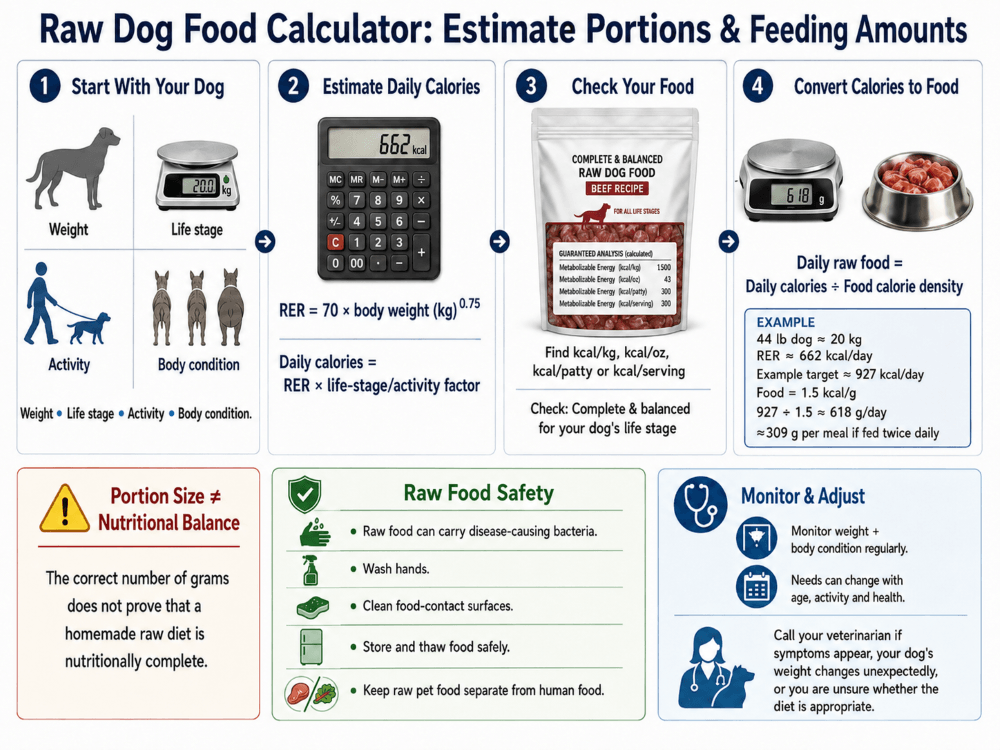
Example Calculation
For a 44-pound / 20 kg adult dog:
- RER: about 662 kcal/day
- Example multiplier: 1.4
- Estimated daily calories: about 927 kcal
- Food calorie density: 1.5 kcal/g
- Daily raw food: about 618 g
- If fed twice daily: about 309 g per meal
This is a worked mathematical example, not a prescription for every 44-pound dog. A different activity level, body condition, health status, or raw food could change the amount considerably.
Raw Dog Food Infographic
Frequently Asked Questions
The Bottom Line
The most useful raw dog food calculator starts with calories, not a universal percentage of body weight. Estimate your dog's energy requirement, find the calorie density of the exact food being fed, and convert those calories into grams or ounces. Then watch the dog, not just the calculator. Body weight, waistline, rib coverage, muscle condition, activity, and overall health tell you whether the starting amount is appropriate.
Most importantly, remember that feeding amount and nutritional completeness are different questions. A mathematically correct portion of an unbalanced homemade diet is still an unbalanced diet. If you plan to feed homemade raw food long term, have the recipe properly formulated. Seek veterinary guidance for puppies, pregnancy or lactation, chronic disease, significant weight problems, unexplained weight change, or concerning gastrointestinal symptoms.
For related feeding decisions, a dog calorie calculator, dog feeding calculator, dog protein calculator, and how long will dog food last calculator can help you monitor portions and healthy weight over time. You can also check out homemade raw dog food.