How Long Will Dog Food Last Calculator [Free Tool 2026]

Canine Bible is reader-supported. We receive affiliate commissions via some of our links. Learn more.
Buying dog food is easier when you know whether a bag will last two weeks, six weeks, or several months. The answer depends mainly on how much food you have and how much your dog actually eats each day. The How Long Will Dog Food Last Calculator below estimates the number of days and weeks remaining in your supply. It can also help you plan a refill date, estimate monthly food needs, compare package sizes, and account for multiple dogs. Keep one distinction in mind: how long a supply lasts is not the same as how long opened dog food remains fresh or suitable to feed. Storage conditions, package instructions, best-by dates, and the type of food still matter.
Remember to ALWAYS check the food’s feeding guidelines and consult your veterinarian if you are unsure how much your dog should eat. If you can't reach your vet, you can chat live with a registered online veterinary professional via our online vet chat or video chat support (24 hours a day, 7 days a week). Or use Chewy's online vet services (6 a.m. - midnight ET). Additionally, at-home dog gut health tests can analyze your dog’s microbiome, offering insights into which nutrients their diet should include. Similarly, at-home dog allergy testing kits can identify ingredients that may not be suitable for your dog, enabling you to choose the right diet and care plan to support optimal digestion, nutrition, and health.
How Long Will a Bag of Dog Food Last?
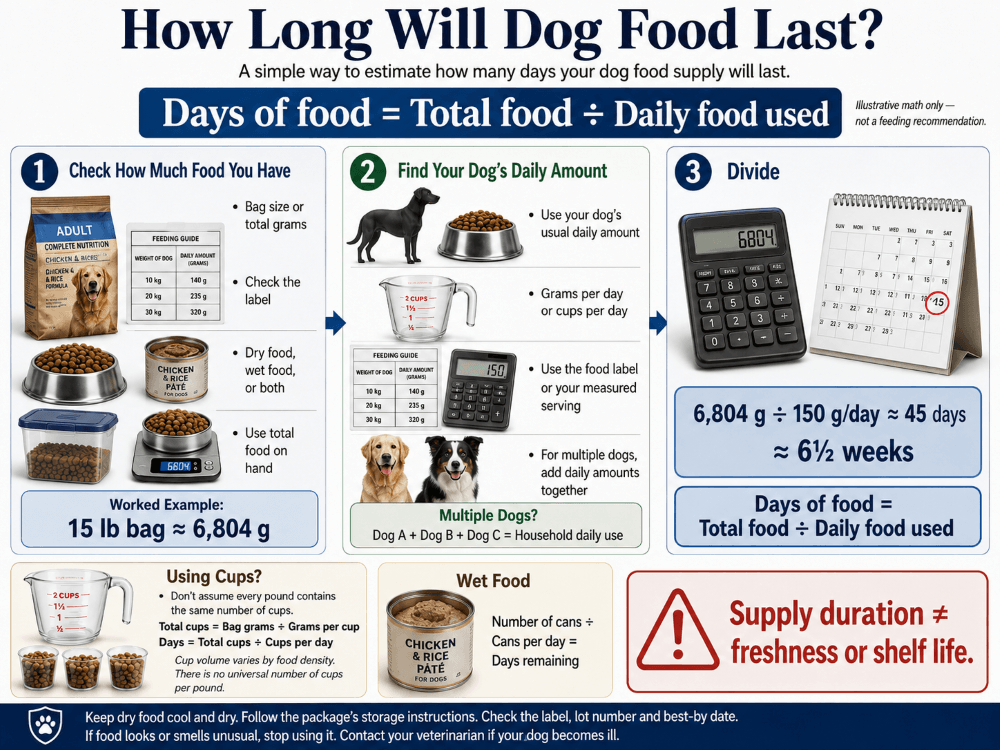
The basic calculation is simple: Days of food = Total amount of food ÷ Amount fed per day
The two amounts need to use compatible units. If your bag is measured in grams, for example, divide by the grams fed per day. Suppose you have a 15-pound bag of kibble. A 15-pound bag contains about 6,804 grams. If your dog eats 150 grams per day:
- 6,804 ÷ 150 = 45.4 days
- That bag should last roughly 45 days, or about 6½ weeks.
This does not mean 150 grams is the correct portion for your dog. The example only demonstrates how to calculate the duration of a known feeding amount.
What If You Feed Dog Food by the Cup?
Cup-based calculations require one extra piece of information. A cup measures volume, while pounds and grams measure weight. Because kibble varies in size, shape, and density, there is no dependable universal rule such as “one pound of dog food equals four cups.” Instead, find the food's grams per cup on the package or from the manufacturer.


- Use:
- Total cups in bag = Bag weight in grams ÷ Grams per cup
- Then:
- Days of food = Total cups ÷ Cups fed per day
- For example, imagine a 30-pound bag contains approximately 13,608 grams, and the kibble weighs 110 grams per cup.
- 13,608 ÷ 110 = about 123.7 cups
- If the dog eats two cups per day:
- 123.7 ÷ 2 = about 61.9 days
- The bag would therefore last approximately 62 days.
The 110-gram figure is only an example. Another kibble may weigh considerably more or less per cup, which changes the result.
Dog Food Duration Chart
The following chart shows how long common dry-food bag sizes would last at several example daily consumption amounts.
| Bag Size | 100 g/day | 200 g/day | 300 g/day | 400 g/day |
|---|---|---|---|---|
| 5 lb | 22.7 days | 11.3 days | 7.6 days | 5.7 days |
| 15 lb | 68 days | 34 days | 22.7 days | 17 days |
| 25 lb | 113.4 days | 56.7 days | 37.8 days | 28.3 days |
| 30 lb | 136.1 days | 68 days | 45.4 days | 34 days |
| 40 lb | 181.4 days | 90.7 days | 60.5 days | 45.4 days |
These numbers are duration examples, not feeding recommendations. Use the amount your individual dog is actually supposed to eat rather than choosing a row based on body weight alone.
Wet Dog Food Case Duration Chart
Wet food is even easier to calculate when your dog eats a predictable number of cans, trays, or pouches each day.
| Case Size | 1 can/day | 2 cans/day | 3 cans/day |
|---|---|---|---|
| 12 cans | 12 days | 6 days | 4 days |
| 24 cans | 24 days | 12 days | 8 days |
| 30 cans | 30 days | 15 days | 10 days |
| 36 cans | 36 days | 18 days | 12 days |
If you use only part of a can at each meal, calculate based on the total cans consumed per day and follow the product's refrigeration and storage instructions once opened.
Dog Food Duration for Multiple Dogs
If two or more dogs eat from the same bag, add their daily amounts together before dividing. For example:
- Dog A eats 180 g/day.
- Dog B eats 270 g/day.
- Combined use = 450 g/day.
- Food on hand = 15 kg, or 15,000 g.
- 15,000 ÷ 450 = 33.3 days
- The household supply should therefore last about 33 days.
How Much Dog Food Do I Need for a Month?
Once you know your dog's daily intake, calculating a 30-day supply is straightforward: Monthly amount = Daily amount × 30
A dog eating 250 grams per day, for example, would use: 250 × 30 = 7,500 grams. That equals 7.5 kg of food every 30 days. Here are several quick examples.
| Daily Use | 30-Day Supply | Approx. Weekly Use |
|---|---|---|
| 100 g/day | 3 kg | 700 g |
| 150 g/day | 4.5 kg | 1.05 kg |
| 200 g/day | 6 kg | 1.4 kg |
| 250 g/day | 7.5 kg | 1.75 kg |
| 300 g/day | 9 kg | 2.1 kg |
| 400 g/day | 12 kg | 2.8 kg |
| 500 g/day | 15 kg | 3.5 kg |
If you measure food in cups, the same idea applies. A dog eating two cups per day would consume approximately 60 cups in 30 days. For wet food, multiply the daily number of cans or pouches by 30. A dog eating 1.5 cans per day would require about 45 cans for 30 days. This calculation can help with autoship schedules, boarding supplies, travel planning, monthly budgeting, and comparing package sizes.
Dog Food Supply Guidelines for Dogs
For a duration calculation, the most useful number is usually what your dog actually eats per day. If your dog receives 240 grams daily, use 240 grams. If you feed twice a day, make sure you enter the total for both meals, not the amount in one bowl.
Package feeding directions can provide a starting point when determining portions, but individual needs vary. Age, activity, body condition, life stage, health status, and the calorie density of the food can all affect an appropriate amount. Feeding directions should therefore be treated as guidelines rather than a guarantee of what every dog needs.
For the duration calculation itself, measuring food by weight is especially useful. A kitchen scale lets you compare a bag's weight directly with grams or ounces fed per day without estimating how many cups are inside. If you prefer cups, use the product-specific grams-per-cup figure. Calorie information on U.S. pet-food labels is commonly expressed per kilogram and per familiar household unit, such as a cup or can, which can also help owners compare different products.
Supply Duration and Freshness Are Two Different Things
A calculator may tell you that a large bag should last 90 days. That does not automatically mean the food should sit open for 90 days under any storage conditions. Use the calculator to plan consumption. Use the package instructions and manufacturer guidance to determine storage and handling. This distinction matters most for small dogs eating very large bags, multi-month supplies, fresh or frozen diets, and opened wet food.
Factors That Can Affect How Long Your Dog's Food Lasts
Several everyday factors can make your real-world supply disappear sooner or later than the calculator predicts.
| Factor | Why It Matters | What to Check |
|---|---|---|
| Daily portion | Larger portions use the supply faster. | Enter the full amount fed each day. |
| Food density | Different kibbles weigh differently per cup. | Use the product's grams per cup. |
| Multiple dogs | Shared food increases daily consumption. | Add every dog's daily amount. |
| Life stage | Portions may change as dogs grow or age. | Recalculate when feeding amounts change. |
| Mixed feeding | Dry and wet supplies may run out at different times. | Calculate each food separately. |
| Training food | Kibble used as rewards still comes from the bag. | Include regular extra use. |
| Food change | New foods may have different density and portions. | Start a new calculation after switching. |
Body weight can influence how much food a dog needs, but it does not need to be the calculator's primary input if you already know the dog's current daily portion.
Common Mistakes to Avoid
Most inaccurate results come from measurement problems rather than complicated math.
| Mistake | Why It Matters | Better Approach |
|---|---|---|
| Pounds ÷ cups | Weight and volume are not interchangeable. | Use the food's grams per cup. |
| Per-meal entry | Entering one meal understates daily use. | Add all meals for the day. |
| Mixed units | Grams, pounds, and cups cannot always be divided directly. | Convert to compatible units first. |
| Ignoring other dogs | Shared bags run out faster than expected. | Add household consumption together. |
| Old portion size | Current intake may differ from past feeding. | Update the calculation after changes. |
| Ignoring extras | Training and enrichment kibble increase use. | Include predictable extra food. |
| Assuming freshness | A long supply estimate does not guarantee storage life. | Follow product storage guidance. |
A calculator is most useful when the inputs describe what is actually happening in your household. Recheck the numbers if the result seems dramatically different from how quickly you normally finish a bag.
How to Store Dog Food Safely While It Lasts
A well-calculated food supply still needs appropriate storage. Keep dry food in a cool, dry location, protect it from excess heat and moisture, and keep the package closed between feedings. Keeping the original bag is useful because the product name, lot number, UPC, manufacturer information, and best-by date may be needed if there is ever a recall or quality concern.
If you place dry dog food inside a storage bin, putting the entire original bag inside the bin is a practical option. If kibble is poured directly into another container, the container should be clean, dry, securely covered, and cleaned between bags so old crumbs and fats do not remain behind. Opened canned or pouched food should be covered and refrigerated promptly when the label permits leftovers to be saved. Discard food that is clearly old, spoiled, contaminated, or stored contrary to the product's directions.
Best-By Date vs. How Long the Bag Lasts
These dates answer different questions. The calculator tells you how quickly your dog or household is expected to consume the supply. The package date tells you information about the manufacturer's intended quality period for the unopened or properly handled product.
Best-by, use-by, and similar dates are set by manufacturers as indicators of when product quality may begin to decline. They should not be replaced by a calculator-generated run-out date. Also keep the lot number. It can identify a particular manufacturing batch and is especially useful if a recall or product complaint occurs.
What If the Food Looks or Smells Wrong?
Do not keep feeding a food simply because the calculator says you have several weeks left. Stop using food that appears contaminated, has an unusual odor or appearance, or is known to be part of a recall. Keep the original package and lot information if you need to contact the manufacturer, report a product problem, or speak with your veterinarian. If your dog becomes ill after eating a food and you suspect the food may be involved, contact your veterinarian promptly.
What to Do If Your Dog Food Runs Out Earlier Than Expected
If your 30-day bag suddenly lasts only three weeks, first check the inputs rather than immediately reducing your dog's food. Confirm the amount being placed in the bowl. If several people feed the dog, make sure everyone is using the same scoop or scale and knows whether the listed quantity is per meal or per day. Then look for food being used elsewhere. Kibble may also be going into:
If your dog's prescribed or appropriate feeding amount has legitimately increased, update the calculator using the new amount. Do not cut your dog's food simply to make a bag last until payday or the next shipment. If cost or supply problems are affecting your ability to maintain an appropriate diet, ask your veterinarian about nutritionally suitable alternatives rather than making a large portion change on your own. A reorder buffer can help prevent future gaps. If the calculator predicts a 45-day supply, for example, ordering around day 38 gives you roughly one week of overlap.
What If the Calculator Says the Food Will Last for Months?
A long result is not necessarily an error. A small dog eating a modest portion can take a long time to finish a large bag. Still, double-check:
Then consider whether buying such a large package makes sense for your storage setup and the manufacturer's recommendations after opening. The lowest price per pound is not always the best value if the package is too large to handle or store appropriately. In some households, smaller bags purchased more frequently may be more practical.
Special Considerations for Certain Dogs
How to Calculate How Long Dog Food Will Last Manually
You do not need a complicated formula. The most important step is making the units match.
Method 1: Calculate by Weight
Use: Days = Total food weight ÷ Daily food weight
Suppose you have 10 kg of food and your dog eats 250 g/day.
- Convert kilograms to grams:
- 10 kg = 10,000 g
- Then divide:
- 10,000 ÷ 250 = 40 days
- Your supply should last approximately 40 days.
Method 2: Convert a Bag of Kibble to Cups
If you know the food's grams-per-cup value:
- Step 1: Convert the bag to grams
- Bag pounds × 453.592 = Bag grams
- Step 2: Calculate cups in the bag
- Bag grams ÷ Grams per cup = Total cups
- Step 3: Calculate duration
- Total cups ÷ Cups per day = Days
- For example:
- 30 lb bag
- 110 g/cup
- 2 cups/day
- 30 × 453.592 = 13,607.8 g
- 13,607.8 ÷ 110 = 123.7 cups
- 123.7 ÷ 2 = 61.9 days
- Estimated duration: about 62 days.
Method 3: Calculate Cans, Trays, or Pouches
Use: Days = Number of containers ÷ Containers used per day
- If you have 24 cans and your dog eats 1.5 cans per day:
- 24 ÷ 1.5 = 16 days
Method 4: Calculate Food for Multiple Dogs
Add everyone's daily portions first: Household daily amount = Dog 1 + Dog 2 + Dog 3
- Then:
- Days = Total food ÷ Household daily amount
Example Calculation
Imagine you buy a 25-pound bag and your dog eats 275 grams per day.
- Convert the bag:
- 25 × 453.592 = 11,339.8 g
- Calculate the duration:
- 11,339.8 ÷ 275 = 41.2 days
- The bag should last approximately 41 days, or just under six weeks.
If you want a seven-day reorder buffer, plan to purchase or ship the next bag at about day 34.
Dog Food Unit Conversion Chart
These conversions can help when your package and feeding amount use different weight units.
| Unit | Conversion | Useful For |
|---|---|---|
| 1 lb | 453.592 g | Converting U.S. bag weights to grams. |
| 1 kg | 1,000 g | Matching kilogram bags with gram portions. |
| 1 kg | About 2.205 lb | Comparing metric and imperial package sizes. |
| 1 oz | About 28.35 g | Converting smaller food portions. |
| 1 cup | Varies by food | Use the product's grams-per-cup value. |
Do not substitute a generic cups-per-pound conversion for the product's actual density.
How Long Will Dog Food Last Infographic
Frequently Asked Questions
The Bottom Line
The easiest way to determine how long dog food will last is: Total food amount ÷ Daily food amount = Days of food
When possible, use weight-based measurements such as grams because they avoid guessing how many cups are in a bag. If you feed by volume, use the particular food's grams-per-cup value instead of relying on a generic cups-per-pound estimate. Use the calculator to plan purchases, refill dates, travel supplies, and monthly food needs, but remember that it estimates consumption, not food freshness or nutritional requirements.
Store food appropriately, keep the original package or identifying information, and follow product-specific handling instructions. If you also need help estimating how much your dog should eat, a dry dog food calculator, dog calorie calculator, dog feeding calculator, dog food transition calculator, or dog protein calculator can help you explore that question separately. You can also check out the best dry dog food and soft dry dog food guide.