What to Do If Your Dog Is Choking: 9 Life-Saving Steps


Canine Bible is reader-supported. We receive affiliate commissions via some of our links. Learn more.
If your dog is choking, act quickly by checking the mouth for a visible obstruction, removing it only if it can be reached safely, and seeking emergency veterinary care. If your dog cannot breathe, cough effectively, or stay conscious, immediate first-aid measures may be needed while you head to a veterinarian. Choking can become life-threatening within minutes, so recognizing the signs early is critical. However, coughing, gagging, reverse sneezing, and choking can sometimes look similar, making it important to know the difference. The correct response may also depend on your dog’s size, whether the airway is partially or completely blocked, and what caused the obstruction. Even after an object is removed, throat injuries, swelling, or inhaled material can cause complications. This guide explains how to recognize choking, what steps to take in an emergency, what to avoid, and when your dog needs immediate veterinary attention.
What Can Cause a Dog to Choke?
Dogs can choke on objects they swallow whole, that compress in the throat, or that lodge at the entrance to the airway. Balls and toys that are small relative to the dog’s mouth are particularly concerning because a smooth, round object can seal the airway tightly. Food chunks, chew pieces, bones, sticks, and fragments of damaged toys can also become obstructive.
Not everything described as “choking” involves a foreign object. Allergic swelling, laryngeal disease, collapsing airways, trauma, and other respiratory emergencies can produce similar distress, which is another reason persistent breathing difficulty needs veterinary assessment even when no object is found.
How to Tell If Your Dog Is Actually Choking
Dogs may cough, gag, retch, reverse sneeze, regurgitate, or paw at their mouths for reasons that do not involve a blocked windpipe. What makes choking especially concerning is reduced airflow: the dog appears to be trying to breathe or cough, but little or no sound and air movement are produced. Extending the neck, becoming frantic, producing unusually high-pitched breathing sounds, or developing pale, gray, or bluish gums also raises concern.
| Situation | What You May Notice | What It Means |
|---|---|---|
| Severe choking | Silent or weak coughing, distress, little airflow, pale or blue gums. | Airway may be critically blocked; begin emergency action. |
| Partial obstruction | Noisy breathing or coughing while some air still moves. | Can worsen suddenly and still needs urgent veterinary care. |
| Productive cough | Strong repeated coughs with obvious airflow between episodes. | Allow coughing while arranging veterinary assessment if persistent. |
| Gagging or retching | Throat contractions occur, but normal breathing continues between them. | May involve throat, stomach, or esophageal irritation. |
| Esophageal object | Drooling, repeated swallowing, gagging, or regurgitating food or water. | The swallowing tube may be blocked rather than the airway. |
What to Know Before Helping a Choking Dog
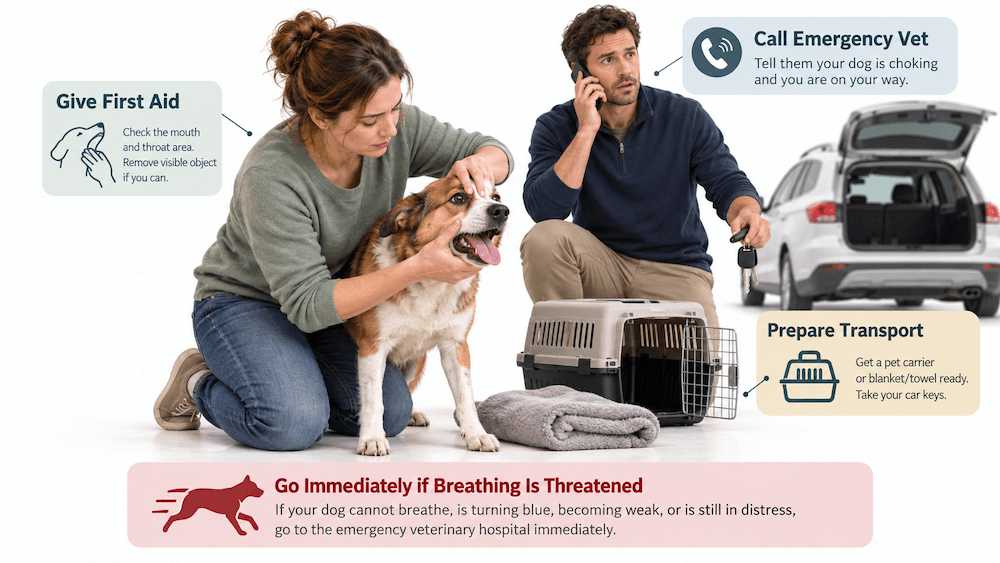
A panicked dog may bite even if it is normally gentle, so first aid must protect both the dog and the person helping. Avoid placing your face directly in front of the mouth, and do not muzzle a dog that is struggling to breathe. If another person is present, have them contact the nearest emergency veterinary hospital and prepare transportation while you provide first aid.


Do not spend precious time gathering equipment. Choking first aid relies mainly on recognizing impaired airflow and using appropriate physical maneuvers. If your dog is still moving air and producing a strong cough, allow the dog to cough rather than immediately applying forceful thrusts; intervention becomes more important when coughing is weak, silent, ineffective, or breathing is clearly failing.
What to Do If Your Dog Is Choking but Still Conscious
A conscious dog with a severe airway obstruction needs immediate assistance. The sequence below is intended for a dog that appears unable to cough effectively or move enough air—not a dog simply coughing strongly after swallowing something.
1. Get Emergency Veterinary Help Moving
Have someone call the nearest open veterinary hospital while you start first aid. If possible, put the phone on speaker so the clinic can give instructions while another person prepares the vehicle. Do not delay airway-clearing efforts during a serious obstruction just to make the call.
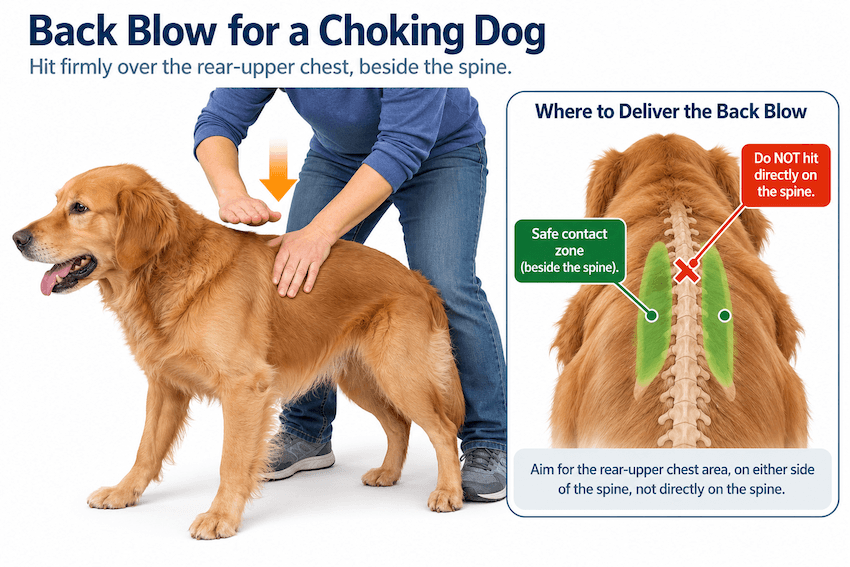
2. Give Up to Five Firm Back Blows
Position yourself safely beside or behind your dog. Using the heel of your hand, give up to five firm blows over the back of the chest, slightly to either side of the spine rather than directly on the spinal column. The goal is to create enough pressure and vibration inside the chest to help expel the obstruction.


3. Lower the Head When It Can Be Done Safely
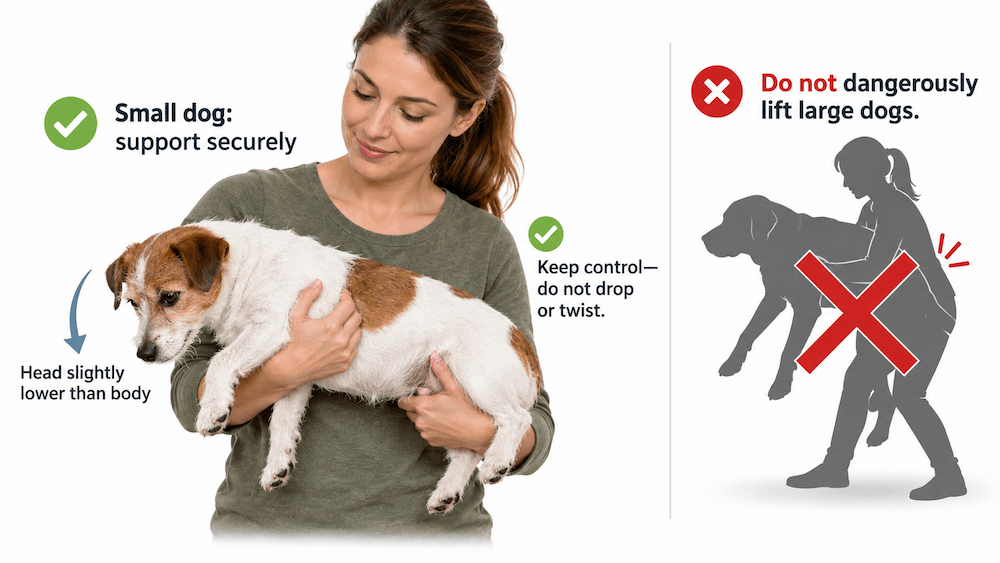
For some dogs, positioning the head lower than the chest can allow gravity to assist while additional back blows are given. This may be practical for a small dog that can be securely supported or for a larger dog whose hindquarters can be elevated without dropping or twisting the animal. Do not waste time struggling to lift a heavy dog or use a position that could injure you or your pet.
4. Try an Alternative Thrust Technique if the Blockage Persists
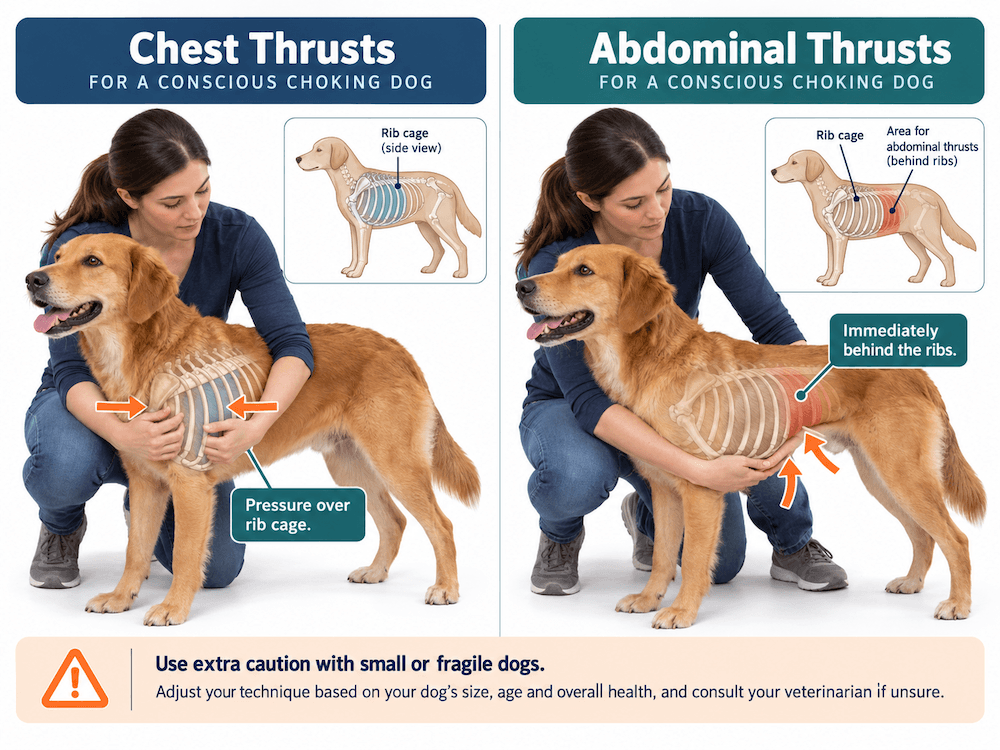
If back blows fail, chest thrusts or carefully performed abdominal thrusts may help generate pressure to expel the object. For chest thrusts, rapid inward pressure is applied to the rib cage; abdominal thrusts apply quick pressure just behind the ribs directed inward and toward the chest. These maneuvers can cause injury if they are excessively forceful, particularly in very small, thin, pregnant, injured, or medically fragile dogs.
5. Reassess Breathing After Each Attempt
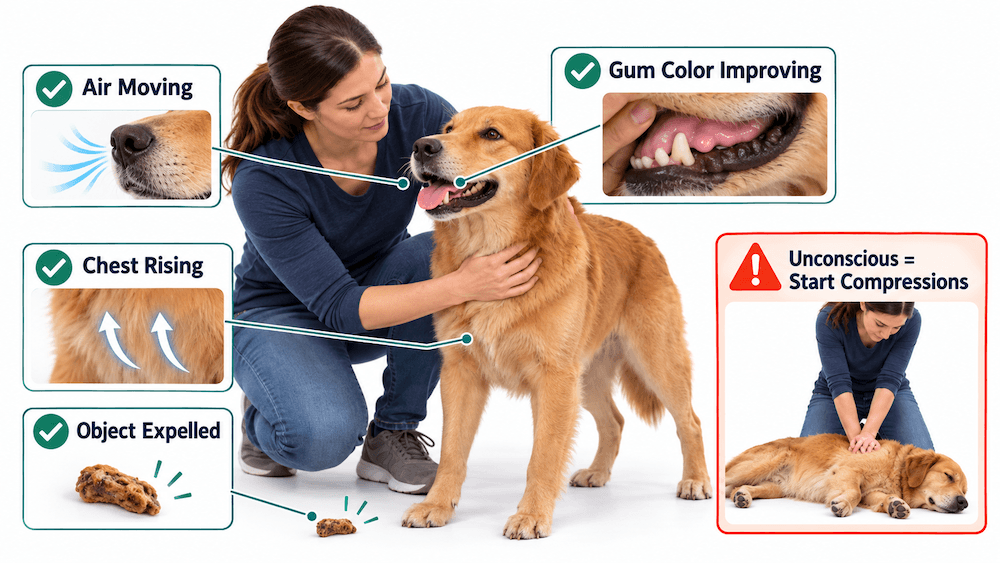
Watch for a return of normal airflow, stronger coughing, normalizing gum color, or the object being expelled. Once the dog can breathe effectively, stop forceful choking maneuvers and proceed to veterinary care rather than continuing to press on the chest or abdomen. If the dog collapses or becomes unconscious, switch immediately to the unconscious-dog sequence below.
What to Do If a Choking Dog Becomes Unconscious
An unconscious choking dog should be treated differently from a conscious dog. Lay the dog on a firm surface and begin chest compressions rather than spending an extended period searching inside the mouth. The repeated changes in chest pressure may themselves help dislodge an airway obstruction.
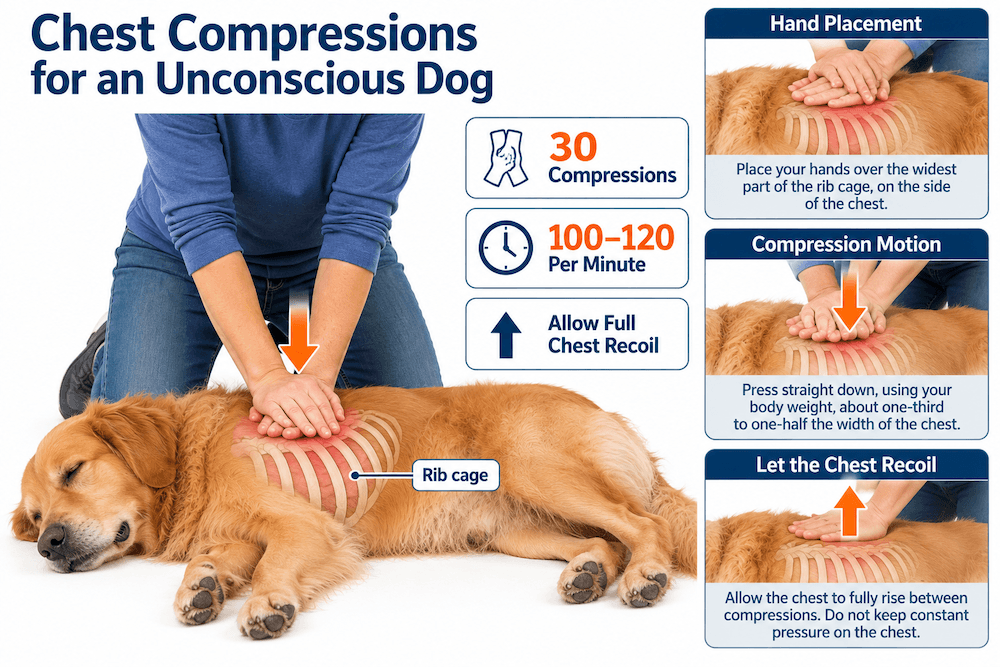
1. Give 30 Chest Compressions
Place the dog on its side on a firm surface unless its body shape or circumstances make another position necessary. Give 30 chest compressions at approximately 100–120 compressions per minute, allowing the chest to recoil between compressions. For most dogs lying on their side, compress the chest approximately one-third to one-half of its width.
2. Check the Mouth for a Visible Object
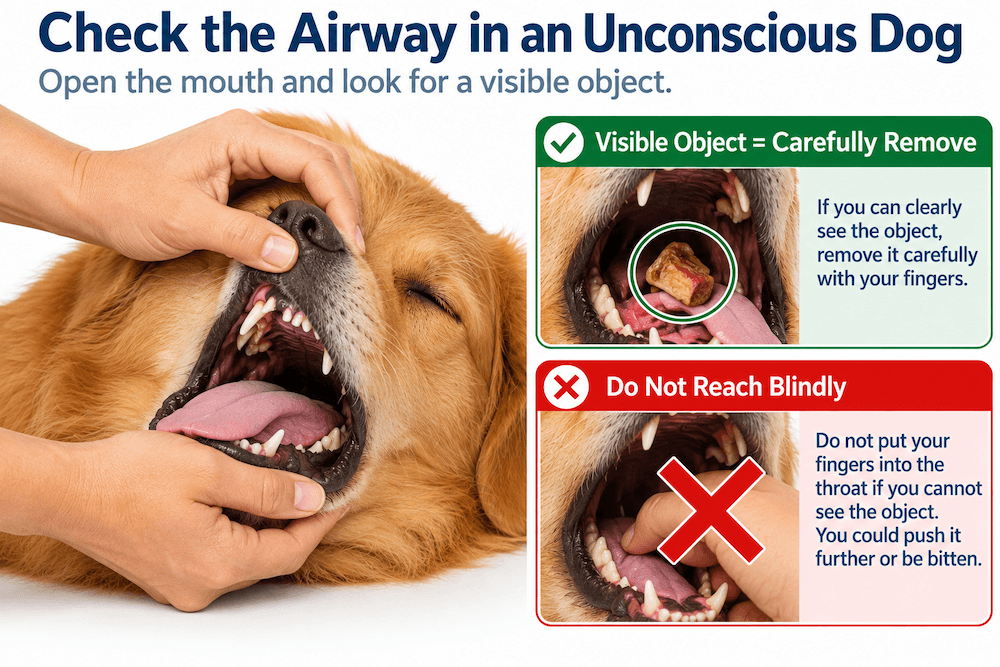
After the 30 compressions, briefly open the mouth and look for the obstruction. If an object is clearly visible and can be removed safely, carefully take it out. Keep this check short so lifesaving compressions are not delayed. Do not sweep fingers blindly through the throat. A blind sweep can push an object deeper or injure the mouth and airway.
3. Give Two Mouth-to-Nose Rescue Breaths
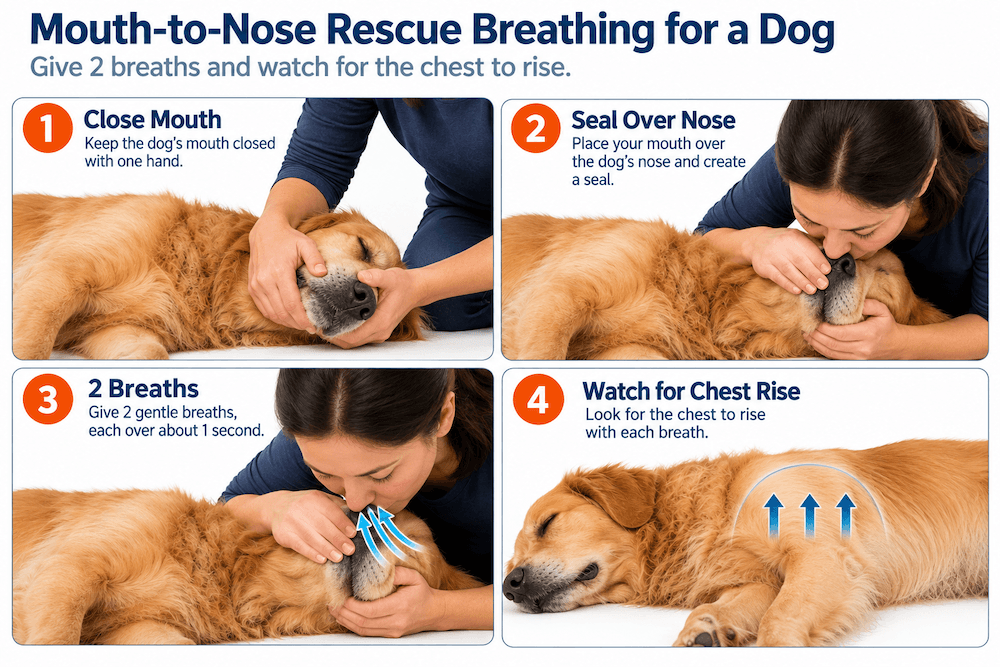
If the dog remains unconscious, close the mouth, extend the head and neck into a natural straight alignment, seal your mouth around the nose, and deliver two rescue breaths. Each breath should create visible but not excessive chest rise. If the chest does not rise, an obstruction may still be preventing airflow. Return immediately to chest compressions rather than spending a long period repeatedly blowing against a blocked airway.
4. Repeat the CPR-Airway Cycle
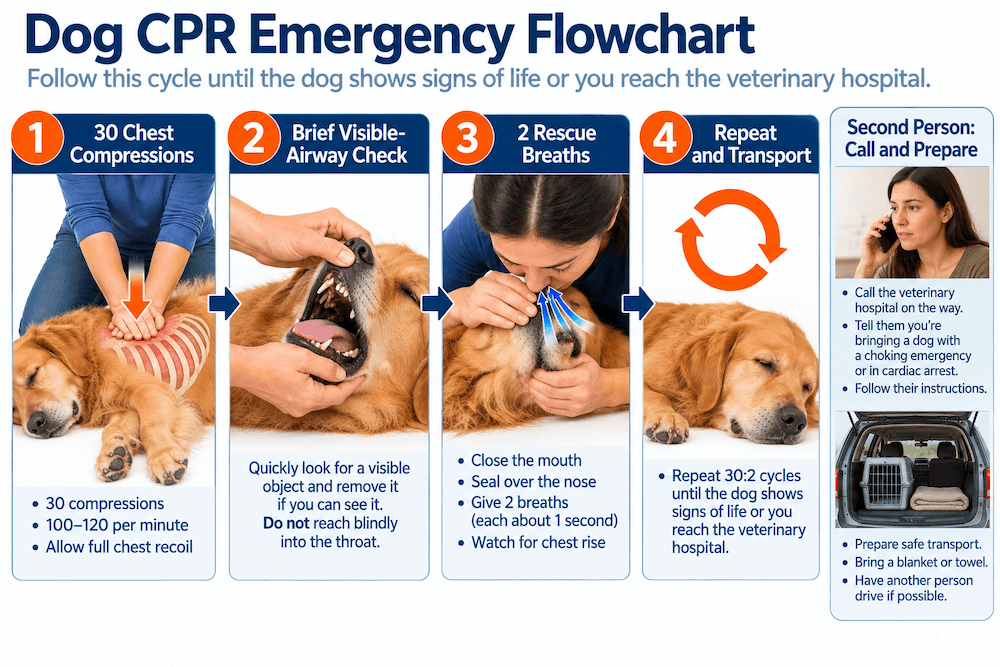
Continue the sequence of 30 compressions, a brief airway check, and two rescue breaths until the obstruction clears, the dog begins breathing, veterinary help takes over, or you reach the veterinary hospital. If another person is available, one person can prepare transport while the other continues lifesaving measures.
What Not to Do When Your Dog Is Choking
Several instinctive reactions can make an obstruction harder to remove or cause additional injury. The table below highlights mistakes to avoid so emergency actions stay focused on restoring airflow and reaching veterinary care.
| Mistake | Why It Can Be Harmful | Safer Approach |
|---|---|---|
| Blind finger sweep | May push the obstruction farther into the airway. | Remove only clearly visible objects from an unconscious dog. |
| Reaching into a conscious mouth | A panicked dog may bite or aspirate the object deeper. | Start with recommended external airway-clearing maneuvers. |
| Giving food or water | It will not reliably clear an airway obstruction. | Focus on airflow and emergency veterinary transport. |
| Repeated hard abdominal thrusts | Excessive force can injure internal structures. | Use them cautiously after back blows fail. |
| Assuming recovery means safety | Delayed airway or lung complications may still occur. | Have the dog examined after significant choking. |
| Delaying transport | Professional airway treatment may still be needed. | Begin transport as soon as safely possible. |
Do not pour oil, water, or other liquids into a choking dog’s mouth in an attempt to lubricate the obstruction. Likewise, avoid pulling aggressively on sharp objects, string, fishhooks, bones, or material that appears embedded in tissue; removing these improperly can cause bleeding or deeper injury.
When to Go to the Emergency Vet Immediately
A dog that required physical intervention to clear an airway obstruction should be examined by a veterinarian even if breathing appears normal afterward. Throat trauma, swelling, inhalation of food or fluid, chest injury, and delayed lung complications may not be obvious immediately after the event.
Immediate veterinary attention is especially important when any of the following occur:
A dog that continues struggling to breathe should not be forced to lie in an uncomfortable position during transport. Allow the dog to assume the position that makes breathing easiest unless CPR is necessary.
What Happens at the Vet After a Choking Episode
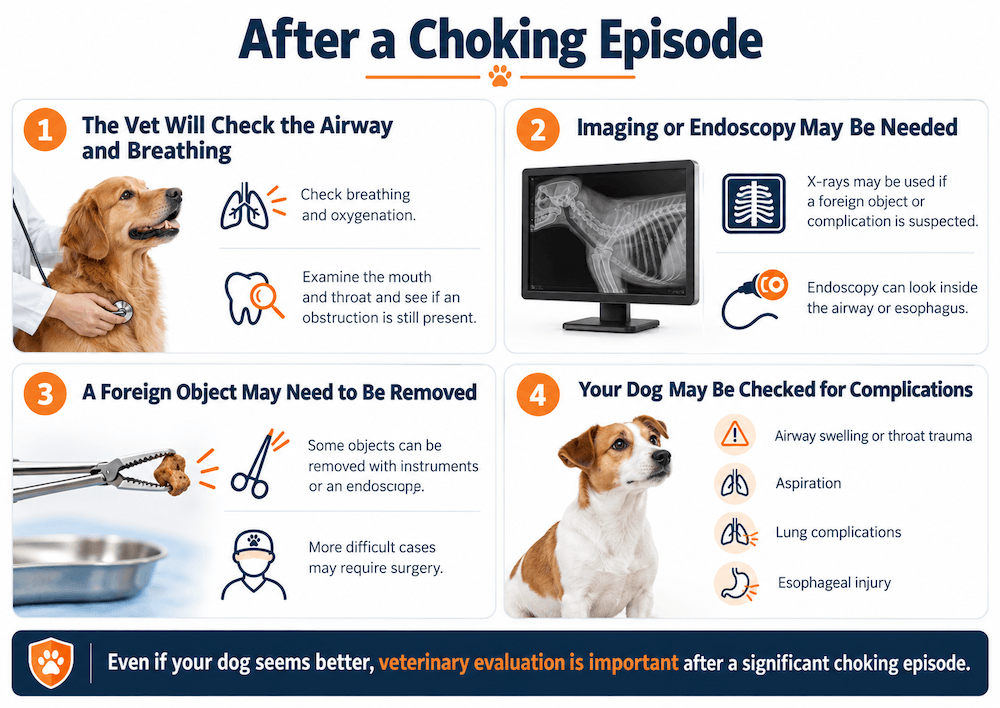
After a choking episode, a veterinarian may assess your dog’s airway and breathing, use imaging or endoscopy to look for a remaining obstruction, and remove any foreign material if needed. They may also check for complications such as throat trauma, aspiration, lung problems, or esophageal injury.
What to Monitor After Your Dog Stops Choking
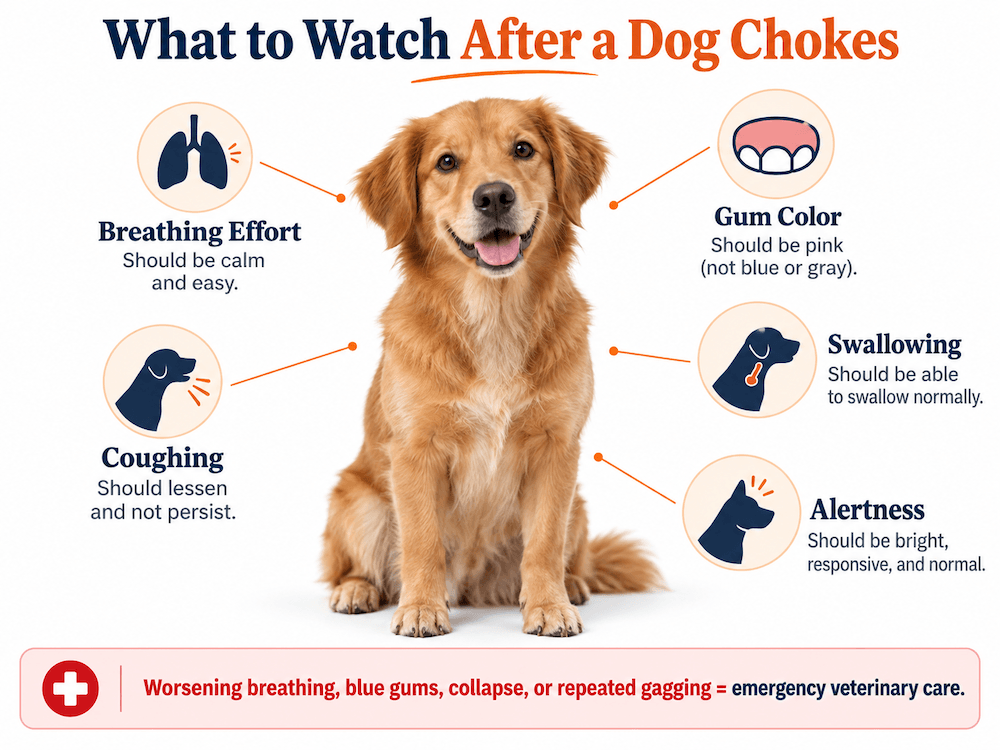
Once normal breathing returns, keep the dog calm and limit unnecessary activity during transport to the veterinarian. Pay attention to breathing effort, coughing, gum color, alertness, swallowing, and whether blood or excessive saliva is present. Tell the veterinary team what the dog may have choked on and exactly which first-aid maneuvers were used.
How to Prevent Choking in Dogs
Most choking prevention comes down to choosing safer items, supervising chewing, slowing fast eaters, and preparing for emergencies before they happen. Use this table as a quick prevention checklist.
| Prevention Step | What to Do |
|---|---|
| Choose properly sized toys | Avoid balls or toys small enough to slip behind your dog’s teeth. |
| Supervise chews and treats | Remove pieces once they become small enough to swallow whole. |
| Slow fast eaters | Use smaller portions, suitable food sizes, or a slow feeder. |
| Replace damaged toys | Discard cracked or torn toys before loose fragments break off. |
| Know your emergency vet | Save the nearest open emergency clinic’s details before you need them. |
| Learn pet CPR | Take a pet first-aid course so emergency steps are familiar. |
What Veterinary Guidelines Say About Choking First Aid in Dogs
The 2026 RECOVER First Aid Guidelines for Dogs and Cats provide the most current veterinary consensus guidance specifically addressing foreign-body airway obstruction outside the hospital. They recommend up to five back blows beside the spine as the first maneuver for a conscious choking dog and advise trying alternative techniques if those are unsuccessful. They also recommend against reaching into the mouth of a conscious animal and against blind finger sweeps in an unconscious animal.[1]
The same RECOVER guidelines changed the recommended approach when a choking dog becomes unconscious. Rather than searching the mouth first, the guidance calls for 30 chest compressions at 100–120 per minute, followed by a brief visual airway check and removal only if the object can actually be seen, then two mouth-to-nose breaths. The sequence is repeated while arranging transport, and veterinary evaluation is recommended after any episode requiring first-aid intervention.[1]
The 2024 RECOVER CPR Guidelines, published in the Journal of Veterinary Emergency and Critical Care, also support a compression rate of 100–120 per minute for dogs and cats and a 30:2 compression-to-ventilation ratio for non-intubated patients receiving single-rescuer CPR. These recommendations help standardize the CPR portion of care if choking progresses to cardiopulmonary arrest.[2]
Frequently Asked Questions
The Bottom Line
If your dog is choking, the priority is to determine whether air is still moving and act quickly if breathing is severely impaired. A dog that can cough strongly may still be moving air, while weak or silent coughing, abnormal gum color, severe distress, or collapse can signal a critical airway obstruction. Conscious dogs with a severe obstruction may need back blows followed by other airway-clearing techniques if the blockage does not move. If your dog becomes unconscious, chest compressions, a brief airway check, and rescue breaths become the focus while emergency veterinary care is arranged. Avoid blind finger sweeps, giving food or water to force an object down, or continuing forceful maneuvers after normal breathing returns. Dogs that require choking first aid should be evaluated by a veterinarian because airway irritation, injury, or respiratory complications may not be immediately obvious. Choosing appropriately sized toys and chews, supervising chewing, slowing fast eaters, and learning pet first aid can also help reduce future risk.
If your dog swallows an object instead of choking on it, our guide to intestinal blockage in dogs explains the warning signs and when a swallowed item can become an emergency. For safer chewing choices, see our guide to choosing bones for dogs, including important choking and dental considerations. You can also use our dog symptom checker to better understand when coughing, breathing changes, weakness, or other symptoms may require veterinary attention.