What to Do If Your Dog Bites Someone: Steps, Legal Concerns & Prevention

Canine Bible is reader-supported. We receive affiliate commissions via some of our links. Learn more.
If your dog bites someone, immediately separate the dog from the person, secure your dog safely, and make sure the injured person receives appropriate first aid or medical care. Even a minor-looking bite should be cleaned promptly because broken skin can become infected. What happens next can depend on the severity of the injury, your dog’s vaccination status, the circumstances of the bite, and local reporting requirements. Owners may also need to exchange contact information, document what happened, and cooperate with medical, animal-control, or public-health officials. But not every dog bite is the same, and factors such as provocation, bite location, and previous behavior can affect what steps are necessary. Understanding what to do in the first few minutes—and what mistakes to avoid afterward—can help protect the injured person, your dog, and you. This guide explains the immediate response, medical concerns, reporting considerations, and practical steps to take after a dog bite.
What to Do Immediately After Your Dog Bites Someone
The first few minutes should focus on preventing another bite and caring for the injured person. Stay calm and keep your dog completely separated while the situation is assessed.
1. Separate and Secure Your Dog
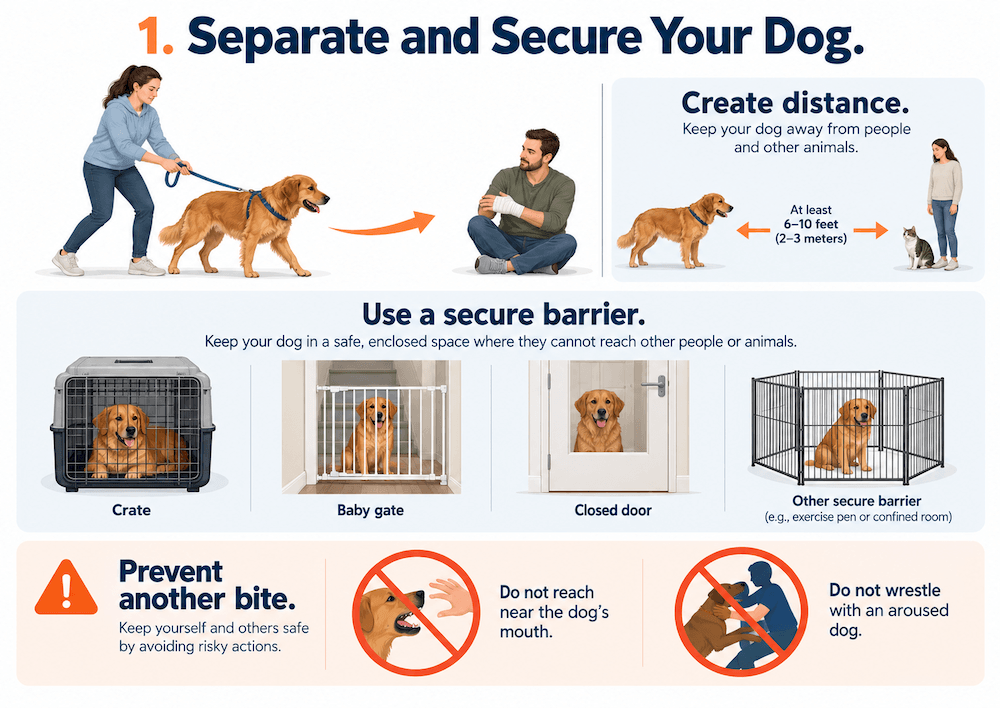
Move your dog away from the injured person and secure them behind a closed door, gate, crate, or another reliable barrier. Avoid grabbing near the dog’s mouth or physically wrestling with an aroused dog whenever possible. Keep the dog separated from other people and animals while everyone settles down.
2. Check the Injured Person
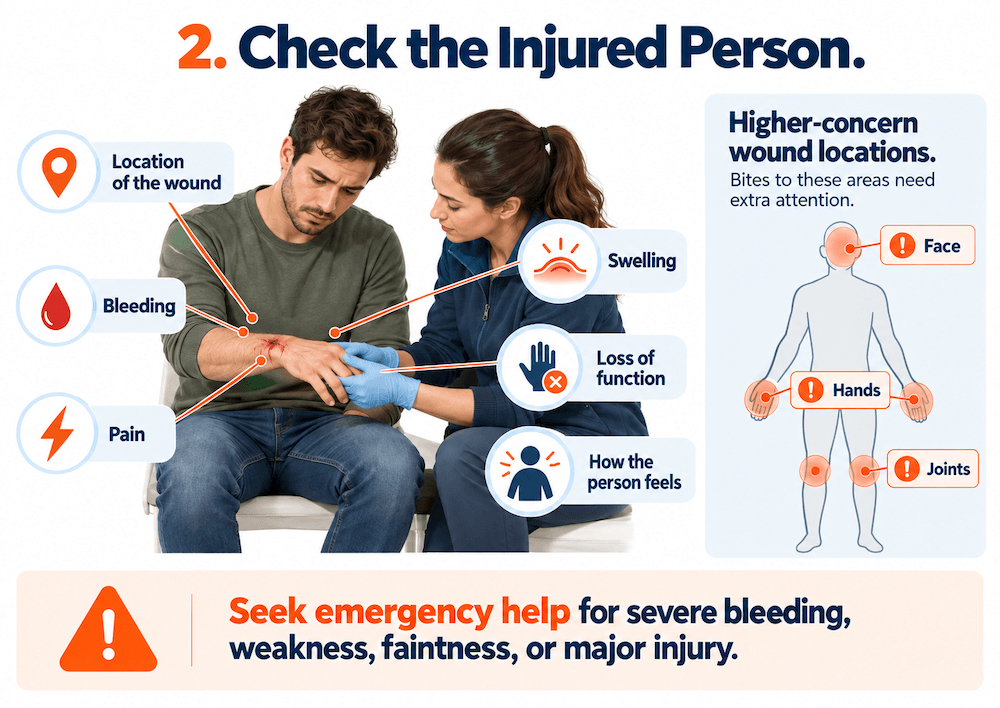
Look at the location and apparent severity of the injury and ask how the person is feeling. Deep punctures, torn tissue, severe pain, loss of function, or wounds involving the face, hands, or joints deserve particular attention. If bleeding is severe or the person feels weak, faint, or otherwise unwell, seek emergency medical help.
3. Clean the Wound
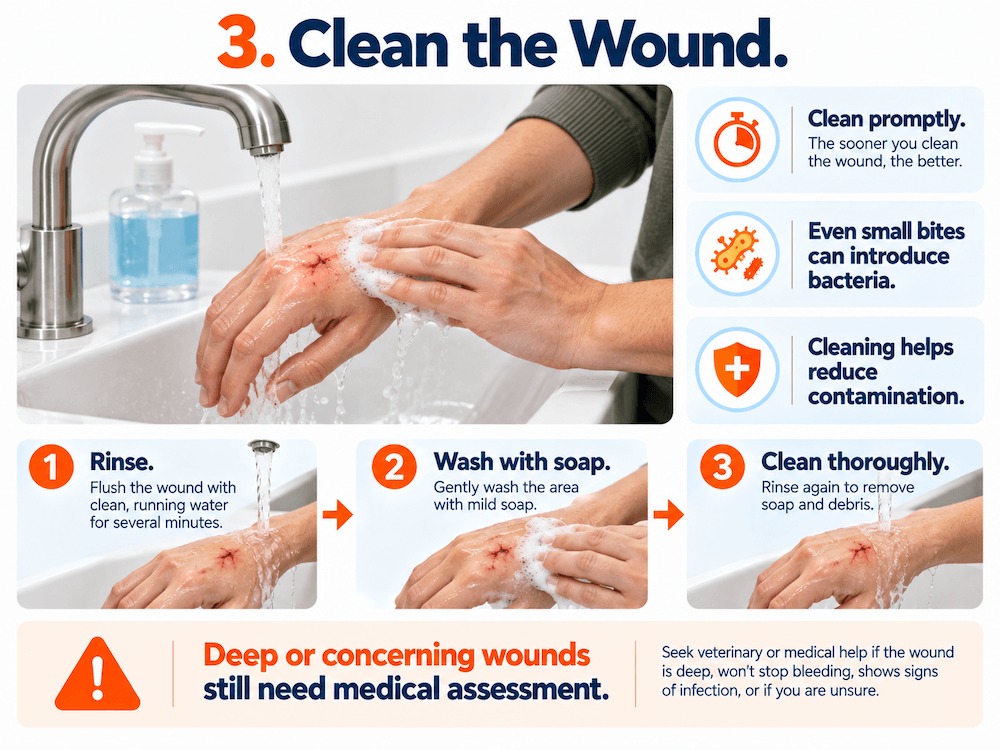
If the bite is minor and the person can safely do so, wash the area thoroughly with soap and running water. Even a small break in the skin can introduce bacteria from the dog’s mouth, similar to what can happen when a dog licks an open cut. Cleaning the wound promptly helps reduce contamination, but it does not replace medical assessment when the bite is deep or otherwise concerning.


4. Control Active Bleeding
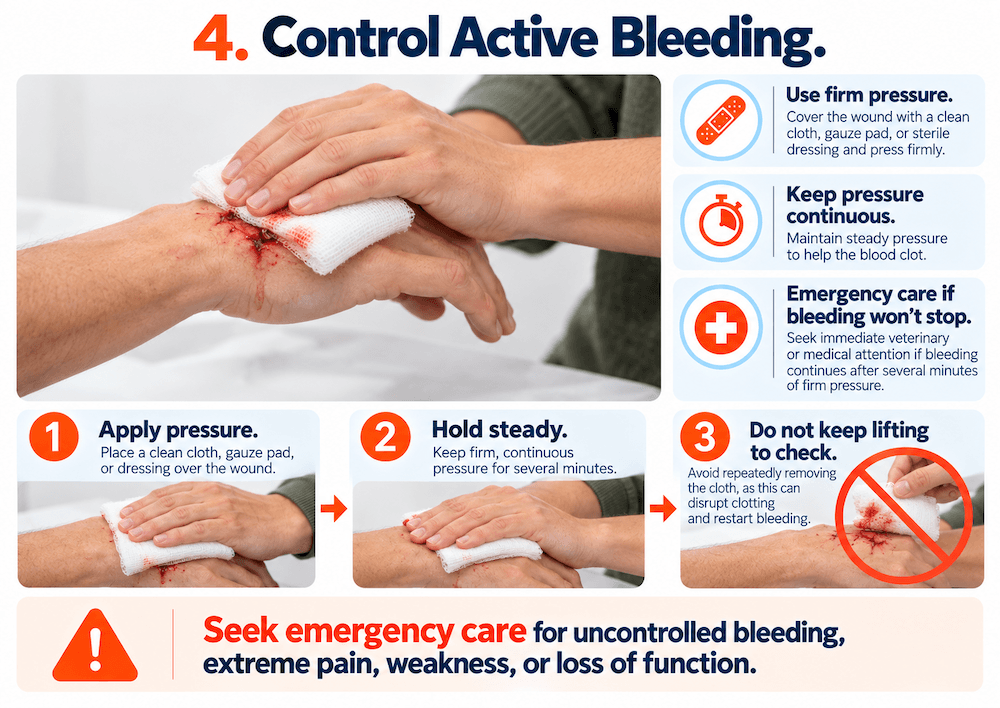
Apply firm pressure with a clean, dry cloth or dressing if the wound is actively bleeding. Continue pressure rather than repeatedly lifting the material to check the wound. Bleeding that cannot be controlled, extreme pain, weakness, or loss of function warrants emergency care.
5. Exchange Contact and Rabies Information
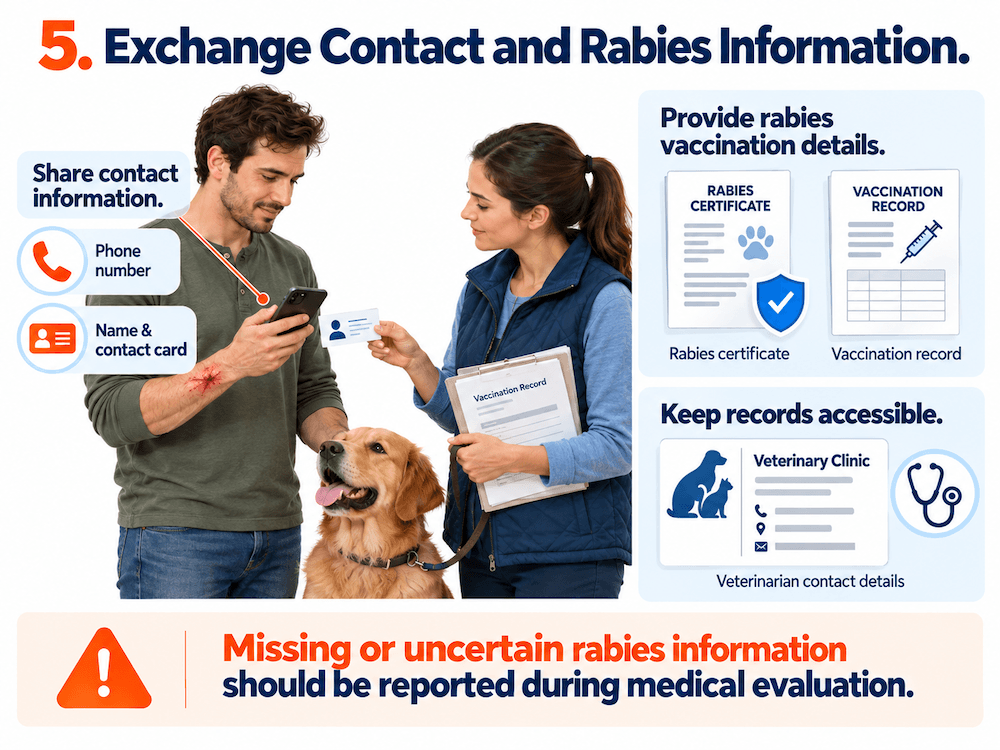
Give the injured person your name and contact information along with available information about your dog’s rabies vaccination. Keep the veterinarian’s contact information and rabies certificate accessible in case medical or public-health professionals need to verify the dog’s status. If vaccination information is missing or uncertain, the injured person should mention this when seeking medical advice.
6. Document What Happened
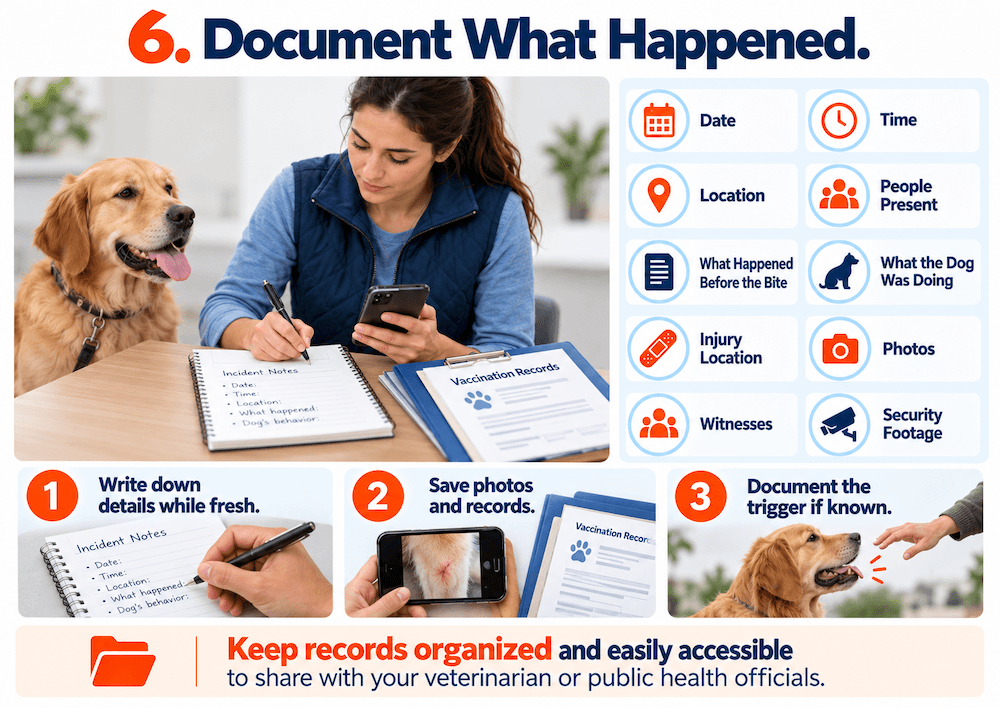
Write down the date, time, location, people present, and events immediately before and after the bite while the details are still fresh. Note what the dog and person were doing, whether there appeared to be a trigger, and the general location of the injury. Preserve photographs, witness information, vaccination records, and any relevant security-camera footage.
If the dog is still actively attacking, prioritize getting people to safety rather than putting your hands near the dog’s mouth. Emergency medical services should be contacted for severe injury, uncontrolled bleeding, extreme pain, weakness, or loss of function.


When Does a Dog Bite Need Medical Attention?
A bite can appear small while still creating a deeper puncture beneath the skin. Medical urgency depends on the depth and location of the injury, the person’s health, infection risk, bleeding, and potential rabies or tetanus exposure.
| Situation | What to Watch For | Recommended Action |
|---|---|---|
| Minor superficial wound | Small break in the skin with bleeding that stops easily. | Clean thoroughly and monitor closely. |
| Puncture or deep bite | Teeth penetrated deeply or tissue was torn or crushed. | Seek prompt medical assessment. |
| Hand, face, or joint injury | Sensitive structures or areas prone to complications may be involved. | Medical evaluation is advisable. |
| Infection signs | Increasing redness, warmth, swelling, pain, drainage, or fever. | Contact a healthcare professional promptly. |
| Higher-risk person | The person has a weakened immune system or another condition that may increase complication risk. | Seek medical advice rather than relying only on home monitoring. |
| Rabies uncertainty | Vaccination status is unknown, the dog is acting abnormally, or rabies exposure may be possible. | Seek prompt medical and public-health guidance. |
| Major injury | Uncontrolled bleeding, extreme pain, weakness, exposed tissue, or loss of function. | Seek emergency medical care. |
Animal bites are considered saliva-contaminated wounds when tetanus prevention is assessed. Whether a tetanus-containing vaccine or other preventive treatment is needed depends on the wound and the person’s vaccination history. Rabies risk also needs to be considered separately from wound severity. A healthcare professional or public-health authority can determine whether post-exposure treatment is necessary based on the dog, vaccination history, availability for observation, local rabies epidemiology, and circumstances of the bite.
Reporting & Documentation of the Dog Bite
Once everyone is safe and the person’s immediate medical needs have been addressed, create a detailed record of the incident. Dog-bite reporting, confinement, and quarantine requirements vary by country, state, and municipality, so check with the appropriate local animal-control or public-health authority.
Do not alter the account of what occurred or pressure the injured person not to report the bite. A factual record is more useful than trying to assign blame while the incident is still being evaluated.
What Happens to Your Dog After It Bites Someone?
A bite does not automatically mean a dog will be euthanized. The outcome can depend on local law, bite severity, vaccination status, previous incidents, the circumstances surrounding the bite, and whether public-health officials have concerns about rabies.
| Possible Outcome | What It May Involve | What Owners Should Do |
|---|---|---|
| Observation or confinement | The dog may be monitored at home or another approved location. | Follow all public-health or animal-control instructions. |
| 10-day rabies observation | Healthy dogs in the U.S. are commonly observed for 10 days. | Keep the dog available and report illness immediately. |
| Investigation | Authorities may review bite severity, circumstances, and prior incidents. | Provide accurate records and cooperate with requests. |
| Veterinary examination | A health or behavior assessment may be required. | Attend promptly and provide vaccination records. |
| Safety restrictions | Leash, muzzle, fencing, or containment rules may be imposed. | Follow restrictions exactly to prevent another incident. |
| Dangerous-dog designation | Some jurisdictions impose additional legal requirements after serious bites. | Check local rules and comply with all conditions. |
| Euthanasia consideration | Not automatic; it depends on law and case-specific factors. | Follow official guidance and seek professional advice if needed. |
Could You Be Legally or Financially Responsible If Your Dog Bites Someone?
Legal responsibility after a dog bite depends on local law. Depending on the jurisdiction, liability may be based on strict liability, negligence, or whether the owner knew or should have known the dog posed a risk. Factors such as provocation, trespassing, prior behavior, leash-law compliance, and where the bite occurred can also matter.
Financial responsibility may include medical bills, lost income, property damage, pain and suffering, or other losses. Homeowners or renters insurance may provide liability coverage for dog bites, but exclusions, coverage limits, prior bite history, and insurer requirements vary by policy.
Owners should not assume that a first bite, a provoked incident, or a bite on private property automatically eliminates liability. For serious injuries, disputed circumstances, insurance claims, or questions about legal responsibility, seek guidance from the appropriate insurer or a qualified professional familiar with local law.
Dog Bite Liability Laws by State
Dog-bite liability differs considerably across the United States. The table below summarizes the general civil liability approach in all 50 states, but exceptions involving provocation, trespassing, location, prior behavior, local ordinances, and comparative fault may change the outcome of an individual case.
| State | General Liability Rule | Key Conditions / Exceptions |
|---|---|---|
| Alabama | Limited statutory strict liability | Mainly applies on the owner’s property or after pursuit from it; provocation and prior knowledge affect damages. |
| Alaska | Knowledge / negligence | Liability may depend on known dangerous tendencies or negligent control. |
| Arizona | Strict liability | Victim must be in public or lawfully on private property; provocation is a defense. |
| Arkansas | Knowledge / negligence | Known dangerous tendencies or negligent restraint can create liability. |
| California | Strict liability for bites | Applies in public or when the victim is lawfully on private property. |
| Colorado | Limited strict liability | Generally covers economic damages for serious bite injuries; several statutory exceptions apply. |
| Connecticut | Strict liability | Trespassing, another tort, or provoking the dog can provide defenses. |
| Delaware | Strict liability | Exceptions include trespassing, certain criminal acts, and provoking the dog. |
| Florida | Strict liability | Comparative fault can reduce damages; trespassing and certain warning-sign rules may apply. |
| Georgia | Knowledge / negligence-based | Dangerous tendencies, owner knowledge, restraint violations, and provocation can matter. |
| Hawaii | Negligence-based | Prior knowledge need not always be shown, but owner negligence generally must be established. |
| Idaho | Strict liability | Trespassing, physical provocation, and other specific statutory exceptions may apply. |
| Illinois | Strict liability | Victim generally must be acting peaceably and lawfully; provocation is a defense. |
| Indiana | Mixed / limited statutory liability | Special protection applies to certain public-duty workers; other cases may rely on negligence or prior knowledge. |
| Iowa | Strict liability | Exceptions include unlawful acts contributing to the injury and certain rabies-related situations. |
| Kansas | Knowledge / negligence | Liability may arise from known abnormal danger or negligent failure to prevent harm. |
| Kentucky | Strict liability | Owners are broadly responsible for damage caused by their dogs; other fault rules may still matter. |
| Louisiana | Modified strict liability | Generally requires an unreasonable risk, preventable injury, and absence of victim provocation. |
| Maine | Strict liability off owner’s premises | Incidents on the owner’s property generally require another liability theory. |
| Maryland | Mixed rule | Strict liability applies when dogs run at large; other cases include a presumption of owner knowledge. |
| Massachusetts | Strict liability | Trespassing, another tort, or provoking the dog may defeat liability. |
| Michigan | Strict liability for bites | Victim must be lawfully present; provocation is a defense. |
| Minnesota | Strict liability | Victim must generally be acting peaceably and be somewhere they may lawfully be. |
| Mississippi | One-bite / knowledge rule | Prior dangerous tendencies, owner knowledge, and foreseeability are important. |
| Missouri | Strict liability for bites | Provocation is a defense; victim fault can reduce damages. |
| Montana | Limited strict liability | Statute applies to bites in incorporated cities or towns; provocation is a defense. |
| Nebraska | Strict liability | Trespassers are excluded; playful or mischievous conduct may fall outside the statute. |
| Nevada | Negligence-based | No general statewide bite statute; animal-control violations may help establish negligence. |
| New Hampshire | Strict liability | Broadly covers harm caused by dogs; trespass or another tort can be a defense. |
| New Jersey | Strict liability for bites | Applies in public or when the victim is lawfully on private property. |
| New Mexico | Knowledge / negligence | Known dangerous tendencies or negligent control can support liability. |
| New York | Strict liability or negligence | Prior dangerous tendencies support strict liability; ordinary negligence claims are also allowed. |
| North Carolina | Mixed rule | Strict rules cover dangerous dogs and certain dogs running at large; other claims may require knowledge or negligence. |
| North Dakota | Negligence-based | No general strict-liability bite statute; ordinary duty-of-care principles generally apply. |
| Ohio | Strict liability | Exceptions include provocation, criminal trespass, and certain criminal conduct. |
| Oklahoma | Limited strict liability | Victim must be lawfully present and not provoking the dog; geographic limits apply. |
| Oregon | Limited statutory liability | Economic damages need not depend on foreseeability; broader damages may require proof of fault. |
| Pennsylvania | Strict medical costs; negligence for more | Medical treatment is generally covered strictly; additional damages usually require proof of negligence. |
| Rhode Island | Strict liability outside enclosure | Inside the owner’s enclosure, prior knowledge of dangerous tendencies may need to be shown. |
| South Carolina | Strict liability | Victim must be in public or lawfully on private property; provocation is a defense. |
| South Dakota | Knowledge / negligence | Owner may be liable for known abnormal danger or negligent failure to prevent harm. |
| Tennessee | Mixed / limited strict liability | At-large rules apply broadly, but a residential-property exception may require prior knowledge. |
| Texas | One-bite rule plus negligence | Known dangerous tendencies can create strict liability; negligent handling can create separate liability. |
| Utah | Strict liability | Prior viciousness is unnecessary; statutory exceptions include some secured-property and law-enforcement situations. |
| Vermont | One-bite / knowledge rule | Owner generally must have reason to know the dog presented a danger. |
| Virginia | One-bite rule plus negligence | Known dangerous tendencies and failure to exercise reasonable care can support liability. |
| Washington | Strict liability for bites | Applies in public or when the victim is lawfully on private property; police-dog exceptions apply. |
| West Virginia | Strict liability when at large | If the dog was not running at large, knowledge or negligence theories may apply instead. |
| Wisconsin | Strict liability | Comparative fault applies; certain repeat bites can trigger enhanced damages. |
| Wyoming | Knowledge / negligence | Claims may rely on known dangerous tendencies, negligent control, or violation of restraint laws. |
How Serious Was the Bite?
The appearance of the wound is only one part of evaluating a bite incident. From a behavioral-safety perspective, it also matters how the dog used its mouth, whether the dog stopped or continued, what triggered the incident, and whether similar behavior has happened before.
| Bite Pattern | What Happened | Why It Matters |
|---|---|---|
| Contact without puncture | The dog’s teeth contacted the person but did not break the skin. | Still indicates that the situation escalated to biting behavior and warrants investigation. |
| Shallow puncture | One or several small punctures broke the skin without extensive tissue damage. | Shows greater bite force and creates medical as well as behavioral concerns. |
| Deep bite | Teeth penetrated deeply or caused substantial bruising, crushing, or tearing. | Raises the seriousness of both the injury and future safety assessment. |
| Hold or shake | The dog maintained its grip or shook after biting rather than immediately releasing. | Can cause substantial tissue damage and warrants professional risk assessment. |
| Multiple bites | The dog repeatedly bit or re-engaged after an initial bite. | Repeated engagement may indicate a higher-risk incident requiring strict management. |
Bite depth alone should not determine whether a dog is considered safe or dangerous. Risk assessment also considers predictability, previous incidents, the circumstances of the bite, the people exposed to the dog, and whether the owner can reliably prevent access to triggering situations.
Why Did Your Dog Bite?
A bite describes what happened, but it does not explain why it happened. Understanding the context matters because preventing another incident depends on identifying the circumstances that pushed the dog toward biting.
What Not to Do After Your Dog Bites Someone
How the dog is handled after the incident can influence both immediate safety and future behavior.
| What Not to Do | Why to Avoid It |
|---|---|
| Punish the dog | Confrontational corrections can increase fear, arousal, or defensive aggression. |
| Punish warning signals | Suppressing growls or freezing does not remove the underlying trigger. |
| Recreate the incident | Testing the same trigger can lead to another bite. |
| Force interaction | Reuniting the dog and injured person may create more stress and risk. |
| Label the dog permanently | One incident should be assessed in context rather than reduced to a label. |
| Judge by breed alone | Breed does not explain an individual bite or replace behavioral assessment. |
How to Prevent Your Dog From Biting Again
Until the cause and risk are better understood, management comes before training. Prevent access to circumstances that could produce another bite instead of repeatedly testing whether the dog will tolerate them.
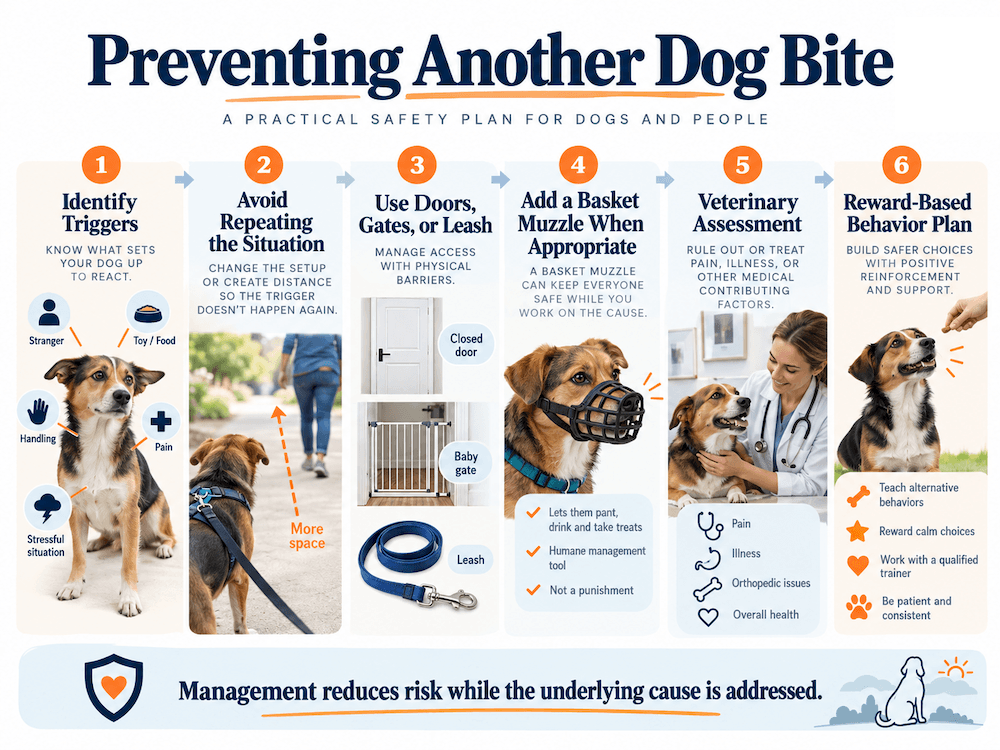
When to Seek Veterinary or Behavior Help After a Dog Bite
Book a veterinary examination if your dog suddenly develops aggression, shows signs of pain, resists normal handling, or shows a major behavior change. Unexpected aggression can sometimes be linked to an underlying medical problem.
Seek qualified behavior support if the bite caused significant injury, your dog has bitten before, triggers are difficult to avoid, or you are unsure how to manage the dog safely. More serious cases may benefit from a board-certified veterinary behaviorist.
Seek prompt veterinary care if sudden aggression occurs with seizures, disorientation, weakness, difficulty walking, major sensory changes, or other abnormal neurologic or physical signs. These symptoms may indicate a medical issue requiring timely assessment.
What Research Says About Dog Bites and Aggression
Dog-bite wounds can carry meaningful infection risk even when they initially appear minor. In a prospective multicenter study of 495 dog-bite patients, 345 completed follow-up and 18 wounds became infected, an infection rate of 5.2%. Puncture wounds were independently associated with a higher infection risk, with the analysis finding roughly four times greater odds of infection than non-puncture wounds after other factors were considered.[1]
Aggression in dogs can arise from multiple interacting behavioral and medical factors rather than a single cause. Fear, territorial responses, guarding, and other behavioral motivations can contribute, while pain and physical disease may trigger new aggression or worsen an existing problem. Painful conditions are particularly important to consider when aggression appears suddenly or when a previously tolerant dog becomes defensive about touch or handling.[2]
Punishment and confrontational handling can also increase the risk of an aggressive response. In a study of 140 dogs with behavior problems, confrontational techniques such as hitting or kicking, alpha rolls, staring dogs down, forcing objects from their mouths, and grabbing and shaking their jowls triggered aggression in at least a quarter of dogs exposed to several of these methods. The findings support using management and reward-based methods to train an aggressive dog after a bite rather than physically confronting or punishing the dog.[3]
Frequently Asked Questions
The Bottom Line
If your dog bites someone, the immediate priorities are to secure your dog, help the injured person, and make sure the wound receives appropriate care. Even a minor bite should be taken seriously because broken skin can become infected and the circumstances may trigger reporting or observation requirements. Owners should document what happened, provide rabies vaccination information, and follow instructions from medical, veterinary, animal-control, or public-health professionals when applicable. The bite should also be evaluated in context, since fear, pain, resource guarding, handling sensitivity, territorial behavior, or frustration may have contributed. Punishment or recreating the incident can increase risk rather than solve the underlying problem. Until the cause is better understood, careful management and avoidance of known triggers are important for preventing another bite. Veterinary or qualified behavioral help is especially valuable when aggression is sudden, severe, repeated, or difficult to manage safely.
If your dog has shown aggressive behavior, read our complete guide to training an aggressive dog for practical management and behavior strategies. Dogs that bite from fear may also benefit from understanding the causes and warning signs covered in our fear-based aggression in dogs guide. If food, toys, or other valued items contributed to the incident, see our article on resource guarding in dogs. For concerns about vaccination or possible exposure, our rabies in dogs guide explains transmission, warning signs, and prevention.
Sources
- Predictors of infection from dog bite wounds: which patients may benefit from prophylactic antibiotics?
- Canine aggression toward people: a guide for practitioners
- Survey of the use and outcome of confrontational and non-confrontational training methods in client-owned dogs showing undesired behaviors