How to Socialize a Puppy in 7 Steps: Checklist & Socialization Guidelines

Canine Bible is reader-supported. We receive affiliate commissions via some of our links. Learn more.
Socializing a puppy means gradually exposing them to different people, animals, places, sounds, and experiences in a safe, positive way. Starting early and keeping each interaction calm and rewarding can help your puppy grow into a confident, well-adjusted dog. But good socialization involves more than simply letting your puppy meet everyone they see. Too much exposure, frightening encounters, or poorly managed introductions can sometimes create fear instead of confidence. You may also wonder how to socialize a puppy before vaccinations are complete or what to do with a shy or nervous pup. The right approach depends on your puppy’s age, temperament, health, and previous experiences. In this guide, you’ll learn how to socialize your puppy safely, what experiences to prioritize, and which common mistakes to avoid.
Socializing a Puppy in a Safe & Positive Way
The most valuable socialization happens early in puppyhood, but quality matters more than collecting as many encounters as possible. Keep experiences brief, positive, and appropriate for your puppy’s vaccination status, and increase difficulty only while your puppy remains comfortable.
Why Puppy Socialization Matters—and When to Start
Young puppies go through a sensitive developmental period when they are especially receptive to learning what is normal and safe. The exact boundaries vary between dogs, but the most influential period generally falls within the first three to four months of life. Positive experiences during this stage can help build confidence around situations the dog will encounter later.
Socialization is often mistaken for constant interaction. A puppy does not need to greet every person, wrestle with every dog, or explore every crowded environment. Learning to calmly watch a jogger, hear a motorcycle from a comfortable distance, stand quietly during a paw examination, or ignore another dog can all be successful socialization.
The aim is a dog that can cope appropriately, not necessarily a dog that wants to socialize with everyone. Genetics, early experiences before adoption, temperament, health, and later learning all influence adult behavior, so even an excellent socialization plan cannot guarantee a fearless or universally outgoing dog.


Before You Start: Health, Vaccinations, and Puppy Body Language
Before expanding your puppy’s world, check both physical health and emotional readiness. Socialization is most useful when your puppy feels well, encounters new experiences at a manageable intensity, and is protected appropriately from infectious-disease risks.
Make Sure Your Puppy Is Healthy Enough for Socialization
A newly adopted puppy should have a veterinary examination, an appropriate vaccination and parasite-control plan, and guidance about disease risk in your area. A puppy with vomiting, diarrhea, coughing, marked lethargy, pain, fever, or another sign of illness should not attend social activities until a veterinarian says it is appropriate.
Health status can also affect behavior. A puppy that suddenly becomes unusually withdrawn, irritable, reluctant to move, or sensitive to handling may be uncomfortable rather than simply nervous, so unexplained changes deserve closer attention.
How to Socialize a Puppy Before Vaccinations Are Complete
The early socialization period overlaps with the weeks when puppies are still completing their initial vaccine series. That does not mean a young puppy must remain isolated indoors, but exposure should be carefully controlled to reduce contact with environments where infectious organisms may be present.
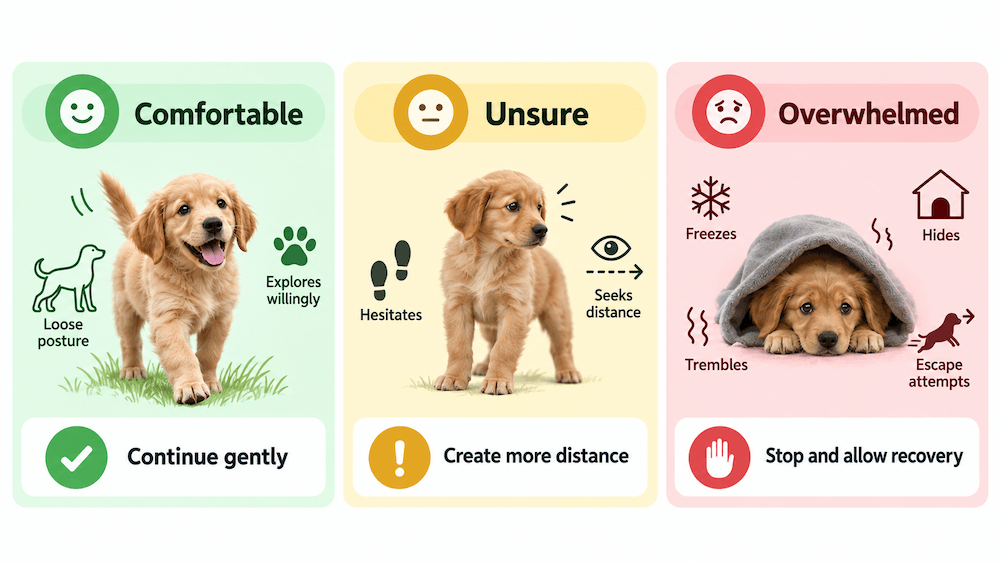
Know When Your Puppy Is Comfortable, Unsure, or Overwhelmed
Your puppy’s body language should determine whether you continue, make the experience easier, or stop. A relaxed puppy may still pause or investigate cautiously, but they should retain the ability to explore, take food, respond to you, and move away when they want to.


What You Need to Socialize a Puppy
You do not need much equipment to socialize a puppy successfully, but a few essentials can make each outing safer and easier to manage. Bring rewards your puppy values, secure walking gear, and a familiar comfort item so you can reinforce calm behavior and help your puppy settle when needed.
Puppy Socialization Checklist: What Should Your Puppy Experience?
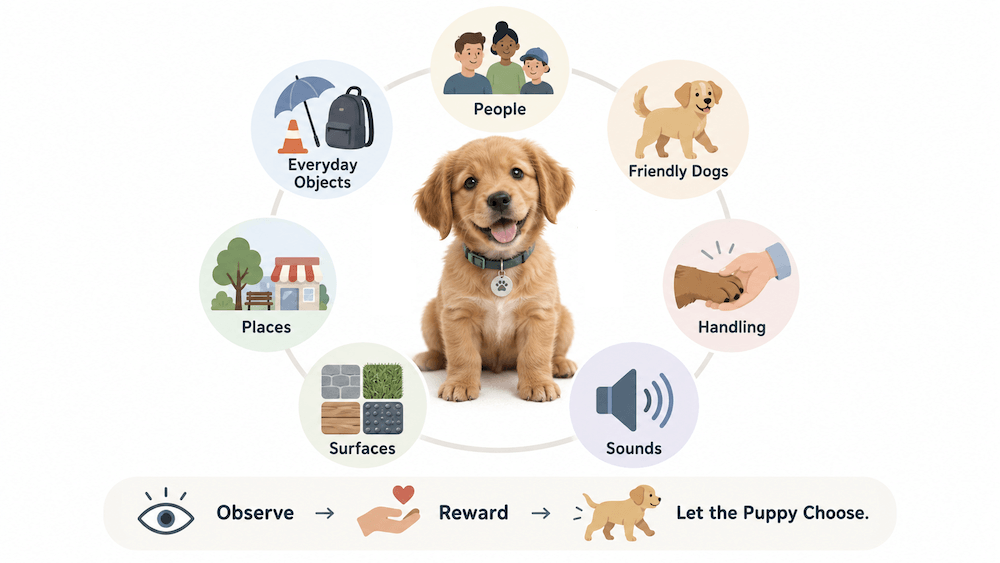
A well-rounded socialization plan exposes your puppy to more than just people and other dogs. Use this checklist as a quick reference for the different sights, sounds, surfaces, handling, places, and everyday situations your puppy may encounter as they grow. You do not need to complete every item at once—the goal is broad, positive exposure over time.
How to Socialize a Puppy: A Step-by-Step Guide
Puppy socialization works best as a progression rather than a checklist race. Teach your puppy that novelty happens at manageable levels and that they have safe ways to respond before making situations harder.
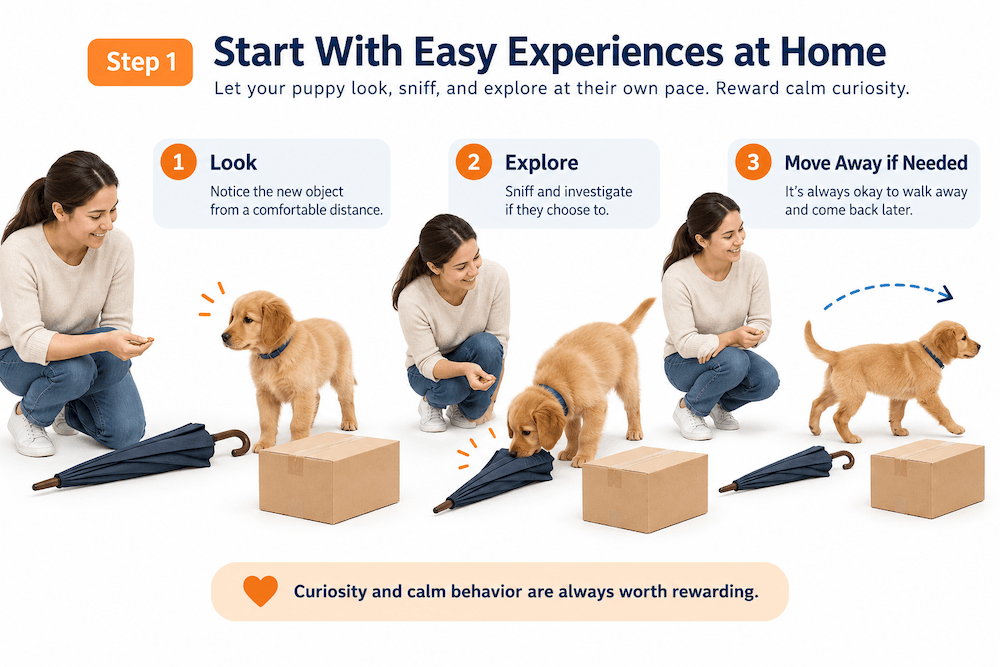
Step 1: Start With Easy Experiences at Home
Begin in a familiar space where your puppy already feels secure. Introduce one harmless new object or surface, such as a closed umbrella, cardboard box, grooming brush, or different flooring, and let your puppy investigate or move away freely. Reward calm curiosity without placing or pulling your puppy closer.
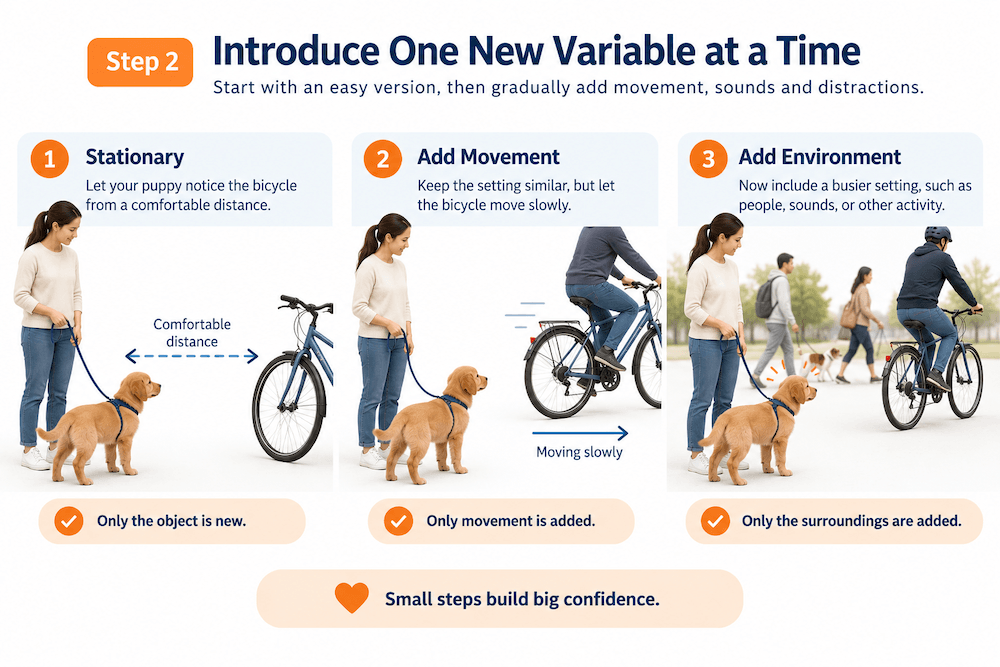
Step 2: Introduce One New Variable at a Time
Keep early exposures simple so your puppy is not processing several unfamiliar things at once. For example, let your puppy observe a stationary bicycle in a quiet location before adding movement, noise, or a busier environment. Increase only one element at a time while your puppy remains comfortable.
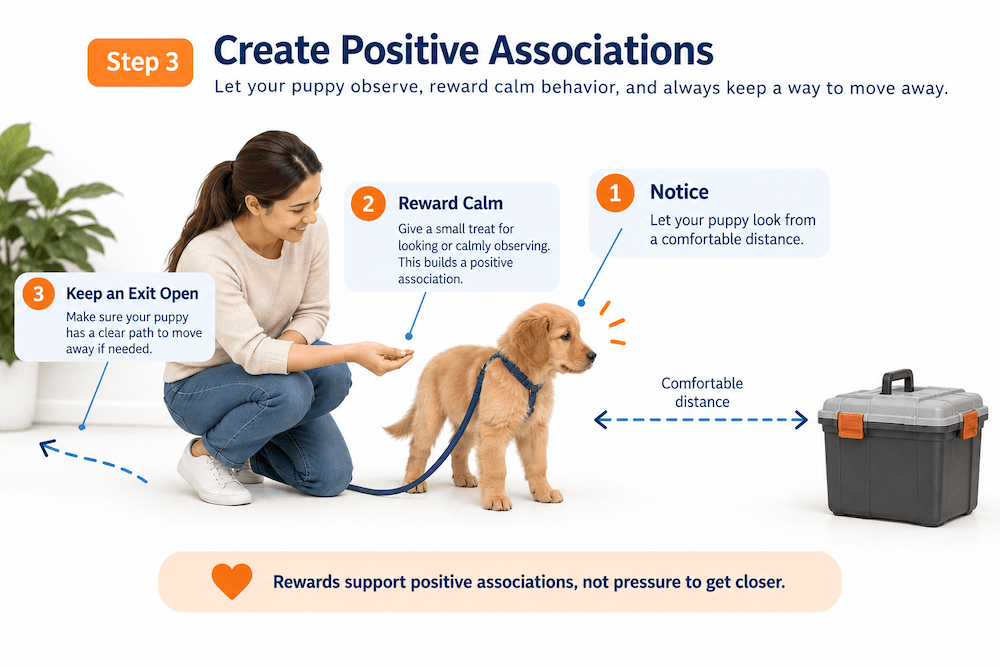
Step 3: Pair New Experiences With Choice and Rewards
Let your puppy notice something unfamiliar while staying far enough away to remain relaxed, then reward calm observation with food, play, praise, or another valued reward. Do not use treats to lure a frightened puppy toward something they are trying to avoid. Keep an open path available so your puppy can create distance whenever needed.
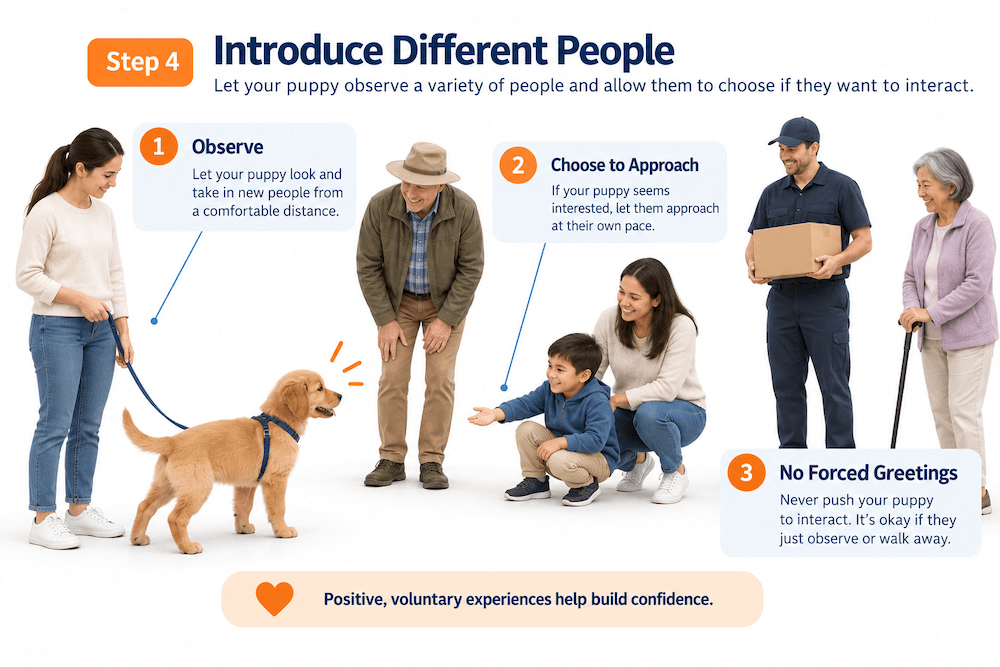
Step 4: Socialize Your Puppy With Different People
Let your puppy calmly see people with different ages, appearances, clothing, movements, and mobility aids without expecting a greeting every time. When interaction does occur, allow the puppy to approach voluntarily and ask people to avoid looming, hugging, or reaching repeatedly toward the face. Always supervise interactions with children.
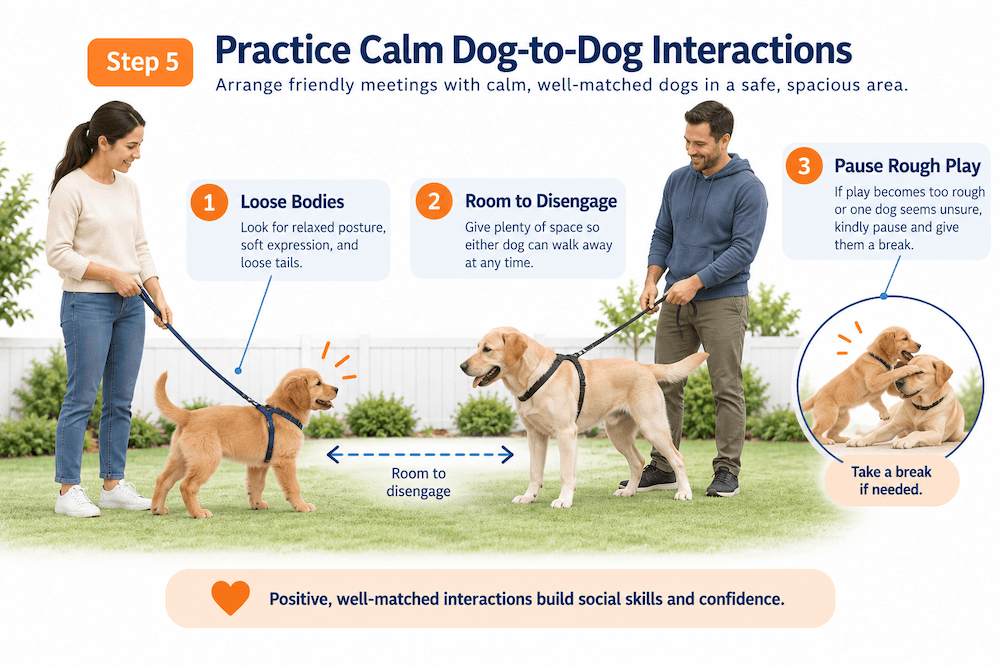
Step 5: Introduce Other Dogs Carefully
Choose healthy, appropriately vaccinated dogs that are calm and known to interact well with puppies. Give both dogs room to approach, pause, and disengage rather than forcing a tight face-to-face greeting. End or interrupt play if it becomes persistently one-sided, frightening, or overly intense.
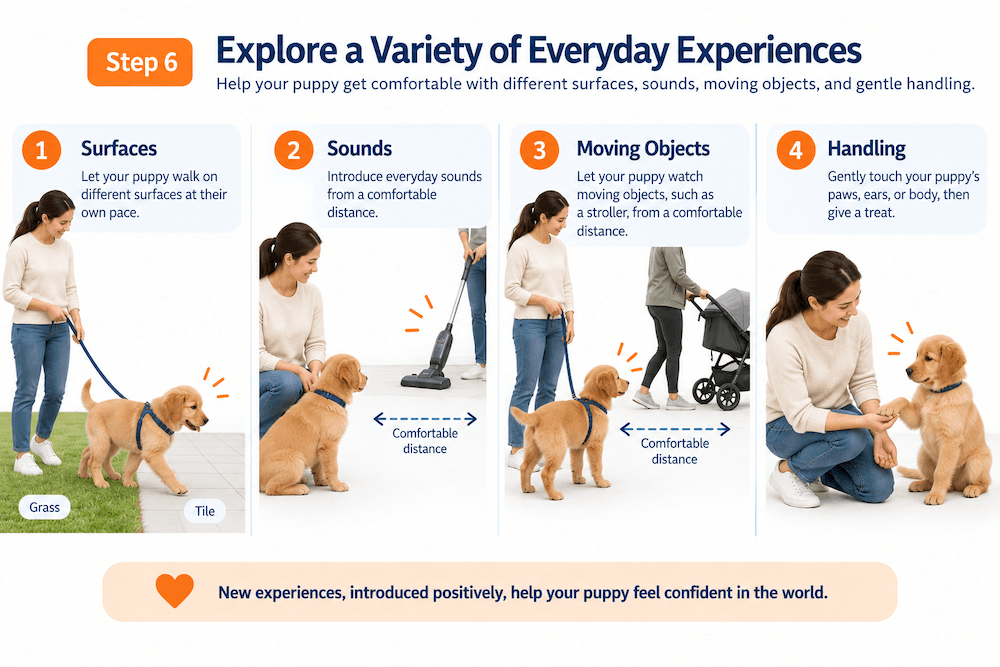
Step 6: Practice Sounds, Surfaces, Objects, and Handling
Expose your puppy to everyday experiences beyond people and dogs, including different surfaces, household sounds, moving objects, grooming tools, car rides, and gentle body handling. Keep sounds and movements at manageable levels, and pair brief touches to paws, ears, mouth, and other areas with rewards. Stop or make the exercise easier if your puppy begins struggling or trying to escape.
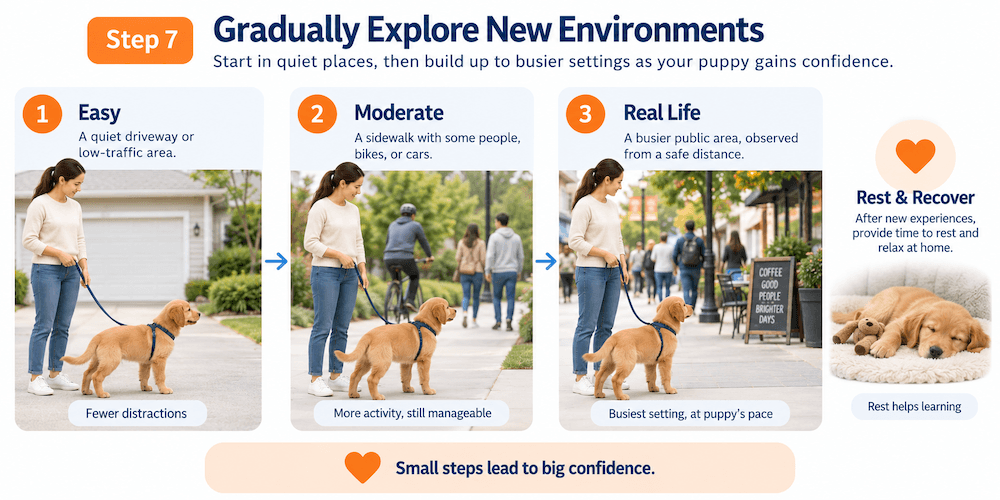
Step 7: Gradually Practice in Real Life
Once your puppy handles simple exposures comfortably, practice the same skills in slightly busier real-world settings. Progress from quiet environments to moderate activity while keeping enough distance for your puppy to stay relaxed and responsive. Finish before your puppy becomes exhausted or overstimulated, and allow plenty of recovery time afterward.
How to Choose a Puppy Socialization Class
A good puppy class should build confidence without forcing interaction. Use the checklist below to quickly compare programs before enrolling.
| What to Look For | Good Sign | Red Flag |
|---|---|---|
| Training method | Rewards are used to teach calm, confident behavior. | Intimidation, leash corrections, or aversive tools are used. |
| Health rules | Clear vaccination and illness requirements are enforced. | Sick puppies or unknown health histories are accepted freely. |
| Environment | The space is clean, controlled, and securely managed. | The area is crowded, dirty, or difficult to supervise. |
| Puppy interaction | Play and greetings are actively supervised. | Puppies are left to “work it out” themselves. |
| Choice and distance | Puppies can step away, rest, or observe from afar. | Fearful puppies are pushed closer to triggers. |
| Greetings | Interactions are voluntary and matched to comfort levels. | Puppies are forced into face-to-face greetings. |
| Play management | Instructors pause play when puppies become overwhelmed. | Rough or one-sided play continues despite stress. |
Mistakes That Can Make Puppy Socialization Harder
Many socialization problems come from too much intensity rather than too little effort. The following mistakes can turn an otherwise useful exposure into an experience the puppy learns to avoid.
How to Troubleshoot Puppy Socialization Problems
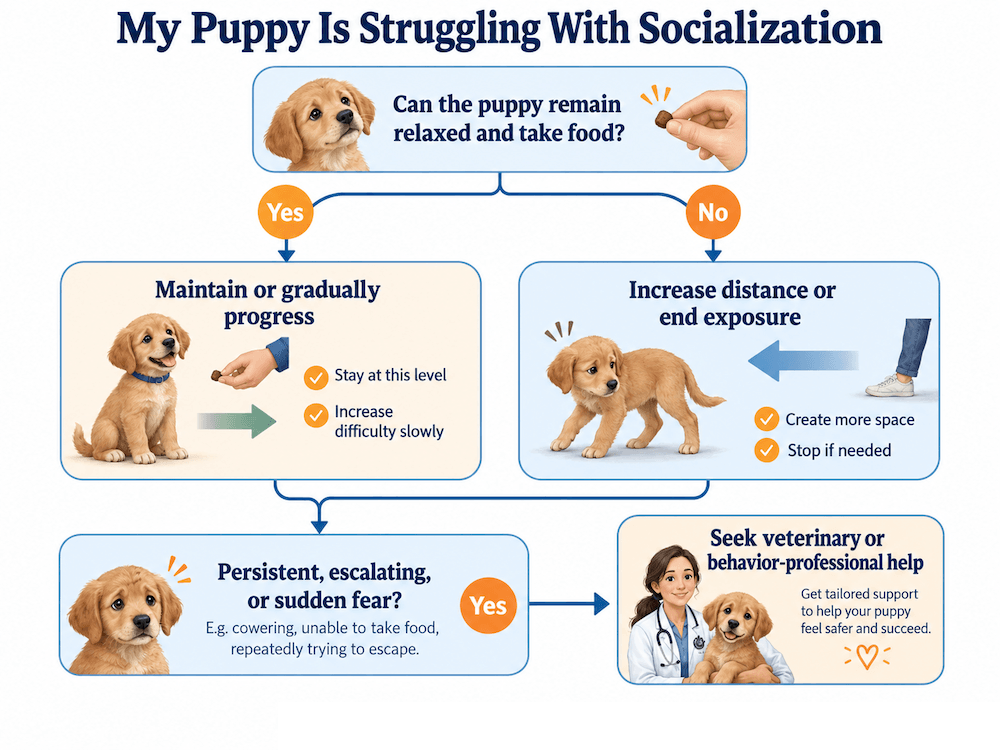
Some puppies enthusiastically explore new environments from the start, while others require much slower introductions. Temperament differences are normal, and the appropriate goal is improvement relative to your puppy’s baseline, not comparison with another puppy.
When to Contact a Veterinarian, Trainer, or Veterinary Behaviorist
Professional help is appropriate before behavior becomes severe. A veterinarian is especially important when fear or irritability appears suddenly, the puppy seems painful or unwell, vaccination or disease exposure is uncertain, or behavior changes coincide with physical symptoms.
A qualified reward-based trainer can help with routine socialization planning, puppy classes, overexcitement, leash skills, and confidence-building. Look for someone who adjusts exercises to individual puppies rather than forcing fearful dogs to interact or using intimidation to suppress behavior.
More specialized help is warranted when a puppy shows persistent panic, repeated freezing, serious escape attempts, escalating growling or snapping, difficulty recovering after triggers, or fear across many everyday situations. A veterinary behaviorist can also evaluate whether medical factors and clinically significant anxiety are contributing.
Early assistance is particularly useful with a fearful puppy. Waiting for the puppy simply to “grow out of it” can allow rehearsed avoidance or defensive behavior to become more established.
How to Maintain Puppy Socialization as Your Dog Grows
Socialization does not end when the early developmental window closes. Continue giving your puppy and adolescent dog controlled opportunities to practice calm behavior around visitors, dogs, traffic, grooming, veterinary handling, vehicles, unfamiliar places, and other situations relevant to your lifestyle.
What Veterinary Research Says About Puppy Socialization
The American Veterinary Society of Animal Behavior (AVSAB) identifies the first three months of life as the most important period for puppy socialization and supports carefully managed social exposure before the full vaccine series is completed. Its position statement emphasizes exposure that is safe and does not produce excessive fear, withdrawal, or avoidance.[1]
The Merck Veterinary Manual describes roughly 3–12 weeks as a major socialization period and notes that insufficient exposure to social and environmental stimuli during this stage can increase the risk of fearful adult behavior. Its owner guidance also emphasizes that learning continues beyond the early window rather than stopping at a fixed age.[2]
A review by Howell, King, and Bennett examined early-age socialization practices and concluded that appropriate exposure should be controlled and pleasant, with socialization continuing beyond the earliest developmental stage. The review links appropriate puppy socialization with a lower likelihood of later problems such as fearfulness and aggression, while recognizing that development is influenced by multiple factors.[3]
Disease prevention remains important during this period. A study published in the Journal of the American Animal Hospital Association examined vaccinated puppies up to 16 weeks old and found no greater confirmed parvovirus risk among puppies attending socialization classes than among vaccinated puppies not attending them; none of the 279 class-attending puppies in the study were suspected of or diagnosed with parvovirus. This does not make every environment risk-free, but it supports the use of appropriately managed early classes alongside veterinary vaccination guidance.[4]
Frequently Asked Questions
The Bottom Line
Socializing a puppy means helping them experience people, animals, sounds, surfaces, handling, and everyday environments in a safe, positive way. Start early, but focus on quality rather than the number of experiences your puppy collects. Keep exposures manageable, watch body language closely, and give your puppy enough choice and distance to remain comfortable. Balance early socialization with sensible vaccination and disease-prevention precautions. As your puppy grows, continue practicing calm behavior and useful life skills instead of treating socialization as something that ends after puppyhood. If fear becomes persistent, severe, or difficult to manage, involve your veterinarian or a qualified behavior professional. The goal is not a puppy that loves everything, but a dog that can cope confidently with normal life.
Continue building your puppy’s confidence with our guide on how to introduce a puppy to a dominant dog. You can also strengthen everyday skills with our leash training guide, which can make socialization outings easier to manage. For calmer rest and travel routines, see our complete guide on how to crate train a puppy or dog.