What Do Dogs Think About All Day? Do They Have Conscious Thoughts?


Canine Bible is reader-supported. We receive affiliate commissions via some of our links. Learn more.
Dogs think about the people, animals, places, and experiences that matter in their daily lives. Their thoughts are shaped mainly by scent, emotion, memory, learned associations, and immediate needs rather than human-like inner language. A dog may think about food, play, safety, familiar routines, social interactions, or how to respond to something happening nearby. However, canine thinking varies with breed, age, training, health, personality, and past experiences. Dogs can remember people and events, solve simple problems, anticipate routines, and react to human expressions and tone of voice. Understanding how dogs process the world can explain behaviors that owners often mistake for guilt, stubbornness, jealousy, or revenge. Exploring what dogs think about offers a clearer view of their emotions, decisions, dreams, memories, and relationship with humans.
The Science Behind a Dog’s Brain and Thoughts
| Key Concept | What It Means for Dogs |
|---|---|
| Sensory thinking | Dogs process much of their world through scent, sound, movement, and touch. |
| Emotional responses | Feelings such as fear, excitement, and comfort influence attention and choices. |
| Memory and learning | Past experiences help dogs recognize people, routines, rewards, and possible threats. |
| Predicting events | Familiar cues allow dogs to anticipate meals, walks, departures, and other routines. |
| Social awareness | Dogs evaluate human and canine voices, expressions, posture, scent, and attention. |
| Individual differences | Age, genetics, training, environment, and personality shape how each dog responds. |
| Health influences | Pain, illness, sensory loss, or cognitive decline can change thinking and behavior. |
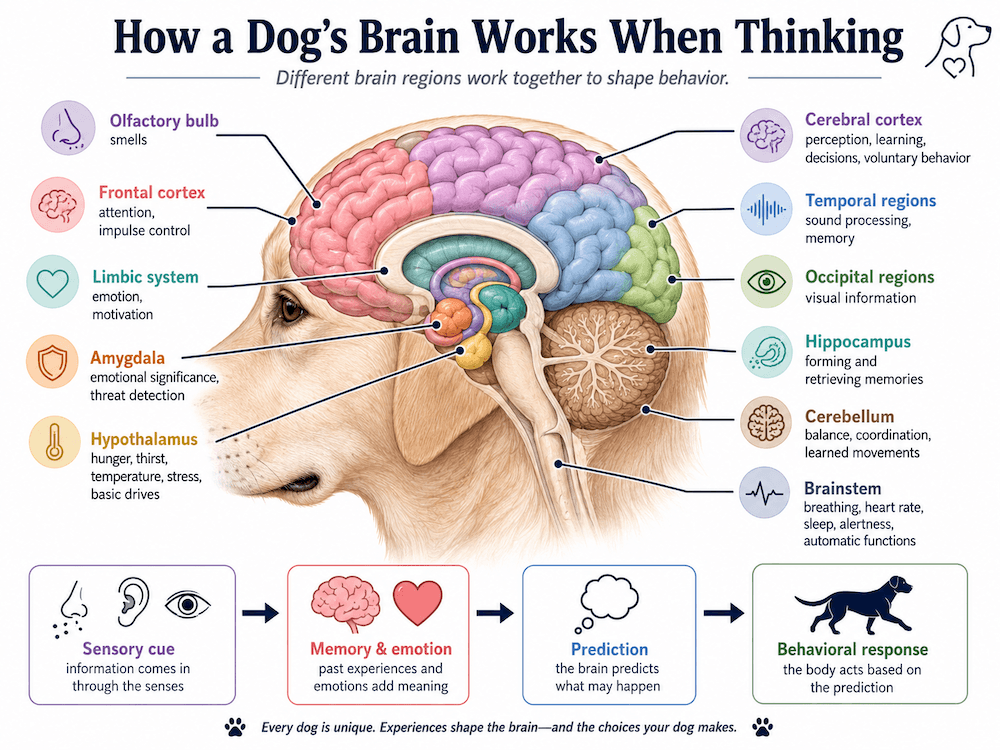
How a Dog’s Brain Works When Thinking
A dog’s thoughts emerge as different brain regions work together to process smells, sounds, sights, emotions, memories, body sensations, and learned cues. The brain quickly compares new information with past experiences, evaluates whether something is safe or rewarding, and helps the dog choose a response such as approaching, avoiding, playing, resting, or seeking help.
How Dogs Think Without Human-Style Language
There is no good evidence that an average dog silently narrates its day in complete sentences. A dog may recognize spoken sounds and connect them with actions, objects, people, or outcomes, but recognizing “walk” does not mean the dog understands the word in the same abstract way that an adult human does.
Most dogs learn cues through repeated associations. The sound “sit” becomes connected with a behavior and its consequence. A dog may also recognize tone, gaze direction, hand movements, household context, and the speaker’s posture at the same time, meaning the spoken word is often only one part of the message.
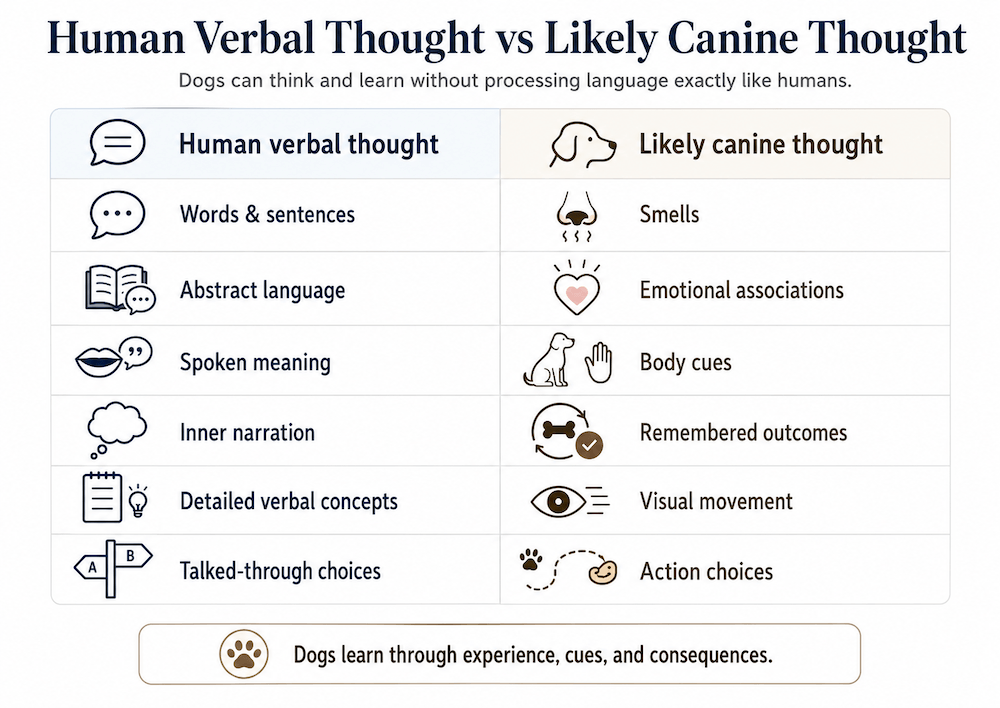
A small number of unusually capable dogs can learn many toy labels and retrieve named objects. This ability is exceptional rather than typical, and it does not mean those dogs possess full human language. Even gifted word-learning dogs show specialized label-to-object learning rather than grammar, conversation, or broad symbolic reasoning.


Dogs can also use human gestures, including pointing and gaze cues, although success depends on the exact task, the clarity of the signal, and the dog’s experience with people. Sensitivity to communication allows dogs to make useful choices without needing to understand a person’s complete thought process.
What a Dog’s Thoughts Are Probably Like
A dog’s mind is not empty, purely instinctive, or limited to food. Dogs process information about their bodies, surroundings, social relationships, previous experiences, and expected outcomes. The major difference is that they experience this information through a distinctly canine sensory and emotional system.
Humans often organize thoughts through spoken language and visual detail. Dogs appear to rely heavily on scent, movement, tone of voice, body posture, location, emotional significance, and associations such as “this sound predicts something.” Their thoughts may therefore resemble a shifting collection of sensations, expectations, emotional reactions, and action choices rather than a narrated story.
The following overview shows what may occupy a dog’s mind during an ordinary day.
| Likely Focus | What the Dog May Be Processing | Everyday Example |
|---|---|---|
| Sensory information | New smells, sounds, movement, surfaces, and environmental changes. | Investigating where another dog walked earlier. |
| Basic needs | Hunger, thirst, toileting, rest, temperature, and physical comfort. | Waiting beside the door when needing to urinate. |
| Social relationships | Attention, safety, play, proximity, conflict, and familiar individuals. | Following a trusted person into another room. |
| Predictions | What familiar objects, actions, places, or sounds usually predict. | Becoming excited when the leash is lifted. |
| Past learning | Which actions produced rewards, safety, discomfort, or unwanted outcomes. | Sitting because sitting previously earned food. |
| Problems and choices | How to reach, avoid, retrieve, open, or obtain something. | Working out how to empty a puzzle feeder. |
| Emotional state | Excitement, fear, frustration, contentment, anticipation, or uncertainty. | Seeking distance from an unfamiliar person. |
The Main Things Dogs Think About Each Day
Dogs’ daily thoughts are largely shaped by what is happening around them, what they need, and how they feel. Their attention commonly shifts between sensory information, food and comfort, social interactions, familiar routines, safety, play, and learned expectations.
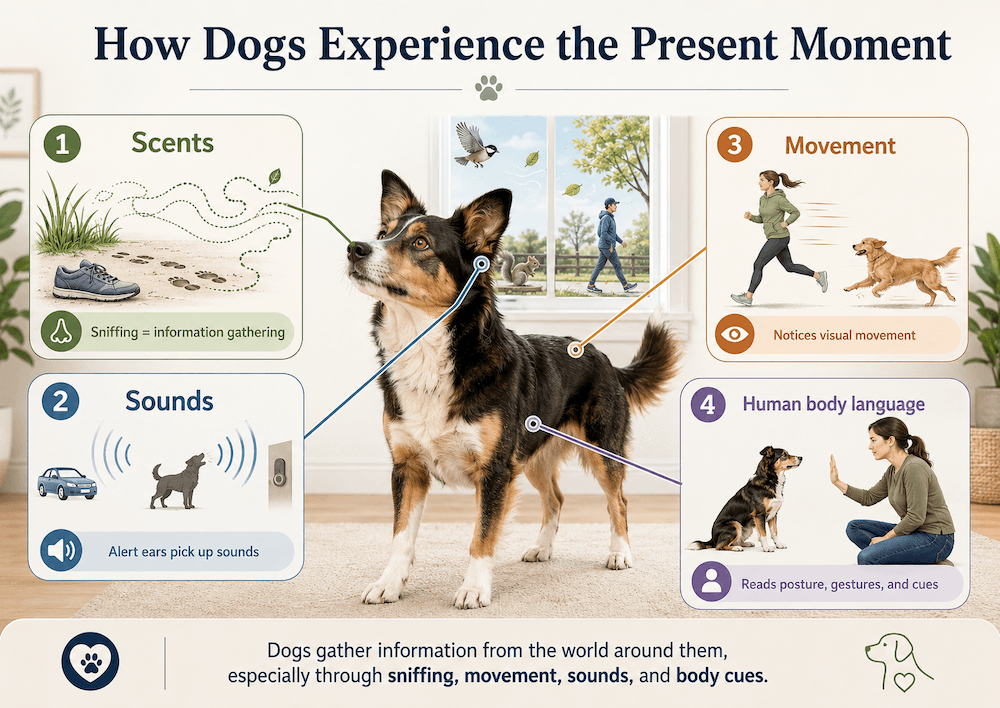
1. What is happening right now
Dogs focus heavily on immediate sights, sounds, scents, movements, and changes in their surroundings. Smell is especially important because it can reveal information about food, people, animals, familiarity, stress, and recent activity. This is why sniffing during walks is more than a distraction—it is a major way dogs investigate and understand their environment.
2. What the dog wants or needs
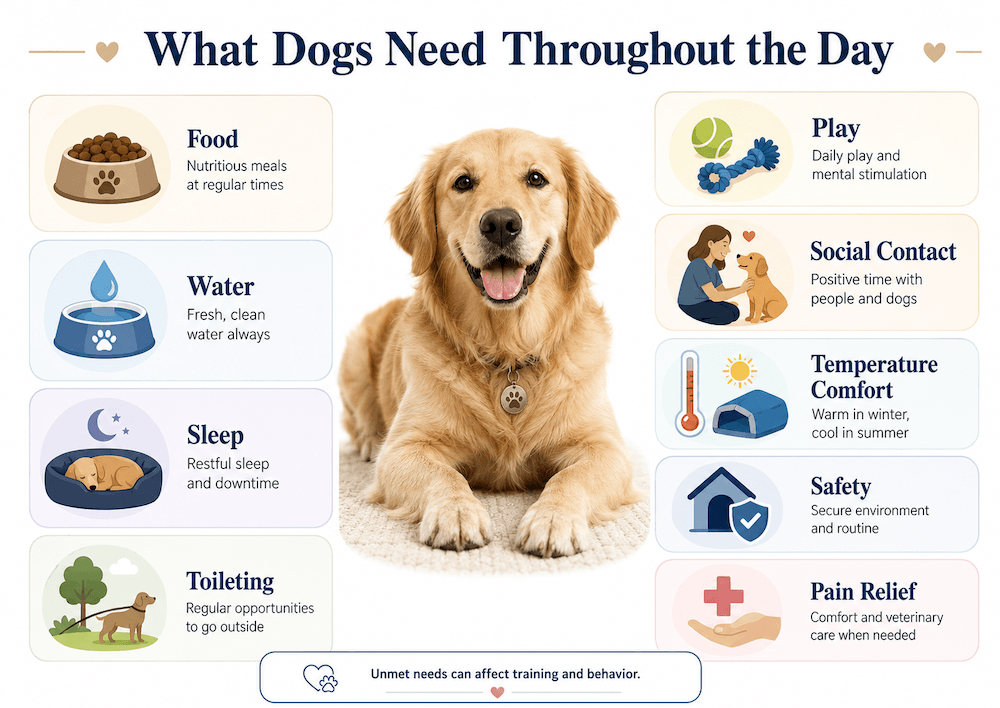
Dogs regularly think about immediate needs such as food, water, rest, toileting, play, safety, comfortable temperatures, social contact, and relief from pain. These needs affect attention and behavior, so a frightened, tired, overheated, uncomfortable, or hungry dog may struggle to respond normally to training, touch, or rewards.
3. What familiar events predict
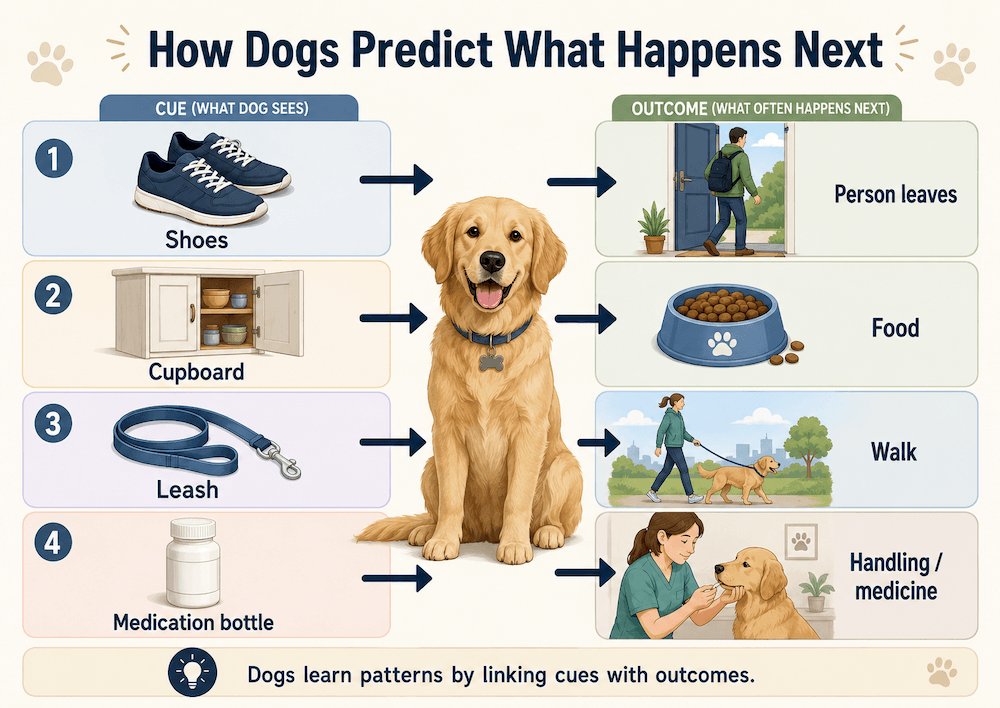
Dogs learn to connect familiar objects, places, actions, and routines with what usually happens next. Shoes may signal that someone is leaving, a cupboard may predict food, and a certain route may indicate the dog park or veterinary clinic. Their reaction is usually based on learned associations rather than a detailed understanding of the owner’s future plan.
4. What is safe, rewarding, or worth avoiding
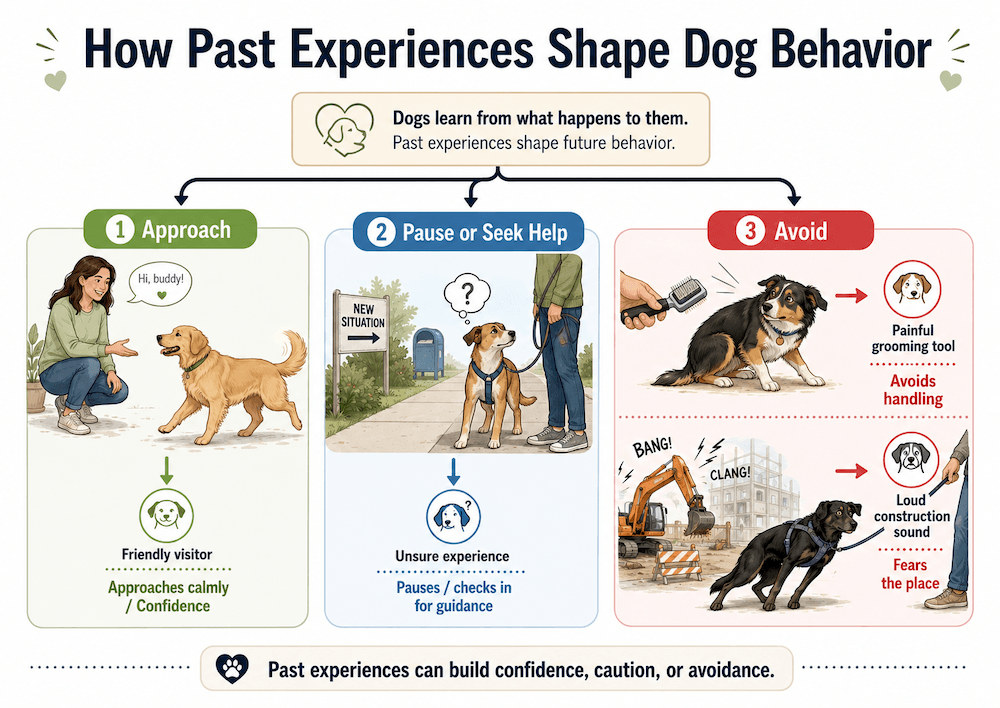
Dogs use previous experiences to decide whether to approach, play, wait, bark, retreat, freeze, or seek support. Positive experiences can increase confidence, while frightening or painful events may create lasting avoidance of similar people, places, sounds, objects, or situations. Behavior that appears unreasonable to humans may therefore be a logical response to what the dog has learned.
Do Dogs Remember the Past and Anticipate the Future?
Dogs clearly retain information. They remember learned behaviors, familiar people, locations, scents, emotional associations, daily routines, and actions that previously produced useful outcomes. Memory allows a dog to recognize a caregiver, return to a hidden chew, avoid a frightening location, or perform a skill learned weeks earlier.
Experiments also indicate that dogs can recall some unexpectedly witnessed actions after a delay, a capacity described as episodic-like memory. This does not prove that dogs mentally relive autobiographical events exactly as humans do, but it suggests that their memory is more flexible than simple habit alone.
Dogs also anticipate events. They may wait near the feeding area before dinner or become restless around the usual walk time. This does not necessarily mean they understand clocks, calendar dates, or time as an abstract timeline. Internal body rhythms, daylight, household sounds, human behavior, and repeated sequences can all help them predict what comes next.
What Dogs Think About Their Owners and Other Dogs
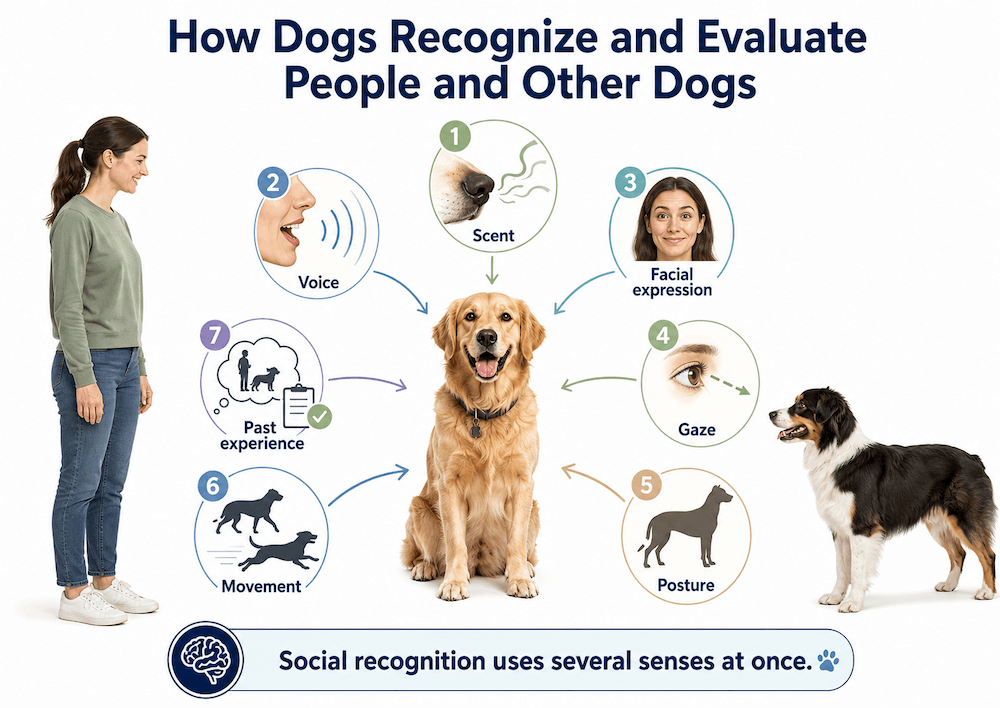
People are often central to a pet dog’s social world. Dogs recognize familiar individuals through scent, voice, appearance, movement, and context, while also monitoring eye contact, body direction, gestures, and emotional expressions. These cues may help them judge whether a person is attentive, friendly, uncertain, or likely to offer guidance or rewards.
Dogs also think about other dogs in terms of identity, play, safety, distance, mating information, competition, and access to resources. They use scent, posture, facial tension, tail position, movement, and vocalizations to assess each encounter. Their responses vary with the individual and situation rather than reflecting a constant need to dominate other dogs.
Do Dogs Feel Love, Guilt, Jealousy, or Empathy?
Dogs experience emotional states, but owners can easily assign a complicated human story to behavior that has several possible explanations. The most useful approach is to acknowledge canine emotion while remaining cautious about exact labels and motives.
| Common Belief | More Accurate Interpretation | Practical Meaning |
|---|---|---|
| “Dogs feel guilty.” | The guilty look often reflects owner cues or expected conflict. | Do not punish after discovering an old mess. |
| “Dogs love unconditionally.” | Dogs form strong attachments and individual social preferences. | Trust still depends on safe, consistent interactions. |
| “Dogs are jealous.” | Some display jealousy-like behavior around social rivals. | Also consider arousal, guarding, or learned attention-seeking. |
| “Dogs understand sadness.” | They detect emotional cues but may not understand their cause. | Comforting behavior can have several motivations. |
| “A stubborn dog knows better.” | Stress, distraction, pain, or unclear training may interfere. | Check context before assuming deliberate defiance. |
The “Guilty Look”
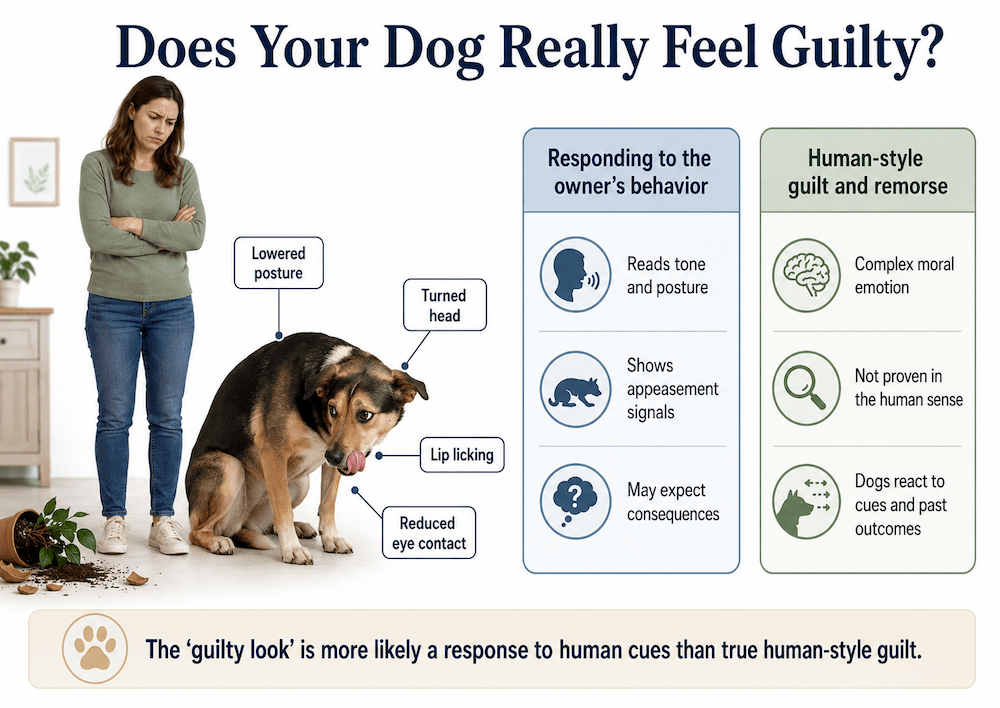
A lowered posture, turned head, lip licking, reduced eye contact, or cautious movement may look like guilt, but research suggests these behaviors are strongly influenced by an owner’s tone and body language. Dogs may anticipate an unpleasant reaction based on past patterns, but this is not the same as human-style moral guilt, reflection, or remorse.
Affection and Attachment
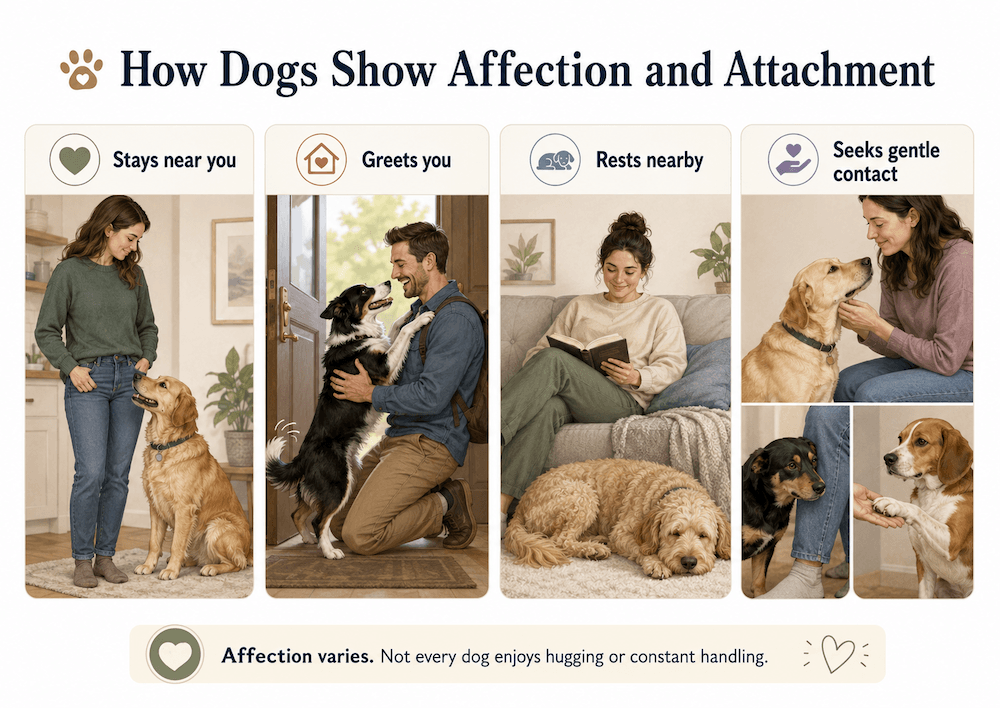
Dogs form strong social attachments, often preferring familiar people, seeking closeness, and showing positive responses to trusted caregivers. Describing this bond as love is reasonable, but affection should not be confused with a willingness to accept constant touching, hugging, restraint, or uncomfortable handling.
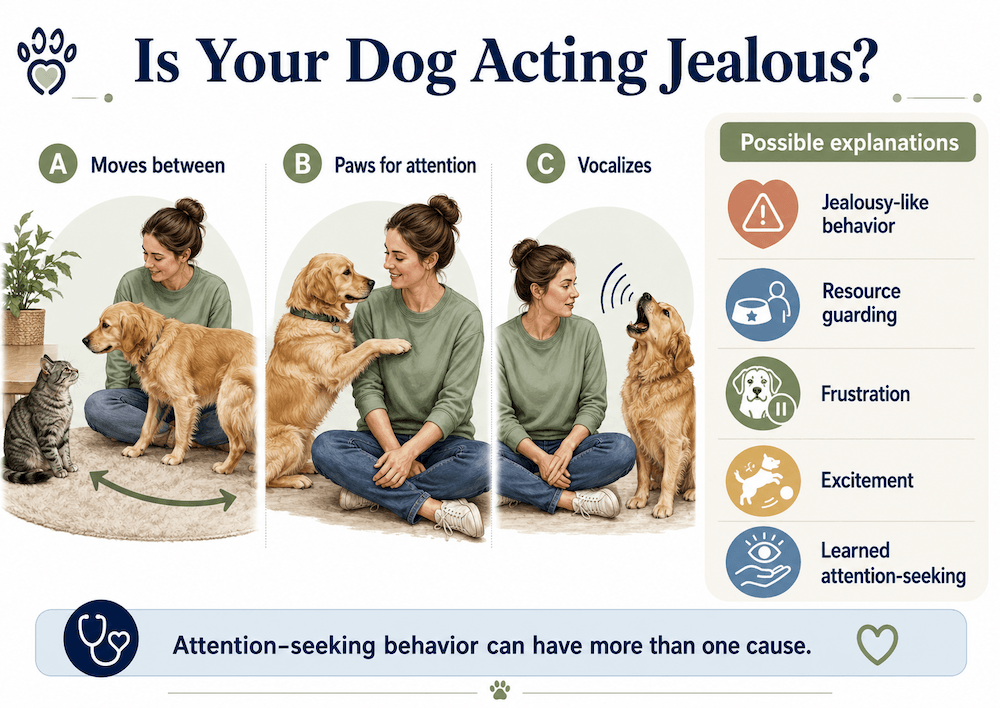
Jealousy-Like Behavior
Dogs may push between their owner and another animal, vocalize, seek attention, or interact with a perceived rival. These behaviors may resemble basic jealousy, but they can also result from resource guarding, frustration, excitement, insecurity, or actions that have previously earned attention.
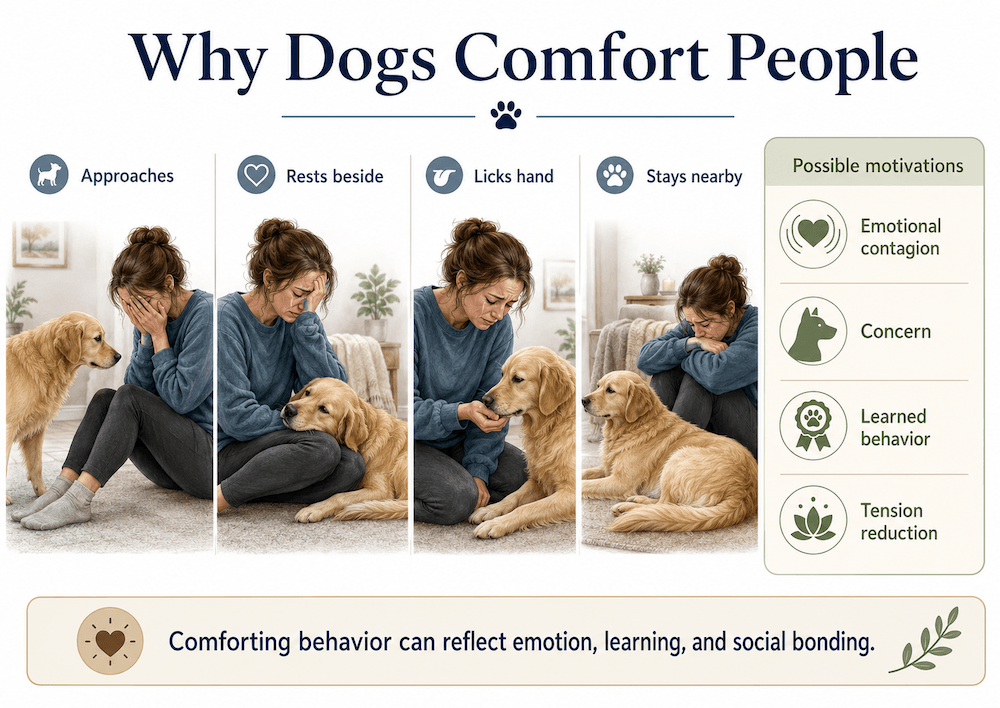
Empathy and Comforting Behavior
Dogs may approach a crying person, lie nearby, lick them, or become quieter when someone is distressed. This may reflect emotional contagion, concern, learned behavior, sensitivity to unusual sounds, or an attempt to reduce tension, and the response can still be comforting even when the dog’s exact motivation is uncertain.
What Dog Behavior Can Reveal—and What It Cannot
Behavior provides clues about motivation and emotional state, but it is not a perfect translation of thought. The same behavior can mean different things in different settings. A yawn may reflect tiredness, stress, or social tension, while a wagging tail can accompany friendliness, uncertainty, frustration, or high arousal.
You should consider the entire dog: posture, muscle tension, facial expression, ears, tail, movement, breathing, vocalization, environment, and what happened immediately beforehand. Repeated patterns are usually more informative than one isolated signal.
| Observed Behavior | Possible Thought or Motivation | What Else to Check |
|---|---|---|
| Staring at you | Requesting information, food, access, attention, or reassurance. | Look for the object or event nearby. |
| Following you | Seeking company, safety, activity, or a predicted reward. | Consider routine, anxiety, and ability to settle alone. |
| Sniffing intensely | Gathering detailed information about the environment. | Allow safe exploration without pulling the dog away. |
| Waiting by a door | Expecting someone, requesting access, or needing to toilet. | Check timing, body language, and household routines. |
| Turning away | Avoiding pressure, conflict, touch, or overwhelming attention. | Pause and give the dog more space. |
| Growling | Communicating discomfort, fear, pain, or resource concern. | Do not punish; identify and manage the trigger. |
| Pacing repeatedly | Anxiety, frustration, pain, nausea, confusion, or urgent need. | Note duration, triggers, age, and physical symptoms. |
| Sudden withdrawal | Fatigue, stress, illness, pain, fear, or social avoidance. | Arrange veterinary care if unusual or persistent. |
How Age, Breed, Experience, and Health Shape a Dog’s Mind
Age, breed tendencies, learning history, and health all influence how a dog pays attention, solves problems, and responds to the world. These factors provide useful context, but no single trait can fully predict an individual dog’s behavior or intelligence.
| Factor | How It May Shape the Mind | What Owners May Notice | Key Consideration |
|---|---|---|---|
| Puppy stage | Prioritizes exploration, play, chewing, and social learning. | Short attention span and limited impulse control. | Provide safe, positive early experiences. |
| Adult stage | Uses established routines, memories, and learned strategies. | More consistent responses in familiar situations. | Continue training and varied enrichment. |
| Breed history | May influence scenting, retrieving, persistence, or independence. | Natural preferences for certain tasks or stimuli. | Do not judge personality by breed alone. |
| Experience | Shapes expectations about rewards, threats, people, and places. | Confidence or caution based on past outcomes. | Use gradual, reward-based learning. |
| Senior stage | May bring slower learning and reduced sensory awareness. | Sleep changes or difficulty adjusting to routines. | Support comfort and predictable routines. |
| Health | Pain or illness can alter attention, mood, and memory. | Withdrawal, irritability, confusion, or housetraining changes. | Seek veterinary care for sudden changes. |
How to Help Your Dog Develop Healthy Thoughts and Expectations
You cannot control every thought a dog has, but you can create an environment that promotes safety, confidence, curiosity, and predictable learning. A mentally healthy routine includes opportunities to explore, rest, make appropriate choices, interact socially, and use natural behaviors.
When Changes in Thinking or Behavior Need Veterinary Attention
Sudden changes in a dog’s behavior or awareness may be an early sign of pain or illness. Irritability, withdrawal, restlessness, sleep disruption, handling sensitivity, guarding, confusion, or aggression can be linked to neurological, hormonal, digestive, urinary, sensory, or age-related problems.
Monitor a mild, explainable change only when the dog remains comfortable and continues eating, drinking, sleeping, responding, and eliminating normally. Book a veterinary appointment when changes persist, worsen, or occur with appetite loss, disrupted sleep, housetraining accidents, new fears, unusual aggression, reluctance to move, nighttime pacing, staring, getting lost, clinginess, or forgotten routines.
Seek urgent care for collapse, seizures, breathing difficulty, severe pain, sudden disorientation, head pressing, abnormal walking, or possible toxin exposure. Do not punish sudden growling, snapping, house soiling, withdrawal, or confusion; create distance from triggers, protect children and other animals, and arrange veterinary assessment because behavioral training cannot treat an underlying medical condition.
What Research Says About How Dogs Think
A 2024 review of canine social neuroscience described brain-imaging evidence involving dogs’ processing of faces, bodies, emotional information, and social interactions. This supports the view that dogs actively evaluate socially meaningful information rather than responding through simple reflexes alone. It does not establish that their conscious experience is identical to ours.[1]
A study published in Current Biology found that dogs could recall human actions they had observed incidentally and reproduce them after a delay. The researchers described this as episodic-like memory, providing evidence that dogs can retain information about an event even when they did not originally expect to be tested on it.[2]
Work published on emotional recognition found that dogs could integrate visual and vocal emotional information from both people and dogs. Other behavioral experiments found that dogs used human emotional displays when responding to social situations. For owners, this means facial expression, tone, posture, and emotional intensity may all influence a dog’s choices.[3]
The Merck Veterinary Manual explains that normal aging can involve slower learning and reduced retention, while canine cognitive dysfunction can cause disorientation, altered interactions, sleep changes, housetraining loss, anxiety, and activity changes. It also emphasizes that pain and other medical conditions must be considered when behavior changes unexpectedly.[4]
Frequently Asked Questions
The Bottom Line
Dogs likely think about their immediate surroundings, physical needs, emotions, relationships, memories, and what familiar cues predict. Their thoughts are shaped more by scent, sound, body language, learned associations, and emotional experiences than by human-style sentences. Dogs can remember people and events, solve practical problems, anticipate routines, and respond to the moods of those around them. However, behaviors that appear guilty, jealous, stubborn, or spiteful may have simpler explanations based on fear, learning, stress, or expectation. Watching the full situation and the dog’s complete body language gives owners a more accurate picture of what may be happening mentally. Sudden changes in awareness, personality, sleep, sociability, or behavior should be discussed with a veterinarian, especially in senior dogs. Understanding how dogs process the world helps owners communicate more clearly, reduce stress, and build stronger relationships with them.