How Smart Are Dogs? Canine Congnition & Intelligence Explained

Canine Bible is reader-supported. We receive affiliate commissions via some of our links. Learn more.
Dogs are remarkably smart animals, but their intelligence does not look exactly like human intelligence. Most dogs can learn words, routines, problem-solving patterns, and social cues, especially when training and motivation are strong. Some breeds tend to excel in obedience and working tasks, while others show intelligence in more independent or instinct-driven ways. That is why the real question is not just how smart dogs are, but what kind of intelligence they show. Why does one dog seem to learn commands instantly while another ignores them but solves problems on its own? How much do breed, training, environment, and human interaction shape a dog’s mental abilities? Understanding those differences helps explain what dogs truly know, how they learn, and why canine intelligence is more complex than many owners realize.
How Dog Intelligence Works
| Aspect of Intelligence | What It Means in Dogs |
|---|---|
| Learning Commands | Dogs can learn cues, words, and routines, though some pick them up faster than others. |
| Problem Solving | Many dogs can figure out simple challenges, especially when food, toys, or access is involved. |
| Social Awareness | Dogs are skilled at reading human body language, tone of voice, and emotional signals. |
| Memory | Dogs remember repeated experiences, familiar people, places, and patterns in daily life. |
| Adaptability | Smart dogs often adjust well to new routines, environments, and training expectations. |
| Instinctive Ability | Some dogs show intelligence through breed-based skills like herding, scent work, guarding, or retrieving. |
| Decision Making | Dogs often make choices based on past rewards, safety, and what has worked before. |
What Canine Intelligence Actually Includes
Canine intelligence is broader than obedience. It can include learning by repetition, remembering routines and places, solving simple problems, tracking what predicts reward, and changing behavior based on consequences. It also includes social cognition, which is one reason dogs do so well in human homes.
Dogs often pay close attention to pointing, gaze, tone of voice, and familiar interaction patterns. Hence, part of what owners call “smart” is often a dog’s ability to understand people. It can also include short-term memory, such as remembering where a toy, treat, or person was last seen. Some dogs also show behavioral flexibility, meaning they can change their response when a familiar strategy stops working.
The 4 Aspects of Canine Cognition
These four areas help explain why canine cognition is better understood as a set of distinct skills rather than a single trait. A dog may do well in social reading or language learning without showing the same strength in problem-solving or memory-based tasks.


What Dog Intelligence Tests Can and Cannot Tell You
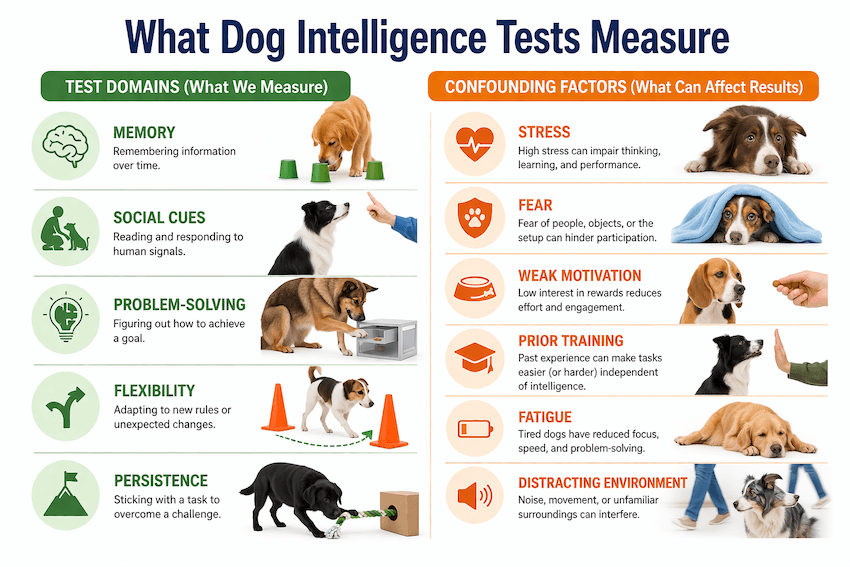
Dog cognition tests can capture useful traits such as problem-solving style, persistence, response to social cues, short-term memory, inhibitory control, and flexibility. Researchers use a range of tasks in these areas, including detour tests, gaze-following tasks, memory tasks, and reversal learning tasks.
But tests can also miss a lot. A dog’s result may be shaped by fear, stress, motivation, prior training, environment, fatigue, or breed-typical working style, so a weak score on one day does not automatically mean the dog lacks cognitive ability. Reviews of canine testing methods note substantial variation in design and standardization, and studies show stress and noise sensitivity can reduce performance on problem-solving tasks.
Breed Differences vs. Individual Differences in Dog Intelligence
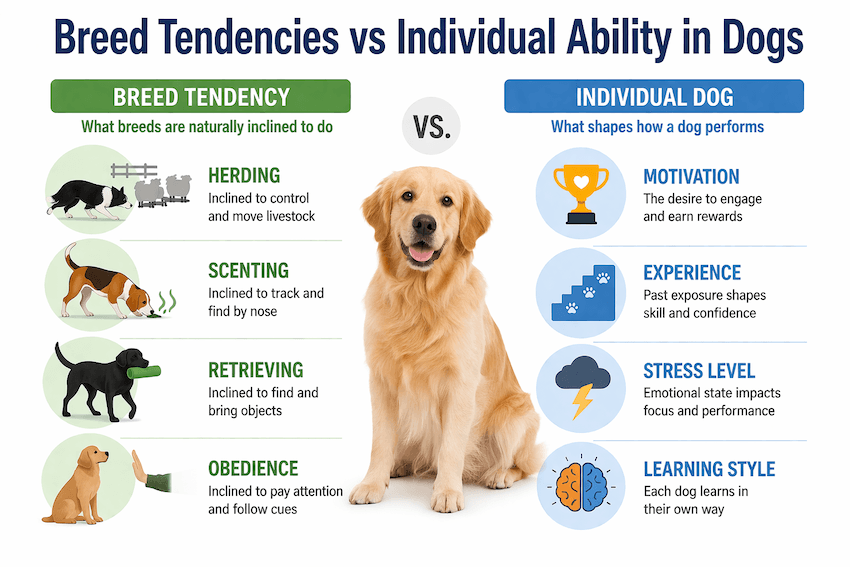
Breed tendencies do matter, especially for traits linked to working history, trainability, motor patterns, scenting, and social responsiveness. Some recent work has also found breed-linked differences in certain cognitive traits, including aspects of social cognition and inhibitory control. Still, the pattern is trait-specific rather than a single universal ranking.


At the same time, individual variation still matters a lot. Two dogs of the same breed can differ in persistence, attention, emotional regulation, motivation, early experience, and training history, which means breed gives a tendency, not a full prediction of what any one dog can do.
Dog Breeds Commonly Ranked Among the Smartest
This reflects the smartest dog breeds based on Stanley Coren’s well-known rankings, which were derived from surveys of North American obedience judges and popularized in The Intelligence of Dogs; the AKC still summarizes this top-20 list as a trainability-based ranking.
| Breed | Description | Often Recognized For |
|---|---|---|
| Border Collie | Exceptional herding focus and fast cue learning. | Advanced obedience and herding work. |
| Poodle | Highly trainable and versatile working companion. | Fast learning and task versatility. |
| German Shepherd | Strong working drive and task reliability. | Service, police, and protection work. |
| Golden Retriever | Quick learner with stable cooperative style. | Retrieving and service dog roles. |
| Doberman Pinscher | Responsive, fast, and reliable in structured work. | Protection work and obedience. |
| Shetland Sheepdog | Alert herder with strong trainability. | Obedience and agility performance. |
| Labrador Retriever | Biddable retriever with strong task engagement. | Retrieving and assistance work. |
| Papillon | Small dog with striking obedience ability. | Agility and fast cue response. |
| Rottweiler | Capable worker with solid task learning. | Guarding and structured training. |
| Australian Cattle Dog | Persistent, driven, and quick to learn routines. | Herding and environmental problem-solving. |
| Pembroke Welsh Corgi | Bright herding breed with strong responsiveness. | Herding instincts and trainability. |
| Miniature Schnauzer | Sharp, engaged, and easy to train. | Quick household learning and alertness. |
| English Springer Spaniel | Energetic worker with good task focus. | Field work and responsiveness. |
| Belgian Tervuren | Attentive herding dog with strong trainability. | Precision work and advanced obedience. |
| Schipperke | Alert, active, and quick-pattern learner. | Alertness and rapid routine learning. |
| Belgian Sheepdog | Responsive worker with high engagement. | Herding and structured task work. |
| Collie | Cooperative herder with dependable cue learning. | Herding and family responsiveness. |
| Keeshond | Attentive companion with good obedience potential. | Companion responsiveness and alert behavior. |
| German Shorthaired Pointer | Driven sporting dog with strong learning capacity. | Hunting work and active training. |
| Flat-Coated Retriever | Enthusiastic retriever with good working responsiveness. | Retrieving and cooperative learning. |
How to Tell if Your Dog Is Smart
Here are some practical signs that can help you tell whether your dog is learning well, solving simple problems, and using social and memory skills effectively.
How to Test Your Dog’s IQ at Home
A home “IQ test” is not a clinical score. It is better viewed as a simple look at problem-solving, memory, social cue use, and flexibility, and results can be affected by reward value, stress, fatigue, and prior experience.
How to Build and Nurture Your Dog’s Cognitive Skills
The goal is not to create a “genius dog.” It is to give your dog regular opportunities to observe, think, choose, and learn without being overloaded. Research and training literature on how to train a dog supports short, reward-based learning and varied practice rather than endless drilling.
Mental work is most useful when it is manageable and repeatable. Dogs benefit from enrichment that matches their confidence, age, motivation, and working style, with enough rest to recover and stay engaged. Older dogs or stressed dogs may need simpler tasks and more support.

What Research Says About Dog Intelligence
A PLOS ONE study found that dogs use context and tone of voice when following a human point, which matters because it shows dogs are not just reacting mechanically to a gesture. They are interpreting social information.[1]
A Frontiers in Veterinary Science review explains that dogs learn through Pavlovian conditioning, operant conditioning, and social learning. That helps answer the “how smart are dogs” question by showing that canine cognition is closely tied to learning processes, not just raw obedience.[2]
Research in Current Biology and related reports suggests dogs can show episodic-like memory, meaning they may recall actions or events even when they were not obviously trained to do so. That supports the idea that canine memory is richer than simple habit alone.[3]
A 2024 scoping review of dog behavioral testing noted major variability in how cognition is measured across studies. That is important because it explains why no single test should be treated as a full measure of a dog’s total cognitive ability.[4]
Additional Tips for Supporting Dog Intelligence
| Tip | Why It Helps | How to Apply It |
|---|---|---|
| Rotate Enrichment | Variety prevents boredom and repetitive problem patterns. | Swap puzzles, scent games, and toy tasks weekly. |
| Use Food Puzzles | They add effort, choice, and reward-linked learning. | Use them for part of regular meals. |
| Train Briefly | Short sessions improve focus and reduce frustration. | Practice for a few minutes, then stop. |
| Reward Curiosity | Confident exploration supports flexible learning. | Mark and reward calm investigation of new items. |
| Vary Settings Gradually |
Generalization improves outside a single room. | Practice known skills in easy new locations. |
| Protect Sleep and Recovery |
Tired dogs learn and cope less efficiently. | Balance enrichment with downtime and predictable rest. |
Common Mistakes When Judging or Building Dog Intelligence
| Mistake | Why It’s a Problem | Better Approach |
|---|---|---|
| Equating Obedience With Total Ability |
It ignores memory, social reading, and problem-solving. | Look at several domains, not compliance alone. |
| Comparing Dogs Unfairly |
Breed, age, stress, and history distort comparisons. | Compare each dog mainly to its own progress. |
| Testing While Stressed |
Fear can suppress problem-solving and engagement. | Test only when the dog is relaxed. |
| Overtraining | Too much repetition can reduce motivation and clarity. | Use short sessions and stop on success. |
| Ignoring Motivation | Low reward value can look like poor cognition. | Use rewards the dog truly wants. |
| Assuming Breed Tells Everything |
Breed trends do not predict one individual perfectly. | Consider temperament, experience, and learning style too. |
Ongoing Enrichment for Dog Cognitive Health
Support for cognitive health is usually simple: keep the dog engaged, not overloaded. Regular enrichment, varied training, sniffing opportunities, and manageable novelty help many dogs stay mentally active over time.
Performance can still change with age, pain, stress, illness, sleep quality, and daily routine. If a dog that used to learn or navigate well seems newly confused, less flexible, or less responsive, it is worth monitoring the pattern and speaking with a veterinarian, especially in senior dogs.
Frequently Asked Questions
The Bottom Line
Dogs are undeniably intelligent, but their intelligence is best understood as a mix of social skills, learning ability, memory, problem-solving, and adaptability rather than one simple trait. Some dogs shine in trainability, others in persistence, communication, or reading people, which is why no single test or breed ranking tells the whole story. What matters most for owners is not whether a dog fits a headline about being “smart,” but how that individual dog learns, responds, and adjusts in daily life. By looking at the full picture, it becomes easier to appreciate what dogs truly can do and how to support their cognitive potential over time.
Sources
- Domestic Dogs Use Contextual Information and Tone of Voice when following a Human Pointing Gesture
- Working Dog Training for the Twenty-First Century
- Recall of Others’ Actions after Incidental Encoding Reveals Episodic-like Memory in Dogs
- Methods of behavioral testing in dogs: a scoping review and analysis of test stimuli