How to Get a Service Dog 101: (& Best Places to Get One)

Canine Bible is reader-supported. We receive affiliate commissions via some of our links. Learn more.
Getting a service dog usually means first having a qualifying disability, then choosing a dog with the right temperament, and training it to perform specific tasks related to that disability. In many cases, you can get one through a professional program or train your own dog if it can reliably do the work required. But the process is often more complex than people expect. Not every dog is suited for service work, and not every condition is handled the same way. Many owners also misunderstand what legally counts as a service dog, what training is required, and whether registration is necessary. The right path depends on your needs, your dog, your budget, and how much training support you may need. This guide breaks down how to get a service dog, what mistakes to avoid, and how to choose the best route for your situation.
Service Dog Basics to Understand First
| What to Know | Why It Matters |
|---|---|
| Requires a disability | A service dog must help with a qualifying disability, not simply provide comfort or emotional support. |
| Needs task training | The dog must be trained to do specific work or tasks directly related to the handler’s disability. |
| Not every dog qualifies | Temperament, health, focus, and public behavior all affect whether a dog is truly suited for service work. |
| Training takes time | Even a promising dog needs consistent training to become reliable at home and in public settings. |
| Programs can be costly | Professional service dogs may involve major costs, so it helps to understand funding options and waitlists early. |
| Owner training is allowed | Some people train their own service dog, but doing it well still requires the right dog and strong training support. |
| No registration required | There is no official federal registration, which helps you avoid scams and misleading service dog websites. |
| Public access has rules | Knowing the legal standards helps you understand your rights, your responsibilities, and where service dog access applies. |
What Legally Counts as a Service Dog
Under the ADA, a service dog is a dog individually trained to do work or perform tasks for a person with a disability, and those tasks must be directly related to that disability. This means that the dog must do more than provide comfort. It must be trained to take specific actions that help with the person’s condition.
That is why comfort, companionship, or emotional support alone do not qualify as service-dog work under the ADA. The dog must perform a trained disability-related task, not simply help by being present.
Examples of qualifying tasks include guiding, alerting to sounds, retrieving dropped items, mobility-related assistance when appropriate, and interrupting disability-related behaviors. What matters most is the dog’s trained work, not its breed, vest, or registration.
Businesses generally cannot require certification, registration, ID, or a demonstration. But a service dog can still be excluded if it is out of control or not housebroken.
Do You Qualify for a Service Dog?
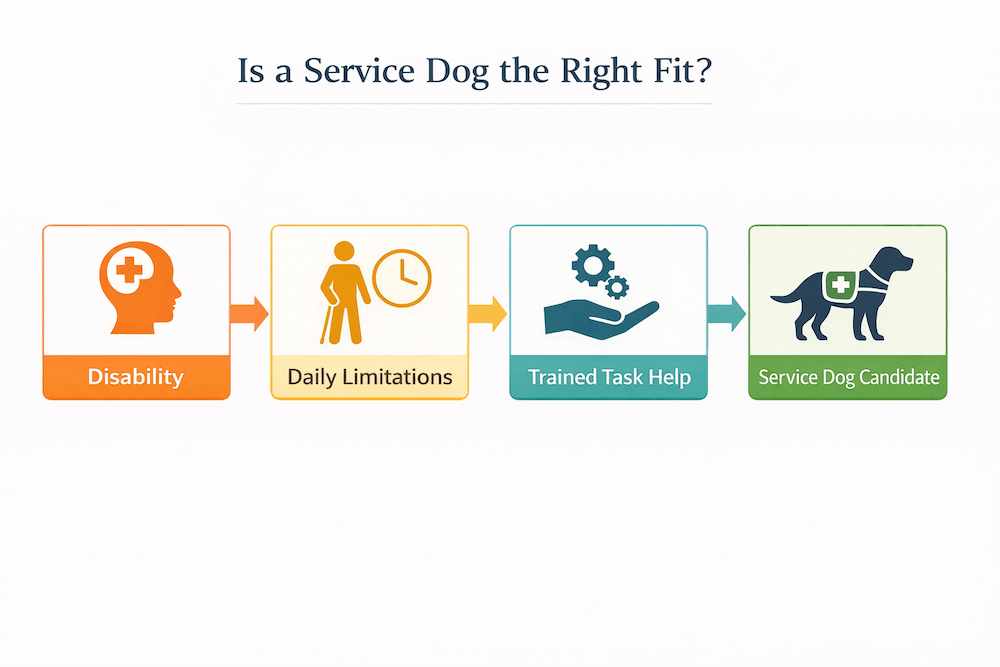
Qualifying for a service dog starts with your needs, not the dog. The key question is whether you have a disability that meaningfully affects daily life and whether a trained dog could perform specific tasks that reduce those limitations in a practical, reliable way.
It is also important to think honestly about readiness. A service dog may provide real support, but it also requires daily feeding, exercise, grooming, veterinary care, and consistent handling. You also need to consider whether you can manage training yourself or work with a qualified program, trainer, or other professional support when needed.


A service dog must be able to live and work safely within your routine, and you need the time, finances, and physical or emotional capacity to maintain that partnership long term. In many cases, it also helps to have support from a healthcare provider, therapist, or care team who understands your condition and can help you decide whether a service dog is an appropriate part of your treatment or daily support plan.
Program-Trained Service Dog vs Owner-Trained Service Dog
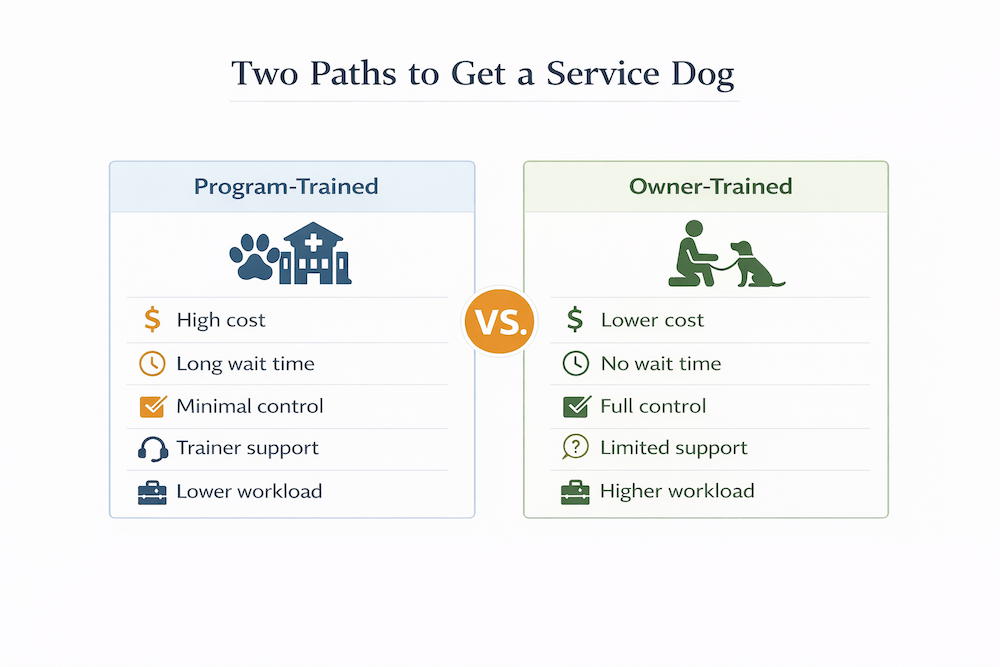
There are two main ways to get a service dog: working with a professional program that places a trained dog, or training your own dog if the dog is suitable for service work. Both paths can lead to a legitimate service dog, but they differ in cost, workload, flexibility, and the amount of support built into the process.
Program-trained dogs often offer more structure and guidance, while owner-trained dogs give the handler more control over how the dog is selected and trained. The tradeoff is that owner-training usually places much more of the screening, training, troubleshooting, and public-access preparation on the handler.
| Factor | Program-Trained Service Dog | Owner-Trained Service Dog |
|---|---|---|
| Cost | Often very high, though some programs offer grants or fundraising help. | Can cost less upfront, but training, gear, and setbacks still add up. |
| Wait time | Usually longer because many programs have screening and waitlists. | Can start sooner if you already have a suitable dog. |
| Professional support | Usually includes structured training, matching, and follow-up guidance. | Depends on whether you hire trainers or work largely on your own. |
| Control over training | Less control because the program sets much of the process. | More control over dog choice, task work, pace, and methods. |
| Handler workload | Usually lower because much of the training is already done. | Usually much higher because the handler manages daily training and exposure. |
| Risk of washout | Still possible, but screening may reduce some avoidable failures. | Often higher because dog selection and training quality vary more. |
| Best for | People who want more structure, matching help, and professional oversight. | People with a suitable dog, training access, and time for the process. |
Neither path is automatically easier or better. A program-trained dog may reduce some of the training burden, but it can come with long wait times, limited control, and major cost. Owner-training may offer more flexibility, but it also places far more responsibility on the handler to choose the right dog, build reliable skills, and manage setbacks. If you already have a suitable dog, learning how to make your dog a service dog requires careful screening, task training, and public behavior work.
The best choice depends on your disability-related needs, budget, time, dog-handling experience, and access to qualified support. What matters most is not which path sounds better in theory, but which one gives you the best chance of ending up with a safe, reliable dog that can truly do the work you need.
How to Get a Service Dog Step by Step
Here are the key steps to getting a service dog, from confirming that one is the right disability tool to choosing a training path, building reliable tasks, and understanding your rights and responsibilities.


Step 1: Confirm That a Service Dog Is the Right Disability Tool
Start by asking whether a dog can perform tasks that directly reduce the impact of your disability in daily life. A service dog is appropriate when the dog can do trained work such as guiding, alerting, retrieving items, interrupting specific disability-related behaviors, or helping with mobility-related tasks. Comfort alone does not meet the ADA service-dog standard.
Step 2: Choose Your Path: Program a Dog or an Owner-Trained Dog
You can get a service dog either through a professional program or by training your own dog if the dog is capable of the work. The ADA does not require professional training, but the dog still must be individually trained to perform disability-related tasks and behave appropriately in public. Program dogs may offer more structure, while owner-training can offer more control and flexibility but usually demands more time, handling skill, and careful screening of the dog.
Step 3: Select a Dog With the Right Temperament and Health
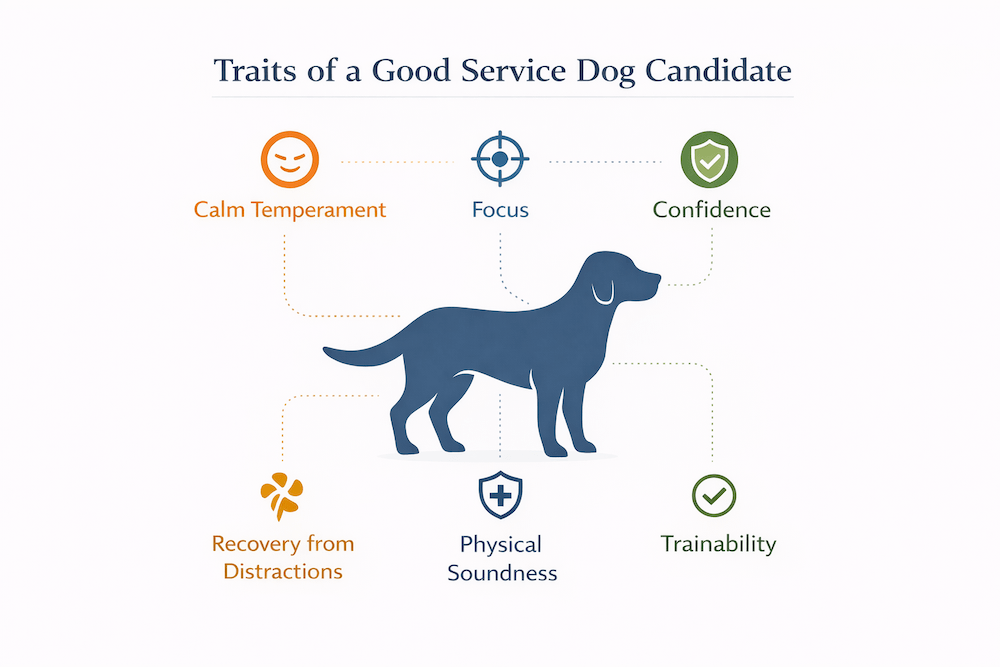
Look for a dog that is stable, trainable, healthy, environmentally resilient, and able to recover quickly from distractions without shutting down or becoming reactive. If you already have a dog, evaluate it honestly before investing heavily in training. A dog that is fearful, highly reactive, unhealthy, or unable to focus in busy environments may not be a good service-dog candidate, even if it is a wonderful pet.
Step 4: Build a Strong Foundation of Obedience and Public Behavior
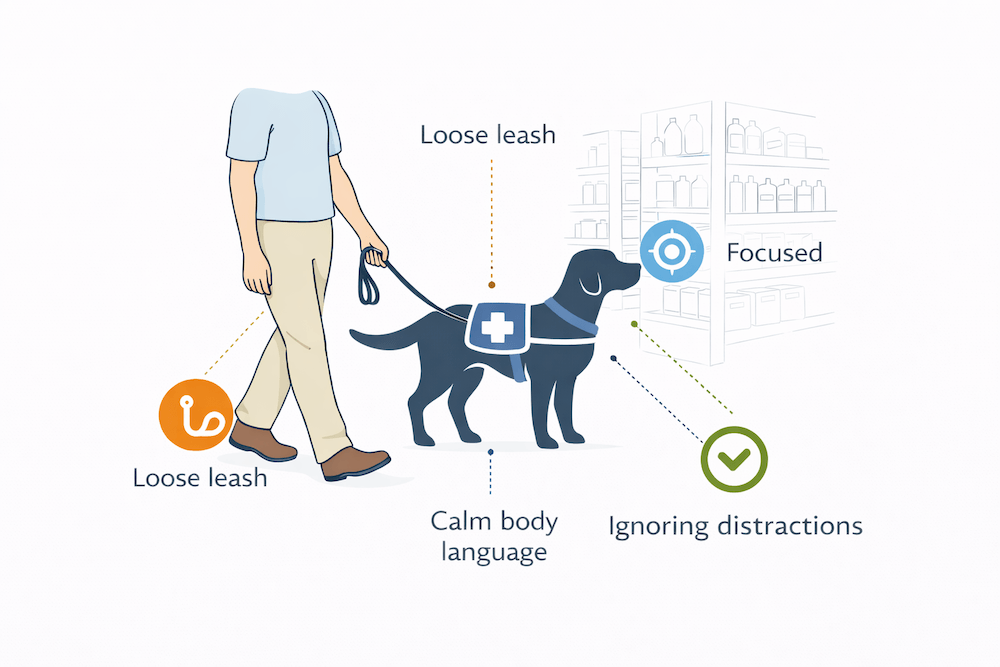
Before advanced task work, it helps to understand how to train a dog with short, consistent, reward-based sessions. The dog needs dependable basics: loose-leash walking, settling, ignoring distractions, recall, handling tolerance, and calm behavior around people, dogs, noises, carts, doors, and unfamiliar environments. Public access depends on behavior, not gear. A service dog can still be removed from a business if it is out of control or not housebroken.
Step 5: Train Specific Tasks Related to Your Disability
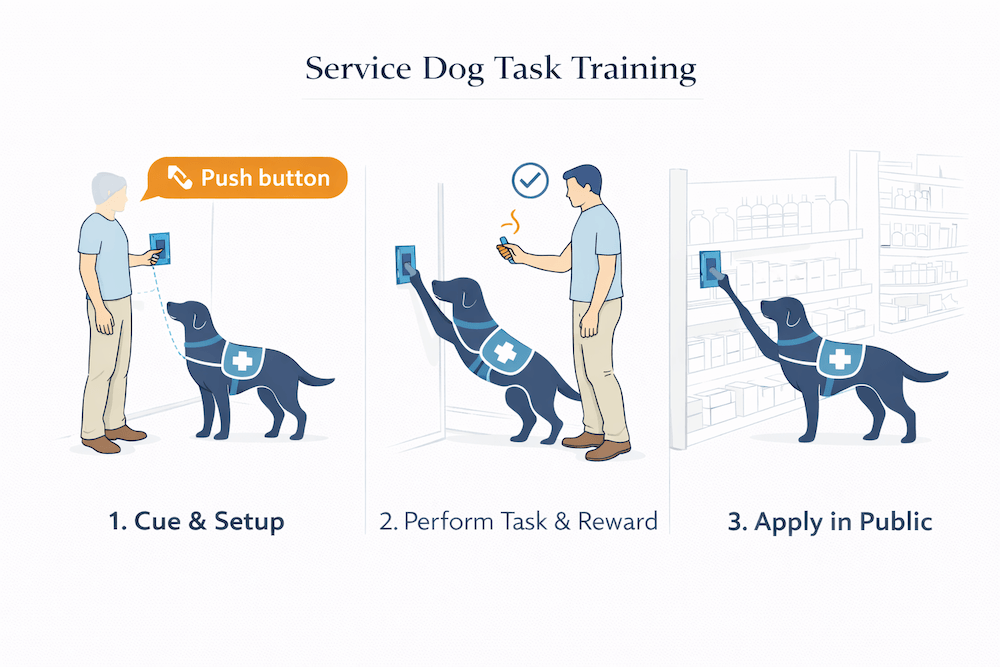
Task training is what turns a well-behaved dog into a service dog. The task must directly help with your disability, such as alerting to sounds, guiding around obstacles, retrieving dropped items, pressing a medical alert button, interrupting disability-related behaviors, or providing trained mobility assistance when appropriate.
Train one task at a time, then generalize it across rooms, people, surfaces, and public settings. The dog should be able to perform the task reliably without confusion, excessive prompting, or stress.
Step 6: Practice Real-World Reliability
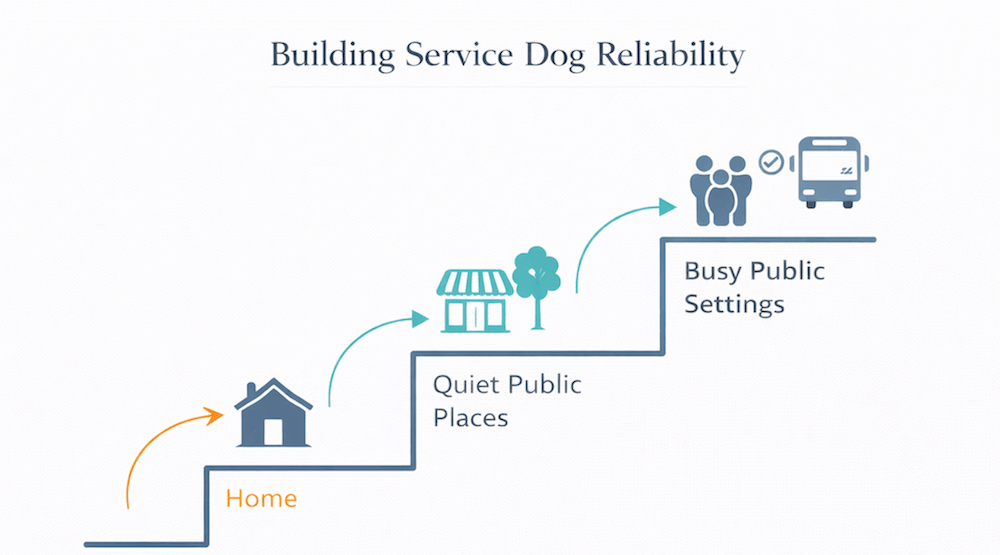
Once the dog knows the task, test it in increasingly challenging environments: home, sidewalk, parking lot, quiet store, busier store, restaurant patio, medical office, and other places relevant to your life. Reliability matters because service-dog access assumes the dog is trained and under control in public.
Use short sessions, clear criteria, and gradual difficulty increases. If the dog struggles, lower the challenge instead of forcing the dog through stressful situations too early.
Step 7: Learn Your Rights and Responsibilities
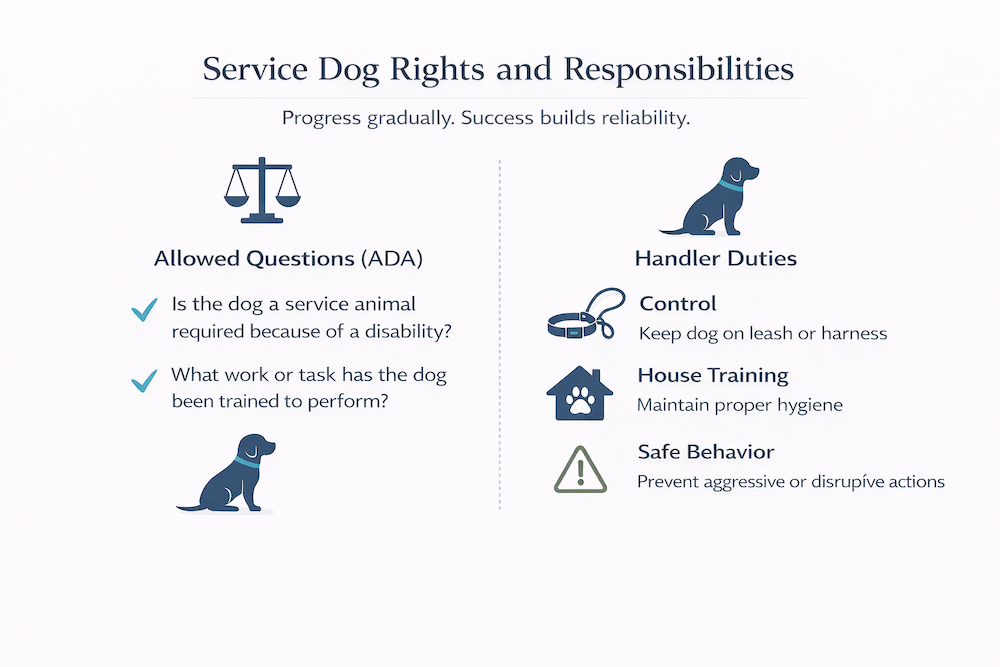
In public places covered by the ADA, staff may generally ask only two questions when the need is not obvious: whether the dog is required because of a disability and what work or task the dog has been trained to perform. They generally may not require documentation, ask about your diagnosis, or demand a demonstration.
At the same time, handlers still have responsibilities. The dog must remain under control, and access protection does not excuse disruptive or unsafe behavior. Knowing both sides helps you avoid conflict and misinformation.
Step 8: Get Professional Help When Needed
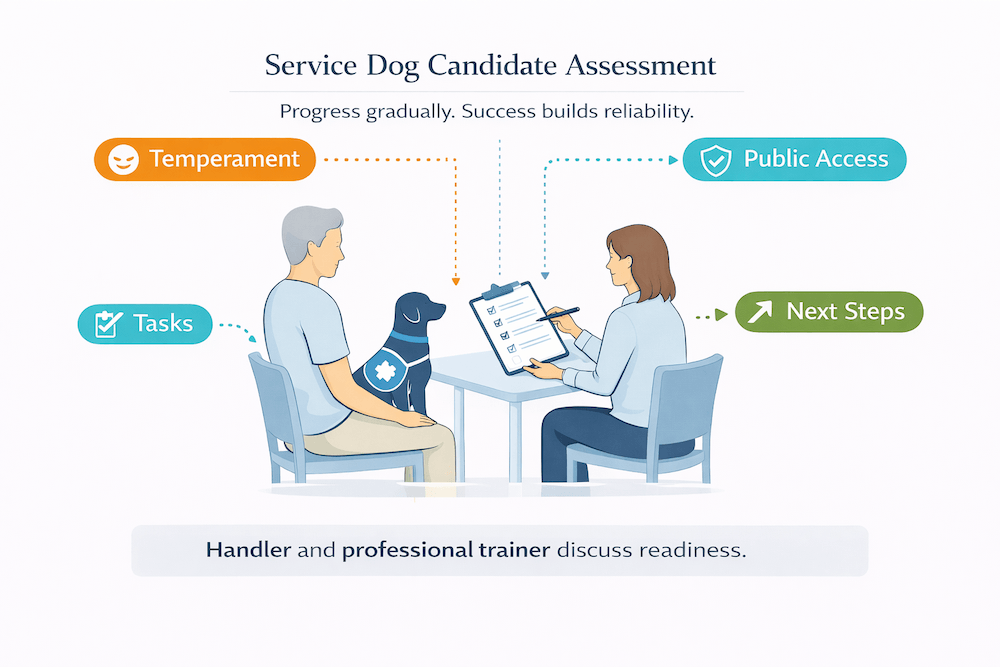
Work with a qualified trainer, service-dog organization, or veterinarian when the dog shows fear, reactivity, health problems, or inconsistent task performance. Professional guidance can help you determine whether the dog should continue in training, change training methods, or wash out of service work.
How to Find a Legitimate Service Dog Program or Trainer
A legitimate service-dog program or trainer should clearly explain their training methods, task experience, evaluation process, pricing, and follow-up support. Reputable providers should also have a verifiable reputation, such as references, cross-checked reviews, or recognition by established organizations.
Red flags include instant certification promises, guaranteed public access, no real evaluation process, vague training claims, pressure to pay quickly, or selling IDs, vests, or registrations as if they create legal status. Under the ADA, those items do not make a dog a service dog.
Before committing, ask:
A legitimate provider should answer clearly and without pressure.
Best Places to Apply For A Service Dog
If you need legitimate places to apply for a service dog in the U.S., these are strong starting points:
Best place to start
- Assistance Dogs International (ADI) Member Search — best directory for finding accredited programs by state, disability type, and whether they work with owner-trained dogs. ADI says its accredited members have met its standards and undergone on-site evaluation.
Major national programs
- Canine Companions — national nonprofit service dog program with an application/request process for service dogs.
- PAWS With A Cause — places assistance and facility dogs nationwide; its client application request opens annually.
- NEADS World Class Service Dogs — has a pre-qualifying questionnaire and formal application process for service dogs.
- Dogs for Better Lives — places hearing dogs, autism assistance dogs, and facility dogs.
- Atlas Assistance Dogs — useful for people who already have a dog and want help training that dog as a service dog. ADI specifically points people seeking programs that work with their own dog to its member search, and Atlas says it helps disabled people train their own service dogs.
Guide dog programs
- Guide Dogs for the Blind — offers guide dog applications for people who are blind or visually impaired.
- The Seeing Eye — accepts applications online or by phone for guide dogs.
- Guide Dog Foundation — has an application process for guide dogs.
- Guiding Eyes for the Blind — another guide dog program with stated eligibility requirements.
Veterans
- K9s For Warriors — provides service dogs for veterans with PTSD, TBI, and/or MST at no financial cost to the veteran according to its program page.
Illinois options
- Paws Giving Independence — ADI member search lists it as serving Illinois for service dogs, including mobility, seizures, and other medical categories.
- Got Your Six Support Dogs — ADI member search lists it in Illinois for veterans and first responders with military PTSD.
One important note: under the ADA, there is no official federal service dog registry or certification requirement, and the DOJ says online registration/certification documents do not create legal rights. That is why real programs are usually nonprofits, guide dog schools, or ADI-listed providers rather than “pay for instant registration” websites.
Application, Evaluation, Wait Times, and Cost
The process often starts with an application, followed by interviews and sometimes disability-related documentation, especially through formal programs. Programs may also assess the handler’s needs, lifestyle, and readiness, while owner-training often begins with evaluating the dog’s temperament, health, and suitability for service work.
Wait times vary depending on the provider, the type of service work needed, and whether you are applying for a program dog or training your own. Costs may include program fees, private training, travel, gear, vet care, grooming, follow-up sessions, and future replacement or retirement planning. Training expenses may also include reward tools such as clickers, treat pouches, and dog training treats for consistent practice.
| Expense | What It May Include | Why It Varies |
|---|---|---|
| Program fees | Placement, matching, instruction, and transition support. | Programs differ in funding, scope, and included services. |
| Private training | Lessons, task work, and public-access coaching. | Rates vary by trainer, region, and training needs. |
| Travel | Assessment visits, training trips, or placement travel. | Distance and number of required visits can differ. |
| Gear | Harnesses, leashes, vests, crates, and reward tools. | Needs depend on tasks, dog size, and setup. |
| Vet care | Preventive care, exams, vaccines, and health treatment. | Age, health status, and local pricing all matter. |
| Grooming | Bathing, nail care, coat maintenance, and supplies. | Breed, coat type, and grooming frequency affect cost. |
| Follow-up sessions | Refresher training and problem-solving support. | Some programs include this, while others charge separately. |
| Retirement planning | Replacement training, transition support, and future care. | Timing and long-term dog health are unpredictable. |
What to Expect After You Get a Service Dog
After placement or initial training, the first weeks and months are usually an adjustment period, not the finished product. Even a well-trained dog may need time to bond with a new handler, settle into a new home, and learn a new daily rhythm, while the handler also learns timing, handling skills, reinforcement, and how to work with the dog confidently in public.
Expect continued practice, small setbacks, and gradual improvement in real-life routines. Public access confidence often builds over time as the team learns from each other, and success usually looks like increasing consistency, smoother handling, and reliable task performance across the environments that matter most to your daily life.
ADA Rules and Common Misunderstandings
These are common myths about service dogs that can cause confusion among handlers, businesses, and the public, especially regarding certification, vests, public access rights, and removal rules.
Common Mistakes When Getting a Service Dog
Avoiding common mistakes can help protect your time, money, legal access, and the dog’s long-term welfare throughout the service-dog process.
| Mistake | Why It’s a Problem |
|---|---|
| Buying a registry card | Registration does not create legal service-dog status. |
| Skipping task planning | The dog may be helpful but not legally qualify. |
| Choosing the wrong dog | Poor temperament can derail the entire process. |
| Ignoring public manners | Bad behavior can lead to lawful removal. |
| Rushing public outings | Too much pressure can damage confidence and focus. |
| Overlooking health issues | Pain or illness can reduce safe working ability. |
| Forcing an unsuitable dog | Not every good pet can become a service dog. |
What Research Says About Getting a Service Dog
The legal foundation is clear: under the ADA, service dogs are dogs individually trained to perform work or tasks directly related to a disability, and there is no federal registration requirement. That matters because many people waste money on scam registries instead of focusing on actual training and suitability.
Research also supports being realistic about the benefits and demands of service dogs. A 2019 study on professionally and self-trained service dogs reported benefits such as increased independence, self-esteem, and quality of life, which helps explain why many people pursue either a program dog or owner-training path.[1]
A 2020 review of assistance dogs found positive effects on psychosocial health, including emotional functioning and well-being, but the evidence base remained mixed in some areas. That matters because a service dog can be life-changing, but it is still a serious long-term working partnership rather than a quick solution.[2]
Selection research matters too. Work on selecting quality service dogs emphasizes that success depends heavily on matching the dog’s temperament, health, and traits to the job. In practice, this means that choosing the right dog is often just as important as the training plan itself.[3]
Ongoing Responsibilities After Getting a Service Dog
Getting a service dog is not a one-time process. Long term, you need to maintain the dog’s task reliability, public behavior, health, and overall quality of life so the dog can keep working safely and effectively.
That means continuing to practice trained tasks, reinforcing calm public behavior, and keeping the dog responsive in real-world settings. Just as important, the dog still needs regular exercise, enrichment, grooming, and veterinary care to stay physically and mentally well.
Handlers should watch for stress, fatigue, slower recovery, reluctance to work, or signs of pain in dogs that may affect the dog’s safety and performance. Part of responsible service-dog ownership is planning ahead for retirement, recognizing when the dog should do less, and knowing when it is time for full retirement from work.
Frequently Asked Questions
The Bottom Line
Getting a service dog is not about buying a vest or filling out a quick form. It is about finding the right path, the right dog, and the right training to create a safe, reliable working partnership that truly helps with daily life. For some people, that means applying through a professional program. For others, it means carefully owner-training a suitable dog with the right support. The best route depends on your disability-related needs, readiness, budget, and ability to maintain the dog’s training and care over time. In the end, a legitimate service dog is defined by what it can reliably do, not by registration or appearance. Taking the process seriously from the start gives you the best chance of ending up with a dog that can support you well for years to come.