How to Make My Dog a Service Dog: Complete Guide (Step-by-Step)

Canine Bible is reader-supported. We receive affiliate commissions via some of our links. Learn more.
You can only make your dog a service dog if it is individually trained to perform specific tasks that help with your disability. A dog is not a service dog just because it is well-behaved, provides comfort, or has an online certificate or vest. That is where many people get confused, especially when emotional support animals, therapy dogs, and service dogs are often treated like the same thing. Your dog also needs the right temperament, health, obedience, and public behavior to handle the job safely and reliably. Some dogs can learn the work, while others are not suited for it, even if they are loving pets. The process can involve disability-related task training, public access skills, and important legal limits that many owners misunderstand. In this guide, you will learn what qualifies a dog, what does not, and how to tell whether your dog can realistically do the work.
Key Service Dog Basics to Understand First
| Key Point | Details |
|---|---|
| Definition | A service dog is trained to perform specific tasks for a person with a disability. |
| Task requirement | The dog’s trained work must directly relate to the handler’s disability. |
| Not emotional support | Emotional support and therapy dogs do not have the same task-based status. |
| Breed and size | Many breeds and sizes can qualify if they safely perform the needed tasks. |
| Training source | A dog can be owner-trained if it learns reliable disability-related tasks. |
| Public behavior | The dog must stay controlled and dependable in public settings. |
| Gear and paperwork | A vest, ID, or registration alone does not make a dog a service dog. |
| Ongoing reliability | Service dogs need continued practice and care to remain dependable. |
What Legally Counts as a Service Dog
Under the ADA, a service dog is defined by trained, disability-related work, not by a vest, online registration, or the fact that the dog provides comfort. That means the dog must be individually trained to take specific actions that directly help its handler’s disability, including in some psychiatric cases.
ADA Rules for Service Dogs
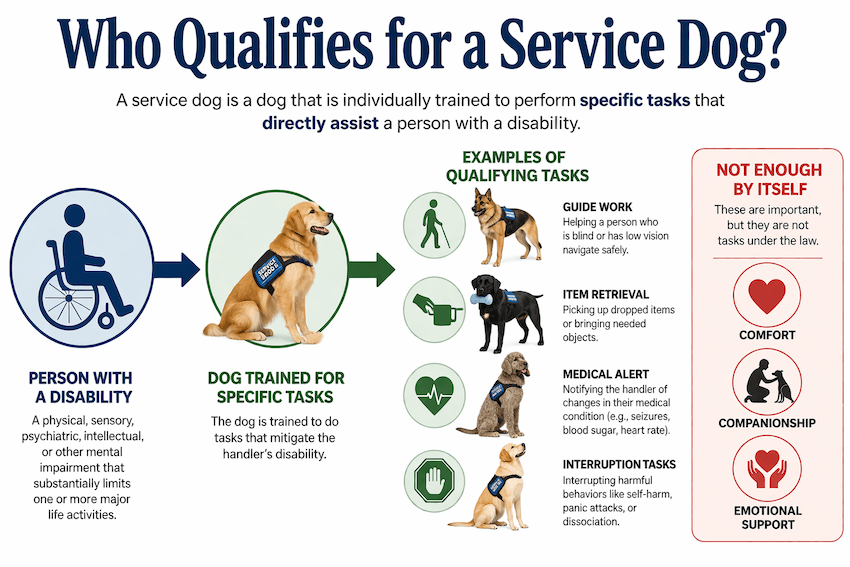
Under the Americans with Disabilities Act, a service dog is a dog that has been individually trained to do work or perform tasks for a person with a disability. The key point is the training and the task: the dog’s job must directly relate to that person’s disability. A dog that provides comfort just by being present does not meet the ADA definition of a service dog. In public-access settings covered by the ADA, the legal focus is on disability-related task work, not on labels, appearances, or general companionship.
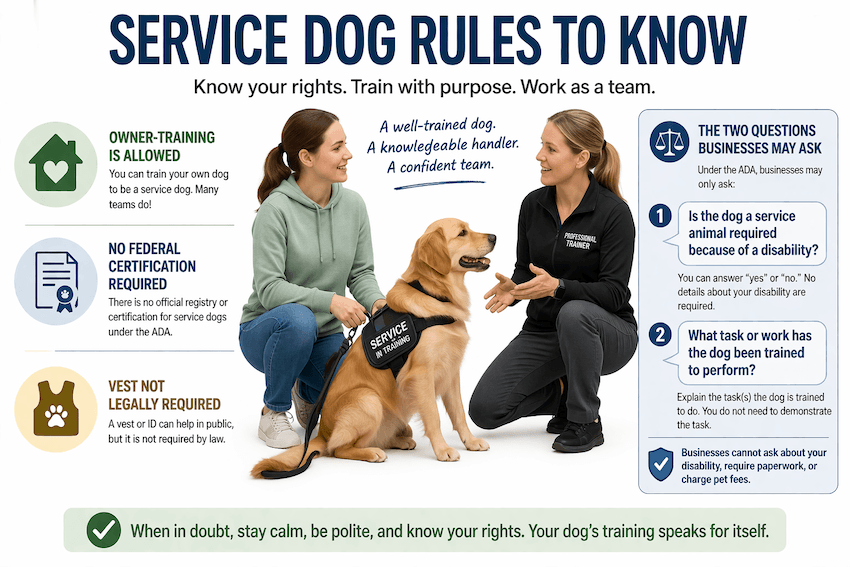
The practical takeaway is simple: federal ADA rules do not require a professional training program, and they do not require a vest, ID card, certificate, or registration. A business also should not treat those items as proof that creates service-dog status. When the dog’s service is not obvious, businesses are generally limited to asking whether the dog is required because of a disability and what work or task the dog has been trained to perform.


Service Dog vs Emotional Support Animal vs Therapy Dog
This reflects ADA public-access basics for service dogs and shows how emotional support animals and therapy dogs are treated differently under that framework.
| Type | Main Role | Task Training Required? | ADA Public-Access Status |
|---|---|---|---|
| Service dog | Performs disability-related work or tasks for one handler. | Yes, specific trained tasks are required. | Yes, if it meets ADA rules and stays under control. |
| Emotional support animal | Provides comfort or companionship through presence. | No, task training is not required. | No, not as a service animal under the ADA. |
| Therapy dog | Provides comfort to other people in structured settings. | No, not disability-task training for one handler. | No, not as a service animal under the ADA. |
How to Make My Dog a Service Dog Step by Step
Here are the key steps to help you determine whether you qualify for a service dog and what it takes to train a dog to legally and reliably perform disability-related tasks.
Step 1: Confirm That You Qualify for a Service Dog
A service dog is for a person with a disability, and the dog must be trained to perform tasks that directly help with that disability. Comfort alone is not enough under the ADA. For example, valid tasks may include guiding, alerting to medical events, retrieving items, interrupting harmful behaviors, bracing only when appropriate and safely advised, or helping with other trained disability-specific actions.


Step 2: Evaluate Whether Your Dog Is Actually a Good Candidate
Your dog should be physically healthy, emotionally stable, trainable, comfortable around people, and able to recover quickly from distractions or surprises. Dogs that are aggressive, highly fearful, easily overstimulated, noise-sensitive, or unreliable in new places are poor candidates for service work. Screening with a veterinarian and an experienced service-dog trainer can save time and avoid pushing the wrong dog into stressful work.
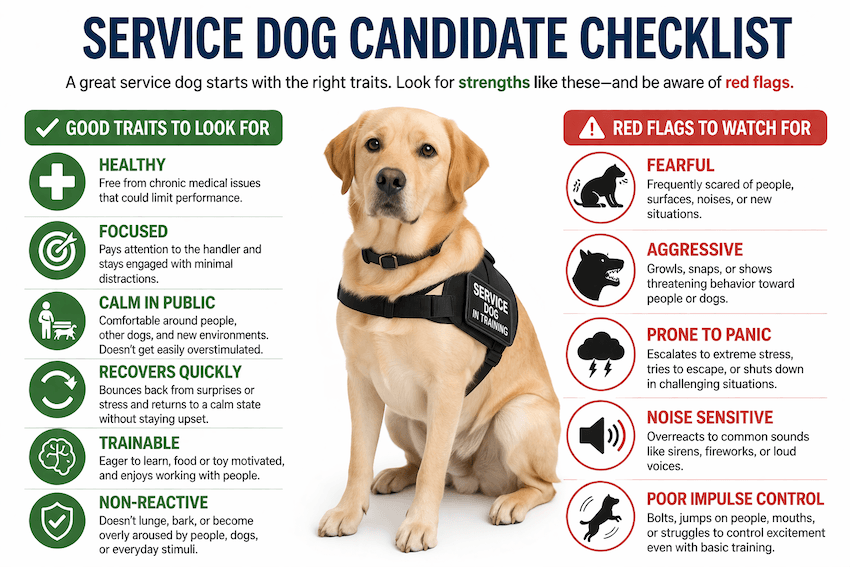
Step 3: Build a Strong Foundation, Obedience, and Neutral Public Behavior
Before task training, your dog should reliably respond to core cues like sit, down, stay, come, leave it, settle, loose-leash walking, and polite handling. Just as important, the dog must learn neutrality: ignoring food, strangers, carts, other dogs, loud sounds, and everyday public movement. The dog should not lunge, bark, sniff excessively, beg for attention, or panic when working in public.
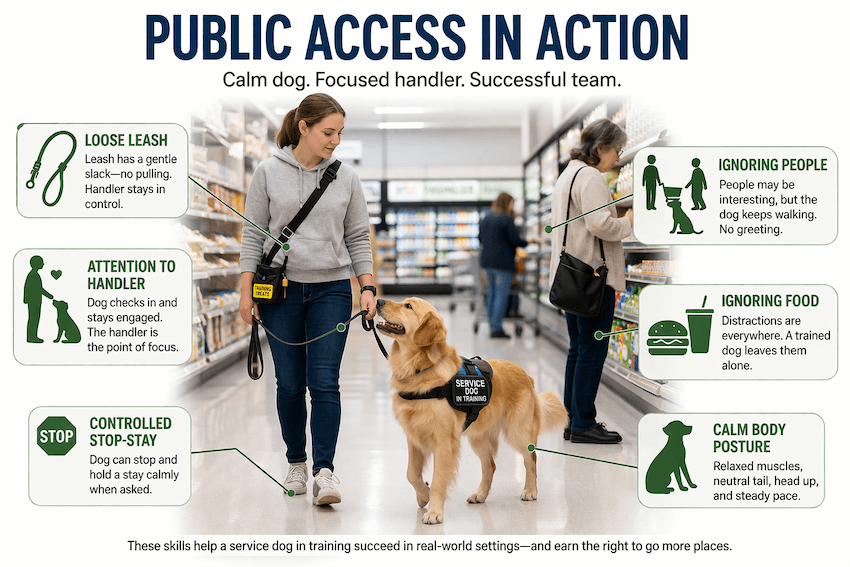
Step 4: Train One or More Specific Disability-Related Tasks
This is the part that legally matters most. Your dog must be trained to take a specific action that helps with your disability. Start with one clear task, break it into small behaviors, reward each piece, then proof it in different locations and situations. Examples may include retrieving dropped items, alerting to a trained cue, opening or closing doors, guiding to an exit, interrupting a dissociative episode, or performing another directly relevant task.
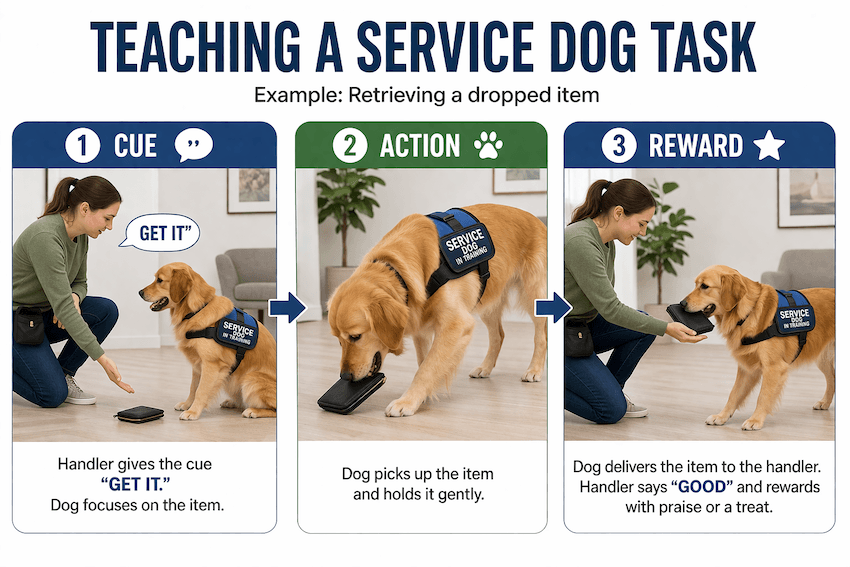
Step 5: Proof the Training in Real-Life Environments
A dog that performs at home but falls apart in public is not ready. Practice the trained tasks and public manners in gradually harder environments: home, driveway, quiet sidewalk, pet-friendly stores, busier places, and only then, the settings your disability actually requires. Increase difficulty slowly so the dog stays successful and confident.
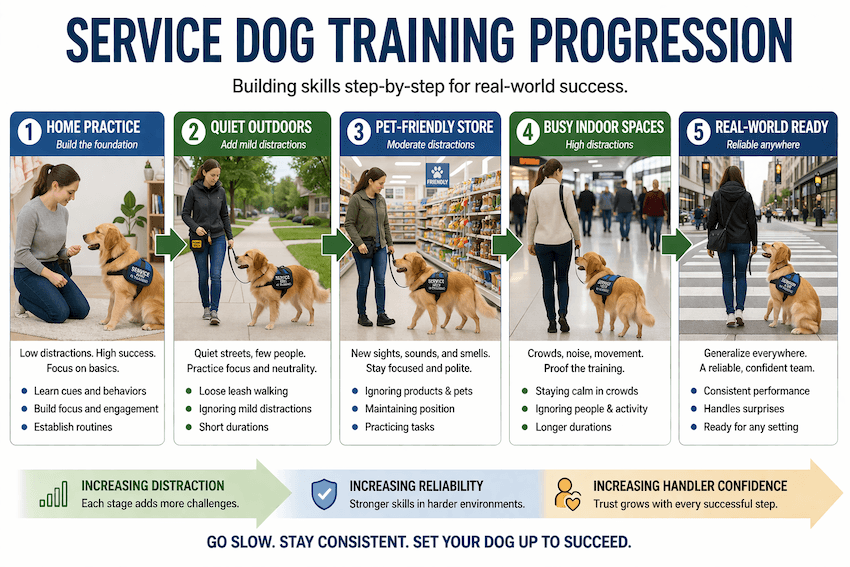
Step 6: Work With a Qualified Professional and Know the Legal Rules
Owner-training is allowed under the ADA, and a professional training program is not federally required. But professional help is often the safest path, especially for task design, behavior screening, public-access standards, and difficult cases. Also, know the legal basics: the ADA does not require certification, registration, special ID, or a vest, and businesses generally may ask only two questions when the service provided is not obvious: whether the dog is required because of a disability and what task it has been trained to perform.
Ongoing Training for Service Dogs
Service dog training is ongoing, not a one-time finish line. Even after a dog learns its core tasks, the handler needs to keep practicing task work, obedience, calm public behavior, and response under distraction so performance stays reliable over time.
That also means adjusting training as real life changes. New environments, busier routines, health changes, age-related slowing, or shifting disability needs can all affect performance, so refreshers and small training updates help keep the dog safe, effective, and ready for public work.
Service Dog Handler Responsibilities
A service dog’s work depends heavily on the handler, not just the dog. The handler is responsible for keeping the dog healthy, clean, under control, and consistently ready to perform trained tasks in public.
Additional Tips That Help When Making Your Dog a Service Dog
A successful service dog is built through steady, structured practice, not rushed or inconsistent training. These tips focus on habits that improve reliability, reduce setbacks, and support safer long-term progress.
| Tip | Why It Helps | How to Apply It |
|---|---|---|
| Start With One Task | Simple training plans create faster and cleaner progress. | Pick one disability-related behavior and shape it first. |
| Train Short Sessions | Short sessions reduce frustration and preserve accuracy. | Practice for 5 to 10 minutes several times daily. |
| Proof Slowly | Gradual exposure builds reliability without overwhelming the dog. | Increase distractions one environment at a time. |
| Reward Calm Neutrality | Public access depends on steady behavior around distractions. | Reinforce ignoring people, dogs, food, and noise. |
| Track Training Data | Notes reveal patterns, gaps, and readiness levels. | Log cues, mistakes, distractions, and task success. |
| Use Professional Feedback | Expert input catches weaknesses before they become habits. | Schedule evaluations with a qualified service-dog trainer. |
Common Mistakes When Trying to Make Your Dog a Service Dog
Many service-dog training problems start with misunderstanding the legal standard or moving faster than the dog is ready for. Knowing the most common mistakes early can help protect the dog’s confidence, safety, and working ability.
| Mistake | Why It’s a Problem |
|---|---|
| Buying a Certificate | Paperwork does not replace legal task training. |
| Skipping Suitability Testing | Poor candidates often struggle or wash out later. |
| Training Only at Home | Home success rarely guarantees public reliability. |
| Rushing Public Access | Too much pressure can damage confidence and behavior. |
| Confusing Comfort With Tasks | Emotional support alone does not meet ADA standards. |
| Ignoring Reactivity Signs | Fear or reactivity can make working unsafe. |
What Research and ADA Rules Say About Service Dogs
The ADA is the key legal source in the U.S. It states that service animals are dogs individually trained to do work or perform tasks directly related to a person’s disability, and it also makes clear that emotional support alone does not qualify. This matters because many owners mistakenly focus on registration, vests, or letters instead of task training and public behavior.
Behavior research also matters. A 2019 Frontiers in Veterinary Science study found that behavior measures helped predict which dogs would successfully complete assistance-dog training, and a related 2026 Frontiers paper reinforced that specific behavioral traits influence career outcomes in assistance dogs. Clinically, that supports early screening for confidence, trainability, and emotional stability rather than assuming any bonded pet can do the job.[1]
Other working-dog research has found that cognitive and behavioral testing can help identify dogs more likely to succeed in demanding roles, while guide-dog outcome work has shown that behavioral questionnaires can support better early selection decisions. These studies support the same takeaway: suitability and consistent training matter as much as motivation.[2]
Frequently Asked Questions
The Bottom Line
Making your dog a service dog is not about buying paperwork or putting on a vest. It means your dog must be individually trained to perform specific tasks that directly help with your disability, and it must be able to work safely and reliably in public. For many people, the biggest part of the process is being honest about whether their dog is truly suited for the job. A good service dog needs the right health, temperament, training, and consistency, and that takes time, structure, and ongoing practice. If your dog can meet those standards, owner-training may be possible under the ADA, with or without professional help. The goal is not just to have a dog with a label, but to build a dependable working partner that improves daily life in a real, lawful, and practical way.