How Often Do Dogs Go Into Heat? Heat Cycle Timeline, Signs, More


Canine Bible is reader-supported. We receive affiliate commissions via some of our links. Learn more.
Female dogs usually go into heat about every 6 to 8 months, which means most have two heat cycles per year. That said, the exact timing can vary based on breed, size, age, and the individual dog. Some dogs cycle more often, while others may go longer between heats, especially if they are very young, very old, or a giant breed. It is also easy to confuse normal heat timing with a cycle that is delayed, silent, or irregular. Knowing what is typical matters because heat affects fertility, behavior, bleeding, and health monitoring. Owners also need to know when a dog can get pregnant, what signs to watch for, and when cycle changes may point to a problem. In this guide, we’ll break down how often dogs go into heat, what can change that schedule, and when it is time to call your vet.
Dog Heat Cycle Quick Facts
| Heat Cycle Fact | Typical Range |
|---|---|
| Cycle frequency | Most female dogs go into heat about every 6 to 8 months, or roughly twice a year. |
| First heat age | Many dogs have their first heat between about 6 and 15 months, depending on breed and size. |
| Small breed timing | Small dogs often start earlier and may cycle a bit more often than large or giant breeds. |
| Large breed timing | Large and giant breeds may start later and sometimes go 8 to 12 months between cycles. |
| Heat duration | A full heat cycle usually lasts around 2 to 4 weeks from start to finish. |
| Fertile window | The most fertile days often happen about 1 to 2 weeks after bleeding begins, but timing can vary. |
| Cycle changes with age | Older dogs may still go into heat, though the timing can become less predictable over time. |
| Irregular cycles | Very young dogs may have uneven early cycles, but repeated long gaps or unusual changes should be checked by a vet. |
When Dogs Usually Go Into Heat for the First Time
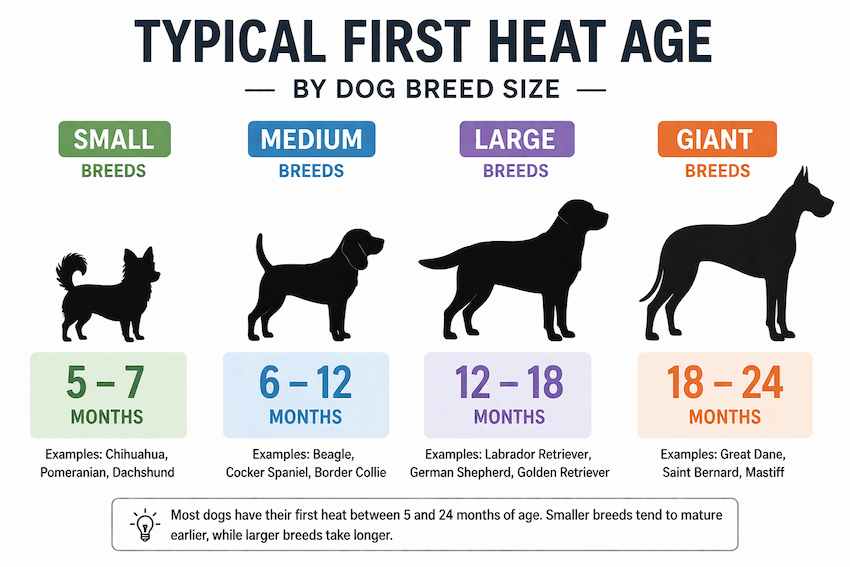
A dog’s first heat usually starts somewhere between 6 and 24 months of age, which is a wide range but still considered normal. Small breeds often mature earlier, while large and giant breeds may not cycle until much later. That difference can make first-time owners think something is wrong when their large-breed dog simply has a later timetable.
It also helps to think about overall development, not just the calendar. A puppy that is still growing and immature may not follow the same reproductive timing as a small dog that reaches sexual maturity early. Veterinary sources also note that early cycles can be irregular, so the first heat does not always mean the next one will arrive on a perfect schedule. Owners are usually better served by tracking the first cycle and then watching for a pattern to emerge over the next year or two.
How Often Heat Cycles Usually Happen
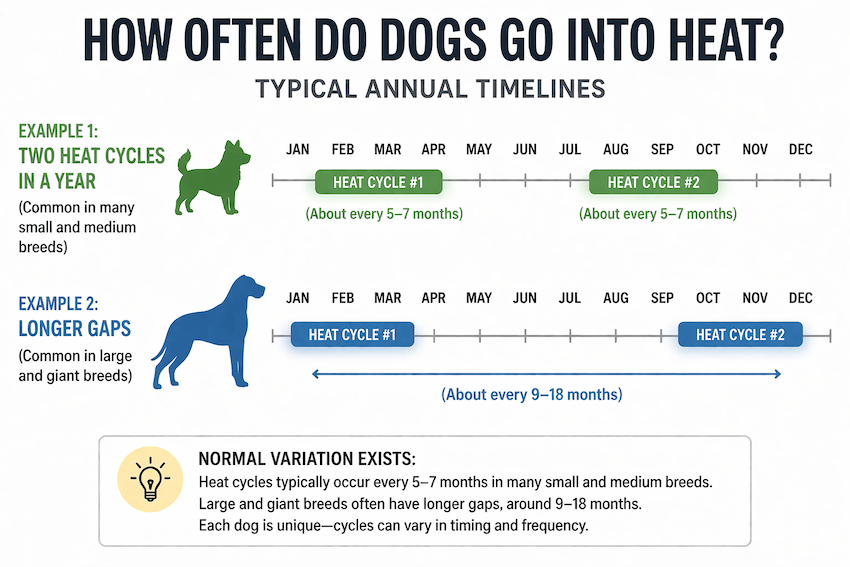
After puberty, many intact female dogs settle into a pattern of going into heat about twice a year. Merck describes a common interval of about 7 months, while owner-facing veterinary guidance from Cornell and VCA puts the typical pattern around every 5 to 11 months or twice yearly. Those numbers are close enough to support the same practical takeaway: twice a year is common, but a healthy dog may still fall outside an exact six-month rhythm. That is why “about every six months” is a useful rule of thumb, not a strict rule.


The cycle often becomes more predictable as a dog matures, although some normal dogs never become clockwork-regular. Younger dogs can take up to two years to develop regular cycles, and giant breeds may normally go much longer between heats than toy or small breeds. Some breed exceptions also exist, including dogs that may cycle once yearly rather than twice.
What Affects How Often a Dog Goes Into Heat
Heat timing is partly predictable and partly individual. Veterinary references agree that breed, body size, age, and cycle maturity all influence how often a dog comes into heat. Once a dog has had a few cycles, her own pattern becomes one of the most useful guides. Health problems can also disrupt cycling, which is why a schedule change matters most when it is new, persistent, or paired with other signs of illness.
The Stages of a Dog’s Heat Cycle
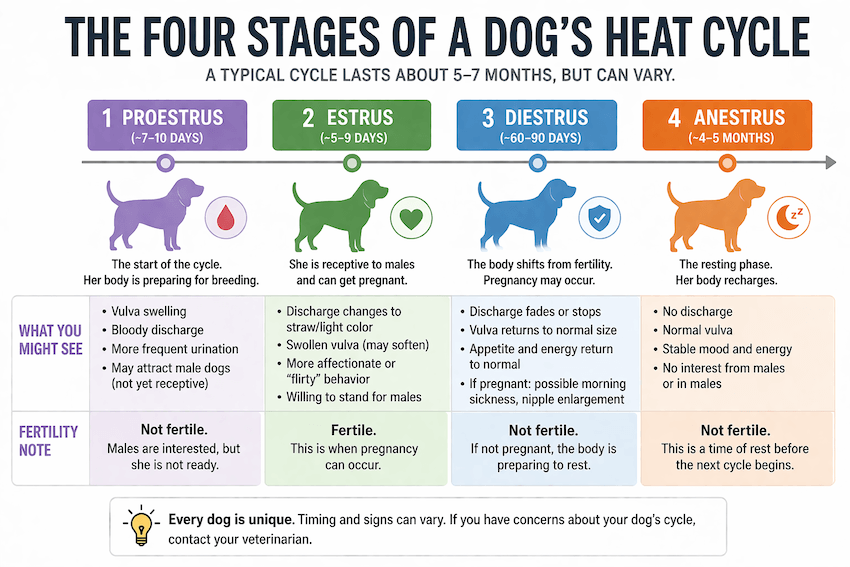
A dog’s reproductive cycle has four main stages, and the part owners call “being in heat” is only one piece of the full process. Cornell and Merck describe these stages as proestrus, estrus, diestrus, and anestrus, with visible signs being most obvious in the first two. Understanding the stages helps owners separate what they can see, such as discharge and swelling, from the longer hormonal shifts happening in the background. That makes it easier to judge fertility risk, expected timing, and whether a cycle seems unusually prolonged.
Signs a Dog Is in Heat
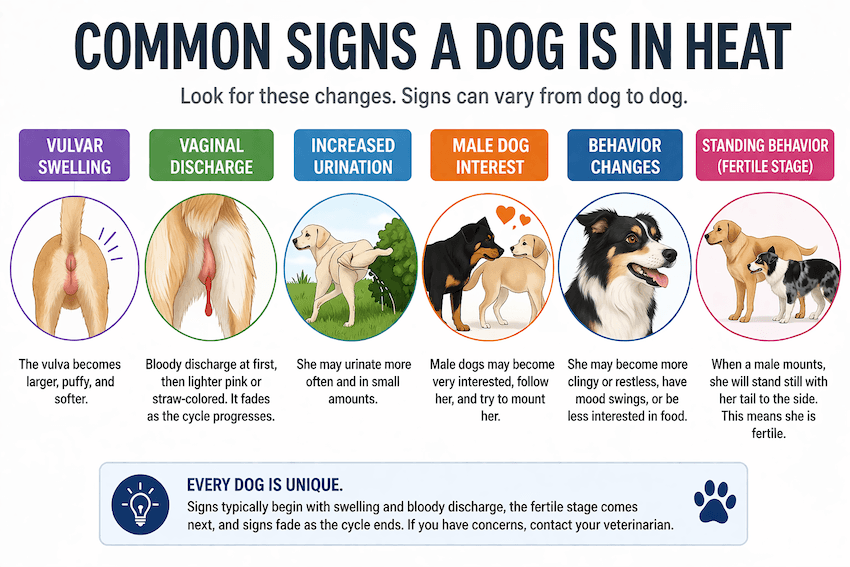
The signs of heat are often recognizable once you know what to look for, but they do not look identical in every dog. Some females show obvious swelling and discharge, while others have subtler signs that are easier to miss. The most useful approach is to watch for a cluster of changes rather than one sign alone. That includes physical changes, changes in urination, and shifts in how other dogs respond to her.


How Long a Dog Stays in Heat
The visible period, most owners call being in heat, usually lasts about 2 to 4 weeks, though the most fertile and receptive phase is often shorter. Bleeding, swelling, and fertility do not line up perfectly, which is why a dog may still seem in heat even after the main mating phase has shifted.
It also helps to remember that the heat cycle is only one part of the full reproductive cycle, which continues beyond the most obvious visible signs. That is why monitoring after heat still matters, especially if your dog seems unwell once bleeding has ended.
Pregnancy Prevention During a Dog’s Heat Cycle
During heat, close supervision matters because pregnancy risk can be present even when owners think the danger window is over. A female dog can get pregnant at any point while she is in estrus, and the stage when discharge becomes lighter or more watery may actually coincide with peak fertility rather than the end of risk. Male dogs may stay highly motivated throughout this period, so relying on appearance alone is not safe.
In practical terms, that means no off-leash outdoor time, careful separation from intact males, and no assumption that dog diapers or fences alone are enough. If you do not want future heat cycles or pregnancy risk, spaying is the most reliable long-term prevention, and it also prevents pyometra and reduces some reproductive risks; the right timing should be discussed with your veterinarian for your individual dog.
Do Dogs Go Through Menopause?
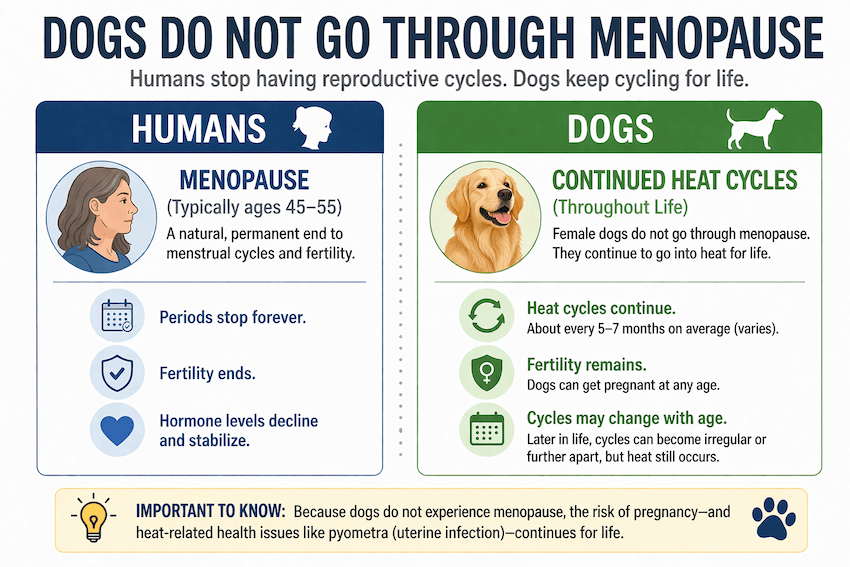
Dogs do not go through menopause the way humans do. Older intact females can continue to have heat cycles and can still become pregnant, although the cycles may become less obvious, less regular, or less fertile with age.
That does not make late-life cycling harmless, because reproductive disease risk remains relevant in older intact dogs. In practice, an aging intact female should be viewed as still reproductively active unless a veterinarian confirms otherwise.
When to Call a Vet About a Dog’s Heat Cycle
A little variation is normal, but some patterns deserve veterinary attention sooner rather than later. The most helpful rule is to look for timing that is far outside your dog’s expected pattern, heat signs that last too long, or illness signs around or after a cycle. Problems can range from abnormal hormone cycling to infection, ovarian disease, or pregnancy-related concerns. Calling early is especially wise when a schedule change is paired with discharge that looks abnormal, pain, lethargy, or a generally sick dog.
What Research and Veterinary Guidance Say About Dog Heat Cycles
A widely cited review by Concannon describes the inter-estrus interval in dogs as commonly about 6 to 7 months, while also emphasizing that healthy intervals can span roughly 5 to 12 months. Clinically, that matters because it supports the everyday advice owners hear most often—many dogs cycle about twice a year—while also confirming that a meaningful amount of normal variation exists between dogs and even between cycles in the same dog.[1]
Merck Veterinary Manualoffers practical owner guidance that lines up well with the research summary: many dogs cycle about twice yearly, the interval can range from 4 to 13 months, and some large breeds normally go 9 to 12 months between heats. That is useful because it helps owners avoid overreacting to every schedule difference while still recognizing that a prolonged or dramatically changed pattern may deserve medical review.[2]
Cornell University College of Veterinary Medicine also adds a strong owner-focused context by outlining the 6- to 24-month first-heat window, the main stages of the cycle, and the fact that bloody discharge often lasts 14 to 21 days. Cornell’s stage-by-stage explanation is especially helpful clinically because it connects visible signs, fertility, and the longer hormonal cycle that continues after the obvious bleeding phase.
Tips for Managing a Dog in Heat
These management tips reflect standard owner guidance to use leash walks, close supervision, separation from intact males, and careful symptom monitoring during and after heat.
| Tip | Why It Helps | How to Apply It |
|---|---|---|
| Leash walks only | It lowers escape and mating risk. | Skip off-leash areas until heat fully ends. |
| Supervise outdoor time | Male dogs can appear unexpectedly. | Stay outside with her every time. |
| Use washable bedding | It keeps cleanup simpler at home. | Rotate covers, towels, or easy-wash blankets. |
| Track cycle dates | It helps spot her normal pattern. | Record start date, end date, and interval. |
| Separate from intact males | Brief contact can still lead to pregnancy. | Use doors, crates, and separate spaces. |
| Watch for unusual symptoms | Post-heat illness can need fast care. | Call your vet for lethargy or odd discharge. |
Common Owner Mistakes During a Dog’s Heat Cycle
Most owner mistakes happen because the cycle looks simpler from the outside than it really is. The table below focuses on common misunderstandings about timing, fertility, and abnormal signs.
| Mistake | Why It’s a Problem | Better Approach |
|---|---|---|
| Expecting exact 6-month cycles | Normal intervals can vary widely. | Track your dog’s personal pattern instead. |
| Allowing off-leash access | Escape or mating can happen fast. | Use leash walks and direct supervision. |
| Assuming bleeding means peak fertility is over | Risk can persist as discharge changes. | Treat the whole heat as a fertile period. |
| Ignoring abnormal discharge | Infection or uterine disease may be missed. | Call your vet about foul or pus-like discharge. |
| Failing to track dates | Pattern changes become harder to spot. | Log start date, end date, and interval. |
| Waiting too long on irregular cycles | Hormonal or reproductive disease may progress. | Ask your vet about repeated abnormal timing. |
Dog Heat Cycle Monitoring
After and between cycles, the most useful thing an owner can do is track the pattern. Veterinary reproductive guidance recommends collecting the age at first heat, the date and duration of cycles, and the length of the interval between them because those details help reveal whether a dog is following her usual rhythm or drifting into something abnormal. A simple calendar, note app, or paper log is usually enough if you update it consistently. What matters most is being able to compare this cycle with the last one rather than relying on memory.
Good monitoring also means noting what actually changed during the cycle: discharge color, behavior changes, male dog interest, and the date visible signs ended. Over time, that record helps you see whether your dog tends to have a mild or obvious heat, whether her intervals are steady, and whether any red flags are starting to repeat. Contact your veterinarian if the pattern shifts sharply, if she seems ill after a heat, or if you are seeing signs that fit pyometra or another reproductive problem. Tracking does not replace veterinary care, but it makes a vet visit far more useful because you can describe the cycle clearly and accurately.
Frequently Asked Questions
The Bottom Line
Most intact female dogs go into heat about every 6 to 8 months, but that timing is not identical for every dog. Breed, size, age, and individual pattern can all affect when the first heat starts and how often later cycles happen. For most owners, the most useful approach is to learn what is typical for their own dog, watch for the common signs, and track each cycle carefully. That makes it easier to manage pregnancy risk, spot changes earlier, and know when a pattern still falls within normal variation. If a cycle seems unusually early, delayed, frequent, prolonged, or is paired with illness signs, it is safest to check in with your veterinarian.