
How Long Are Dogs Pregnant? Week by Week Gestation Period, Signs & More


Canine Bible is reader-supported. We receive affiliate commissions via some of our links. Learn more.
Dogs are typically pregnant for about 63 days (around 9 weeks) from ovulation. However, the exact length can vary slightly, usually ranging between 58 and 68 days depending on the individual dog and timing of breeding. This small window can make it tricky for owners to know exactly when puppies will arrive. Factors like breed, litter size, and when ovulation occurred can all influence the timeline. Some dogs may show clear signs of pregnancy early, while others remain subtle until the final weeks. Understanding the full pregnancy timeline can help you prepare, spot issues early, and support your dog every step of the way.
How Dog Pregnancy Is Timed: Breeding Date vs Ovulation Date
| Timing Method | What It Means for Pregnancy Length |
|---|---|
| Breeding date | Counting from the day dogs mate gives a wider estimate because mating may happen before or after ovulation. |
| Ovulation date | Counting from ovulation is more accurate because canine pregnancy length is more consistent from that point. |
| Average from breeding | When timed from breeding, pregnancy is often estimated at about 58 to 68 days depending on when conception actually occurred. |
| Average from ovulation | When timed from ovulation, pregnancy is usually around 63 days, which gives a more precise due date. |
| Multiple matings | If a female is bred on more than one day, the due date can be harder to predict from breeding records alone. |
| Hormone testing | Progesterone testing helps identify ovulation, which can improve due-date accuracy and breeding planning. |
| Due-date planning | Using ovulation timing can help owners and breeders prepare more confidently for whelping and veterinary care. |
| Late or early worries | A dog may seem early or overdue if you count from breeding, even when the pregnancy is still within a normal range. |
Early Signs of Pregnancy in Dogs
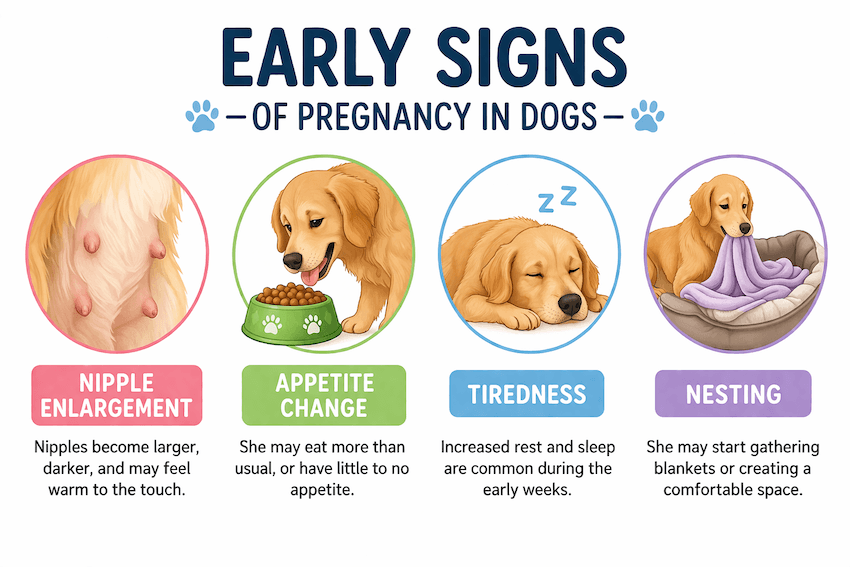
Early signs can be subtle. Some pregnant dogs show increased appetite, mild weight gain, enlarged nipples, lower energy, more affection, or nesting behavior, but these signs are not reliable enough to confirm pregnancy on their own.
That is why owners should treat early physical changes as clues, not proof. A dog may look or act pregnant and still need proper veterinary confirmation, especially if breeding dates are uncertain or the dog seems unwell.
How a Vet Confirms Dog Pregnancy
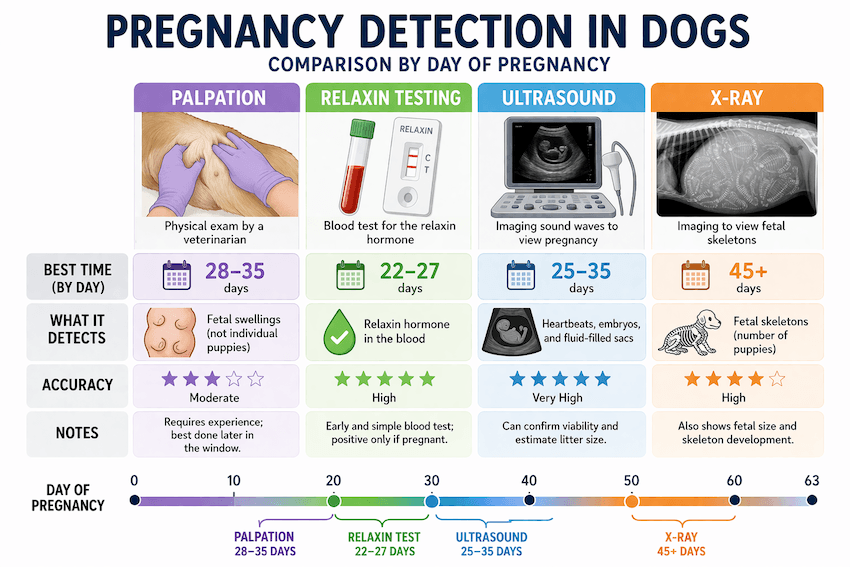
Veterinarians confirm pregnancy more accurately than home observation. Ultrasound is widely used because it can detect pregnancy at roughly 3 weeks post-breeding and is especially useful for checking fetal viability. It is generally most useful around 25 to 35 days of gestation, while testing too early can cause false negatives.
Other methods are useful at different stages. Abdominal palpation may help around 30 days, a relaxin blood test may help after about 26 days, and radiographs are most useful after 45 days, especially for counting puppies later in pregnancy.


A practical takeaway is this: ultrasound is usually best for early confirmation, while X-rays are better later when the goal is puppy count and whelping planning.
Dog Pregnancy Timeline by Week
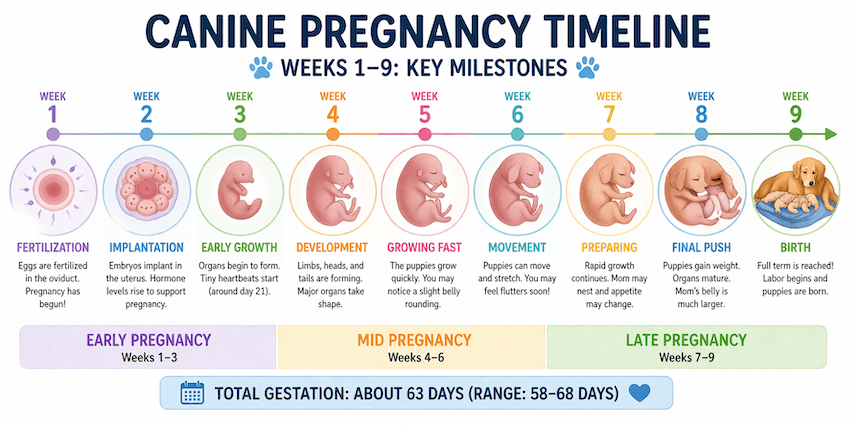
The biggest reason owners get confused is that dog pregnancy length depends on what date you start counting from. From ovulation, the pregnancy window is tighter. From breeding, it is wider.
| Pregnancy Stage | What Usually Happens | What Owners May Notice |
|---|---|---|
| Week 1 | Fertilization may occur, but outward signs are usually absent. | Most dogs look and act completely normal. |
| Week 2 | Early embryonic development continues inside the uterus. | No dependable visual changes yet. |
| Week 3 | Pregnancy may become detectable on early ultrasound. | Subtle appetite or behavior changes may begin. |
| Week 4 | Ultrasound is often more useful in this window. | Nipples may enlarge and energy may dip. |
| Week 5 | Fetal development progresses and nutritional planning becomes more important. | Weight gain and abdominal enlargement may become clearer. |
| Week 6 | The abdomen usually becomes more obvious. | The dog may tire more easily and seek comfort. |
| Week 7 | Late pregnancy care and whelping setup matter more. | Nesting behavior may start increasing. |
| Week 8 to 9 | Labor approaches, especially near day 63 from ovulation. | Temperature drop, restlessness, and labor signs may appear. |
This week-by-week view is only a guide. Exact timing is more precise when ovulation was tracked with progesterone or LH testing, and less precise when owners only know the breeding dates.
Care During Pregnancy in Dogs
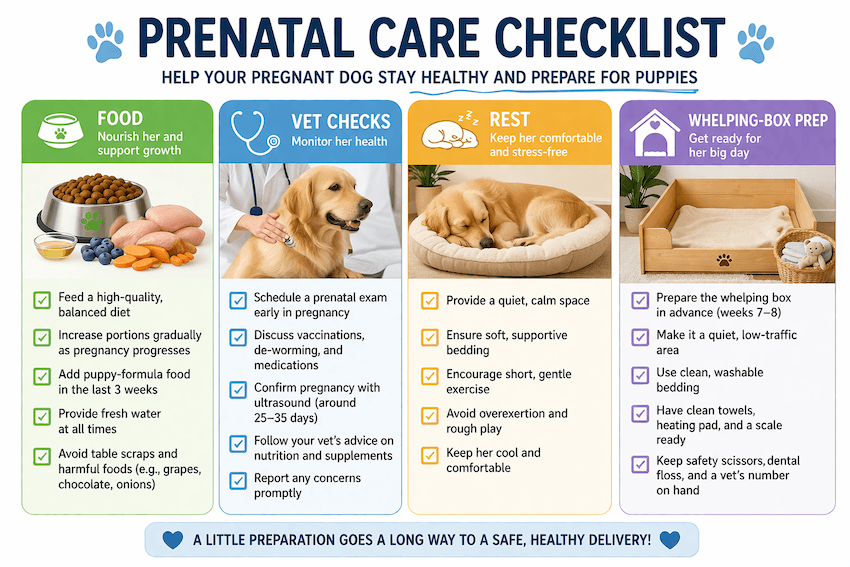
Pregnant dogs need calm routines, proper feeding amounts, and veterinary oversight rather than dramatic changes. As pregnancy progresses, owners should avoid unnecessary stress, keep the dog in good body condition, follow the veterinarian’s feeding advice, and plan ahead for the due window and possible complications.


Care matters most in the second half of pregnancy, when fetal growth accelerates, and preparation for whelping becomes more important. Late-pregnancy monitoring is also when owners often move from “Is she pregnant?” to “How many puppies are coming, and when should I be worried?”
Can Dogs Have Miscarriages?
Yes. Dogs can lose a pregnancy, and the signs are not always dramatic. Early pregnancy loss may be missed entirely because embryos can be resorbed before the owner ever sees tissue or discharge. Later pregnancy loss is more likely to look like miscarriage or abortion.
Causes can include hormonal problems, infection, fetal abnormalities, placental issues, and, in some cases, low progesterone. Because the causes vary widely, any suspected pregnancy loss should be treated as a veterinary issue rather than monitored casually at home.
| Cause | What It Means | What Owners Can Do |
|---|---|---|
| Infection | Infections can interfere with a healthy pregnancy. | See your vet quickly for testing and treatment. |
| Low progesterone or hormonal problems | Hormone issues may make pregnancy harder to maintain. | Follow your vet’s testing and treatment plan. |
| Fetal abnormalities | Some fetuses do not develop normally. | Get veterinary guidance and know some losses are unavoidable. |
| Placental issues | Placental problems can reduce support to the puppies. | Report concerning signs and keep up vet monitoring. |
| Maternal illness | The mother’s health can affect the pregnancy. | Address illness early with veterinary care. |
| Medication-related causes | Some medications may not be safe during pregnancy. | Only use medicines approved by your veterinarian. |
| Physical stress or trauma | Injury or major stress may raise pregnancy risk. | Keep her safe and call your vet after trauma. |
| Unknown causes | Sometimes no clear cause is found. | Focus on vet follow-up and future risk review. |
Preparing for Whelping
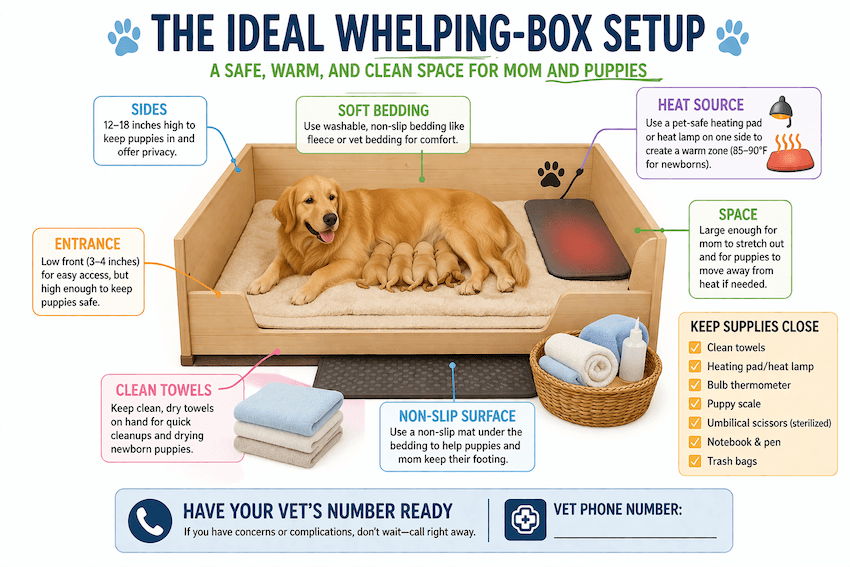
Preparation should begin before the estimated due date, not once labor starts. Owners should know the likely date range, set up a quiet whelping area, keep emergency veterinary contact information ready, and understand which labor signs are normal versus urgent.
This is also when later-pregnancy imaging can help. Radiographs after about 45 days can help estimate puppy count, which is useful when deciding whether labor is complete or a retained puppy may still be present.
Signs of Labor in Pregnant Dogs
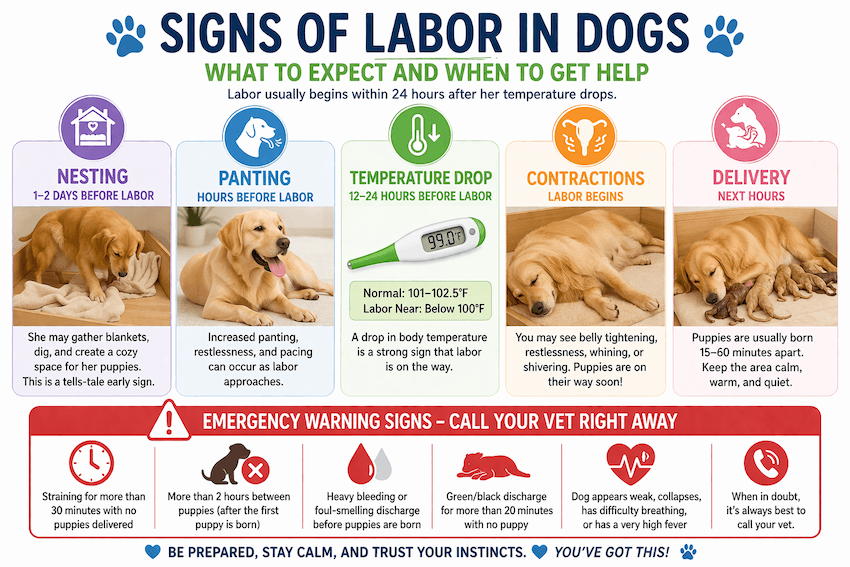
Dogs often show behavioral changes before active delivery. Nesting, restlessness, panting, and discomfort commonly appear during stage I labor, which often starts 6 to 12 hours before parturition and may last up to 24 to 36 hours.
A drop in rectal temperature is one of the better-known warning signs. Labor often begins within about 12 to 24 hours after the temperature falls below 100°F, often into the 98–99°F range.
One important nuance: green discharge can be normal once puppies are being delivered, but green or green-black discharge before the first puppy is a red flag and should prompt urgent veterinary contact.
Red Flags and When to Call a Vet About a Dog Pregnancy
Call a veterinarian urgently if the dog has active contractions for 20 to 30 minutes with no puppy produced, weak straining that fails to produce the first puppy within about 2 hours, or more than 2 hours between puppies when more are expected.
You should also call immediately for green-black discharge before the first puppy, profuse bloody discharge, collapse, tremors, or if the pregnancy seems to extend beyond the expected due window without labor signs. AKC also flags no signs of whelping 64 days after the last mating as a reason to call the vet.
Evidence-Based Insights on Dog Pregnancy
Peer-reviewed and veterinary reference sources are consistent on one key point: canine gestation is most accurate when timed from ovulation, not simply from mating. A 2021 study on progesterone concentrations during canine pregnancy reported gestation averaging about 63 days after ovulation, with variation still present across individual dogs. That matters because owners often think a dog is “late” when the issue is really uncertainty about the start date.[1]
Clinical reproductive guidance also supports ultrasound as the best early tool for pregnancy confirmation and fetal viability assessment, especially in the 25- to 35-day range. This matters because physical signs alone are too unreliable for timing decisions or health monitoring.
More recent reproductive reviews describe pregnancy length as roughly 65 ± 1 days from the LH surge or 63 ± 1 days from ovulation, reinforcing why breeders who use hormone timing can predict due dates much more accurately than owners who only know the breeding dates.
There is also evidence that pregnancy loss can happen at any stage. A 2025 review on canine pregnancy loss notes that embryos lost before about day 35 may be resorbed without an obvious miscarriage, while later loss can present as abortion, mummification, or stillbirth. Clinically, that means the absence of puppies is not always as simple as “she never conceived.”[2]
Additional Tips for Understanding How Long Dogs Are Pregnant
| Tip | Why It Helps | How to Apply It |
|---|---|---|
| Track the timing method | Ovulation dates predict due dates better than mating dates. | Ask your vet which date should anchor the countdown. |
| Confirm with ultrasound | It checks pregnancy earlier and helps assess fetal viability. | Plan a scan in the mid-first month after breeding. |
| Use late radiographs | They help estimate how many puppies to expect. | Discuss X-rays later in pregnancy with your veterinarian. |
| Watch temperature closely | A temperature drop can signal labor within a day. | Monitor rectal temperature near the expected due window. |
| Prepare the whelping area | Early setup reduces stress when labor begins suddenly. | Create a quiet, clean, low-traffic nesting space. |
| Know emergency signs | Fast action improves safety for the mother and litter. | Keep your vet and emergency clinic numbers ready. |
Mistakes to Avoid When Tracking How Long Dogs Are Pregnant
| Mistake | Why It’s a Problem |
|---|---|
| Counting from mating only | Breeding dates give a wider and less precise due window. |
| Trusting signs alone | Appetite and nipple changes cannot confirm pregnancy reliably. |
| Testing too early | Very early scans can miss pregnancy and cause false reassurance. |
| Skipping late imaging | X-rays later in pregnancy help estimate puppy count. |
| Ignoring green discharge | Before the first puppy, it can signal fetal distress. |
| Waiting through hard labor | Prolonged straining without a puppy can indicate dystocia. |
| Missing postpartum checks | Mother and puppies can decline quickly after delivery. |
Aftercare for Dog Pregnancy, Whelping, and the Newborn Period
Once the pregnancy ends, the focus shifts to monitoring. Success looks like a calm mother, puppies that nurse well, steady maternal behavior, and no major labor complications. Continued monitoring still matters because some problems appear after delivery, not during it.
Maintain a clean whelping space, make sure puppies are being fed, and watch the mother for weakness, fever, heavy bleeding, pain, or abnormal discharge. Seek veterinary help promptly if the mother seems ill, if puppies are not nursing, or if you suspect a retained puppy or retained placenta.
The core answer is simple: most dogs are pregnant for about 63 days from ovulation. The part that really protects the dog is knowing how that timeline is measured, what changes are normal each week, and which signs should send you to the vet right away.
Frequently Asked Questions
The Bottom Line
Dogs are typically pregnant for about 63 days from ovulation, but the exact timing can vary depending on when fertilization occurred, the individual dog, and other factors like litter size. While that number gives a solid baseline, what really matters is understanding the full pregnancy window and recognizing what’s normal at each stage. From early signs and vet confirmation to tracking weekly changes and preparing for labor, every step plays a role in ensuring a safe pregnancy and delivery. Small variations are normal, but knowing when something feels off—and acting on it quickly—can make a critical difference. By following the timeline, preparing in advance, and staying attentive to your dog’s behavior and health, you can confidently support her through pregnancy, whelping, and the early days of raising healthy puppies.