How Much Does It Cost to Put a Dog Down? Dog Euthanasia Price


Canine Bible is reader-supported. We receive affiliate commissions via some of our links. Learn more.
Having to think about putting your dog down is heartbreaking, and for many owners, it is one of the most painful decisions they will ever face. Along with the grief and uncertainty, there is often a practical side to navigate, too, including the cost of the appointment, aftercare, and any additional services. In general, dog euthanasia often costs about $100 to $500 in a clinic, while at-home euthanasia can range from about $300 to $1,000 or more, depending on location, timing, and what is included. The total can also change based on your dog’s size, aftercare choices like cremation, and whether exam, sedation, or emergency fees apply. You may also be trying to understand when euthanasia is the right choice, whether pet insurance helps, and how to prepare for the appointment. This guide breaks down the typical costs, available options, and practical details to help you prepare.
When Putting Your Dog Down May Be the Right Choice
| Sign or Concern | Why It Matters |
|---|---|
| Uncontrolled pain | If pain can no longer be managed, euthanasia may be the kinder option. |
| Poor quality of life | When your dog no longer enjoys daily life, comfort becomes the priority. |
| Trouble breathing | Severe breathing problems can cause distress and may signal advanced illness. |
| Cannot stand or walk | Loss of mobility can make eating, toileting, and resting much harder. |
| Stops eating or drinking | Refusing food and water may mean your dog is declining quickly. |
| Frequent emergencies | Repeated crisis visits can suggest the condition is worsening with little recovery. |
| No treatment options left | If treatments no longer help, focusing on a peaceful passing may be appropriate. |
| Owner peace of mind | Understanding the signs can help families make a more informed and compassionate decision. |
Considerations When Deciding to Put Your Dog Down
Deciding when to euthanize your dog is rarely about one symptom or one difficult day. It is usually considered when your dog’s comfort, dignity, and ability to enjoy daily life have declined in a lasting way, even with treatment and support. For many families, the question becomes less about whether a condition can be managed at all and more about whether their dog still has enough comfort and quality of life. That is why this decision is usually best made by looking at the bigger picture with your veterinarian. In many cases, it helps to slow down and look at a few practical questions that can bring that bigger picture into focus.
If you are unsure, ask your veterinarian for a quality-of-life discussion to help guide the decision with as much clarity and compassion as possible.
How Much Does It Cost to Put a Dog Down?
Putting a dog down usually involves a veterinary exam, sedation in many cases, the euthanasia procedure itself, and optional aftercare such as cremation or memorial services. Most dog owners are trying to understand the total cost ahead of time so they can plan financially and make a calm, compassionate decision during a difficult moment.


In general, in-clinic dog euthanasia often costs around $100 to $500, while at-home euthanasia commonly runs about $300 to $1,000 or more, depending on location, travel, timing, and what is included. Aftercare can change the total quite a bit: published nonprofit and provider pricing shows communal cremation may add a smaller fee, while private cremation with ashes returned can add substantially more.
A practical way to think about it is this:
Dog Euthanasia Cost by Location and Service Type
Dog euthanasia costs can vary widely depending on where the service takes place and who provides it. In-clinic care is usually less expensive than at-home euthanasia, but the total can rise with travel, timing, and aftercare choices. Lower-cost humane societies and public programs may offer more affordable options, though availability and services can be limited. Private clinics and mobile providers often charge more, especially in higher-cost areas or for evening and weekend visits. That said, these planning ranges can help you compare common situations and understand why one quote may be much higher or lower than another.


| Situation | Typical Cost | Key Note |
|---|---|---|
| Standard private clinic | $110–$253 | Exam or sedation may be extra. |
| Emergency hospital | $220–$500+ | Higher due to urgent and after-hours care. |
| Low-cost humane society | $30–$110 | Lower-cost option with possible limits. |
| Municipal/public program | $0–$50 | Lowest-cost option; fewer choices. |
| Major metro private clinic | $150–$195 | Often higher in big-city markets. |
| Suburban/smaller-city clinic | $120–$140 | Often mid-range pricing. |
| Rural/lower-overhead clinic | $110–$120 | May cost less, but options can be fewer. |
| At-home, standard visit | $325–$747 | Includes home visit and standard travel. |
| At-home, extended travel | $375–$850+ | Extra mileage may apply. |
| At-home, evenings/weekends | $375–$900+ | Timing can raise the total. |
| In-clinic + communal cremation | $155–$453 | Ashes are not returned. |
| In-clinic + private cremation | $210–$703 | Ashes are returned. |
| At-home + communal cremation | $370–$947 | Home visit plus no-return aftercare. |
| At-home + private cremation | $425–$1,197 | Home visit plus ashes returned. |
| Quality-of-life consultation | $70–$174 | Separate visit before euthanasia. |
Average Dog Euthanasia Cost by State
| State | Average Cost |
|---|---|
| Alabama | $118 |
| Alaska | $166 |
| Arizona | $143 |
| Arkansas | $116 |
| California | $186 |
| Colorado | $141 |
| Connecticut | $150 |
| Delaware | $137 |
| District of Columbia | $190 |
| Florida | $137 |
| Georgia | $122 |
| Hawaii | $249 |
| Idaho | $137 |
| Illinois | $127 |
| Indiana | $121 |
| Iowa | $119 |
| Kansas | $116 |
| Kentucky | $123 |
| Louisiana | $124 |
| Maine | $146 |
| Maryland | $154 |
| Massachusetts | $195 |
| Michigan | $121 |
| Minnesota | $128 |
| Mississippi | $111 |
| Missouri | $118 |
| Montana | $138 |
| Nebraska | $126 |
| Nevada | $135 |
| New Hampshire | $150 |
| New Jersey | $153 |
| New Mexico | $125 |
| New York | $165 |
| North Carolina | $131 |
| North Dakota | $122 |
| Ohio | $126 |
| Oklahoma | $114 |
| Oregon | $149 |
| Pennsylvania | $127 |
| Rhode Island | $151 |
| South Carolina | $128 |
| South Dakota | $124 |
| Tennessee | $121 |
| Texas | $123 |
| Utah | $138 |
| Vermont | $152 |
| Virginia | $134 |
| Washington | $154 |
| West Virginia | $112 |
| Wisconsin | $129 |
| Wyoming | $127 |
Additional Dog Euthanasia Costs to Anticipate
Beyond the procedure itself, you may also pay for aftercare, travel, memorial items, or separate service fees that are not always included in the initial quote. Here are some of the most common add-on costs to expect.
Does Dog Weight Affect the Euthanasia Cost?
Dog weight does not always determine the euthanasia fee on its own, but it can still affect the total bill through sedation amount, handling needs, mobility support, and especially aftercare or cremation. Published pricing shows some providers charge one flat euthanasia fee for dogs regardless of size, while others use weight tiers for cremation and related services.
Is Dog Euthanasia Covered by Pet Insurance?
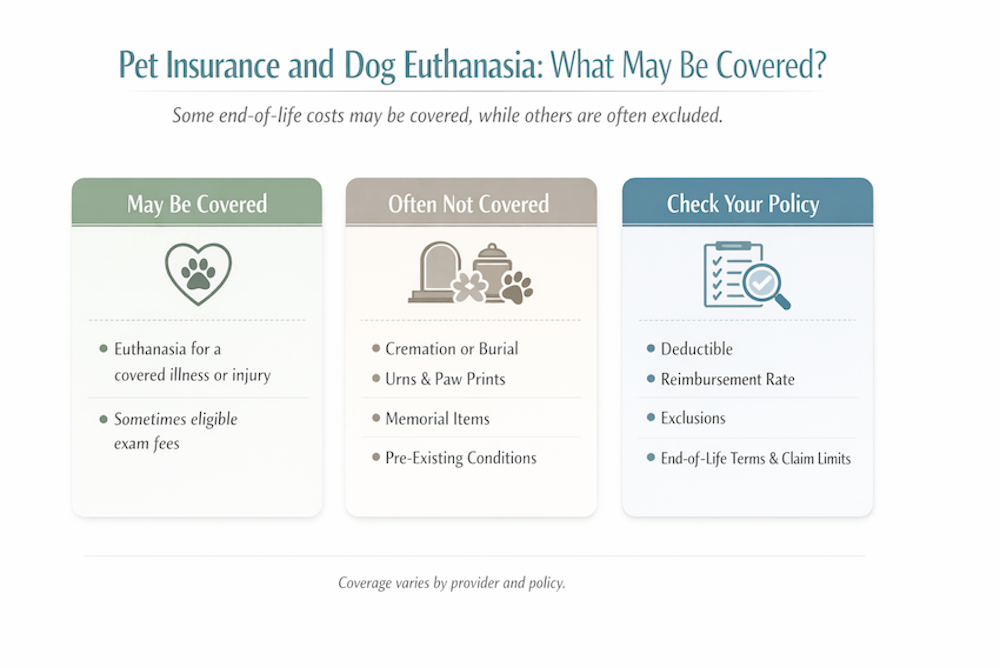
Pet insurance coverage depends on the insurer, the plan, the medical reason for euthanasia, exclusions, and how the claim is reimbursed. Some plans say euthanasia can be covered when it is recommended for humane reasons and tied to a covered illness or injury, while exam fees may be covered only on certain plan designs or only when linked to a covered condition.
Cremation, burial, memorial items, and other aftercare costs are less consistently covered. For example, Embrace says cremation and memorial costs are not covered under its core accident-and-illness plan, while some Pets Best policy forms and Trupanion’s optional assistance package describe limited coverage in specific situations, so it is important to review your own policy’s end-of-life terms, exclusions, reimbursement limits, and claim rules before assuming anything is included.
Research on Humane Dog Euthanasia and End-of-Life Planning
The cost matters, but so does making sure the process is humane and medically appropriate. The AVMA’s euthanasia guidance emphasizes minimizing pain, distress, and anxiety, and the MSD Veterinary Manual similarly describes euthanasia as ending life in a way that minimizes suffering before loss of consciousness. That is why many providers discuss sedation, environment, and aftercare ahead of time rather than treating the visit as a rushed procedure.
Research also shows the emotional side of euthanasia is significant. A survey discussed in Veterinary Record found owner satisfaction with the euthanasia procedure was high, but a meaningful share of owners still struggled afterward, which is one reason clear planning and supportive communication matter so much.[1]
Quality-of-life assessment also plays an important role in deciding timing. A review in Veterinary Sciences noted that quality-of-life evaluation is commonly used to guide decisions about clinical care, home care, and euthanasia, which helps owners frame the question around comfort and suffering rather than price alone.[2]
What to Do After Dog Euthanasia
After the procedure, focus on two things: confirming the aftercare plan and giving yourself space to grieve. Make sure you understand whether your dog will be returned to you, taken for communal cremation, or individually cremated with ashes returned. If you want a paw print, fur clipping, or memorial urn, ask before the appointment whenever possible, because some providers bundle those items and others charge separately.
A good outcome usually means the process was calm, your questions were answered, and the financial side did not catch you off guard at the last minute. If you are still unsure whether euthanasia is the right choice, or if you feel rushed into a decision because of worsening symptoms, ask your veterinarian for a quality-of-life discussion before proceeding. Quality-of-life assessment and supportive communication are both recognized as important parts of end-of-life care.
Frequently Asked Questions
The Bottom Line
The cost to put a dog down can vary quite a bit, but for most families, this is about far more than money. It is an emotional decision made during an incredibly painful time, and many owners are simply trying to understand what to expect while making sure their dog is as comfortable as possible. The final price usually depends on where the service happens, what is included, and whether you choose aftercare such as cremation. Asking for an itemized quote in advance can help prevent added stress and unexpected charges during an already heartbreaking moment. Just as important as cost is making sure the decision is guided by your dog’s quality of life, comfort, and dignity rather than panic or uncertainty. Talking with your veterinarian about timing, pain control, and aftercare can help you make the most compassionate choice for your dog and your family.