
How Many Chromosomes Do Dogs Have? (& Role, Meaning, & Facts)

Canine Bible is reader-supported. We receive affiliate commissions via some of our links. Learn more.
Dogs have 78 chromosomes in total, arranged in 39 pairs. That includes 38 pairs of autosomes and 1 pair of sex chromosomes. While the number is the same in all domestic dogs, what those chromosomes carry can vary in important ways. They help determine everything from coat color and size to inherited health risks and breed traits. This also explains why dogs can look so different from one another despite sharing the same chromosome count. Many owners also wonder how dog chromosomes compare with humans, wolves, and mixed breeds. Understanding the basics of canine chromosomes can make genetics, breeding, and health testing much easier to follow.
Dog Chromosomes at a Glance
| Chromosome Fact | Key Detail |
|---|---|
| Total chromosome number | Dogs have 78 chromosomes in total. |
| Chromosome pairs | Those 78 chromosomes are arranged in 39 pairs. |
| Autosome pairs | Thirty-eight of those pairs are autosomes. |
| Sex chromosome pair | One pair is made up of sex chromosomes. |
| Female chromosome pattern | Female dogs typically have XX sex chromosomes. |
| Male chromosome pattern | Male dogs typically have XY sex chromosomes. |
| What chromosomes carry | Chromosomes contain genes that help shape inherited traits. |
| Where chromosomes come from | Puppies inherit chromosomes from both parents. |
Dog Chromosomes: Knowing the Basics
Chromosomes are tiny structures inside a dog’s cells that carry genetic material. Inside them are genes, which act like instructions for how the body grows, develops, and functions.
In simple terms, chromosomes help organize the information that influences inherited traits. That can include things like coat color, body size, and certain health tendencies. They do not tell the whole story on their own, but they are a big part of how traits get passed down.
Dogs inherit chromosomes from both parents, which is why puppies are a genetic mix of the mother and father. This basic structure is what makes canine genetics easier to understand, whether you are reading about breed traits, dog DNA tests, or inherited conditions.
Autosomes vs Sex Chromosomes in Dogs
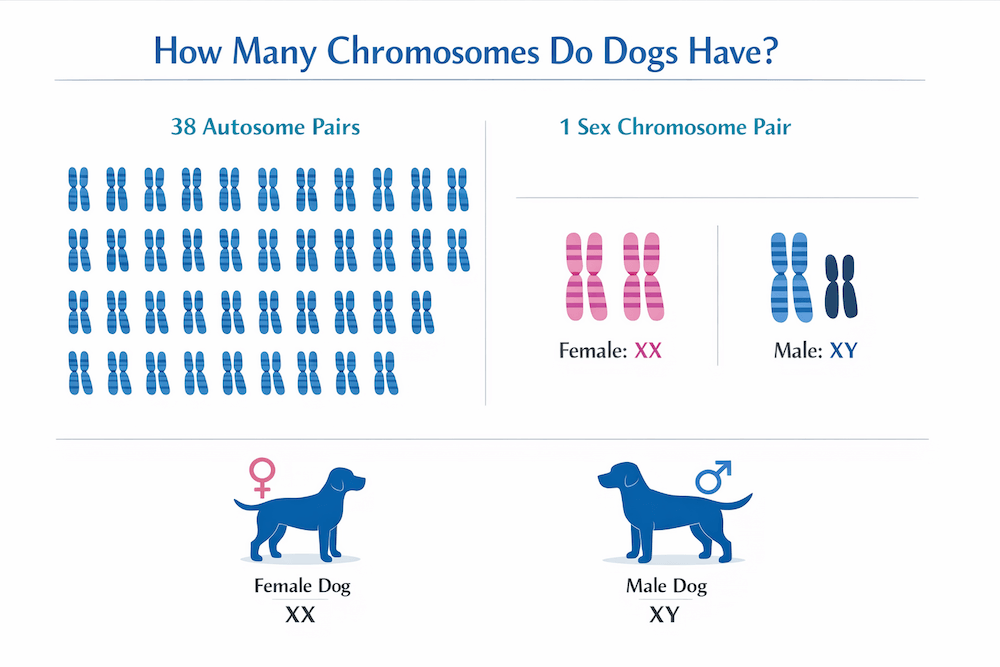
Dogs have 39 chromosome pairs in total. Of those, 38 pairs are autosomes, and 1 pair is a sex chromosome pair.


Autosomes carry most of the genetic instructions related to body structure, growth, metabolism, coat traits, and many inherited health risks. The sex chromosomes determine biological sex, with females typically having XX chromosomes and males XY.
This distinction matters because not all traits are inherited the same way. Some are passed through autosomal patterns, while others may be tied to the sex chromosomes, which can affect how certain traits or conditions appear in males versus females.
What Chromosomes Actually Do
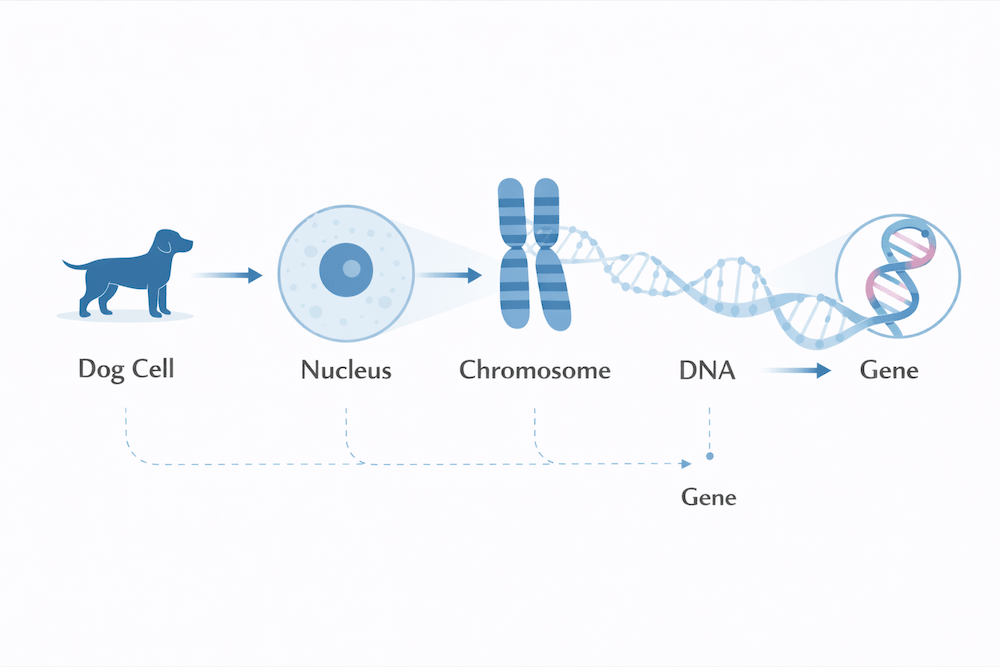
Chromosomes are structures inside cells that carry DNA. That DNA contains genes, and genes provide the instructions the body uses to grow, function, and pass traits to the next generation.
In dogs, chromosomes help organize the genetic information that influences things like coat color, size, body shape, energy level, and some inherited diseases. They also help ensure that genetic material is copied and passed on properly when cells divide.


Put simply, chromosomes do not create traits by themselves. They act more like organized storage packages that hold the genes responsible for those traits.
How Inherited Genetic Conditions Work in Dogs
Inherited genetic conditions happen when dogs pass certain gene variants to their puppies. Those variants are carried on chromosomes, which is why chromosome basics matter when you start looking at disease risk and family lines.
Some inherited conditions are dominant, which means a puppy may be affected after inheriting one copy of the variant. Others are recessive, which usually means the puppy needs to inherit a copy from both parents. Some conditions are more complicated and may involve multiple genes, along with other factors that influence whether signs appear.
For dog owners, the key point is that inherited risk is not random. It follows patterns, even if those patterns are sometimes simple and sometimes more complex. That is what makes genetic testing, breeding history, and family background so useful when trying to understand health risk.
How Dog Chromosomes Compare With Humans & Other Species
| Species | Total Chromosomes | Total Pairs |
|---|---|---|
| Dog | 78 | 39 |
| Human | 46 | 23 |
| Wolf | 78 | 39 |
| Cat | 38 | 19 |
Dogs have 78 chromosomes, while humans have 46; wolves also have 78, and cats have 38. That means dogs and wolves each have 39 pairs, humans have 23 pairs, and cats have 19 pairs.
Even though these numbers differ, chromosome count does not show how intelligent, advanced, or complex a species is. It only reflects how genetic material is organized inside the cells.
This comparison is useful because chromosome numbers vary widely across species. For example, dogs and wolves share the same total chromosome count, while cats and humans have fewer, but that does not make one animal genetically “better” or biologically superior to another.
Why Chromosome Count Matters in Dog Genetics
Knowing that dogs have 78 chromosomes gives dog owners a foundation for understanding canine genetics. It helps explain how puppies inherit genetic material from both parents and why traits can be passed down through family lines.
Chromosome count also matters when discussing breeding, ancestry, inherited disorders, and DNA testing. It gives context to how genes are grouped and passed along, even though the actual trait outcomes depend on the specific genes involved, not just the number of chromosomes.
For owners, this matters most when reading breed health information, looking at genetic test results, or trying to understand why certain traits show up in one puppy but not another.
What Chromosomes Do Not Tell You
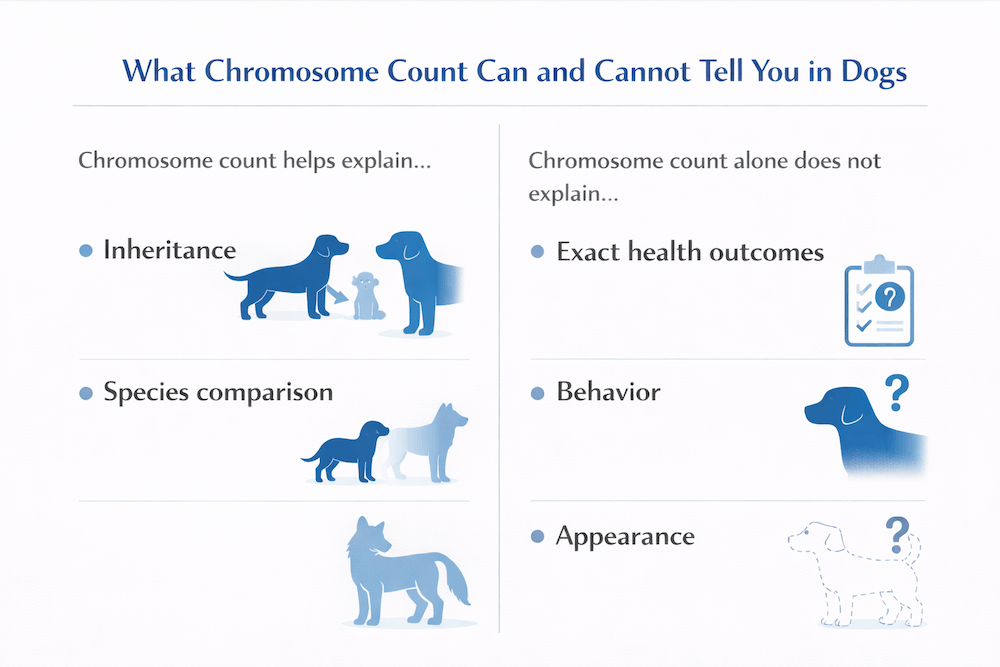
Chromosome count tells you how many chromosomes a dog has, but it does not tell you everything about that dog’s health, personality, or appearance.
For example, chromosome count alone cannot tell you whether a dog will develop a certain disease, what exact temperament it will have, or how strong a specific trait will be. Those answers depend on the specific genes, how they interact, and sometimes environmental influences such as nutrition, stress, and lifestyle.
That is why chromosome count is a useful starting point, but not a complete explanation of canine genetics. It gives structure, not the full story.
Can Dogs Have Down Syndrome?
Not in the human sense, no. Down syndrome is a human condition caused by an extra full or partial copy of chromosome 21, also called trisomy 21. Dogs have a different chromosome setup altogether: they normally have 78 chromosomes in 39 pairs, not 46 in 23 pairs like humans, so the condition does not transfer directly from people to dogs.
People usually ask this question when a dog has unusual facial features, slower development, or other differences that seem similar to a human genetic condition. That comparison is understandable, but it can be misleading. A dog with developmental or physical abnormalities may still have something medically important going on; it is just not the same diagnosis as human Down syndrome.
So the practical takeaway is this: “not Down syndrome” does not mean “nothing is wrong.” It means the human label is not the right one for dogs. If a dog has unusual growth, developmental concerns, or multiple physical abnormalities, the next step is a veterinary evaluation rather than trying to match the signs to a human condition. With that limit in mind, it helps to look at what the research actually says about dog chromosomes and canine genetics.
What Research Says About Dog Chromosomes
Research consistently shows that domestic dogs have a diploid chromosome number of 78, which means 39 pairs in a typical body cell. Classic canine cytogenetics work, including a widely cited karyotype study published in Chromosome Research, helped map and identify the dog’s chromosome set in detail, which matters because it confirms the basic number behind everything from inheritance to genetic testing.
Comparative genetics research also helps put that number in context. A review in Heredity notes that the domestic dog has 2n = 78 and uses the dog as an important reference species for studying chromosome evolution in carnivores. That matters for dog owners because it helps explain why dogs can be compared meaningfully with wolves and other canids, while still being clearly different from species like humans and cats.[1]
More recent genome research strengthens that picture from a DNA-mapping side. A 2021 Communications Biology paper described a high-quality dog reference genome built at chromosome-length resolution, which helps researchers study genes, inherited traits, and disease risk more accurately. In practical terms, that supports the same core takeaway for readers: dogs have 78 chromosomes, they inherit half from each parent, and those chromosomes are the organized packages that carry the genetic instructions behind many traits and health patterns.[2]
Frequently Asked Questions
The Bottom Line
Dogs have 78 chromosomes, arranged in 39 pairs, and that basic number gives you a useful starting point for understanding canine genetics. It helps explain how dogs inherit traits from both parents and why chromosomes matter in areas like breed characteristics, DNA testing, and inherited health risks. At the same time, chromosome count is only part of the picture. It tells you how a dog’s genetic material is organized, but not everything about that dog’s appearance, behavior, or long-term health. For most owners, the key takeaway is simple: knowing the basics of dog chromosomes makes genetics easier to follow and gives better context when reading about breeding, ancestry, or canine health.