How Many Hours a Day Do Dogs Sleep? Is Your Dog Sleeping So Much?

Canine Bible is reader-supported. We receive affiliate commissions via some of our links. Learn more.
Dogs typically sleep between 12 to 14 hours a day, though puppies, senior dogs, and certain breeds can sleep 18–20 hours daily. This range varies based on age, activity level, health, and lifestyle. But not all sleep is equal—some dogs nap lightly throughout the day, while others have deeper, longer rest cycles. You might wonder if your dog is sleeping too much, or not enough, and what that actually means. Factors like breed, environment, and daily stimulation can dramatically shift sleep patterns. There are also subtle signs that can indicate whether your dog’s sleep is healthy or a cause for concern. Understanding these differences can help you better support your dog’s energy, behavior, and overall well-being.
Why Understanding Your Dog’s Sleep Matters
| Why It Matters | Key Impact |
|---|---|
| Catches problems early | Changes in sleep habits can be one of the first signs that something is wrong with your dog’s health. |
| Supports better health | Good sleep helps the body recover, regulate energy, and maintain normal daily function. |
| Explains behavior changes | Too little or too much sleep can affect your dog’s mood, focus, and overall behavior. |
| Reduces unnecessary worry | Knowing what is normal for your dog’s age and breed can help you tell the difference between healthy rest and a concern. |
| Improves daily routine | Understanding sleep needs makes it easier to balance walks, playtime, feeding, and rest. |
| Protects puppies and seniors | Younger and older dogs often need more sleep, so knowing this helps owners avoid unrealistic expectations. |
| Supports recovery | Dogs recovering from illness, stress, or heavy activity may need extra rest to heal properly. |
| Guides when to call the vet | Sudden extreme sleepiness or unusual restlessness can signal that your dog may need medical attention. |
Dog Sleep Hours by Age
A simple way to think about dog sleep is by life stage:
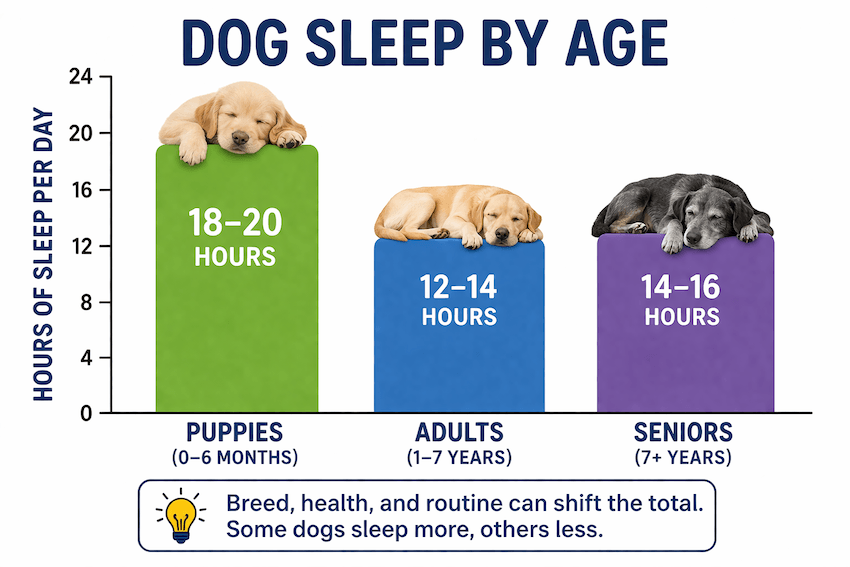
These are broad ranges, not hard rules. A young working dog with lots of structured activity may sleep differently from a calm companion dog, and an older dog may nap more because aging changes energy use and sleep structure.
Does Breed Affect How Much a Dog Sleeps?
Breed can influence how a dog tends to sleep, but it does not determine sleep needs on its own. Larger or more relaxed breeds may appear to sleep more, while high-energy and working breeds often seem more alert, but factors like age, health, exercise, mental stimulation, and daily routine usually matter more. In practice, sleep is less about breed alone and more about the individual dog, especially since puppies and senior dogs across all breeds often need more rest. Breed-related traits can still shape sleep patterns, though, such as brachycephalic dogs having noisier or more disrupted sleep due to airway issues.
| Breed Type or Category | General Sleep Pattern | Key Notes for Owners |
|---|---|---|
| Large / giant breeds | Often seem to doze more and may have longer quiet rest periods. | More rest can be normal, but sudden lethargy still deserves attention. |
| High-energy / working breeds | May appear more alert and sleep less during the day when well engaged. | Under-stimulation can affect behavior, rest quality, and settle time. |
| Toy / companion breeds | Often adapt closely to household routines and may nap around their owners. | Do not assume small size alone means lower sleep needs. |
| Brachycephalic breeds | May rest often but can have noisier or less comfortable sleep. | Snoring, heat intolerance, and breathing effort should not be ignored. |
| Senior dogs across breeds | Usually need more sleep and more recovery time than younger adults. | Track changes from baseline, especially with pain, confusion, or weakness. |
Why Do Dogs Sleep So Much?
Dogs are polyphasic sleepers, which means they sleep in multiple bouts rather than one long block like many humans try to do. They also spend a different proportion of sleep in REM than humans, which helps explain why dogs often nap throughout the day instead of packing all recovery into one uninterrupted night.


In practical terms, that means a dog can look like it “sleeps all day” and still be perfectly normal. Many dogs sleep, rest, doze, wake quickly, and then settle again in short cycles, especially when the home is quiet or stimulation is low.
What Affects How Much Dogs Sleep
How much a dog sleeps is influenced by more than just breed or age. Factors like body size, activity level, health, daily routine, and even changes in the home environment can all affect how much rest a dog needs. In general, older dogs and larger dogs often spend more time sleeping or dozing, but what matters most is whether your dog’s pattern is normal for them. A sudden change in sleep, especially along with other symptoms, deserves closer attention.
| Factor | How It May Affect Sleep | Practical Note for Owners |
|---|---|---|
| Age | Puppies and seniors usually sleep more. | More rest can be normal at both life stages. |
| Breed | Some breeds seem more relaxed or more alert. | Breed may influence sleep, but it is not the whole picture. |
| Body Size | Larger dogs may spend more time dozing. | Big dogs often rest more, but should still seem engaged when awake. |
| Activity Level | Dogs often sleep more after active days. | Extra rest after exercise is usually normal. |
| Environment | Noise, comfort, and household activity can affect rest. | A calm sleep space can improve sleep quality. |
| Health Status | Illness, pain, or discomfort can change sleep. | Watch for sleep changes with other symptoms. |
| Daily Routine | Feeding, walks, and household patterns shape sleep habits. | Consistent routines make sleep easier to track. |
| Stress or Changes | Travel, visitors, or schedule changes may disrupt sleep. | Short-term changes can happen after disruptions. |
| Medication or Recovery | Treatment or healing may increase sleep needs. | Compare changes with recent recovery or medication use. |
How Puppies Sleep Differently
Puppies sleep the most because growth and development place a huge demand on the body and brain. AKC states that puppies commonly sleep 18 to 20 hours a day, and one large owner-reported study found that 16-week-old puppies slept longer during the day and over 24 hours overall than 12-month-old dogs, even though they slept less at night.
That puppy pattern often surprises owners. A puppy may seem wildly energetic when awake, then crash hard, then wake again, ready to play. That stop-and-start rhythm is normal, especially in the first months.
How Adult Dogs and Senior Dogs Sleep Differently
Adult dogs usually settle into a predictable routine, often totaling around 12 to 14 hours a day. They tend to sleep overnight and then add daytime naps, with the exact split changing based on exercise, enrichment, and the household schedule.


Senior dogs often need more recovery time. AKC notes that many geriatric dogs sleep 12 to 15 hours a day, and age-related conditions such as arthritis or heart disease can also make a dog seem sleepier or less willing to move.
What Normal Dog Sleep Looks Like
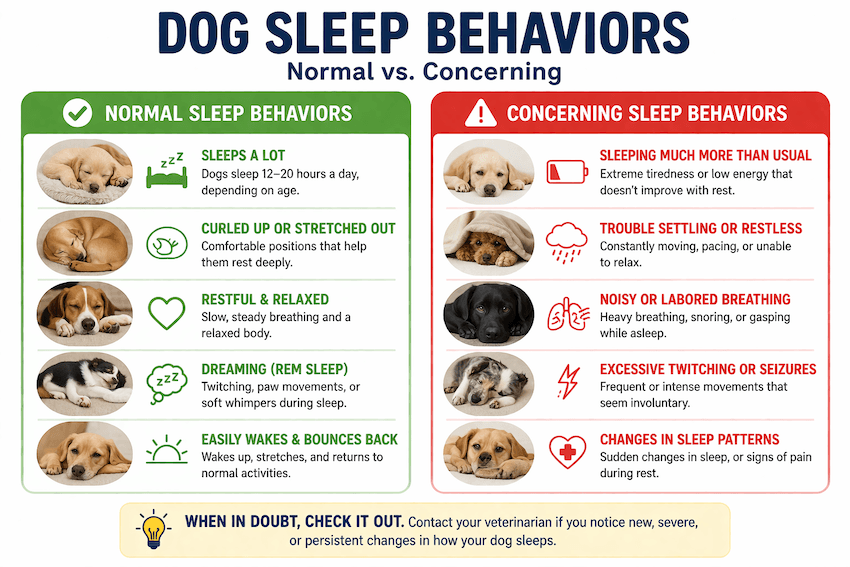
Normal sleep usually looks like a mix of overnight sleep, daytime naps, easy settling, and normal alertness when awake. A healthy dog should still show interest in meals, walks, play, people, or normal household cues, even if they spend many hours resting.
Normal dogs may twitch, paddle, softly vocalize, change position, or wake briefly and settle again. What is less normal is a dog who seems hard to rouse, uninterested in usual activities, restless all night, or suddenly far sleepier than usual.
Evidence-Backed Insights on Dog Sleep
Research helps explain why sleep changes deserve attention. In a large questionnaire study of 1,330 dogs, dogs sleeping less than 6 hours while caregivers were in bed had greater caregiver-reported problem-behavior severity, and sleep patterns below 8 hours or above 10 hours in that context were also linked with higher reported problem-behavior scores. That does not prove sleep alone caused the behavior, but it strongly suggests that disrupted or atypical sleep and daytime behavior often travel together.[1]
A separate study following dogs from puppyhood found that 16-week-old puppies slept more over 24 hours than 12-month-old dogs, which supports the everyday observation that younger dogs need more frequent rest and daytime sleep.[2]
In senior dogs, polysomnography research found that dogs with higher dementia scores and worse cognitive performance spent less time in NREM and REM sleep, suggesting that sleep changes can be part of canine cognitive decline rather than “just old age.”[3]
Another observational study described dogs as polyphasic sleepers and noted that sleep loss was linked with altered daytime behavior and reduced welfare indicators. Clinically, that matters because sudden sleep disruption can be a useful clue that something in a dog’s body, environment, or routine has changed.
Monitoring How Many Hours Your Dog Sleeps
You do not need to count every minute your dog sleeps to get a useful picture of their rest. In most cases, it is enough to track sleep patterns over a week or two and pay attention to when your dog settles, how often they nap, how easily they wake, and whether they still seem interested in normal activities like meals, walks, play, or greeting you. It also helps to note whether changes in sleep align with exercise, travel, stress, weather, signs of pain, or medication, since all of these can affect how much a dog rests.
What matters most is a change from your dog’s normal baseline, not one isolated sleepy day. A dog who has always slept long hours may be perfectly normal, especially if they wake easily and still act like themselves. But a dog who suddenly starts sleeping several extra hours, pacing at night, or showing much less interest in daily life deserves closer attention.
Signs Your Dog May Be Sleeping Too Much
A dog may be sleeping too much when you notice a sudden increase in total sleep, especially if they also seem hard to wake, less interested in food or walks, or slower to respond than usual. Other warning signs can include stiffness, limping, heavy breathing, confusion, or restless nights followed by excessive daytime sleep. In older dogs, these changes can sometimes be linked to pain, heart disease, or cognitive dysfunction, rather than simple aging.
At the same time, context matters. One extra-sleepy afternoon after a long hike, busy weekend, or exciting outing is usually not a reason to panic. A pattern that persists for several days or accompanies other physical or behavioral changes is much more meaningful.
Signs Your Dog May Not Be Getting Enough Sleep
Too little sleep can look very different, but it can affect a dog just as much. Some dogs become irritable, restless, or unable to settle, while others seem more hypervigilant, reactive, or behaviorally difficult than usual. Research has linked shorter sleep duration and greater sleep disruption to greater caregiver-reported behavior problems, suggesting that poor sleep can spill over into how a dog feels and acts during the day.
If your dog seems tired but cannot stay asleep, it is important not to assume they just need more exercise. In many cases, the better question is whether something is interfering with rest, such as anxiety in dogs, pain, a poor sleep environment, late-night stimulation, or an underlying medical issue. Once you understand what normal sleep looks like for your dog, it becomes much easier to spot when a change is harmless and when it may be time to look more closely.
Tips for Managing Healthy Dog Sleep Patterns
| Tip | Why It Helps | How to Apply It |
|---|---|---|
| Track the baseline | Normal patterns are easier to spot when recorded. | Log sleep, naps, energy, appetite, and walks weekly. |
| Protect quiet naps | Undisturbed rest supports mood and recovery. | Give your dog a calm area away from noise. |
| Keep routines steady | Predictable days support more stable sleep cycles. | Feed, walk, and settle your dog at similar times. |
| Use daytime enrichment | Mental activity can improve rest quality later. | Rotate sniffing games, training, and food puzzles. |
| Match exercise level | Balanced activity prevents boredom and overtiredness. | Adjust walks to your dog’s age and condition. |
| Watch sudden changes | Fast shifts may signal pain or illness. | Note changes lasting more than a day or two. |
| Support senior comfort | Pain and stiffness can disrupt normal rest. | Use supportive bedding and discuss pain signs early. |
Sleep Disorders That Can Affect Dogs
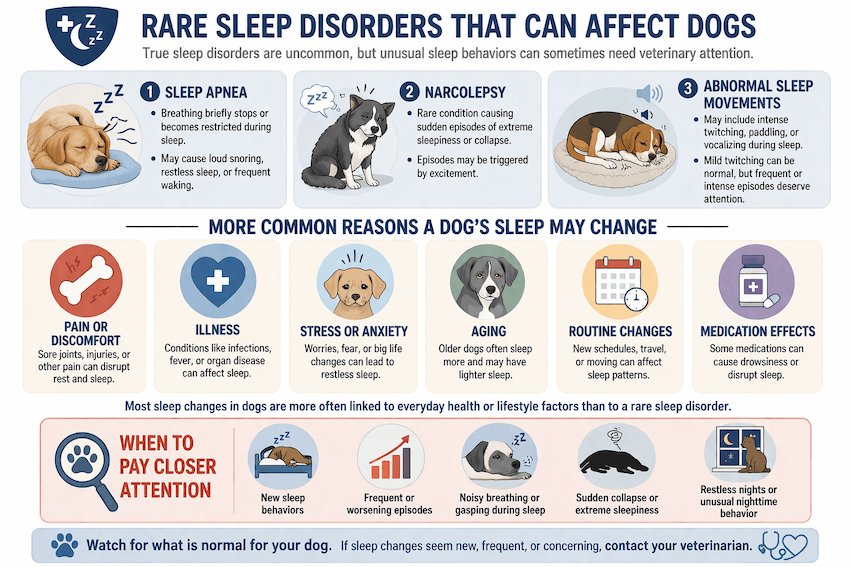
True sleep disorders in dogs are uncommon, but unusual sleep behaviors can happen and sometimes need veterinary attention. In some cases, a dog may have sleep apnea, which means breathing briefly stops or becomes restricted during sleep, often causing loud snoring, restless sleep, or frequent waking. Narcolepsy is another rare condition that can cause sudden episodes of extreme sleepiness or collapse, often triggered by excitement. Some dogs may also show abnormal sleep movements, such as intense twitching, paddling, or vocalizing, though many mild movements during sleep are completely normal.
That said, a rare sleep disorder does not cause most sleep changes in dogs. More often, extra sleep, restless nights, or unusual sleep behavior are linked to pain, illness, stress, aging, routine changes, or medication effects. For dog owners, the key is to pay attention to what is normal for their dog and notice when something seems new, frequent, or concerning. That is why the next step is knowing when a change in your dog’s sleep is worth a call to the vet.
When Dog Sleep Changes Mean a Vet Visit
Call your veterinarian if your dog’s sleep changes are sudden, persistent, or paired with other symptoms such as appetite loss, limping, coughing, breathing changes, confusion, pacing, whining, house-soiling, or collapse. In senior dogs, especially, sleep changes can be tied to pain or cognitive decline, not just “slowing down.”
A vet visit also makes sense when your dog is sleeping far more than usual, seems hard to wake, or is no longer interested in normal daily activities. That pattern is more concerning than a dog who simply enjoys lots of routine naps.
Monitoring Your Dog’s Sleep Over Time
After you start paying attention to sleep, the main job is simple: keep tracking the pattern and compare your dog to their own normal. A healthy pattern usually looks consistent over time, with normal interest in food, movement, play, and interaction when awake.
Maintain a sleep-friendly routine with regular activity, enrichment, quiet rest periods, and a comfortable place to settle, such as calming dog beds. If the pattern stays stable, you are probably looking at normal dog sleep. If it shifts noticeably or comes with other symptoms, continue monitoring closely and book a veterinary check if the change does not quickly make sense.
Frequently Asked Questions
The Bottom Line
Most dogs sleep 12 to 14 hours a day, but that number can shift depending on age, health, activity level, and daily routine. Puppies and senior dogs naturally need more rest, while active adult dogs may balance sleep with longer periods of engagement. What matters most is not hitting an exact number, but understanding what’s normal for your individual dog. By paying attention to sleep patterns, you can better support your dog’s energy, behavior, and overall well-being. Consistent routines, proper exercise, and mental stimulation all play a role in healthy rest. If your dog’s sleep suddenly changes or seems unusual, it may be worth a closer look. In the end, healthy sleep is a key part of a happy, thriving dog.