
What Sounds Does a Dog Make? Barks, Whines, Growls & What They Mean


Canine Bible is reader-supported. We receive affiliate commissions via some of our links. Learn more.
Dogs most commonly make a barking sound, often written as “woof,” “ruff,” or “arf.” They can also growl, whine, howl, yelp, sigh, grunt, or whimper depending on what they feel and what they want to communicate. These sounds are not random noises; they can signal excitement, fear, pain, warning, playfulness, loneliness, or a need for attention. A happy bark sounds very different from a defensive growl, and a short yelp may mean something more urgent than simple whining. Some breeds are naturally more vocal, while others communicate more through body language than sound. Even silence can matter if a dog suddenly stops making its usual noises. Understanding what each dog sound means can help owners respond better, prevent misunderstandings, and spot possible health or behavior concerns early.
The Science Behind Dog Sounds
| Sound Concept | What It Means for Dog Owners |
|---|---|
| Vocal cords | Dogs make sounds when air moves through the larynx, creating barks, whines, growls, howls, and other vocal signals. |
| Pitch and tone | Higher sounds often suggest excitement, stress, or need, while lower sounds may signal warning, discomfort, or seriousness. |
| Sound length | A quick bark, repeated howl, or drawn-out whine can change the meaning of what the dog is trying to communicate. |
| Emotional triggers | Dogs may vocalize because of fear, play, frustration, pain, loneliness, alertness, or a desire for attention. |
| Body language | The same sound can mean different things depending on the dog’s tail, ears, posture, eyes, and movement. |
| Breed differences | Some breeds are naturally more vocal, while others rely more on posture, facial expression, or quiet behavior. |
| Health warning | Sudden changes in barking, whining, breathing sounds, or voice quality may point to pain, illness, stress, or injury. |
Types of Sounds a Dog Makes & What They Usually Mean
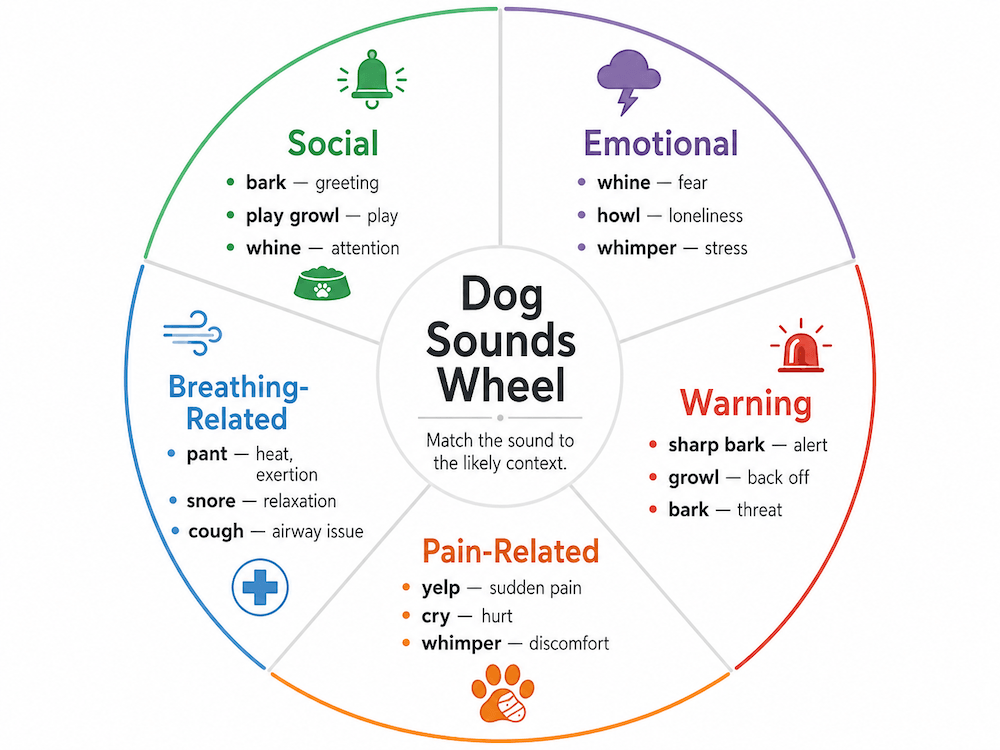
Dogs communicate through many sounds, including barking, whining, growling, howling, yelping, whimpering, sighing, groaning, huffing, grunting, coughing, and wheezing. Barking may signal alertness, greeting, play, frustration, or attention-seeking, while whining and whimpering often suggest anxiety, excitement, need, appeasement, or discomfort. Growling can be playful but may also warn that a dog feels afraid, threatened, possessive, uncomfortable, or in pain.
Howling is usually a longer social sound linked to sirens, music, other dogs, loneliness, or separation. Yelping often points to sudden pain, fear, or surprise, while sighing, groaning, huffing, and grunting may reflect relaxation, mild frustration, effort, curiosity, or discomfort. Coughing and wheezing are different because they may signal throat, airway, respiratory, or heart-related problems rather than normal communication.
Is “Woof” the Correct Dog Sound?
“Woof” is the most common English word people use for a dog’s bark, but it is not the only correct version. People may write dog sounds as woof, ruff, arf, bow-wow, yap, yip, bark, howl, or growl depending on the pitch, breed, size of the dog, and the situation. A Chihuahua’s sharp “yap” and a large dog’s deep “woof” can both be normal barks.
For children, language learners, or simple animal-sound questions, the direct answer is: a dog says “woof” or “bark.” For dog owners, the fuller answer is that dogs make many sounds, and each one needs context. A bark at the window, a whine at the door, a growl over a chew, and a yelp after jumping off the couch are all different messages.


It also helps to remember that dogs do not use words the way humans do. VCA’s canine communication guidance explains that dogs communicate through a combination of sounds, scent, and visual cues, with body posture and scent being especially important parts of dog language. In other words, a dog’s “voice” is only one layer of the message.
How Do Dogs Produce Sounds?
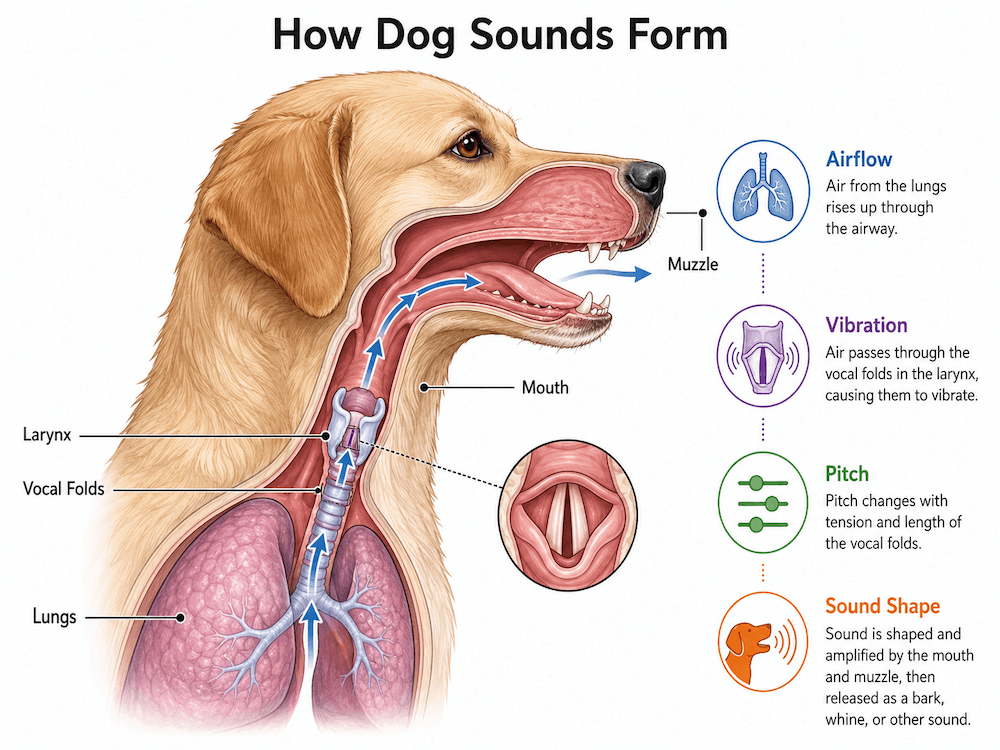
Dog sounds are produced when air moves through the larynx and vocal folds, then changes as the mouth, tongue, throat, and breathing pattern shape the final sound. The meaning is not just “bark equals bark.” Acoustic features such as pitch, rhythm, length, repetition, and pauses can affect how humans interpret a dog’s emotional state. In one study, human listeners were able to classify many dog barks above chance level using sound alone, especially when the emotional context was less ambiguous.
Dogs also process vocal emotion in meaningful ways. Comparative fMRI research reported voice-sensitive brain regions in dogs and found that dog brains respond to acoustic cues of emotion, supporting the idea that vocal sound is part of canine social communication.
How to Understand What a Dog Sound Means
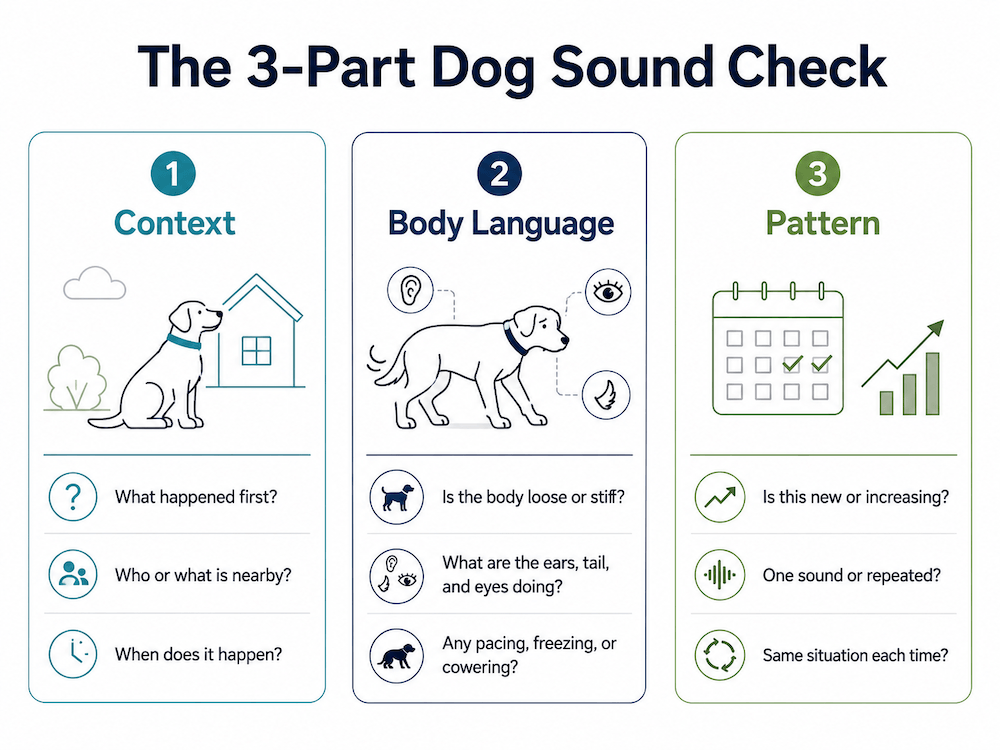
The same dog sound can mean different things depending on the situation. A bark during fetch may show excitement, while a bark at the window may be alerting. A growl during tug can be playful, but a growl near a food bowl may be a serious warning. This is why dog sounds should be read as part of a pattern, not as isolated noises.


Start with context by asking what happened right before the sound. The trigger may be a doorbell, another dog, a sore area being touched, being left alone, or a specific activity such as play, rest, eating, grooming, or handling. Then check the dog’s body language, because loose muscles, soft eyes, play bows, and a wiggly body mean something very different from stiffness, a hard stare, pinned ears, raised hackles, or frozen posture.
Finally, look at the pattern over time. A single bark at a delivery driver is different from hours of daily barking, and one startled yelp is different from repeated yelping when touched. A dog that has always howled at sirens may simply be responding to a familiar trigger, while a dog that suddenly starts crying at night may need a medical or behavioral check.
Normal Dog Sounds vs Concerning Dog Sounds
Many dog sounds are normal. Dogs may bark when someone arrives, whine briefly before dinner, howl at a siren, sigh when settling into bed, or make playful growly noises during tug. These sounds usually become less concerning when the dog is otherwise bright, comfortable, eating normally, breathing normally, and able to settle.
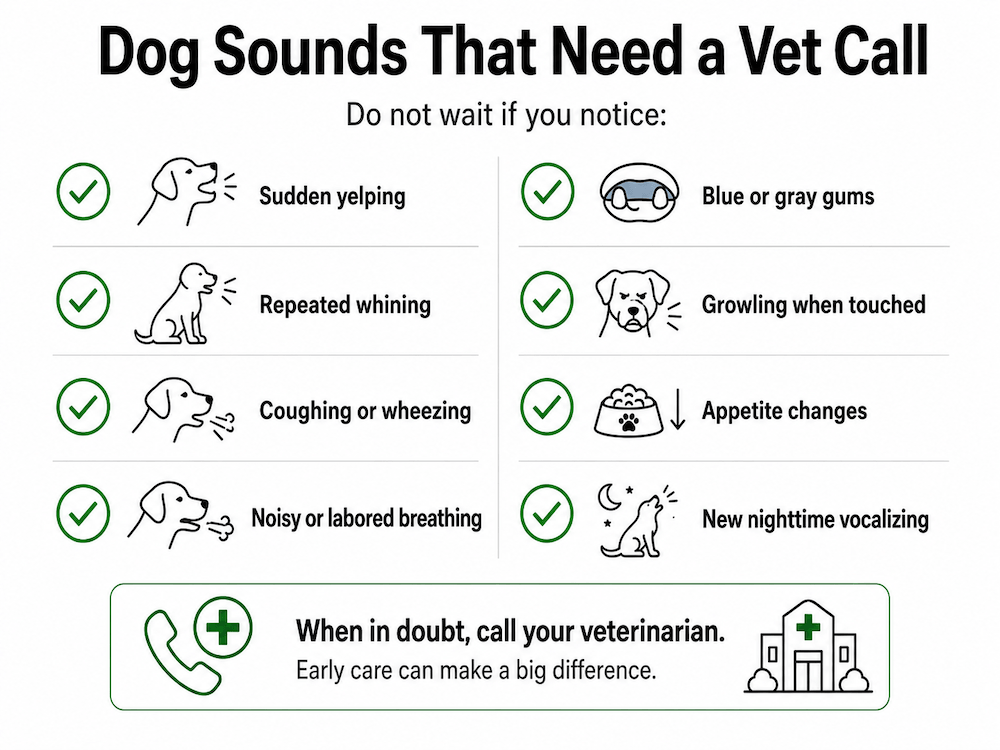
Sounds become more concerning when they are sudden, persistent, painful, intense, paired with behavior changes, or linked to breathing difficulty. A new cough, wheeze, honk, harsh breathing sound, repeated yelp, or whining that happens when the dog is touched should be taken more seriously.
Growling also deserves careful attention. A playful growl during loose, bouncy play may be normal, but a stiff growl around food, toys, sleeping spaces, grooming, children, or touch is a warning signal. Growling is often a clear sign a dog is distressed or afraid and asking for space, and that punishing growling can remove an important warning step before a snap or bite.
| What You Hear | Usually Okay to Monitor | Call a Vet Soon | Seek Urgent Care |
|---|---|---|---|
| Barking | Brief alert bark, play bark, greeting bark | New excessive barking with anxiety, confusion, or pain signs | Barking with collapse, injury, or severe distress |
| Whining | Short whine before food, play, or potty break | Frequent whining, sudden onset, or whining when touched | Whining with severe pain, bloated abdomen, weakness, or trauma |
| Growling | Loose, bouncy play growl during supervised play | Growling around food, children, grooming, handling, or painful areas | Growling with snapping, biting, or inability to safely create distance |
| Howling | Howling at sirens, music, or other dogs | Howling when left alone with pacing, drooling, or destruction | Howling with panic, injury, or severe distress |
| Yelping | One quick yelp from surprise, then normal behavior | Repeated yelping, limping, hiding, or guarding a body part | Yelping after fall, accident, bite, or suspected serious injury |
| Coughing or Wheezing | One mild cough after drinking, then normal breathing | Persistent cough, honking, wheeze, or exercise intolerance | Labored breathing, blue/gray gums, open-mouth breathing, collapse |
Why Dogs Bark, Whine, Growl, and Howl
A dog’s sounds are easiest to understand when you connect them to the trigger, body language, and repeated pattern. Barking, whining, growling, and howling can all be normal, but the same sound may mean excitement, alerting, anxiety, pain, frustration, or a need for space depending on what is happening around the dog.
What Not to Do When Your Dog Makes Unwanted Sounds
Do not automatically punish a dog for making noise. Yelling, hitting, leash corrections, shock collars, or scolding may stop the sound in the moment, but they can also increase fear, stress, or confusion. Aversive training techniques should be avoided in aggression cases because they may worsen the underlying emotional state and increase future risk.
Do not punish growling. Growling is communication. If a dog learns that growling gets punished, the dog may stop giving that warning and escalate more quickly to snapping or biting. Do not assume every sound is behavioral. A dog who whines, yelps, coughs, wheezes, groans when moving, or suddenly becomes more vocal may have pain, illness, anxiety, cognitive changes, or respiratory disease.
Instead, respond to the cause. If the dog is bored, add exercise, enrichment, and training. If the dog is anxious, reduce triggers and ask a veterinarian or qualified behavior professional for help. If the dog is in pain or breathing abnormally, treat it as a health concern, not a manners problem.
When to Call a Veterinarian About Dog Sounds
Call a veterinarian if your dog’s sound is new, sudden, persistent, painful, increasing, or paired with other changes. A new whine in a normally quiet dog, a repeated yelp during movement, a new cough, or a growl that appears only when a certain body part is touched can all point to discomfort or illness. A veterinarian can check for pain, injury, respiratory disease, dental problems, neurologic issues, anxiety, or age-related changes.
Common Misunderstandings About Dog Sounds
Dog sounds are easy to misunderstand because people often interpret them through a human lens. A barking dog is not always “being bad,” a growling dog is not always “aggressive,” and a quiet dog is not automatically calm. Dogs communicate with layered signals, and sound is only one part of the picture.
| Misunderstanding | Fact | Better Owner Response |
|---|---|---|
| “Dogs only say woof.” | Dogs bark, whine, growl, howl, yelp, sigh, groan, huff, and make breathing-related sounds. | Notice the sound type and the situation. |
| “A growl is bad behavior.” | A growl is often a warning or request for space. | Pause, create distance, and identify the trigger. |
| “A barking dog is always aggressive.” | Barking can signal excitement, alerting, play, boredom, fear, or frustration. | Read the dog’s body language and recovery time. |
| “Whining means the dog is spoiled.” | Whining can reflect need, anxiety, appeasement, excitement, or pain. | Check for patterns and rule out discomfort. |
| “If the sound stops, the problem is solved.” | Suppressing sound can hide stress, fear, pain, or warning signals. | Treat the cause, not just the noise. |
What Research Says About Dog Sounds and Canine Communication
Research supports what many owners notice: dog sounds carry useful information, but they are not a perfect translation system. A review on dog communication notes that dogs use visual, tactile, auditory, and olfactory communication, meaning vocal sounds are only one part of a broader communication system.[1]
Studies on barking suggest that barks can contain context-specific and individual-specific information. A PubMed-indexed study using machine learning analyzed dog barks for context and individual features, supporting the idea that barks are not all acoustically identical noise.[2]
Growl research also shows that dog vocalizations can carry emotional and contextual information, but human interpretation is not always perfect. One study on dog growls found that people use acoustic cues to judge emotional content, yet may have difficulty distinguishing some growl contexts without additional information.[3]
Pain and distress sounds deserve special caution. Research on puppy whines suggests that acoustic features in whines can influence how humans perceive urgency or distress, which may help explain why crying or whining sounds quickly capture owner attention. In real life, that sensitivity is useful—but it should lead to calm assessment, not panic.[4]
How Dog Owners Can Respond to Different Sounds
The best response depends on why the dog is making the sound. For normal communication, acknowledge the dog, check the need, and reward calm alternatives. For example, if a dog barks to come inside, wait for a brief pause before opening the door, then teach a quieter signal such as sitting by the door or pressing a bell.
For attention barking or demand whining, avoid rewarding the loudest version of the behavior. Meet the dog’s real needs first, such as exercise, potty breaks, food, rest, enrichment, or social contact, then reward quieter choices. Predictable routines and enough daily activity often reduce excessive barking and whining.
For fear, pain, or breathing-related sounds, respond with safety first. Create distance from scary triggers, avoid scolding growls or anxious barking, and get professional help if the pattern is intense or worsening. Coughing, wheezing, labored breathing, sudden yelping, or repeated whining during movement should be treated as possible health signs and checked by a veterinarian.
Frequently Asked Questions
The Bottom Line
Dogs most commonly make a barking sound, but barking is only one part of how they communicate. Dogs may also whine, growl, howl, yelp, sigh, grunt, huff, cough, wheeze, or snore depending on their mood, body language, environment, and health. The same sound can mean different things, so owners should always look at the context, trigger, and pattern over time. A playful growl is very different from a stiff warning growl, just as a quick alert bark is different from nonstop anxious barking. Sudden yelping, repeated whining, coughing, wheezing, labored breathing, or a major change in vocal behavior should not be ignored. The best way to understand a dog’s sound is to listen carefully, read the whole dog, and respond to the reason behind the noise. When in doubt, especially if pain or breathing trouble may be involved, a veterinarian can help rule out a medical problem.