
What Is a Seizure Alert Dog? How They Work, Training, Costs & More

Canine Bible is reader-supported. We receive affiliate commissions via some of our links. Learn more.
A seizure alert dog is a specially trained assistance dog that may warn a person that a seizure is approaching or beginning. Some dogs appear to recognize subtle behavioral, scent, or physiological changes and alert their handler through a trained behavior such as pawing, nudging, or staring. However, not every seizure assistance dog can reliably predict seizures, and scientific evidence for consistent pre-seizure detection is still developing. Many are also trained as seizure response dogs, performing tasks such as fetching help, activating an alarm, retrieving medication, or staying beside their handler during recovery. Their abilities can vary depending on the dog, the person’s seizure pattern, and the training program. Understanding the difference between seizure alert and seizure response dogs is important when considering what these animals can realistically do. In this guide, we will explain how seizure alert dogs work, how they are trained, what tasks they may perform, and what to know before considering one.
What to Know About Seizure Alert Dogs
| Key Point | What Dog Owners Should Know |
|---|---|
| Advance warning | Some trained dogs may alert before or near seizure onset, but prediction is not guaranteed. |
| Response support | Dogs can be trained to get help, activate alarms, retrieve items, or stay with their handler. |
| Detection ability | Dogs may notice scent, movement, behavior, or other subtle changes associated with seizures. |
| Individual reliability | Alert accuracy varies between dogs, handlers, seizure patterns, and real-world situations. |
| Training needs | Suitable dogs need strong temperament, health, obedience, public manners, and task-specific training. |
| Daily commitment | Handlers remain responsible for exercise, feeding, grooming, veterinary care, training, and downtime. |
| Cost and access | Fees, wait times, eligibility rules, and financial assistance vary widely between programs. |
| Medical role | A seizure dog should support an established medical and seizure action plan, not replace it. |
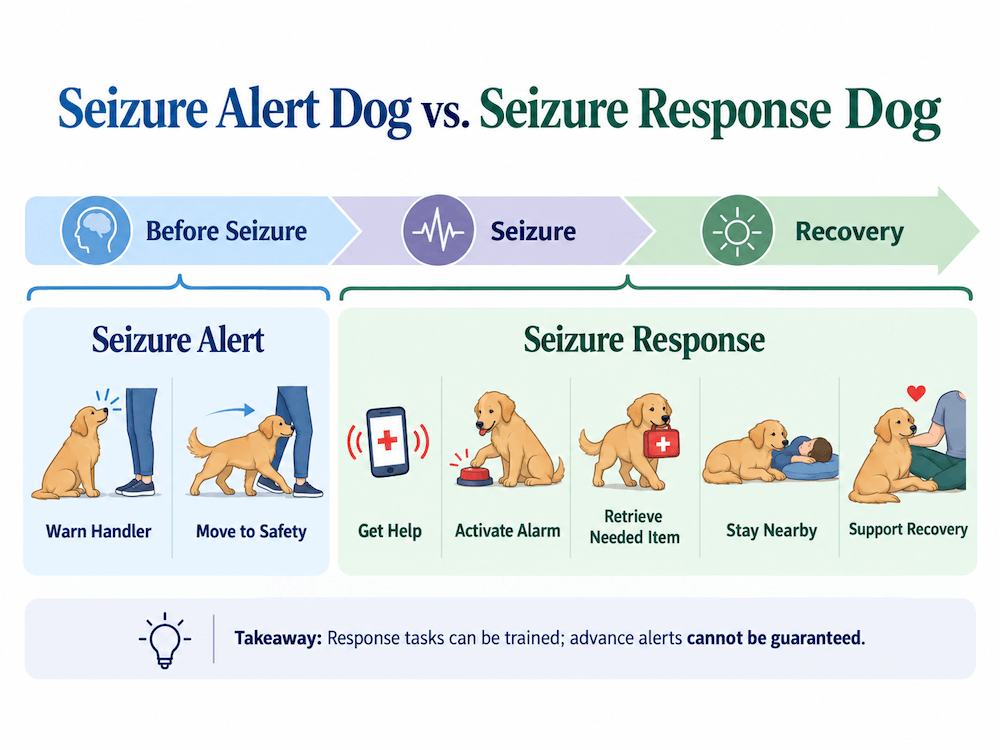
Seizure Alert Dog vs. Seizure Response Dog
The main difference is when the dog acts. Alert dogs attempt to warn before or near seizure onset, while response dogs perform trained tasks during or after a seizure.
How Does a Seizure Alert Dog Know a Seizure Is Coming?
Researchers still do not know exactly what every seizure alert dog detects. Possible cues include changes in body odor, movement, breathing, behavior, posture, or other physiological signals that occur around a seizure.
Scent is one promising explanation. Controlled experiments have shown that trained dogs can distinguish seizure-associated human odor samples, and other work has found detectable scent changes before some recorded seizures. Those findings support a possible biological mechanism but do not prove that every working dog can reliably predict seizures in everyday life.
What Types of Seizures Can Seizure Alert Dogs Detect?
Reports of dogs alerting have involved several seizure types, but there is not enough evidence to say that a particular type is consistently detectable. Detection also appears to vary substantially between individual people and dogs.


| Seizure Pattern | What It Means | What We Know About Dog Alerts |
|---|---|---|
| Focal seizures | Begin in one area of the brain. | Alerting has been reported, but reliability varies. |
| Generalized seizures | Involve networks on both sides of the brain from onset. | Some alerting reports exist across generalized seizure types. |
| Tonic-clonic seizures | Cause stiffening followed by rhythmic jerking. | Frequently represented in seizure-dog reports, but not guaranteed detectable. |
| Absence seizures | Cause brief interruptions in awareness. | Alerting has been reported in limited observational evidence. |
| Nocturnal seizures | Seizures occurring during sleep or at night. | No evidence shows dogs reliably detect all nighttime seizures. |
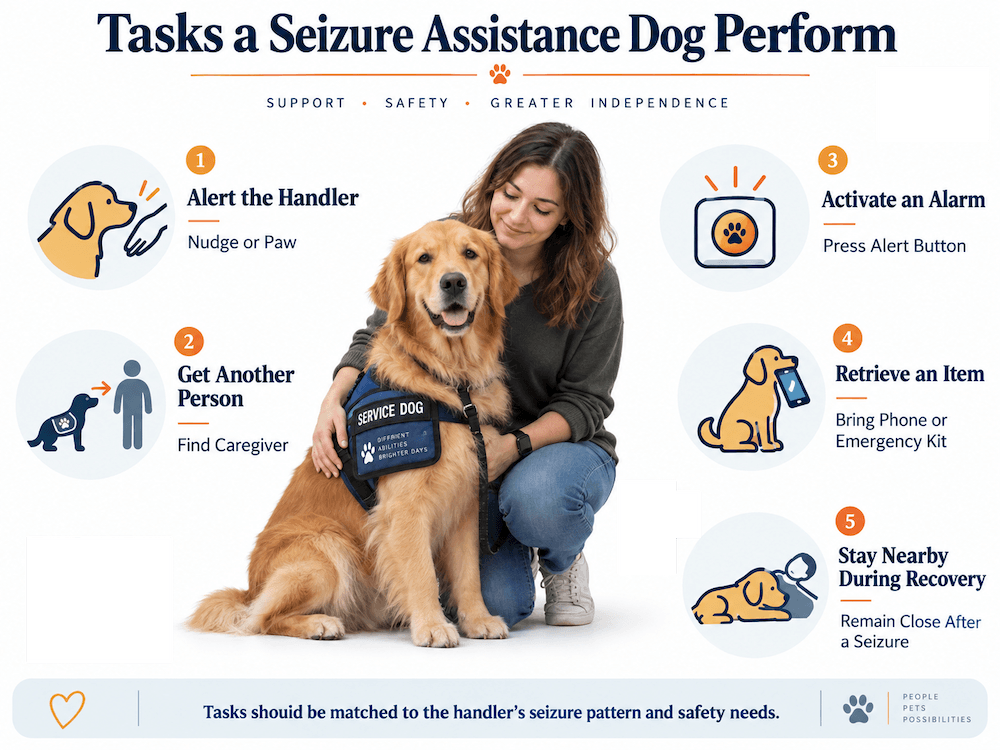
What Tasks Can a Seizure Assistance Dog Perform?
Seizure assistance dogs can perform several disability-related tasks, and these response behaviors are generally more straightforward to train than advanced prediction. The exact task set should match the handler’s seizure pattern and safety needs.
Who Can Benefit From a Seizure Assistance Dog?
A seizure assistance dog may be worth considering when seizures create specific safety or independence challenges that a trained dog can realistically address. Suitability depends less on the diagnosis alone and more on what tasks would improve day-to-day safety.
Programs can apply very different eligibility rules, including requirements related to age, seizure frequency, location, mobility, home environment, caregiver participation, and ability to attend team training.
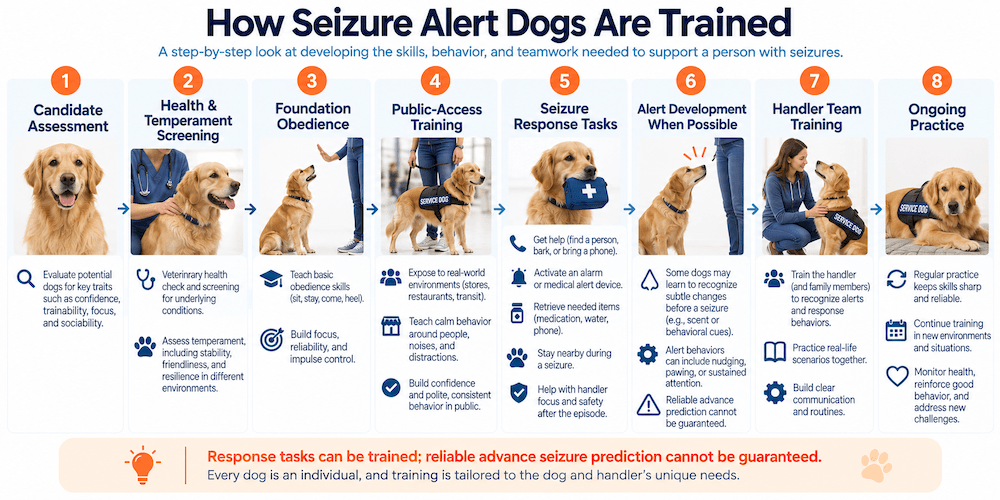
How Are Seizure Alert Dogs Trained?
Training starts with the same foundations expected of other service dogs: stable temperament, obedience, public-access manners, handler focus, impulse control, and reliable disability-related tasks. Dogs must also learn to work calmly around food, crowds, transportation, other animals, unusual noises, and unfamiliar environments.
Seizure response behaviors can be deliberately taught. Alert training is less predictable: some trainers use seizure-related scent work, while some dogs develop spontaneous pre-seizure behavior that can then be reinforced into a clearer signal.
How Long Does Training Take?
Preparing a service dog is usually a long-term process rather than a short training course. Some established programs report that dogs may spend around two years in preparation before being partnered with an individual or child-parent team.


The timeline varies with the dog’s age, prior training, required tasks, program model, and how quickly the handler-dog team progresses. More time may also be needed after placement to strengthen the working relationship.
What Breeds Make Good Seizure Alert Dogs?
There is no scientifically established best breed for seizure alerting. Labrador Retrievers, Golden Retrievers, Poodles, German Shepherds, Border Collies, and several other breeds have been used in seizure-assistance work, while Cocker Spaniels and Border Terriers have also appeared in published seizure-dog research. Individual temperament, health, trainability, handler focus, and suitability for the required tasks matter more than breed alone.
| Breed | Why They May Suit Seizure Assistance Work | Important Consideration |
|---|---|---|
| Labrador Retriever | Trainable, people-focused, adaptable, and widely used for service work. | Needs regular exercise, weight management, and responsible health screening. |
| Golden Retriever | Gentle, cooperative, handler-focused, and highly responsive to training. | Requires regular grooming, exercise, and careful health screening. |
| Standard Poodle | Highly intelligent, trainable, attentive, and lower shedding than many breeds. | Needs substantial grooming plus regular mental and physical activity. |
| German Shepherd | Intelligent, task-oriented, responsive, and capable of advanced service work. | Stable temperament, socialization, and sound orthopedic health are especially important. |
| Border Collie | Exceptionally trainable, attentive, and sensitive to subtle handler changes. | Very high mental and exercise needs can make the breed unsuitable for some handlers. |
| Collie | Responsive, perceptive, people-oriented, and generally receptive to structured training. | Individual confidence and ability to remain calm in busy environments must be assessed. |
| Cocker Spaniel | Intelligent, affectionate, trainable, and reported among dogs used in seizure-related work. | Smaller size may limit certain physical response tasks. |
| Border Terrier | Alert, trainable, and among breeds represented in published seizure-dog research. | Terrier independence and smaller size require careful individual assessment. |
What Should You Do When a Seizure Alert Dog Alerts?
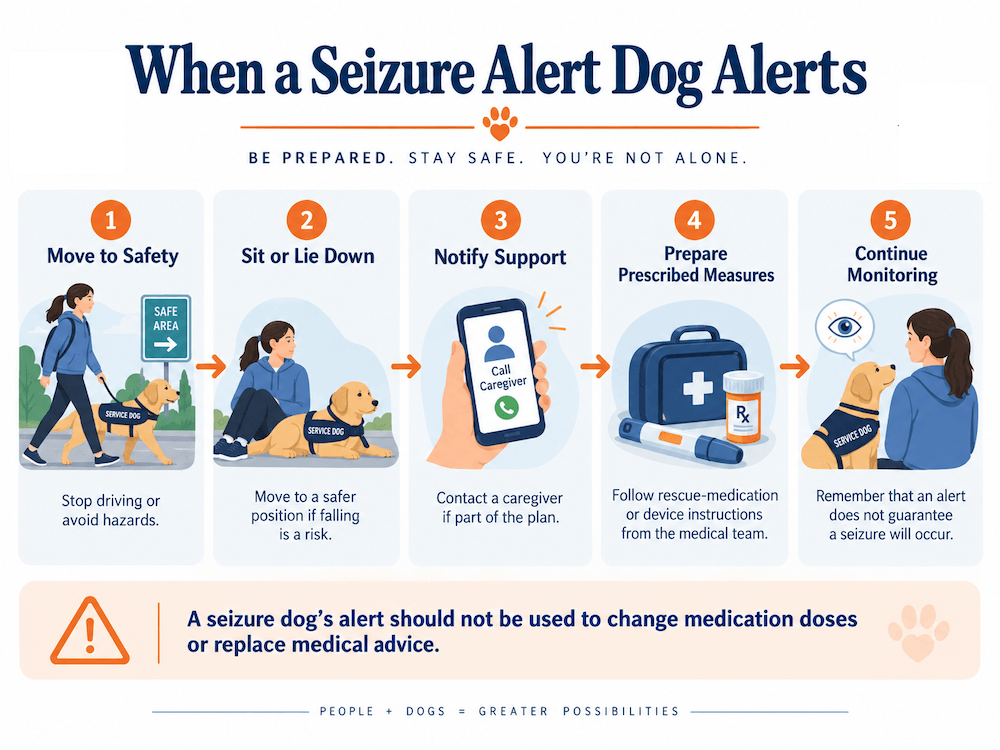
A dog’s alert should trigger the person’s established seizure action plan, not an improvised response. When there is enough warning, the goal is to reduce immediate hazards and prepare for the possibility that a seizure is about to occur.
What to Consider Before Getting a Seizure Alert Dog
The decision is best based on specific needs and realistic expectations, rather than on the idea that a dog will automatically predict every seizure.
| What to Consider | Why It Matters |
|---|---|
| Needed tasks | Define what the dog must do to improve safety or independence. |
| Alert expectations | Reliable advance seizure prediction may never develop. |
| Daily responsibility | You or a caregiver must meet the dog’s needs every day. |
| Cost | Plan for placement, training, routine care, and unexpected expenses. |
| Waiting period | Applications, matching, and training can take considerable time. |
| Home environment | Consider housing, children, other pets, work, school, and travel. |
| Support system | Identify who can help manage the dog when needed. |
| Alternatives | Compare service dogs with monitors, caregiver support, and other safety strategies. |
A good decision should make sense even if the dog’s most valuable contribution turns out to be dependable response work rather than seizure prediction.
How to Get a Seizure Alert Dog
Start by identifying what you actually need the dog to do. A request for reliable response tasks—such as alerting another person or activating an alarm—is different from seeking a dog guaranteed to predict seizures.
1. Application and Eligibility
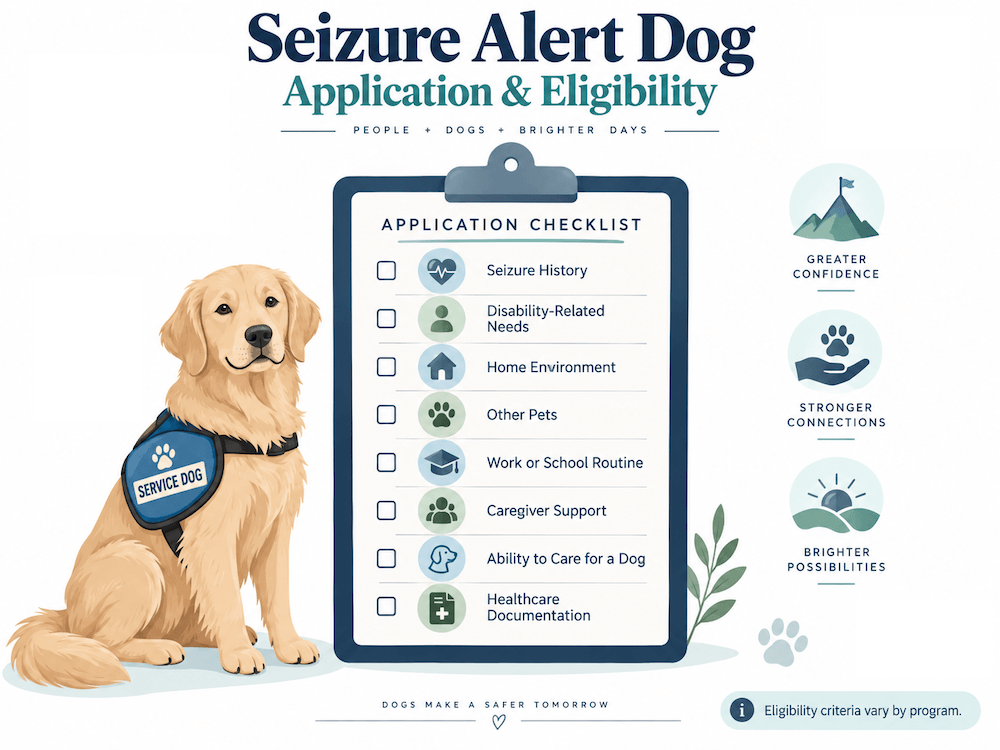
Programs may ask about seizure history, disability-related needs, household members, other pets, daily schedule, mobility, housing, work or school, caregivers, and your ability to care for a dog. Also, some programs serve only particular regions, ages, diagnoses, or levels of need. Others require documentation from a healthcare professional or an in-person assessment.
2. Finding a Reputable Program or Trainer
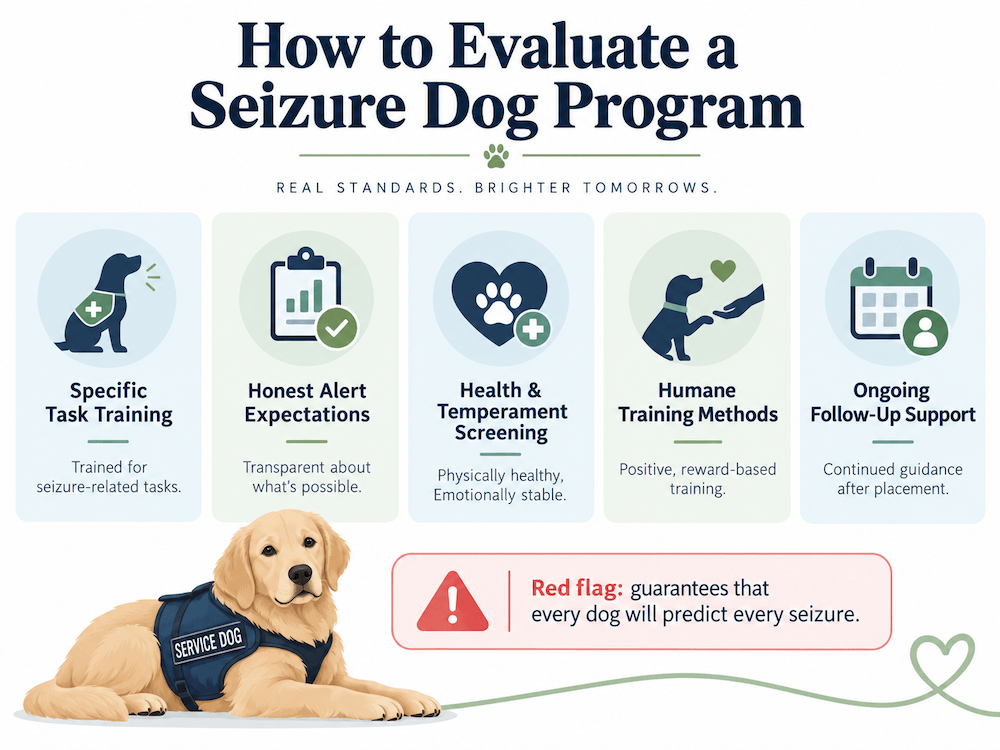
Ask exactly what the organization trains and how it evaluates success. Be cautious when expensive programs guarantee that every dog will predict every seizure.
3. Matching With a Dog
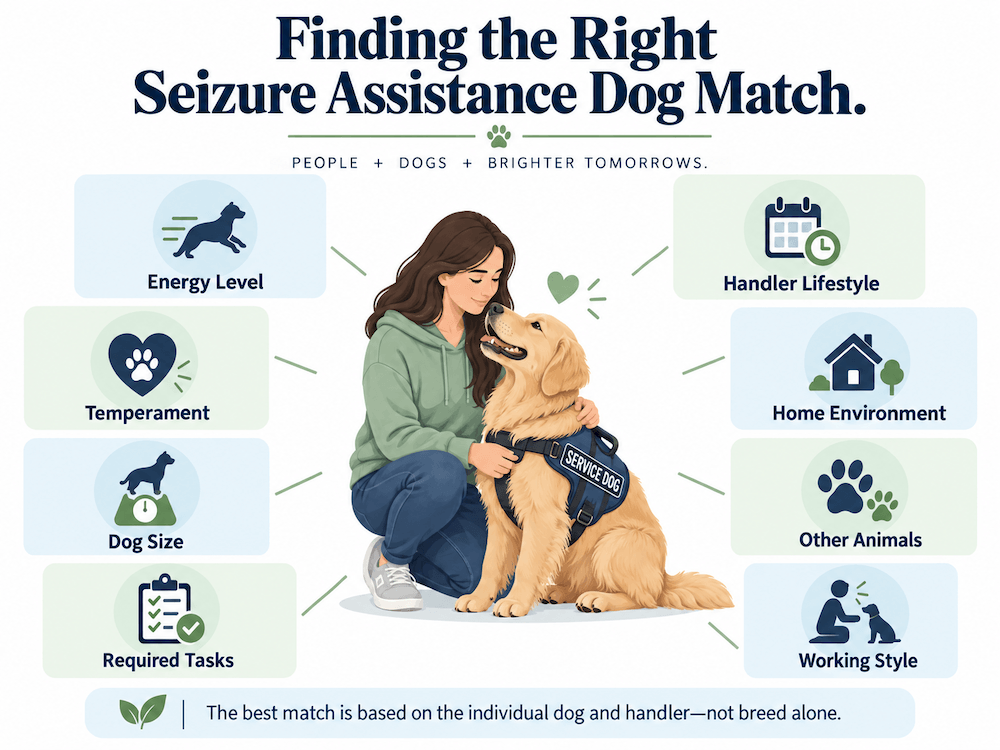
A successful placement depends on more than training level. Energy, confidence, physical size, working style, handler preferences, household environment, other animals, and the tasks required all influence whether a particular dog is a good match.
4. Handler Team Training
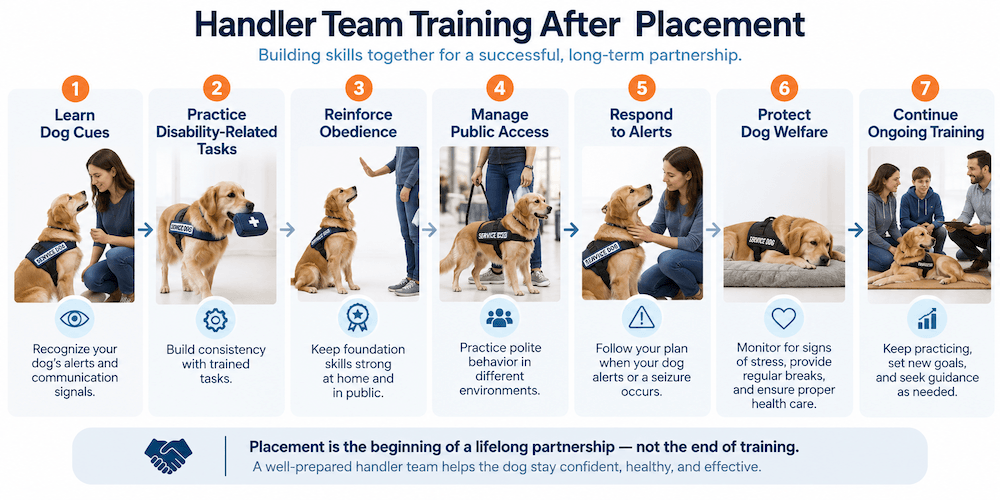
Placement is not the end of training. The handler—or a parent or caregiver partner—must learn how to cue and reinforce tasks, read the dog’s behavior, manage public access, maintain obedience, protect the dog’s welfare, and respond appropriately when an alert occurs.
How Long Is the Wait for a Seizure Alert Dog?
There is no standard waiting period. Programs may have months-long or multi-year timelines because dogs must be raised, screened, trained, matched, and tested before placement. Waits can become longer when a person needs uncommon tasks, a particular dog size, child-parent placement, or a program operating in a limited geographic area.
How Much Does a Seizure Alert Dog Cost?
There is no universal price for a seizure alert dog. Some nonprofit programs subsidize most or all placement costs, while private training and fee-based programs can involve expenses reaching tens of thousands in local currency. The placement fee is also only part of the financial commitment.
Current programs range from no placement fee to roughly $20,000+ charged to recipients, while the actual cost of raising and training a service dog can exceed $40,000–$50,000.
| Cost Area | Typical U.S. Cost | What It May Include | Why It Varies |
|---|---|---|---|
| Dog and training | About $20,000–$50,000+ total training value | Selection, raising, obedience, task training, and placement. | Some nonprofits subsidize the cost, while private programs may charge substantial fees. |
| Team training | About $0–$3,000+ out of pocket | Handler instruction, supervised practice, and placement classes. | Some programs include training while others require travel or additional instruction. |
| Travel | About $500–$2,000+ per placement trip | Transportation, lodging, meals, and local travel. | Distance, length of team training, and lodging needs affect the total. |
| Daily care | About $1,200–$2,500 per year | Food, treats, grooming, preventives, toys, and routine supplies. | Dog size, diet, grooming needs, and location affect ongoing costs. |
| Veterinary care | About $700–$1,500 per year | Wellness exams, vaccines, testing, dental care, and routine treatment. | Emergency care, medications, and chronic conditions can raise expenses significantly. |
| Working equipment | About $200–$600 initially | Harnesses, leashes, crates, beds, identification, and task equipment. | Specialized gear and replacement frequency differ between teams. |
Financial assistance may come from charitable programs, grants, fundraising, subsidized placements, or other disability-support resources. Always ask for an itemized explanation of fees and ongoing obligations before committing.
Does Insurance Cover a Seizure Alert Dog?
Standard health insurance does not routinely cover the purchase or training of service dogs, and coverage varies by insurer and public program. Prospective handlers should check their specific benefits rather than assuming a seizure dog will be reimbursed.
In the U.S., qualified service-animal expenses may also have tax implications: current IRS guidance allows eligible costs of buying, training, and maintaining certain service animals—including food, grooming, and veterinary expenses—to be included as medical expenses when the requirements are met.
Seizure Alert Dog Laws and Public Access Rights
In the United States, the ADA defines a service animal as a dog individually trained to perform work or tasks directly related to a person’s disability. A seizure dog may qualify when its trained tasks mitigate the handler’s disability—for example, detecting seizure onset and taking a trained action to help the person remain safe.
Federal ADA rules do not require a service dog to have professional certification, registration, a special ID card, or a vest. When the dog’s function is not obvious, covered businesses generally may ask only whether the dog is required because of a disability and what work or task it has been trained to perform; they cannot demand service-dog certification as a condition of entry.
An emotional-support animal is different. Comfort or companionship alone does not satisfy the ADA service-animal definition because the dog must be trained to perform disability-related work or tasks.
Handlers remain responsible for controlling and caring for their dogs, and ordinary local requirements such as licensing or vaccination may still apply. Laws outside the United States—and some additional state, local, housing, employment, school, and transportation rules—can differ, so handlers should check the requirements that apply to their situation.
What Is It Like to Live With a Seizure Alert Dog?
A seizure assistance dog is both a working partner and a dog with daily physical and emotional needs. The handler gains assistance but also assumes responsibility for feeding, exercise, grooming, preventive healthcare, training maintenance, toileting, equipment, public behavior, rest, and recreation.
Service dogs also need regular opportunities to simply be dogs. Downtime, play, sleep, appropriate social interaction, and time away from demanding environments help protect long-term welfare.
When Does a Seizure Alert Dog Retire?
Retirement should be based on the individual dog’s health, comfort, stamina, behavior, and ability to perform safely, not simply a birthday. Some seizure-dog programs estimate working careers of roughly eight to nine years, but individual dogs may retire earlier or later.
Signs that retirement planning may be appropriate include chronic pain, declining mobility, sensory loss, anxiety about working, reduced stamina, difficulty concentrating, or a persistent fall in task performance. After retirement, some dogs remain with their handler as pets; others live with a family member or another trusted home while a successor dog takes over working duties.
Caring for the Health of a Working Seizure Dog
A seizure assistance dog’s ability to work safely depends on protecting its own physical and emotional health. Routine veterinary care, appropriate nutrition, weight management, dental care, parasite prevention, exercise, rest, and early treatment of illness all support a longer working life.
A dog that develops collapse, seizures, serious injury, marked weakness, or another acute neurological problem needs veterinary attention for its own health, independently of its handler’s epilepsy care.
Seizure Alert Dogs vs. Seizure Detection Devices
Dogs and electronic seizure-detection systems work in fundamentally different ways. A dog may respond to individualized scent, behavioral, or physiological cues and can perform trained assistance tasks, while wearable or bedside devices use sensors and algorithms to detect patterns such as movement, heart rate, electrodermal activity, muscle activity, sound, or brain electrical signals.
| Comparison | Seizure Alert Dog | Seizure Detection Device |
|---|---|---|
| How it works | May detect scent, behavior, movement, or physiological changes. | Uses sensors and algorithms to identify seizure-related patterns. |
| Main benefit | Can combine alerts with personalized assistance tasks. | Provides continuous automated monitoring. |
| Response support | Can get help, retrieve items, activate alarms, or stay nearby. | May send alerts to caregivers or connected devices. |
| Detection strength | Individualized, but advance warning varies greatly. | Generally strongest for seizures with prominent movement. |
| Main limitation | Reliable seizure prediction cannot be guaranteed. | Accuracy varies by seizure type, sensor, and false-alarm rate. |
| Ongoing needs | Requires daily care, training, exercise, and veterinary care. | Requires charging, setup, maintenance, and correct device use. |
What Research Says About Seizure Alert Dogs
A 2018 PLOS ONE scoping review found only five qualifying quantitative studies on seizure-alert and seizure-response dogs, most relying heavily on owner reports. Dogs were reported to alert across several seizure types, but the evidence was too limited to determine reliable accuracy, ideal breeds, best training methods, or which seizure types are most predictable. For prospective handlers, this means impressive individual reports should not be treated as proof that a new dog will perform the same way.[1]
A 2019 Scientific Reports experiment found that five trained dogs could distinguish seizure-associated odor samples from non-seizure samples, with sensitivity ranging from 67% to 100% and specificity from 95% to 100%. The study demonstrated a seizure-associated odor signal but tested samples collected during seizures—not whether working dogs could consistently predict seizures before they began.[2]
A prospective Epilepsy & Behavior study involving 60 participants found trained dogs could distinguish seizure-associated sweat samples and identified a seizure-related scent before many captured seizures, with the reported warning phase averaging about 68 minutes. This provides stronger support for a possible pre-seizure scent biomarker, but it still does not establish reliable real-world alerting for every person or dog.[3]
The 2024 EPISODE trial in Neurology followed adults with severe medically refractory epilepsy using a randomized stepped-wedge design. Participants experienced lower seizure frequency and improvements in some quality-of-life outcomes after receiving seizure dogs, although the study was small and focused on people with severe, frequent epilepsy rather than everyone who experiences seizures. It suggests seizure-dog partnerships can provide meaningful benefits for selected people while leaving unanswered questions about who benefits most and which dog behaviors drive those outcomes.[4]
Frequently Asked Questions
The Bottom Line
A seizure alert dog may warn a person before or near the onset of a seizure, while also performing trained assistance tasks that improve safety and independence. However, reliable advance seizure prediction varies between individual dogs and cannot be guaranteed. Response tasks such as getting help, activating an alarm, retrieving items, or staying nearby can be trained more predictably. A successful partnership depends on the dog’s temperament, health, training, and suitability for the handler’s specific needs and lifestyle. Prospective handlers should also consider program eligibility, waiting periods, costs, public-access requirements, and the ongoing responsibility of caring for a working dog. Children and adults may benefit from seizure assistance dogs when the arrangement fits their needs and support system. Ultimately, these dogs are best viewed as one part of a broader seizure safety and medical management plan.