Dog Xylitol Toxicity Calculator: How Much Is Toxic, Charts & Survival Rates

Canine Bible is reader-supported. We receive affiliate commissions via some of our links. Learn more.
Xylitol can be extremely dangerous to dogs. This sugar substitute is found in some sugar-free gums, candies, baked goods, nut butters, toothpastes, medications, supplements, and other household products. The Dog Xylitol Toxicity Calculator below estimates how much xylitol your dog may have consumed relative to body weight. It can help you calculate an exposure in milligrams per kilogram (mg/kg) and compare it with commonly used veterinary toxicity reference points.
Remember to ALWAYS contact your veterinarian or a pet poison control service immediately if your dog may have ingested xylitol, even if your dog appears normal or the amount seems small. If you can't reach your vet, you can chat live with a registered online veterinary professional via our online vet chat or video chat support (24 hours a day, 7 days a week). Or use Chewy's online vet services (6 a.m. - midnight ET). Additionally, at-home dog gut health tests can analyze your dog’s microbiome, offering insights into which nutrients their diet should include. Similarly, at-home dog allergy testing kits can identify ingredients that may not be suitable for your dog, enabling you to choose the right diet and care plan to support optimal digestion, nutrition, and health.
How Much Xylitol Is Toxic to Dogs?
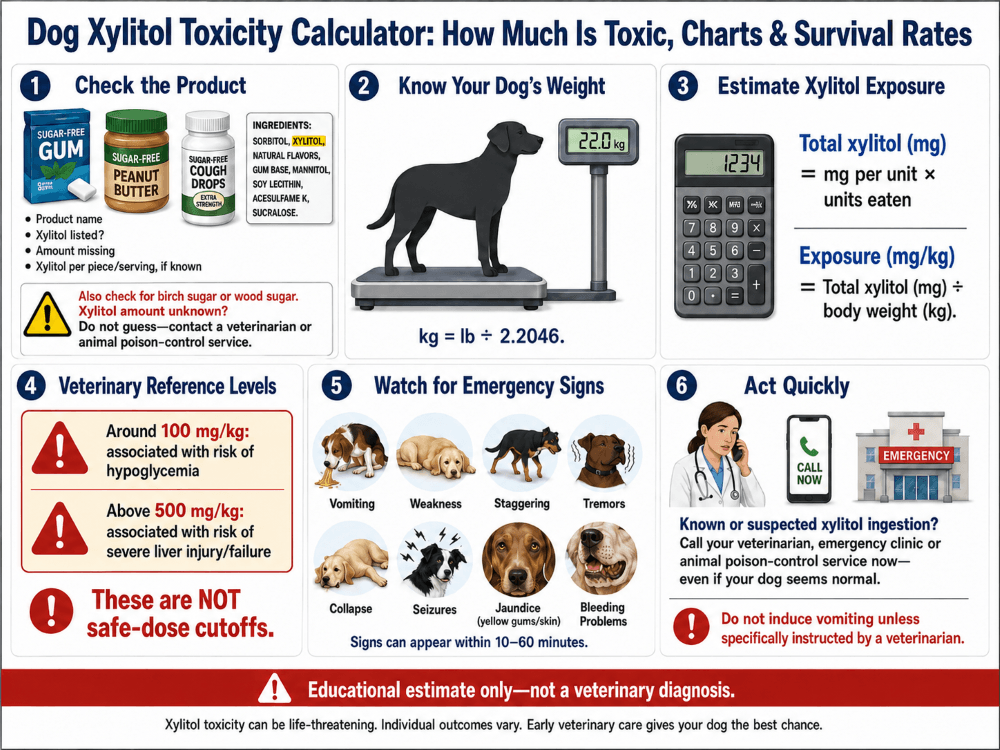
Xylitol exposures above approximately 100 mg/kg (0.1 g/kg) have been associated with hypoglycemia, or dangerously low blood sugar, in dogs. At exposures above approximately 500 mg/kg (0.5 g/kg), some dogs may develop severe liver injury or liver failure.
These numbers are veterinary concern levels, not safe-dose cutoffs. A result below 100 mg/kg does not prove that an exposure is harmless, especially when the product's xylitol content or amount consumed is uncertain.
Dogs process xylitol very differently from people. After ingestion, xylitol can trigger a rapid insulin release that drives blood glucose dangerously low. Larger exposures can also damage the liver, and liver-related problems may appear later than the initial blood-sugar effects. The most important factors are:
A small amount that produces a relatively low dose in a large dog can produce a much higher mg/kg exposure in a toy or small-breed dog.


Xylitol Toxicity Chart for Dogs
The following charts show commonly used veterinary reference amounts based on body weight.
Xylitol Toxicity Chart by Dog Weight
This chart shows how much pure xylitol corresponds to approximately 100 mg/kg and 500 mg/kg at common dog weights.
| Dog Weight | Approx. kg | 100 mg/kg Reference | 500 mg/kg Reference |
|---|---|---|---|
| 5 lb | 2.3 kg | 0.23 g xylitol | 1.13 g xylitol |
| 10 lb | 4.5 kg | 0.45 g xylitol | 2.27 g xylitol |
| 15 lb | 6.8 kg | 0.68 g xylitol | 3.40 g xylitol |
| 20 lb | 9.1 kg | 0.91 g xylitol | 4.54 g xylitol |
| 30 lb | 13.6 kg | 1.36 g xylitol | 6.80 g xylitol |
| 40 lb | 18.1 kg | 1.81 g xylitol | 9.07 g xylitol |
| 50 lb | 22.7 kg | 2.27 g xylitol | 11.34 g xylitol |
| 60 lb | 27.2 kg | 2.72 g xylitol | 13.61 g xylitol |
| 80 lb | 36.3 kg | 3.63 g xylitol | 18.14 g xylitol |
| 100 lb | 45.4 kg | 4.54 g xylitol | 22.68 g xylitol |
These amounts are toxicity reference points, not recommended doses or guarantees of safety. Contact a veterinarian or animal poison-control service after known or suspected xylitol ingestion, particularly if the amount is uncertain or your dog has symptoms.
Xylitol Risk Reference Chart
An estimated mg/kg dose can help veterinary professionals place the exposure in context, but it should never be used as permission to wait at home.
| Estimated Exposure | Veterinary Context | Owner Action |
|---|---|---|
| Amount unknown | Risk cannot be calculated reliably. | Contact a veterinarian or poison-control service now. |
| Below 100 mg/kg | Below the commonly cited hypoglycemia reference. | Still seek veterinary advice after confirmed ingestion. |
| 100–500 mg/kg | Hypoglycemia is a significant concern. | Urgent veterinary assessment is warranted. |
| Above 500 mg/kg | Severe liver injury may occur. | Treat as a veterinary emergency. |
| Any dose + symptoms | Clinical poisoning may already be developing. | Seek emergency veterinary care immediately. |
The calculator should never return a green “safe” message. Individual dogs and products vary, and an estimated dose cannot rule out poisoning.
Products That May Contain Xylitol
Xylitol is not limited to chewing gum. Check the complete ingredient list of any product your dog may have eaten.


| Product Type | Examples | What to Check |
|---|---|---|
| Gum | Sugar-free sticks, pellets, cups | Exact xylitol per piece if available. |
| Candy & mints | Sugar-free sweets, breath mints | Ingredients and serving information. |
| Nut butters | Peanut and specialty nut spreads | Check every brand and flavor. |
| Baked foods | Cookies, cakes, muffins | Recipe or manufacturer xylitol amount. |
| Dental products | Toothpaste, mouth rinse | Ingredient list and concentration. |
| Medications | Syrups, liquids, some sprays | Active and inactive ingredients. |
| Supplements | Gummies, vitamins, powders | Xylitol per serving or unit. |
| Bulk sweetener | Granules or powder | Treat as concentrated xylitol. |
Xylitol may also appear on labels under names such as birch sugar, wood sugar, or birch bark extract.
Xylitol Toxicity Guidelines for Dogs
Around 100 mg/kg: Hypoglycemia Becomes a Concern
Xylitol doses above approximately 100 mg/kg, equal to 0.1 g/kg, have been associated with hypoglycemia in dogs. Hypoglycemia happens because xylitol can stimulate a strong release of insulin. Blood glucose then falls too low to reliably supply the brain and other tissues with energy. Possible signs include weakness, lethargy, wobbling, tremors, collapse, and seizures.
Above 500 mg/kg: Severe Liver Injury Becomes a Concern
Some dogs exposed to more than approximately 500 mg/kg, or 0.5 g/kg, may develop severe liver injury or liver failure. Liver damage can develop even after the immediate glucose problem has been addressed. Changes in liver enzymes may appear within hours, while visible signs of liver injury can take a day or longer to develop.
Why These Numbers Are Not Safe-Dose Cutoffs
The 100 mg/kg and 500 mg/kg figures are useful clinical reference points, but toxicity is not a simple on/off switch. Xylitol concentrations vary widely between consumer products. Even different flavors made by the same brand may contain different amounts, which makes a generic “one piece of gum equals X grams” calculation unreliable.
If the package does not state how much xylitol is present, the safest approach is to stop estimating and contact a veterinary professional who can assess the specific product.
Factors That Can Affect Your Dog's Results
Several inputs determine whether a calculated xylitol exposure is meaningful.
| Factor | Why It Matters | What Owners Should Check |
|---|---|---|
| Body weight | Smaller dogs receive a larger mg/kg dose from the same amount. | Use a recent weight in lb or kg. |
| Xylitol amount | The calculation requires actual xylitol, not total product weight. | Check the label or manufacturer information. |
| Amount eaten | Missing pieces or portions determine total exposure. | Count what remains and consider uncertainty. |
| Product type | Concentrations differ widely between products. | Identify the exact brand, flavor, and formulation. |
| Time elapsed | Clinical signs may begin quickly or be delayed. | Estimate when ingestion occurred. |
| Symptoms | Clinical signs can indicate active poisoning regardless of the estimate. | Watch for weakness, wobbling, tremors, or collapse. |
| Health status | Existing disease may complicate assessment and treatment. | Tell the veterinarian about medical conditions and medications. |
If you are unsure about any of the inputs, especially the actual xylitol concentration, do not use a guessed value to reassure yourself.
Common Mistakes to Avoid
Xylitol calculations are simple mathematically, but errors in the inputs can produce a misleading answer.
| Mistake | Why It Matters | Better Approach |
|---|---|---|
| Guessing gum content | Xylitol per piece varies between products and flavors. | Use product-specific information. |
| Using product weight | A 10 g food is not necessarily 10 g of xylitol. | Calculate the xylitol portion only. |
| Mixing mg and g | A unit error can change the result 1,000-fold. | Remember that 1 g equals 1,000 mg. |
| Using lb as kg | Mg/kg formulas require kilograms. | Convert lb to kg first. |
| Ignoring uncertainty | More product may be missing than you observed. | Use the possible maximum when speaking with a vet. |
| Waiting for symptoms | Hypoglycemia can develop rapidly. | Call after known or suspected ingestion. |
| Treating the estimate as diagnosis | A calculator cannot evaluate blood glucose or liver injury. | Use the result only as exposure context. |
| Trying home treatment | Unsupervised treatment can delay appropriate care. | Follow veterinary or poison-control instructions. |
Safety Guidelines for Xylitol Poisoning in Dogs
When Should You Call a Veterinarian?
Contact a veterinarian, emergency veterinary clinic, or animal poison-control service as soon as you know or suspect your dog consumed xylitol. Do not wait until the calculator reaches 100 mg/kg. Call sooner if:
Keep the package, label, wrapper, or recipe available. The exact brand, flavor, formulation, ingredient list, and amount remaining may help a veterinary professional estimate the exposure more accurately.
Emergency Warning Signs
Possible signs of xylitol poisoning include:
Hypoglycemic signs may occur within roughly 30 minutes, although absorption can sometimes be delayed for many hours depending on the product. Liver-related signs may not become apparent until later. If your dog is having a seizure, has collapsed, cannot stand, or is severely weak or disoriented, seek emergency veterinary care immediately.
Do Not Induce Vomiting Unless You Are Told To
Do not give hydrogen peroxide or attempt to make your dog vomit unless a veterinarian or animal poison-control professional specifically instructs you to do so. Xylitol can cause hypoglycemia quickly. Inducing vomiting in a dog that is becoming weak, neurologically abnormal, or unable to swallow normally can create additional risks. Veterinary decontamination is therefore best managed under professional direction.
Activated Charcoal Is Not a Home Treatment for Xylitol
Do not administer activated charcoal for xylitol exposure unless a veterinarian has another specific reason to recommend it. Activated charcoal does not appreciably bind xylitol and is not considered useful for xylitol toxicosis itself.
What to Do If Your Dog Eats Xylitol
If you discover that your dog has eaten a xylitol-containing product, focus on getting accurate information and professional help rather than trying to treat the poisoning at home.
- Remove the product from your dog's reach. Prevent additional exposure and keep other pets away.
- Save the packaging. Keep the ingredient list, wrapper, container, recipe, medication bottle, or supplement label.
- Estimate what is missing. Count remaining gum pieces, servings, tablets, gummies, or other units when possible.
- Check your dog's current weight. A recent veterinary weight is ideal, but a reasonable current estimate is more useful than delaying the call.
- Note when the exposure occurred. If the exact time is unknown, provide the earliest and latest possible times.
- Call your veterinarian, emergency clinic, or animal poison-control service immediately. Provide the product details, your dog's weight, the amount potentially consumed, and the time of exposure.
- Follow the instructions you receive. Veterinary treatment may involve monitoring blood glucose, giving intravenous dextrose, checking liver values, or providing other supportive care depending on the exposure and clinical findings.
Do not give sugar, food, medication, hydrogen peroxide, activated charcoal, or another home remedy unless the veterinarian managing the case specifically tells you to.
Special Considerations for Certain Dogs
Do not adjust toxicity thresholds on your own based on age, breed, or medical history. A veterinarian should evaluate these factors alongside the estimated dose.
How to Calculate Xylitol Exposure in Dogs Manually
The calculator uses the same basic dose calculation commonly used in veterinary toxicology: determine the amount consumed, convert the dog's weight to kilograms, and divide the dose by body weight.
Step 1: Convert Your Dog's Weight to Kilograms
If your dog's weight is in pounds: Body weight (kg) = Weight (lb) ÷ 2.2046
- For example:
- 20 lb ÷ 2.2046 = 9.07 kg
Step 2: Calculate the Total Xylitol Consumed
If you know the amount of xylitol per piece or serving: Total xylitol (mg) = Xylitol per unit (mg) × Number of units eaten
- For example, if a reliable product source confirms 500 mg of xylitol per piece and two pieces were eaten:
- 500 mg × 2 = 1,000 mg xylitol
If the xylitol percentage of a product is explicitly known: Xylitol (g) = Product eaten (g) × Xylitol percentage ÷ 100
Then convert grams to milligrams: Xylitol (mg) = Xylitol (g) × 1,000
Do not use this percentage method merely because xylitol appears high on an ingredient list. Ingredient order does not provide an exact enough concentration for a reliable toxicity calculation.
Step 3: Calculate the Exposure in mg/kg
Use: Xylitol exposure (mg/kg) = Total xylitol consumed (mg) ÷ Dog weight (kg)
Example Calculation
Suppose a 20 lb dog consumed a product known to provide 1,000 mg of xylitol.
- First, convert the dog's weight:
- 20 ÷ 2.2046 = 9.07 kg
- Then divide the xylitol dose by body weight:
- 1,000 mg ÷ 9.07 kg = approximately 110 mg/kg
The calculated exposure is therefore approximately 110 mg/kg, which is above the commonly cited 100 mg/kg reference associated with hypoglycemia. That number provides useful exposure context, but the correct next step is veterinary assessment, not home monitoring.
What If the Xylitol Amount Is Unknown?
If you cannot determine the amount of xylitol from reliable product information, there is no trustworthy number to enter into the formula. A calculator should return something similar to:
“Xylitol concentration unknown. A reliable exposure estimate cannot be calculated from the available information. Save the product packaging and contact a veterinarian or animal poison-control service.” A precise-looking result based on a guessed concentration can be more dangerous than no result at all.
Dog Xylitol Toxicity Infographic
Frequently Asked Questions
The Bottom Line
The dog xylitol toxicity calculator helps convert a known amount of xylitol into an estimated exposure in mg/kg based on your dog's body weight. Around 100 mg/kg is commonly associated with concern for hypoglycemia, while exposures above approximately 500 mg/kg may be associated with severe liver injury. Neither number should be treated as a guaranteed safe-dose boundary. If the amount of xylitol is unknown, the product concentration is uncertain, or your dog is showing symptoms, do not rely on an estimate. Contact your veterinarian, an emergency veterinary clinic, or an animal poison-control service promptly. For other common household exposures, Canine Bible readers may also find a dog chocolate toxicity calculator, dog grape toxicity guide, and 50 toxic dog foods guide useful.