
Dog THC Toxicity Calculator: Estimate Risk & Poisoning Dosage

Canine Bible is reader-supported. We receive affiliate commissions via some of our links. Learn more.
Whether your dog ate an edible, THC oil, cannabis flower, gummies, or another THC-containing product, THC toxicity in dogs can cause serious symptoms and should be taken seriously. That’s why we created this Dog THC Toxicity Calculator—to help you estimate possible risk based on your dog’s weight, product type, amount eaten, timing, and symptoms. In this guide, you’ll also find risk charts, warning signs, safety steps, and answers to common questions so you know when to contact a veterinarian or pet poison-control service.
How Much THC Is Toxic to Dogs?
There is no practical “safe” amount of THC for accidental exposure in dogs. Risk depends on your dog’s weight, the total THC eaten, the product type, the time since exposure, and whether symptoms have started.
Veterinary toxicology references often estimate exposure in milligrams of THC per kilogram of body weight. Mild clinical signs may occur at relatively low exposures, while higher exposures increase concern, but dogs can respond differently.
For example, if a 20-pound dog eats one 10 mg THC gummy, the estimated exposure is about 1.1 mg/kg. That does not prove the dog will become severely ill, but it is enough to contact a veterinarian or pet poison control for case-specific advice.


THC Toxicity Chart for Dogs
The same THC amount is more concerning for smaller dogs because they receive more THC per pound of body weight.
| Dog Weight | 0.3 mg/kg | 1 mg/kg | 2 mg/kg | Why It Matters |
|---|---|---|---|---|
| 5 lb | 0.7 mg THC | 2.3 mg THC | 4.5 mg THC | A tiny dog can reach a concerning exposure from a small edible piece. |
| 10 lb | 1.4 mg THC | 4.5 mg THC | 9 mg THC | One low-dose gummy may be enough to cause signs. |
| 20 lb | 2.7 mg THC | 9 mg THC | 18 mg THC | A single 10 mg serving may create meaningful exposure. |
| 40 lb | 5.4 mg THC | 18 mg THC | 36 mg THC | Risk rises with stronger edibles or multiple servings. |
| 60 lb | 8.2 mg THC | 27 mg THC | 54 mg THC | Concentrates, oils, and brownies can still be serious. |
| 80 lb | 10.9 mg THC | 36 mg THC | 73 mg THC | Larger dogs are not risk-free, especially with high-potency products. |
| 100 lb | 13.6 mg THC | 45 mg THC | 91 mg THC | Multiple edibles or concentrates still need veterinary guidance. |
This chart estimates exposure only. Contact a veterinarian if symptoms appear, the THC amount is unknown, the product was concentrated, or you are unsure.
Most Common THC Products & Their Dosage Toxicity
Use this to help you understand why the same “small amount” can mean very different things depending on the THC product. Dogs may show signs at low THC exposures, and moderate signs become more likely as mg/kg exposure increases, so this table should be treated as a risk guide—not a safety cutoff.
| THC Product | Typical THC Amount | Main Risk | Dog Safety Note |
|---|---|---|---|
| THC gummies | 2.5–10 mg per piece | Small, concentrated dose | Risky for small dogs. |
| Brownies or chocolate | 5–10+ mg per serving | THC plus chocolate | Treat as higher risk. |
| Cookies or baked goods | 5–20+ mg per serving | Uneven THC amount | Save the package. |
| Cannabis flower | Listed as % THC | Hard to estimate | Use grams eaten if known. |
| Vape oil | Highly concentrated | Large dose in small volume | Call if chewed or leaked. |
| Dabs, wax, shatter | Very high THC | High-potency concentrate | Treat as urgent. |
| Full-spectrum CBD | May contain THC | Hidden THC exposure | Check the label. |
| Homemade edibles | Unknown | Unreliable dose | Use a cautious estimate. |
These are examples, not safe limits. Call your veterinarian if your dog ate THC, has symptoms, or the amount is unknown.


Symptom Risk Chart
Symptoms matter because your dog’s actual response is more important than the number alone.
| Symptom Level | Possible Signs | What To Do |
|---|---|---|
| No symptoms yet | Dog appears normal after possible exposure. | Call for guidance if the dose is unknown or product was strong. |
| Mild signs | Sleepiness, mild wobbliness, drooling, or glassy eyes. | Contact a veterinarian and monitor only as instructed. |
| Moderate signs | Vomiting, marked wobbliness, dribbling urine, or agitation. | Seek veterinary advice promptly. |
| Severe signs | Tremors, collapse, seizures, coma, or breathing trouble. | Go to an emergency veterinarian now. |
| Other toxin risk | Chocolate, xylitol, raisins, caffeine, alcohol, or other drugs. | Treat as urgent and call a vet or poison control service. |
Clinical signs can start within 30 minutes to several hours and may last up to 72 hours in some dogs.
Safety Guidelines for Dog THC Exposure
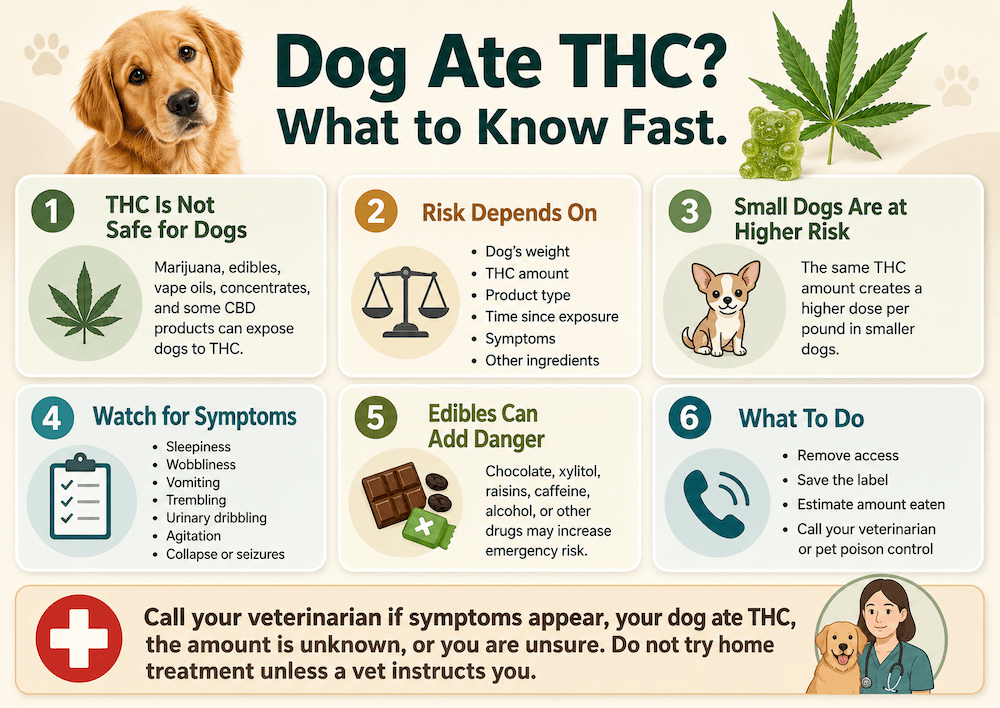
THC exposure can affect dogs differently depending on body weight, product strength, amount eaten, and individual sensitivity. Some dogs may only seem sleepy or wobbly, while others can develop tremors, collapse, seizures, trouble breathing, or other serious signs.
Use the calculator as a triage tool, not a diagnosis or a guarantee of safety. A low estimate may still be concerning if the product strength is unknown, the label is unclear, symptoms are present, or the product may contain other risky ingredients.
Extra caution is needed for puppies, senior dogs, toy breeds, pregnant or nursing dogs, brachycephalic dogs, and dogs with heart, liver, kidney, breathing, neurologic, or seizure disorders. Edibles, baked goods, candies, oils, and mixed products may also contain chocolate, xylitol, raisins, caffeine, alcohol, nicotine, or other substances that can change the risk.
Factors That Can Affect Your Dog’s Results
Several details can change the risk estimate, especially when the amount eaten or product strength is uncertain.
| Factor | Why It Matters | What Owners Should Check |
|---|---|---|
| Weight | Smaller dogs reach higher mg/kg exposure from the same THC amount. | Use your dog’s current weight, not a guess from months ago. |
| Product type | Gummies, oils, and concentrates may contain high THC amounts. | Save the label or take a clear photo. |
| Amount eaten | One serving and one package can be very different doses. | Count missing pieces or estimate grams/mL if possible. |
| Time since exposure | Signs may be delayed and can worsen after ingestion. | Note the earliest and latest possible exposure time. |
| Symptoms | Wobbliness, sedation, vomiting, or tremors increase concern. | Watch walking, alertness, breathing, and temperature changes. |
| Other ingredients | Chocolate, xylitol, raisins, caffeine, or alcohol can add danger. | Read the full ingredient list, not just the THC label. |
| Health status | Puppies, seniors, and medically fragile dogs need extra caution. | Tell the vet about age, disease, and medications. |
Common Mistakes to Avoid
THC exposures are often confusing because labels, serving sizes, and product types are easy to misread.
| Mistake | Why It Matters | Better Approach |
|---|---|---|
| Using wrong units | Milligrams, grams, servings, and percentages are not interchangeable. | Use the label exactly and convert carefully. |
| Assuming CBD is THC-free | Some CBD products may contain THC or contaminants. | Check whether the product is isolate, broad-spectrum, or full-spectrum. |
| Ignoring symptoms | A symptomatic dog needs more caution than a normal-acting dog. | Let symptoms override a “low” estimate. |
| Forgetting other toxins | Edibles may contain chocolate, xylitol, raisins, or caffeine. | Review all ingredients before calling the vet. |
| Treating estimates as exact | Homemade and concentrated products are hard to measure. | Use the result as a risk guide, not a diagnosis. |
| Waiting too long | Signs may worsen, especially in small or fragile dogs. | Call early if the amount is unknown or symptoms appear. |
| Trying home treatment | Vomiting or charcoal can be unsafe in sedated dogs. | Only follow treatment steps from a veterinary professional. |
What to Do If Your Dog Ate a THC Product
1. Move your dog away from the product so they cannot eat more. Put the product, packaging, crumbs, wrappers, or container somewhere safe.
2. Gather the details a veterinarian will ask for: your dog’s weight, what was eaten, how much may be missing, THC strength, time since exposure, and any symptoms. A photo of the package or ingredient label can be very helpful.
3. Call your veterinarian, an emergency clinic, or pet poison control. Do this sooner if your dog is small, already symptomatic, or the product could contain chocolate, xylitol, raisins, caffeine, alcohol, nicotine, or other drugs. If you can't reach your vet, you can chat live with a registered online veterinary professional via our online vet chat or video chat support (24 hours a day, 7 days a week). Or use Chewy's online vet services (6 a.m. - midnight ET).
4. Keep your dog in a calm, safe space while you wait for instructions. Prevent stairs, jumping, rough play, and access to food or medications unless your vet tells you otherwise.
Special Considerations for Certain Dogs
Puppies may be more vulnerable because they are small and still developing. They can also become dehydrated or chilled more quickly if vomiting, sedation, or temperature changes occur. Senior dogs may have hidden health issues that make THC exposure harder on the body. Even mild wobbliness or sedation can increase fall risk in older dogs.
Toy and small breeds deserve extra caution because a small bite of a gummy, brownie, or concentrate can create a higher mg/kg exposure. Do not assume “just a little” is harmless for a small dog.
Dogs with seizure disorders, heart disease, liver disease, kidney disease, breathing problems, or neurologic conditions should be handled more cautiously. Mention all known conditions and medications when you call for help. Brachycephalic dogs, such as Bulldogs, French Bulldogs, Pugs, and Shih Tzus, may need extra care if sedation, vomiting, or breathing changes occur.
How to Calculate THC Exposure Manually
- Use a basic exposure formula: Estimated THC exposure = total THC consumed ÷ dog’s body weight in kg
- Convert pounds to kilograms: Dog weight in pounds ÷ 2.2 = dog weight in kilograms
- If a product lists THC by serving, multiply the THC per serving by the number of servings eaten.
- If the product lists THC by package, divide the total package THC by the number of servings, then estimate how many servings are missing.
For cannabis flower or concentrates listed as a percentage, the estimate is: THC mg = grams eaten × 1,000 × THC percentage as a decimal. For example, 1 gram of 20% THC cannabis equals: 1 × 1,000 × 0.20 = 200 mg THC. This estimate can be wrong if the dog did not eat the full amount, the product was homemade, the edible was unevenly infused, or the label was inaccurate.
Example Calculation
A 20-pound dog eats one gummy labeled 10 mg THC.
- Convert weight: 20 lb ÷ 2.2 = 9.1 kg
- Divide THC by weight: 10 mg THC ÷ 9.1 kg = 1.1 mg/kg
That result suggests meaningful exposure. The next step is to call your veterinarian or pet poison control, especially if the dog is small, symptomatic, or the gummy contains other ingredients.
Frequently Asked Questions
The Bottom Line
The Dog THC Toxicity Calculator is designed to help you estimate possible THC exposure by your dog’s weight, product type, amount eaten, THC strength, timing, and symptoms. It should not be used to decide whether your dog is safe, treat cannabis poisoning at home, or replace your veterinarian’s instructions. If your dog ate weed, edibles, gummies, brownies, oils, vape cartridges, concentrates, or an unknown amount, contact your veterinarian or pet poison control right away if your dog develops wobbliness, unusual sleepiness, vomiting, drooling, urinary accidents, tremors, agitation, breathing changes, collapse, or seizures.
If your dog may have eaten another toxin, use our Dog Chocolate Toxicity Calculator, Dog Coffee Toxicity Calculator, or Dog Caffeine Toxicity Calculator as a first-step guide. For any poisoning concern, our guide on how to make a dog throw up can also help you understand why vomiting should only be done when a veterinarian or poison expert says it is safe.