
How to Make a Dog Throw Up: When It’s Safe & When It’s Not


Canine Bible is reader-supported. We receive affiliate commissions via some of our links. Learn more.
You should only make a dog throw up if a veterinarian or pet poison expert tells you to do so. In many cases, inducing vomiting at home is unsafe and can make the situation worse. What your dog ate, how long ago it happened, and your dog’s age, size, and health all matter. Some substances should never be brought back up because they can burn the throat or be inhaled into the lungs. That is why a fast, correct response matters more than a rushed one. In this guide, we’ll explain when vomiting may be recommended, when it is dangerous, and what to do before taking action. We’ll also cover the common mistakes owners make and the urgent signs that mean you should call a vet immediately.
Why Knowing How to Make Your Dog Throw Up Matters
| Why It Matters | Key Impact |
|---|---|
| Protects your dog | Knowing when vomiting is appropriate can help reduce harm after a dog swallows something dangerous. |
| Avoids serious mistakes | Trying to make a dog throw up in the wrong situation can worsen the problem or cause new injuries. |
| Supports faster action | Understanding the basics helps owners respond quickly instead of losing time during a possible emergency. |
| Prevents toxic damage | In some poisoning cases, the right response may limit how much of the substance the body absorbs. |
| Reduces panic | Clear guidance helps owners stay calmer and make safer decisions under stress. |
| Improves vet communication | When owners know what details matter, they can give the vet more useful information right away. |
| May lower treatment costs | Getting the correct advice early may prevent complications that lead to more intensive care later. |
How to Know if Making Your Dog Throw Up Is the Right Step
Making a dog throw up is not always safe, and it should only be considered after you speak with a veterinarian or a pet poison service first. In some cases, vomiting may be considered if your dog ingested toxic foods recently and is still alert, breathing normally, and able to swallow safely. Veterinary toxicology guidance notes that induced vomiting can help in selected poison exposures, but only when the situation and timing are appropriate.
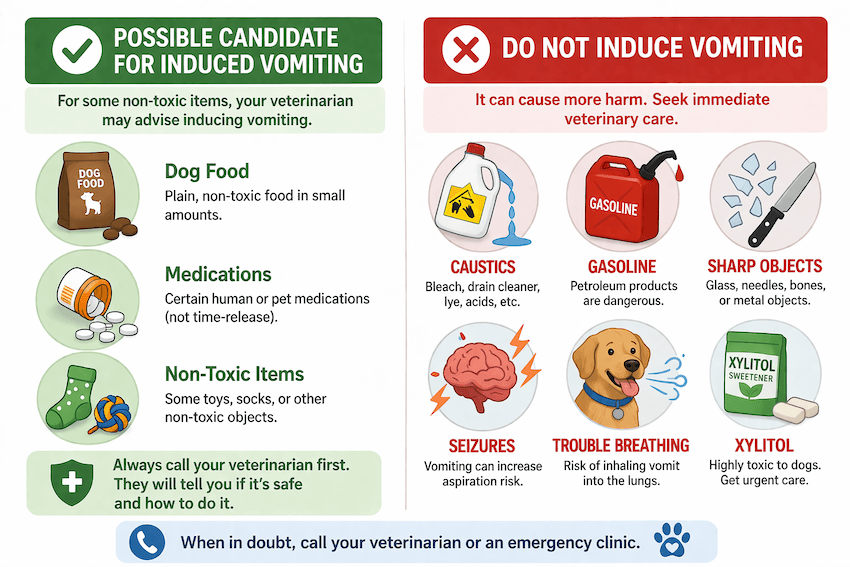
There are also clear red-flag situations where owners should not try to induce vomiting at home. Do not attempt it if your dog swallowed a caustic or corrosive product, a petroleum-based substance, or a sharp object, or if your dog has trouble breathing, seizures, collapse, swallowing problems, or is not neurologically stable. Suspected xylitol exposure is also a call-first emergency because dogs can develop dangerously low blood sugar very quickly.
The key is to avoid guessing. The safest next step is to contact your vet right away so they can tell you whether inducing vomiting is appropriate or whether your dog needs a different kind of emergency care.


How to Make Your Dog Throw Up Step by Step
Follow these steps to properly induce vomiting in your dog.
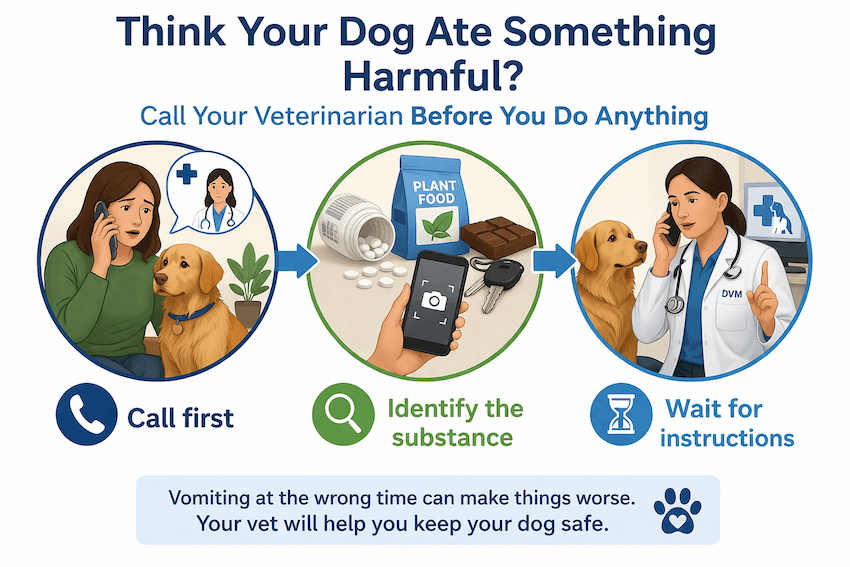
Step 1: Call Your Veterinarian or a Pet Poison Service Before You Do Anything.
That is the safest starting point because the expert can tell you whether vomiting is useful, dangerous, or unnecessary for your dog’s exact exposure. ASPCA Poison Control is available 24/7 in the U.S., and Pet Poison Helpline also emphasizes that inducing vomiting should only be done under veterinary supervision.
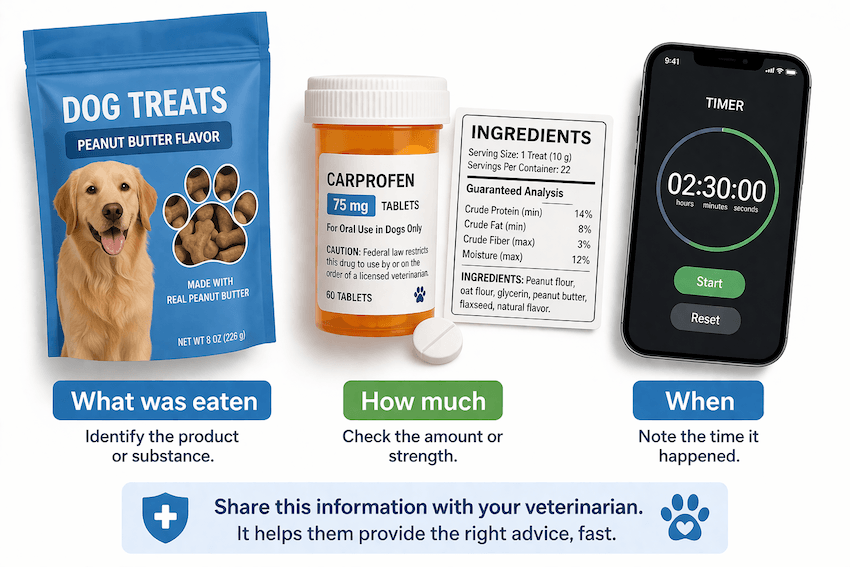
Step 2: Identify Exactly What Your Dog Ate, How Much, and When It Happened.
You need the product name, ingredient list if possible, estimated amount, and time since exposure, so the veterinarian can decide whether vomiting is still useful. This matters because emesis is generally most valuable within a few hours of ingestion, and hydrogen peroxide works best within about 2 hours when it is going to be used.


Step 3: Confirm That This Is a Case Where Vomiting Is Actually Safe to Induce.
Do not try to make your dog throw up if your dog is already neurologically abnormal, seizing, unable to swallow normally, struggling to breathe, in shock, or if the exposure involved a corrosive or caustic product, a petroleum product or hydrocarbon, or a sharp object. If the product may contain xylitol, do not give anything by mouth unless the veterinarian specifically tells you to, because some dogs may already be hypoglycemic, and vomiting can worsen the situation.
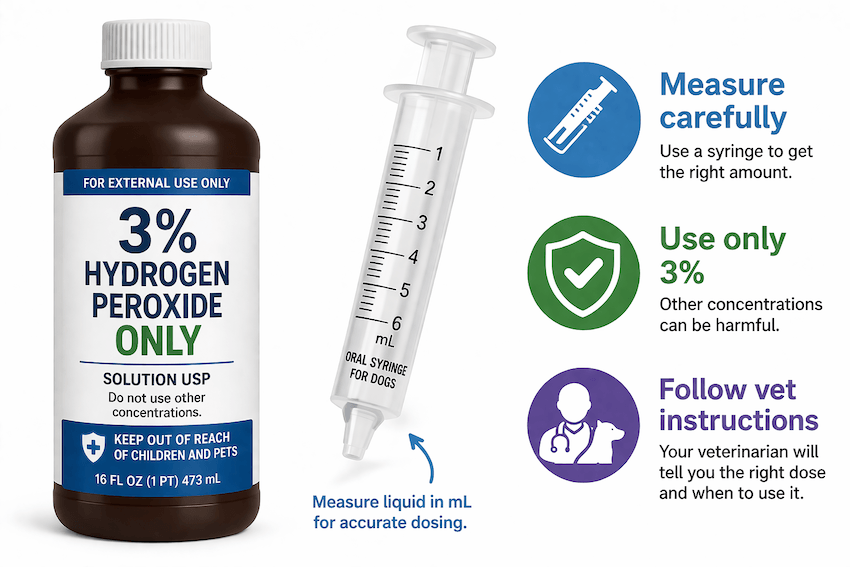
Step 4: If Your Veterinarian Tells You to Do It at Home, Use Only 3% Hydrogen Peroxide at the Exact Dose Given.
For dogs, a commonly cited emergency dose is 3% hydrogen peroxide, 1–2 mL/kg by mouth, up to a maximum of 45 mL, but you should still follow the exact instructions given for your own dog. Do not use any concentration stronger than 3%, and do not substitute salt, mustard, ipecac, dish soap, or other home remedies.
Step 5: Watch Closely for Vomiting and Follow the Next Instructions Exactly.
Hydrogen peroxide should take effect within about 15 minutes if it is going to work. If your dog vomits, prevent re-ingestion and call back with an update; if your dog does not vomit, do not keep repeating doses unless the veterinarian specifically directs you to do so.
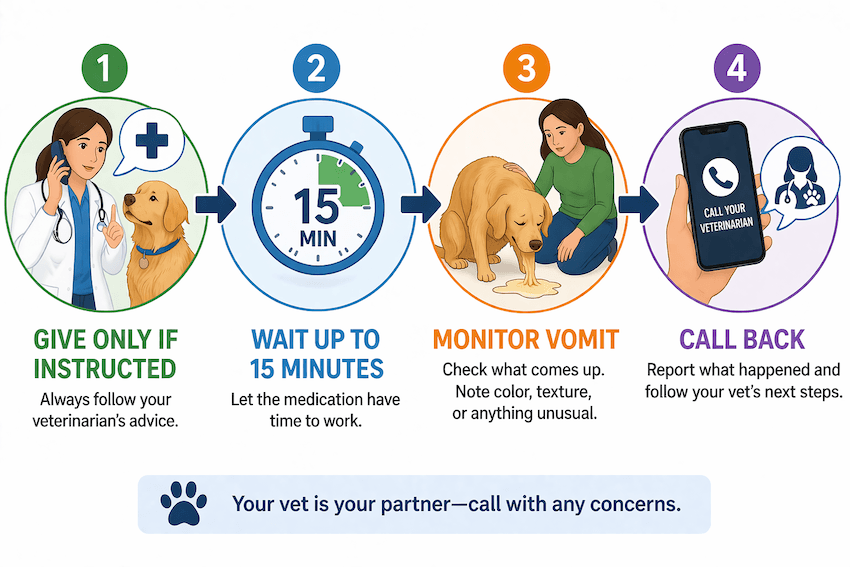
Step 6: Go to a Veterinary Clinic Immediately if Your Dog Worsens or Develops Warning Signs.
Seek urgent care if you see coughing, breathing changes, repeated retching without producing vomit, bloating, pain, weakness, blood in vomit or stool, dark tarry stool, coffee-ground-like vomit, or any worsening neurologic signs. These can signal aspiration, GI injury, bleeding, or other serious complications after hydrogen peroxide.

What to Do After Your Dog Throws Up
After vomiting, keep your dog quiet, prevent re-ingestion, and follow the next instructions from your veterinarian. A dog vomiting once does not automatically mean the emergency is over, because some toxins still need further treatment, monitoring, or veterinarian-administered activated charcoal, and activated charcoal should not be given at home unless a veterinarian directs and administers it.
Signs that the process has gone as intended are that your dog vomits within the expected window, remains alert, breathes normally, and does not develop new concerning signs. Keep monitoring and seek professional help right away if you notice coughing, breathing changes, repeated vomiting, weakness, blood in vomit or stool, abdominal swelling, nonproductive retching, seizures, or if the exposure involved xylitol, which can cause rapid hypoglycemia and is not a case for do-it-yourself follow-up.
Evidence on How to Make Your Dog Throw Up Safely
The Merck Veterinary Manual states that induced vomiting in dogs is generally most useful within a few hours of toxin exposure and is contraindicated when the swallowing reflex is absent, the dog is not neurologically stable, the ingested material is corrosive, or the substance is a volatile hydrocarbon or petroleum distillate. Merck also notes that in dogs, 3% hydrogen peroxide may be used when veterinary care or prescription emetics are not available, while prescription options such as apomorphine and ropinirole are typically more effective and reliable.
A prospective observational study published in the Journal of the American Veterinary Medical Association (JAVMA) evaluated 147 dogs after toxin exposure and found that both apomorphine and 3% hydrogen peroxide effectively induced emesis and helped recover substantial amounts of ingested material. The reported adverse effects were generally mild and self-limiting when these methods were used appropriately. This supports induced vomiting as a legitimate veterinary toxicology tool, but not as a casual home remedy for dogs.[1]
A 2024 JAVMA report on apomorphine-induced emesis in dogs also found that associated complications were generally mild and self-limiting. Clinically, this supports what current dog poisoning guidelines already suggest: when emesis is appropriate, clinic-supervised vomiting induction is usually more controlled, effective, and predictable than improvised treatment at home.[2]
VCA’s hydrogen peroxide monograph also explains why case selection matters so much. Even when 3% hydrogen peroxide is used correctly, it can irritate the esophagus and stomach and may lead to aspiration, gastrointestinal bleeding, or severe abdominal complications in the wrong patient. That is why the safest article advice is not simply “make your dog throw up fast,” but rather “get case-specific veterinary guidance first.”
Extra Tips for Making Your Dog Throw Up Safely
These practical tips reflect the same source-backed rules above: call first, use only 3% hydrogen peroxide if directed, avoid outdated home remedies, and monitor closely afterward.
| Tip | Why It Helps | How to Apply It |
|---|---|---|
| Call first | It prevents vomiting in cases where it is unsafe. | Phone your vet or poison service before giving anything. |
| Use 3% only | Higher concentrations can cause much worse tissue injury. | Check the label before measuring any dose. |
| Measure exactly | Overdosing raises the risk of irritation and complications. | Use your dog’s weight and the vet’s exact instructions. |
| Know the no-vomit list | Some substances are more dangerous coming back up. | Ask specifically about caustics, fuels, sharps, and xylitol. |
| Watch for complications | Early warning signs need fast veterinary follow-up. | Monitor breathing, coughing, bloating, and repeated retching. |
| Plan next care | Vomiting alone may not finish the decontamination process. | Follow the next treatment steps your veterinarian gives. |
Common Mistakes When Trying to Make Your Dog Throw Up
The mistakes below are the ones current veterinary sources repeatedly warn against: choosing the wrong cases, using the wrong substance, redosing without guidance, and ignoring post-vomiting warning signs.
| Mistake | Why It’s a Problem |
|---|---|
| Skipping the call | You may induce vomiting when the safer choice is immediate treatment. |
| Using stronger peroxide | Higher strengths are more damaging than standard 3% solution. |
| Trying salt or mustard | These old remedies are unsafe and specifically not recommended. |
| Inducing after caustics | Corrosive material can burn the throat a second time. |
| Ignoring xylitol exposure | Some dogs may already have low blood sugar. |
| Missing warning signs | Coughing, bloating, or blood can signal serious complications. |
Frequently Asked Questions
The Bottom Line
Trying to make a dog throw up should never be your first reflex without veterinary guidance. The safest approach is to call your veterinarian or a pet poison expert first, because vomiting can help in some cases but can be dangerous in others. What your dog swallowed, how much, and how long ago it happened all change the right answer. Even when vomiting is appropriate, the only commonly accepted at-home option for dogs is 3% hydrogen peroxide, and it should be used only exactly as directed. Caustic products, fuels, sharp objects, breathing problems, seizures, and some toxin exposures are all situations where inducing vomiting can make things worse. That is why speed matters, but accurate guidance matters even more. In the end, the goal is not simply to make your dog vomit. It is to protect your dog as safely and quickly as possible, while avoiding the mistakes that can turn a poisoning scare into a more serious emergency.