
Dog Life Expectancy Calculator: Lifespan Chart by Breed, Size & Weight

Canine Bible is reader-supported. We receive affiliate commissions via some of our links. Learn more.
Whether you’ve just welcomed a puppy, adopted an adult dog, or want to better understand your senior dog’s life stage, estimating your dog’s life expectancy can help you plan for their long-term health and care. While no calculator can predict exactly how long a dog will live, factors like breed, size, weight, age, sex, lifestyle, genetics, and overall health can give you a helpful estimate. That’s why we created this Dog Life Expectancy Calculator—to help you estimate your dog’s potential lifespan based on key details about your dog. In this guide, you’ll also find average life expectancy charts by breed and size, factors that influence longevity, tips to help your dog live longer, age-related health considerations, and answers to frequently asked questions so you can make informed decisions at every stage of your dog’s life.
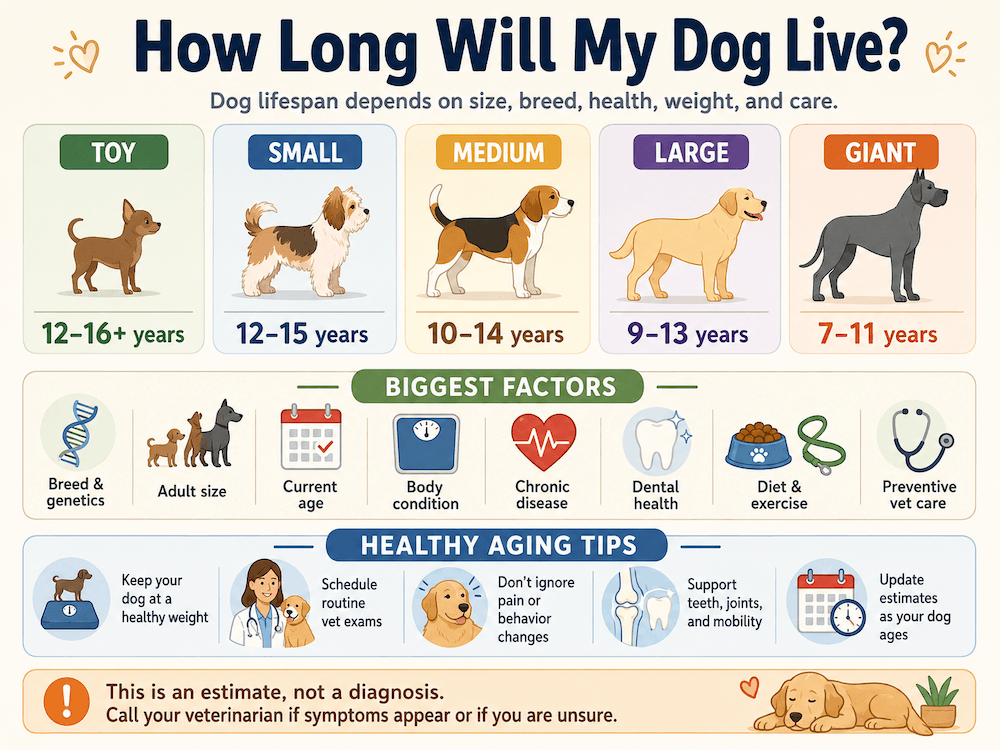
How Long Will My Dog Live?
Most companion dogs live roughly 10 to 15 years, but your dog’s expected lifespan can vary widely based on size, breed, genetics, body condition, lifestyle, preventive care, and existing health conditions. A life expectancy estimate gives you a helpful range, but it cannot account for every individual factor that may affect your dog’s future health.
The biggest pattern is that smaller dogs generally live longer than large and giant breeds. For example, many small-breed dogs may reach their mid-teens, while giant breeds often enter their senior years much earlier. However, breed-specific health risks can change the estimate, so two dogs of the same size may still have very different life expectancies.
Your dog’s current age also matters because life expectancy is not the same as lifespan at birth. A healthy 6-year-old small mixed-breed dog may still have many expected years left, while a 9-year-old giant-breed dog may already be in the senior life stage. Use this estimate as a planning tool, not as a prediction of your dog’s exact lifespan.


Dog Life Expectancy Chart for Dogs
The charts below provide broad owner-friendly ranges. They should be used as general guidance, not as a substitute for your veterinarian’s assessment. Lifespan patterns are influenced by size, breed, sex, body condition, health history, and care quality.
Dog Life Expectancy by Weight Chart
| Dog Weight | Size Category | Estimated Average Lifespan | Notes |
|---|---|---|---|
| Under 10 lb | Toy | 12–16+ years | Often longer-lived, but dental, heart, and orthopedic issues may affect quality of life. |
| 10–25 lb | Small | 12–15+ years | Many small breeds remain active into older age. |
| 26–50 lb | Medium | 10–14 years | Lifespan varies significantly by breed and body condition. |
| 51–90 lb | Large | 9–13 years | Joint health, weight control, and preventive care are especially important. |
| 91+ lb | Giant | 7–11 years | Typically shorter average lifespan and earlier senior transition. |
Dog Life Expectancy by Breed Size Chart
| Breed Size | Typical Examples | Average Lifespan Range | Senior Stage Often Begins Around |
|---|---|---|---|
| Toy | Chihuahua, Toy Poodle, Maltese | 12–16+ years | 10–12 years |
| Small | Dachshund, Shih Tzu, Mini Schnauzer | 12–15 years | 9–11 years |
| Medium | Beagle, Cocker Spaniel, Border Collie | 10–14 years | 8–10 years |
| Large | Labrador Retriever, Boxer, German Shepherd | 9–13 years | 7–9 years |
| Giant | Great Dane, Mastiff, Saint Bernard | 7–11 years | 5–7 years |
Dog Life Expectancy by Life Stage Chart
| Life Stage | General Age Range | What It Means for Longevity Planning |
|---|---|---|
| Puppy | Birth to maturity | Focus on vaccines, nutrition, growth, parasite control, and safe socialization. |
| Young adult | After maturity to middle age | Build long-term habits around weight, exercise, dental care, and annual exams. |
| Mature adult | Middle age | Start monitoring early signs of arthritis, dental disease, lumps, and metabolic issues. |
| Senior | Varies by size | Increase wellness checks, mobility support, lab screening, and pain monitoring. |
| Geriatric | Final life stage | Prioritize comfort, quality of life, pain control, and veterinary guidance. |
Dog Life Expectancy Guidelines
Dog life expectancy is based on population averages, not a precise prediction for any one dog. A calculator can estimate a reasonable lifespan range by comparing your dog’s details with typical patterns for dogs of similar breed, size, age, and health status. However, individual dogs can live shorter or longer lives depending on genetics, environment, disease risk, nutrition, preventive care, accidents, and overall quality of life.
Our Dog Life Expectancy Calculator starts with a baseline lifespan by breed or size group, then adjusts the estimate based on the dog’s current age. From there, the estimate can be refined using factors such as body condition, sex or spay/neuter status if included, known chronic disease, activity level, and consistency of veterinary care. Because these factors are estimates rather than guarantees, the result should be shown as a range instead of one exact number.
For example, a healthy 3-year-old, 22-lb small mixed-breed dog may receive an estimated lifespan range of 12–15 years, with roughly 9–12 expected years remaining. Breed-specific health conditions can help refine the estimate, but they should be handled carefully and not overstated. A breed may have higher risk for certain conditions, but that does not mean an individual dog will develop them or have a shortened lifespan.


Factors That Can Affect Your Dog’s Results
Life expectancy estimates become more useful when they account for size, current age, body condition, and known health concerns. Body condition is especially important because WSAVA recommends assessing body condition as a measure of fat stores, and overweight body condition has been associated with shorter lifespan in dogs.
| Factor | How It Affects Life Expectancy | Owner Note |
|---|---|---|
| Breed and Genetics | Inherited risks can shorten average lifespan. | Mixed-breed status may help, but does not guarantee longer life. |
| Size and Weight | Size is a major lifespan predictor. | Giant breeds usually age faster than small dogs. |
| Current Age | Age changes the estimate of years remaining. | Show total lifespan and remaining years separately. |
| Body Condition | Extra weight can strain joints, metabolism, and breathing. | Sudden weight loss or underweight dogs need vet guidance. |
| Health Conditions | Chronic disease may reduce longevity and comfort. | Heart, kidney, cancer, diabetes, arthritis, respiratory, and dental issues may affect results. |
| Lifestyle and Preventive Care | Daily care habits influence long-term health. | Diet, exercise, dental care, vaccines, parasite prevention, and vet exams matter. |
Common Mistakes to Avoid When Using the Calculator
| Mistake | Why It Matters | Better Approach |
|---|---|---|
| Treating the result as exact | Lifespan estimates are ranges, not promises. | Use the result for planning, not prediction. |
| Ignoring body condition | Two dogs at the same weight can have different health risks. | Consider whether your dog is ideal, overweight, or underweight. |
| Overlooking breed risks | Inherited conditions can affect average lifespan. | Use breed risk as context, not certainty. |
| Using puppy estimates forever | Adult size and health status can change the estimate. | Update the result as your dog matures. |
| Comparing dogs by age only | A 9-year-old toy dog and giant dog may be in different life stages. | Factor in size, breed, and overall health. |
| Assuming senior means unhealthy | Senior dogs may still have good quality of life. | Use senior status to plan proactive care. |
| Delaying vet care for symptoms | Sudden or severe changes may signal illness. | Call your vet for weight loss, appetite loss, breathing issues, collapse, seizures, pain, lumps, lethargy, or behavior changes. |
What to Do If Your Dog’s Life Expectancy Result Seems Low
First, recheck the inputs. Make sure your dog’s age, current weight, size category, body condition, and health status were entered correctly. Then confirm whether the calculator is showing estimated total lifespan or estimated remaining years.
Next, review whether the result may be affected by factors such as excess weight, known disease, underweight body condition, or large or giant breed size. A lower estimate does not mean your dog cannot live longer. It simply means the calculator is placing your dog in a group with a lower average lifespan or fewer estimated years remaining.
Focus on what you can control: maintain ideal weight, feed an appropriate diet, provide safe exercise, keep up with dental care, follow vaccination and parasite prevention plans, and schedule regular veterinary exams. For senior dogs, earlier screening can help identify problems before they become advanced.
How to Calculate Dog Life Expectancy Manually
You can estimate dog life expectancy manually with a simple formula:
Estimated remaining years = estimated average lifespan for your dog’s size or breed − current age
For example, if a dog’s estimated lifespan range is 10–13 years and the dog is currently 7 years old, the rough remaining range is:
10–13 − 7 = about 3–6 estimated years remaining
This is only a rough estimate. It should be adjusted up or down based on body condition, health status, lifestyle, and care quality. Manual calculations should always be shown as a range, not one exact number.
Example Calculation
Example dog:
A 7-year-old Labrador Retriever is a large-breed dog with healthy body condition and no major chronic disease.
Estimated average lifespan range: 10–13 years
Manual estimate: 10–13 minus 7 = about 3–6 estimated remaining years
Responsible interpretation: This dog may have several good years ahead, especially with ideal weight, preventive care, mobility support, dental care, and routine veterinary exams.
Frequently Asked Questions
The Bottom Line
The Dog Life Expectancy Calculator helps owners estimate a dog’s average lifespan and remaining years using practical factors like age, size, breed, weight, body condition, and health status. The most important takeaway is simple: lifespan estimates are ranges, not promises. A calculator can help you plan, but it cannot predict exactly how long your dog will live.
To better understand your dog’s aging timeline, try our Dog Age Calculator or, for large and giant breeds, our Big Dog Age Calculator. Because weight and nutrition can affect long-term health, you may also want to check how heavy your dog should be, estimate daily calorie needs with our Dog Calorie Calculator, compare feeding budgets with our Dog Food Cost Calculator, or explore feeding portions with our Raw Dog Food Calculator. For a broader look at lifespan patterns, read our guide on how long dogs live by breed, size, and health factors.
Use the result to improve preventive care, maintain a healthy weight, plan senior wellness checks, monitor quality of life, and start informed conversations with your veterinarian.