What Colors Can Dogs See? The Full Guide to Dog Color Vision

Canine Bible is reader-supported. We receive affiliate commissions via some of our links. Learn more.
Dogs can see shades of blue and yellow, but they do not see the full range of colors humans do. Colors like red, orange, and green likely appear more muted, brownish, grayish, or yellowish to them. This means your dog’s world is not black and white—it is just built around a different color spectrum. That difference can affect how dogs notice toys, training markers, balls, furniture, and objects outdoors. A bright red toy on green grass may stand out to you, but blend in more easily for your dog. Understanding canine color vision can help you choose better toys, improve training cues, and avoid common myths about what dogs actually see.
The Science of Dog Color Vision
| Eye Feature | What It Means | Why It Matters |
|---|---|---|
| Cone cells | Dogs have two main color-detecting cone types. | This limits their ability to see red and green. |
| Rod cells | Dogs have many light-sensitive rod cells. | This helps them see better in dim light. |
| Tapetum lucidum | A reflective eye layer improves low-light vision. | It helps dogs detect movement in darker settings. |
| Motion sensitivity | Dogs are highly responsive to moving objects. | Movement often matters more than color detail. |
| Visual sharpness | Dogs generally see less fine detail than humans. | Objects may need contrast, movement, or scent cues. |
| Color perception | Dogs mainly see blue, yellow, and muted tones. | Toy and training colors can affect visibility. |
Are Dogs Color Blind?
Dogs are partly color blind compared with humans, but they are not color blind in the sense that they only see black and white. Their eyes have two main types of color-detecting cones, which means they see a more limited range of colors—mostly blues, yellows, grays, and muted brownish tones.
The easiest comparison is human red-green color blindness. Dogs have trouble distinguishing colors like red, green, orange, and pink, so those shades may appear dull, dark, grayish, or yellow-brown. Still, dogs can use color, brightness, contrast, movement, and scent together to recognize objects and navigate their environment.
What Colors Can Dogs See?
Dogs can see colors, but their color range is more limited than ours. They see the world mainly in shades of blue, yellow, gray, and muted brownish tones, because dogs have dichromatic vision, meaning they rely on two main cone types instead of the three cone types most humans have. Research on canine color vision supports that dogs can distinguish colors, but their perception is closer to human red-green color blindness than full human color vision.


This means a blue or yellow toy may stand out clearly to a dog, while red, orange, pink, and green may look duller, darker, grayish, or yellow-brown. Dogs do not see in black and white, but their visual world is less colorful and more contrast-dependent than ours.
Dog Color Vision Chart
This dog color vision chart provides a simple, practical way to understand how dogs may perceive common colors compared with humans. Dogs generally see blue and yellow more clearly, while red, green, orange, pink, and some purple shades may look more muted, grayish, yellowish, or brownish. Because a dog’s ability to notice an object also depends on contrast, brightness, movement, lighting, and background, this chart should be treated as a simplified guide rather than an exact color translation.
| Human Color | Likely Dog View | How Dogs Likely See It | Best Use for Dog Owners |
|---|---|---|---|
| Blue | Blue / visible | Clear and easier for dogs to distinguish. | Great for toys, balls, and training objects. |
| Yellow | Yellow / visible | Clear and highly visible to many dogs. | Great for outdoor toys and visual cues. |
| Green | Yellowish-gray | Often appears muted, yellowish, or grayish. | May blend into grass during outdoor play. |
| Red | Dark gray-brown | Often appears dull, dark, grayish, or brownish. | Not ideal for balls used on grass. |
| Orange | Dull yellow-brown | May lose its bright orange appearance. | Less visible than blue or yellow toys. |
| Pink | Muted beige-gray | Usually appears pale, muted, or less distinct. | Visibility depends heavily on background contrast. |
| Purple | Bluish-gray | May appear closer to blue than purple. | Can work if the shade is blue-based. |
| White | Bright neutral | Appears as a bright light neutral tone. | Useful against dark floors or backgrounds. |
| Brown | Muted brown-gray | Can blend with dirt, wood, or flooring. | Best avoided on similar-colored surfaces. |
| Gray | Gray / neutral | Seen as light or dark neutral tones. | Contrast matters more than color itself. |
How Dog Color Vision Compares to Human Vision
Dogs have fewer cone types than most humans, but that does not mean their vision is poor. Their eyes are more specialized for motion detection, dim-light visibility, and practical environmental awareness. Merck notes that rods help with low-light vision, while cones process color, and dogs’ eyes are more rod-dominant than human eyes.


| Vision Feature | Dogs | Most Humans |
|---|---|---|
| Color Range | Mostly blue, yellow, gray, and muted tones. | Broad red, green, blue, and blended colors. |
| Cone Types | Two cone types support dichromatic color vision. | Three cone types support trichromatic color vision. |
| Red-Green Detail | Red and green are difficult to separate. | Red and green are usually easy to separate. |
| Low-Light Vision | Better adapted for dim-light environments. | Less specialized for low-light visibility. |
| Motion Detection | Highly important for spotting movement. | Color detail often plays a larger role. |
Color Is Only Part of How Dogs See the World
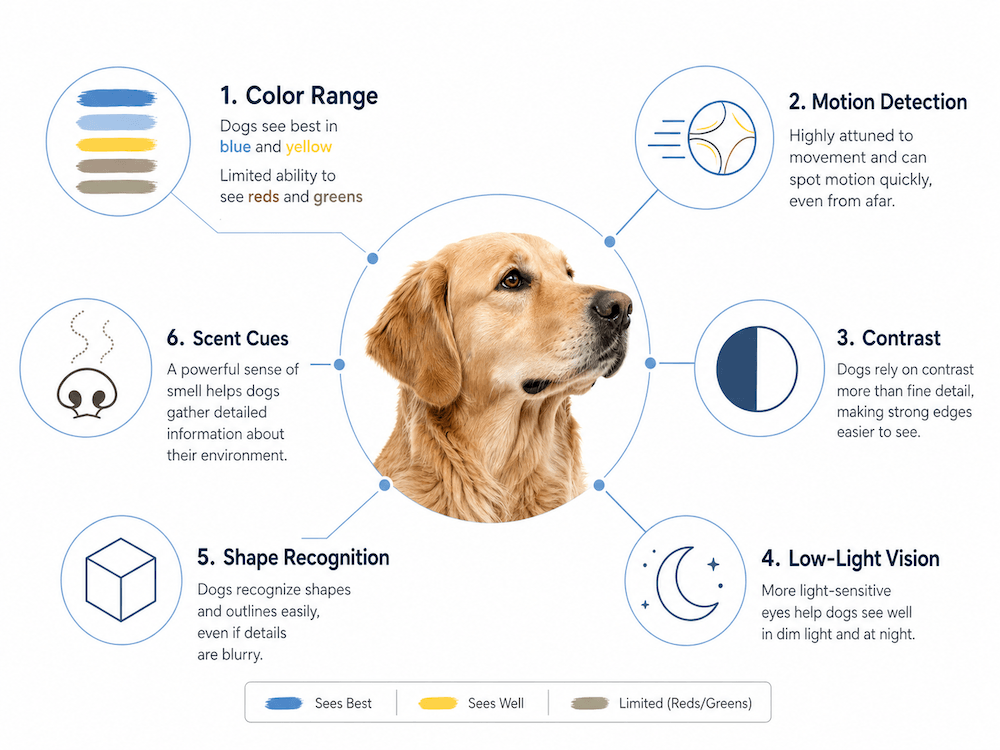
Dogs use color, but they do not rely on color the same way humans do. Their vision is built around a mix of limited color perception, motion detection, contrast, low-light sensitivity, shape recognition, and scent, which often matters more than what shade an object is.
This is why a dog may miss a red toy sitting still in the grass but instantly notice the same toy when it moves. To understand how dogs see the world, think beyond color alone—brightness, movement, smell, texture, and background contrast all help dogs recognize objects and navigate their environment.
Why Dog Color Vision Matters in Real Life
Color vision affects how easily dogs notice toys, balls, training tools, obstacles, and objects in different environments. A red ball on green grass may look obvious to you, but to your dog, both colors may appear more muted and similar. A blue or yellow ball is often easier for a dog to locate because those colors fall closer to the range dogs can distinguish.
This is especially useful for fetch, agility, training markers, enrichment toys, and outdoor play. Color is not the only factor dogs use—smell, movement, brightness, texture, and contrast also matter—but choosing dog-visible colors can make objects easier to recognize.
| Situation | Best Color Choice | Why It Helps |
|---|---|---|
| Fetch Toys | Choose blue or yellow toys for outdoor fetch. | They are easier to spot against grass, soil, and shadows. |
| Training Markers | Use yellow cones, markers, or visual cues. | Yellow is one of the easier colors for dogs to distinguish. |
| Red Ball on Green Grass | Choose a blue or yellow ball instead. | Red may look muted against a similarly muted grassy background. |
| Green Toy in the Yard | Use blue, yellow, or high-contrast toys outside. | Green can blend into grass and appear yellowish-gray. |
| Orange Toy on Dirt | Pick blue for better contrast on brown surfaces. | Orange may appear dull yellow-brown and blend into the ground. |
| White Toy on Dark Floor | White can work well on darker flooring. | Strong brightness contrast makes the toy easier to notice. |
| Blue Toy on Grass | Blue is a strong outdoor play choice. | Blue usually separates better from green outdoor backgrounds. |
| Indoor Toys | Use contrast against flooring and furniture. | Brightness contrast can matter more than color indoors. |
| Red or Pink Toy Indoors | Add contrast, movement, or scent cues. | Red and pink may appear muted or grayish indoors. |
| Senior Dogs | Choose high-contrast toys, bowls, and markers. | Aging eyes may need clearer visual separation. |
Choosing Toys Your Dog Can Actually See
Dogs see toys best when the color, contrast, and background work together. Blue and yellow toys are usually easier for dogs to notice than red, green, orange, or pink toys. For outdoor play, visibility matters because grass, dirt, and shadows can make muted colors harder to find. That’s why choosing the right dog toys matters—not just for fun, but also for making playtime easier, safer, and more engaging for your dog.
Colors That Work Well for Dog Training
For dog training, the best colors are usually the ones your dog can distinguish quickly against the environment. Blue and yellow tend to be the most useful because they fall within a dog’s visible color range, while red, green, and orange may look muted or blend into grass, flooring, or outdoor backgrounds. Color should support the cue, but contrast, movement, placement, and consistency are just as important.
| Training Color | Visual Example | Best Use | Why It Works |
|---|---|---|---|
| Blue | Clear blue | Fetch toys, markers, targets, and agility tools. | Blue is one of the easiest colors dogs distinguish. |
| Yellow | Clear yellow | Training discs, cones, balls, and visual cues. | Yellow usually stands out well to canine vision. |
| White | Bright neutral | Indoor cues, dark flooring, and shaded areas. | White can create strong contrast against dark backgrounds. |
| Blue-Purple | Bluish tone | Training toys when true blue is unavailable. | Blue-based shades may remain more noticeable to dogs. |
| Orange | Dull yellow-brown | Use only when contrast is strong. | Orange may lose brightness in a dog’s vision. |
| Red | Muted gray-brown | Not ideal for grass, dirt, or outdoor fetch. | Red may appear dark, dull, or brownish to dogs. |
| Green | Yellowish gray | Avoid for grass-based training tools. | Green can blend into outdoor backgrounds easily. |
What Research Says About the Colors Dogs See
A classic canine color vision study found that dogs have two cone photopigments, with results consistent with dichromatic color vision. This matters because it explains why dogs can perceive color but cannot separate red and green the way most humans can.[1]
A later study found that color cues could be more informative to dogs than brightness cues under controlled testing conditions. This supports the idea that dogs do not simply rely on light and dark differences; they can use color information when it is available.[2]
Veterinary and animal health sources also describe dogs as having fewer cones than humans and better adaptation for dim-light vision, which helps explain why canine vision is not just “worse” than human vision—it is adapted for different priorities.
Keeping Your Dog’s Vision Healthy
Your dog’s eyesight depends on genetics, age, nutrition, injury prevention, and regular veterinary care. While you cannot prevent every eye problem, you can reduce risk by catching changes early and protecting your dog’s eyes from avoidable irritation or trauma. Watch for signs like cloudiness, redness, squinting, discharge, bumping into objects, or sudden hesitation in low light.
Before using eye drops, supplements, or home remedies for your dog’s eyes, check with your veterinarian first. If you can’t reach your vet, you can chat live with a registered online veterinary professional via our online vet chat or video chat support (24 hours a day, 7 days a week). Or use Chewy’s online vet services (6 a.m. – midnight ET).
Frequently Asked Questions
The Bottom Line
Dogs can see color, but their world is built mostly around shades of blue, yellow, gray, and muted brownish tones. They do not see red, orange, green, or pink the same way humans do, which is why some toys or objects may blend into the background more than owners expect. Choosing blue or yellow toys, using strong contrast, and understanding how dogs perceive color can make play, training, and everyday interactions easier. While dogs do not see the full rainbow we do, their vision is well-adapted for movement, low light, and noticing the world in ways humans often overlook.