What Stores Allow Dogs? 30 Dog-Friendly Stores (2026 Guide)

Canine Bible is reader-supported. We receive affiliate commissions via some of our links. Learn more.
Many stores allow dogs, especially pet-supply retailers, home-improvement stores, outdoor shops, and certain local businesses, but policies can vary widely by location. Some chains are known for being dog-friendly, while others leave the decision to individual store managers or restrict entry to service animals only. Even when dogs are permitted, owners may need to follow rules involving leashes, carts, behavior, or designated areas. Health regulations can also limit where pets are allowed, particularly in stores that sell or prepare food. Policies may differ between states, cities, shopping centers, and individual franchises, making it important to check before visiting. This guide explains which major stores commonly welcome dogs, where restrictions are more likely, and how to confirm a location’s pet policy before you arrive.
Are Dogs Allowed in Stores?
Dogs are allowed in some stores, but not all. Pet stores, farm-and-feed retailers, outdoor stores, and certain home-improvement or clothing chains are often more welcoming to leashed, well-behaved dogs, while grocery stores and other food-focused businesses usually restrict ordinary pets because of health and sanitation rules. Policies can also vary by state, city, mall, landlord, or individual store location, so a chain that allows dogs in one branch may not allow them in another. Service dogs are treated differently from pet dogs and generally have broader public-access rights under U.S. law. When a store’s policy is unclear, the safest approach is to call the exact location before visiting.
30 Stores That Allow Dogs in the U.S.
The stores below fall into two practical groups: retailers with an explicit or strongly established pet-friendly policy, and retailers where dogs are welcomed at many locations but owners should call first. Not every chain operates in every state, so this is more reliable than assuming every location within a state follows the same rule.


Pet Supply Stores
| Store | Location Coverage | Rules & Restrictions |
|---|---|---|
| Hollywood Feed | Dogs welcomed by company | The company encourages customers to bring leashed dogs into its stores. |
| Petco | Generally pet-friendly | Keep dogs appropriately restrained and current on required vaccinations. |
| Pet Food Express | Pet-friendly; confirm local rules | Bring a well-behaved dog and check the store’s handling requirements. |
| PetSmart | Company-wide policy | Dogs must be leashed or safely confined and appropriately vaccinated. |
Home Improvement & Farm Supply Stores
| Store | Location Coverage | Rules & Restrictions |
|---|---|---|
| Family Farm & Home | Dogs welcomed by company | An official company post welcomes leashed pets. |
| Home Depot | Call first | Pet access reports differ. Obtain confirmation from your specific store before bringing a dog. |
| Lowe’s | Published pet-friendly policy | Keep your dog well-behaved and under control, and clean up any accidents. |
| Murdoch’s | Dogs welcomed by company | Well-behaved animals are welcome; keep your dog leashed during the visit. |
| Rural King | Subject to legal restrictions | Pets must be well-behaved and controlled on a leash; disruptive animals may be asked to leave. |
| Tractor Supply | All U.S. locations | Friendly, leashed pets are welcome under a consistent nationwide policy. |
Outdoor & Sporting Goods Stores
| Store | Location Coverage | Rules & Restrictions |
|---|---|---|
| Academy Sports + Outdoors | Call first | Reports conflict. Do not assume pet dogs are permitted without direct store confirmation. |
| Bass Pro Shops | Except where prohibited by law | Pets are welcome unless state or local restrictions apply; call if unsure. |
| Cabela’s | Except where prohibited by law | The shared Bass Pro Shops policy welcomes pets subject to local restrictions. |
| Orvis | Most locations | Check your local store page for a “dogs welcome” message before visiting. |
Clothing & Department Stores
| Store | Location Coverage | Rules & Restrictions |
|---|---|---|
| Ann Taylor | Call first | Confirm pet access with the store and, where applicable, the shopping center. |
| Banana Republic | Call first | A chain-wide pet admission policy was not verified; ask your local branch. |
| Gap | Call first | Check the individual store’s pet rules before arriving. |
| LOFT | Call first | Confirm whether both the store and its shopping center permit pet dogs. |
| Macy’s | Call first | Ask about pet admission and any restrictions within the store. |
| Old Navy | Call first | Confirm local pet access and any mall restrictions. |
| Ross Dress for Less | Call first | Verify that your branch currently permits pet dogs. |
| TJ Maxx | Call first | Ask your specific store before bringing a pet. |
Home Décor & Craft Stores
| Store | Location Coverage | Rules & Restrictions |
|---|---|---|
| At Home | Company-wide policy | Dogs must be harnessed, leashed, or carried by an adult. No dogs in carts or baskets; required licenses and vaccinations must be current. |
| Hobby Lobby | Call first | Confirm the local manager’s pet rules before visiting. |
| HomeGoods | Call first | Verify pet access with your branch; chain-wide coverage was not confirmed. |
| Michaels | Call first | Check current store and property rules for pet dogs. |
Bookstores & Beauty Retailers
| Store | Location Coverage | Rules & Restrictions |
|---|---|---|
| Barnes & Noble | Varies; call first | Contact the local store about non-service animals; local health codes affect access. |
| Half Price Books | Call first | Ask whether your branch welcomes pet dogs and what handling rules apply. |
| LUSH | Call first | Check the individual shop’s rules, including any shopping-center restrictions. |
| Sephora | Call first | Confirm permission with your location; store and mall rules may differ. |
Before you visit: This list includes confirmed pet-friendly retailers and stores requiring local confirmation. “Call first” is not a guarantee of admission. Policies can change, and a dog-friendly branch does not establish permission at every location.
Why Dog Policies Can Vary by Store and Location
A national chain’s policy is only one part of the answer. Local laws and the exact property can still affect whether a pet dog is permitted, which is why it would be misleading to label every location in all 50 states identically.
| What Controls Access? | How It Affects Dog Owners | What to Do |
|---|---|---|
| Corporate policy | The chain may openly welcome pet dogs. | Follow its leash and behavior rules. |
| State or local law | Local regulations can override normal pet access. | Check when the chain lists legal exceptions. |
| Food regulations | Food establishments generally face stricter animal restrictions. | Assume pets are restricted unless clearly permitted. |
| Mall or landlord | The building may prohibit pets despite store policy. | Check the shopping center before visiting. |
| Local management | Some chains leave pet access to each store. | Call that exact location first. |
What Stores Usually Do Not Allow Pet Dogs?
Food-focused retailers and some major big-box chains are much more restrictive. Grocery stores are especially likely to prohibit ordinary pets because food establishments are regulated differently from general retail spaces.


| Store | Ordinary Pet Dogs | Main Rule |
|---|---|---|
| Walmart | Not permitted | Qualifying service animals are welcomed. |
| Costco | Not permitted | Animals allowed only where legally required. |
| IKEA | Not permitted | ADA-qualified service animals are welcomed. |
| Publix | Not permitted | Non-service animals must remain outside. |
| Most grocery stores | Usually restricted | Food-safety rules commonly limit live animals. |
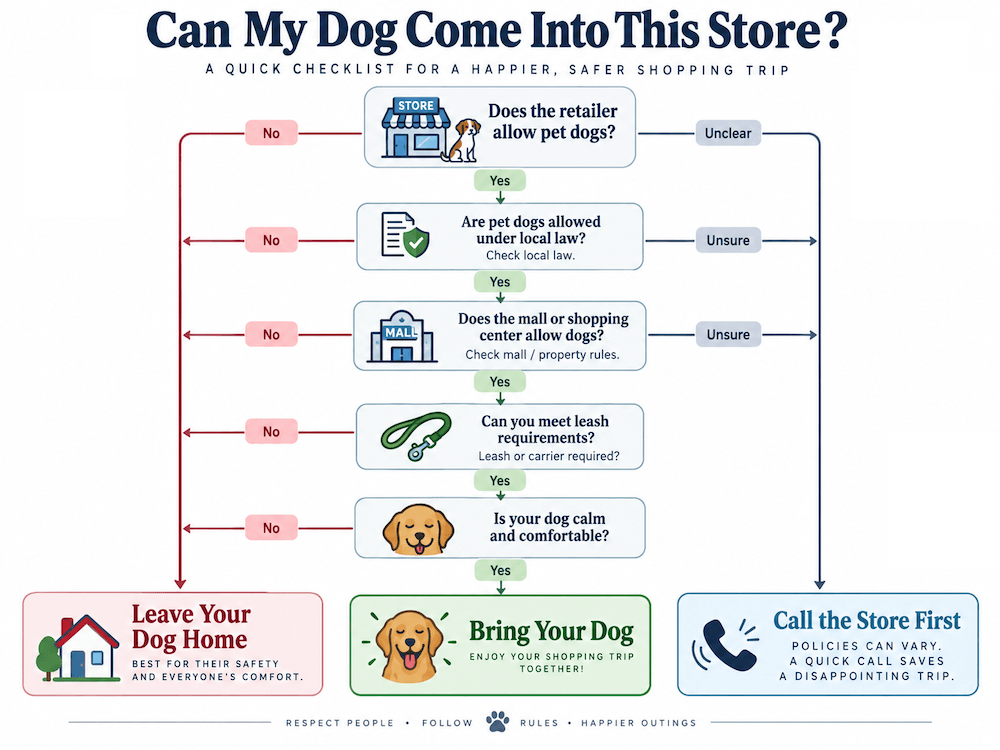
How to Check Whether a Store Allows Dogs Before You Go
When a chain does not have an explicit nationwide policy, checking the exact location is more reliable than relying on social media photos or another shopper’s experience.
What to Do If a Store Doesn’t Allow Your Dog
If a store does not allow pet dogs, respect the policy and use one of these alternatives instead.
| Option | What to Do |
|---|---|
| Leave your dog home | Choose this for planned trips, especially if your dog is anxious, reactive, or uncomfortable in busy stores. |
| Shop curbside | Use curbside pickup when available so your dog can stay with you without entering the store. |
| Use delivery | Order online and have purchases delivered when bringing your dog would create unnecessary stress or inconvenience. |
| Take turns shopping | If you are with someone else, one person can shop while the other stays outside with the dog. |
| Choose another store | Look for a nearby retailer with a clear pet policy that allows well-behaved dogs inside. |
| Do not leave dogs in cars | Parked vehicles can heat up quickly, even on mild days, so never use the car as a waiting area. |
Pet Dogs, Emotional Support Dogs & Service Dogs in Stores
A store voluntarily allowing pets is different from a business’s obligations regarding service animals. Under U.S. federal rules, service dogs generally have access to public-facing businesses even when the business normally prohibits pets.
| Dog | Store Access | What Matters |
|---|---|---|
| Pet dog | Depends on store policy | No general right to enter pet-restricted stores. |
| Emotional support dog | Usually follows pet rules | Comfort alone does not meet ADA service-dog criteria. |
| Service dog | Generally allowed | Trained to perform disability-related work or tasks. |
When Can a Store Ask a Service Dog to Leave?
Under the ADA, a store may ask a service dog to leave if the dog is not housebroken or is out of control and the handler does not take effective action to regain control. Repeated uncontrolled barking, aggressive behavior, or wandering away from the handler could qualify, while a single bark does not automatically mean a service dog is out of control. If a service dog is properly removed, the store should still give the person an opportunity to obtain its goods or services without the dog present.
Should You Take Your Dog Shopping Just Because You Can?
A dog-friendly policy does not mean every dog benefits from visiting a store. Shopping environments can involve carts, children, unfamiliar dogs, slippery floors, loud equipment, tight aisles, smells, and strangers attempting to interact.
What to Bring When Shopping With Your Dog
Packing a few essentials can help keep your dog comfortable and your shopping trip running smoothly. Use this checklist before heading out so you’re prepared for routine needs and unexpected messes.
- Leash and secure harness or collar: Use a short, sturdy leash that keeps your dog close without blocking aisles.
- Waste bags: Carry extras in case your dog needs a bathroom break before or after entering.
- Water: Bring a portable bowl or dog water bottle, especially for longer outings or warm weather.
- Small treats: Use familiar treats to reward calm behavior and help maintain your dog’s attention around distractions.
- Identification: Make sure your dog wears an up-to-date ID tag and, ideally, has current microchip information.
- Cleaning supplies: A few paper towels or pet-safe wipes can be useful for unexpected messes, even when the store provides cleanup supplies.
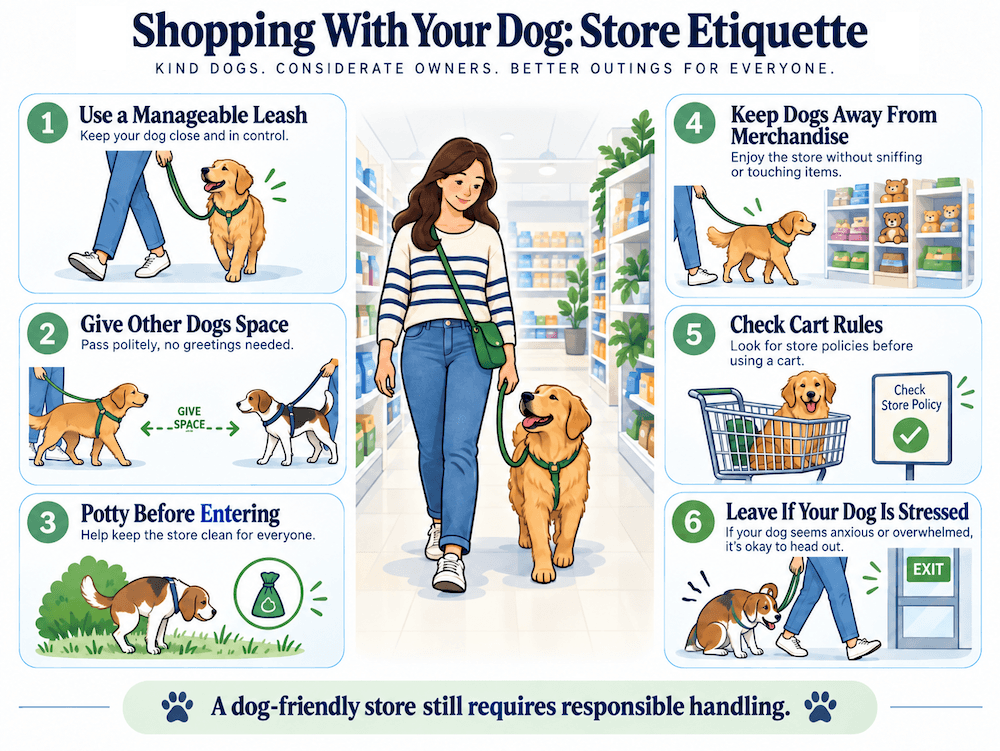
Dog-Friendly Store Etiquette
Even retailers that actively welcome dogs expect owners to prevent their pets from interfering with employees, merchandise, service dogs, or other shoppers.
What Veterinary & Public-Access Guidance Says About Dogs in Stores
The U.S. Department of Justice’s ADA guidance explains that businesses open to the public generally must allow service dogs to accompany people with disabilities even when the business has a no-pets policy. A service dog must be trained to perform work or tasks related to a person’s disability, while emotional support or comfort alone does not meet the ADA definition. This distinction matters because ordinary pet-friendly policies and legally protected service-dog access are not interchangeable.
The U.S. Food and Drug Administration’s Food Code provides the regulatory framework used by many jurisdictions for restaurants and retail food stores. Its provisions generally prohibit live animals in food establishments while recognizing specified exceptions, and the 2022 edition added provisions for approved pet dogs in certain outdoor dining areas. For owners, this explains why a dog may be welcome in a hardware or clothing store but prohibited inside a supermarket.
The AAHA behavior guidelines list panting, trembling, lip licking, yawning, freezing, pacing, hiding, escape attempts, lowered body posture, and increased reactivity among signs of anxiety or distress. The Merck Veterinary Manual also notes that fear and anxiety can drive avoidance and aggression and that medical contributors should be considered when behavioral changes are significant. For dog owners, a pet-friendly store should therefore be treated as an optional enrichment opportunity, not an environment a frightened dog needs to endure.
Frequently Asked Questions
The Bottom Line
Many U.S. retailers allow dogs, but policies can differ between chains and individual locations. Pet stores, farm-and-feed retailers, outdoor stores, and some home-improvement or clothing stores are among the most likely places to welcome well-behaved dogs. Grocery stores and other food-focused businesses usually have stricter rules, while service dogs follow separate public-access protections. Calling the exact store before visiting is the easiest way to avoid confusion when a policy is unclear. Dogs that join shopping trips should remain controlled, comfortable, and respectful of other customers and animals. Bringing a leash, waste bags, water, and a few treats can make outings easier to manage. If your dog becomes stressed or a store does not permit pets, choosing curbside pickup, delivery, or leaving your dog at home is often the better option.
For more helpful guidance, read our guides on how to leash train a dog, how to train a dog, how to get a service dog, and the best dog harnesses for safer, more controlled outings.