Dog Methocarbamol Dosage Calculator: How Much to Give & Charts


Canine Bible is reader-supported. We receive affiliate commissions via some of our links. Learn more.
Methocarbamol is a prescription muscle relaxant commonly used to treat muscle spasms, back injuries, and conditions such as intervertebral disc disease (IVDD) in dogs. If your veterinarian has prescribed this medication, understanding the correct amount for your dog’s weight is essential for safe treatment. Our Dog Methocarbamol Dosage Calculator helps you check a veterinarian-prescribed dose, convert between pounds and kilograms, and understand tablet or liquid measurements. Below, you’ll also find dosage conversion charts, medication guidelines, common side effects, safety precautions, and answers to frequently asked questions.
Always consult your veterinarian before giving methocarbamol to your dog, changing the prescribed dosage, or stopping treatment, especially if your dog is a puppy, senior, pregnant or nursing, has kidney or liver disease, or takes other medications, and seek prompt veterinary advice if you notice excessive drowsiness, vomiting, weakness, loss of coordination, difficulty walking, collapse, breathing difficulties, or other concerning symptoms. If you can't reach your vet, you can chat live with a registered online veterinary professional via our online vet chat or video chat support (24 hours a day, 7 days a week). Or use Chewy's online vet services (6 a.m. - midnight ET).
How Much Methocarbamol Can I Give My Dog?
The amount of methocarbamol your dog can receive depends on their weight, medical condition, and veterinarian-prescribed treatment plan. There is no single dose that is appropriate for every dog, and body weight alone cannot determine a safe medication amount.
Veterinarians may prescribe methocarbamol for painful muscle spasms, injuries, spinal conditions, or other disorders involving muscle rigidity. The prescribed amount can vary depending on the severity of symptoms, the dog's response to treatment, and whether the medication is being used during initial or ongoing care.
Methocarbamol doses may be expressed in milligrams (mg), milligrams per kilogram (mg/kg), or milligrams per pound (mg/lb). These measurements are not interchangeable, and confusing the amount given at one time with the total daily amount can lead to medication errors.
For example, if your veterinarian prescribes 250 mg per dose, that is the amount to verify against the medication label. It does not automatically mean your dog should receive 250 mg daily, nor does it establish how frequently the medication should be administered. Always confirm both the prescribed amount and dosing schedule before giving methocarbamol. If the instructions are unclear, contact your veterinarian or dispensing pharmacist rather than estimating the dose yourself.


Methocarbamol Dosage Chart for Dogs
The following charts help you understand how dog weight, medication strength, and symptoms relate to methocarbamol treatment. They are intended for checking existing prescriptions, not choosing a dose independently.
Dog Methocarbamol Dosage Chart by Weight
Methocarbamol calculations sometimes use a dog's body weight in kilograms. The chart below shows weight conversions and the formula for calculating a dose when your veterinarian has specifically prescribed an amount in mg/kg per administration. In this chart, D = the veterinarian-prescribed mg/kg per dose.
| Dog Weight (lb) | Weight (kg) | Prescribed Dose Calculation |
|---|---|---|
| 5 lb | 2.27 kg | 2.27 × D mg |
| 10 lb | 4.54 kg | 4.54 × D mg |
| 20 lb | 9.07 kg | 9.07 × D mg |
| 30 lb | 13.61 kg | 13.61 × D mg |
| 40 lb | 18.14 kg | 18.14 × D mg |
| 50 lb | 22.68 kg | 22.68 × D mg |
| 75 lb | 34.02 kg | 34.02 × D mg |
| 100 lb | 45.36 kg | 45.36 × D mg |
Note: The chart does not provide recommended treatment doses. Use the formula only when your veterinarian has supplied a specific mg/kg-per-dose instruction, and confirm the result before administering medication.
Methocarbamol Tablet Strength Chart for Dogs
Methocarbamol is available in different formulations, and medication strength affects how a prescription is measured. A 500 mg tablet and a 750 mg tablet are not interchangeable simply because they contain the same active ingredient.
| Formulation | Strength Measurement | Important Consideration |
|---|---|---|
| 500 mg tablet | 500 mg per tablet | Confirm whether tablet splitting is appropriate. |
| 750 mg tablet | 750 mg per tablet | Do not substitute for a different strength. |
| Other tablet strengths | Check pharmacy label | Verify the exact product and directions. |
| Compounded liquid | mg per mL | Confirm concentration before measuring. |
| Injectable form | Product-specific | Used under professional veterinary supervision. |
Always check the actual prescription label rather than assuming the strength from a previous refill. If your medication looks different or the concentration has changed, contact the dispensing pharmacy before using it.
Methocarbamol Side Effects and Warning Signs Chart
Methocarbamol can cause sedation and reduced coordination, but more serious symptoms may require immediate medical attention. This chart helps distinguish symptoms that warrant a veterinary call from potential emergencies.


| Concern Level | Possible Symptoms | Recommended Action |
|---|---|---|
| Possible mild effects | Mild sleepiness or drooling | Monitor and discuss with your veterinarian. |
| Concerning effects | Vomiting, marked weakness, or stumbling | Contact your veterinarian promptly. |
| Emergency signs | Collapse, unresponsiveness, or breathing trouble | Seek emergency veterinary care immediately. |
| Possible overdose | Extra dose or unknown amount swallowed | Call a veterinarian or animal poison service immediately. |
Important: Symptoms alone cannot confirm or rule out an overdose. If you suspect your dog received too much methocarbamol, contact a veterinarian immediately, even if your dog appears normal.
Methocarbamol Dosage Guidelines for Dogs
Methocarbamol works by affecting the central nervous system, helping reduce abnormal muscle activity and painful spasms. It is commonly used alongside other veterinary treatments rather than as the only medication for an injury or spinal condition.
What Is Methocarbamol Used for in Dogs?
Veterinarians prescribe methocarbamol for conditions involving muscle tightness, spasms, or rigidity. Common reasons include muscle strains, traumatic injuries, neck and back pain associated with muscle spasms, and intervertebral disc disease (IVDD).
Methocarbamol may also be used in veterinary hospitals to help control severe muscle tremors associated with certain poisonings. These cases require professional treatment because the underlying toxicity may cause additional life-threatening complications. Although methocarbamol can make a dog more comfortable, it is not a direct pain reliever or anti-inflammatory medication. Your veterinarian may combine it with other treatments to address the underlying cause of discomfort.
How Is Methocarbamol Dosed in Dogs?
Methocarbamol dosing is commonly based on body weight, the condition being treated, and the dog's response to medication. Veterinary prescribing guidelines distinguish between initial treatment and subsequent doses, so the prescribed amount may change as treatment progresses.
The U.S.-approved oral veterinary tablet labeling describes an initial daily regimen divided into two or three administrations, followed by a subsequent daily regimen. However, these labeled directions are not appropriate for every patient, and veterinarians may prescribe different doses based on individual needs. Another important distinction is whether the prescription specifies an amount per dose or per day. For example, a total daily amount divided into three administrations is different from giving that entire amount three times.
How Often Can Dogs Take Methocarbamol?
Methocarbamol is often prescribed two or three times daily, depending on the dog's condition and treatment plan. Your veterinarian will determine the appropriate interval and treatment duration.
If your instructions say twice daily, confirm whether doses should be spaced approximately 12 hours apart. For three daily administrations, the veterinarian may recommend an approximately eight-hour interval or another schedule based on your dog's needs. Never give doses closer together, increase the frequency, or double a missed dose without veterinary instructions.
How Long Does Methocarbamol Take to Work?
Oral methocarbamol generally begins producing noticeable effects within approximately 1–2 hours after administration. Dogs receiving treatment for muscle spasms may gradually appear more comfortable or less tense, although improvement depends on the underlying condition. Drowsiness can also develop during this period. If your dog becomes unusually weak, cannot walk normally, or continues showing significant pain, contact your veterinarian rather than increasing the medication.
Factors That Can Affect Your Dog's Methocarbamol Dosage
Several factors influence how methocarbamol is prescribed and how dogs respond to treatment. Understanding these differences can help you identify when your veterinarian may need to reassess the medication.
| Factor | Why It Matters | What Owners Should Check |
|---|---|---|
| Body weight | Weight affects dose calculations. | Use a recent, accurate weight. |
| Condition severity | Muscle spasms and injuries require different treatment plans. | Discuss persistent or worsening symptoms. |
| Age | Puppies and seniors may need extra monitoring. | Confirm age-appropriate treatment. |
| Kidney or liver health | Illness may affect medication handling. | Report existing medical conditions. |
| Other medications | Some combinations increase sedation. | Review all drugs and supplements. |
| Formulation | Tablet strengths and liquid concentrations differ. | Verify the prescription label. |
| Treatment phase | The prescribed regimen may change over time. | Follow current dosing instructions. |
If your dog's health changes during treatment, ask your veterinarian whether the existing prescription remains appropriate.
Common Methocarbamol Dosage Mistakes to Avoid
Medication errors can occur even when owners carefully follow a treatment routine. Most involve incorrect measurements, misunderstood instructions, or changes made without veterinary approval.
| Common Mistake | Why It Matters | Better Approach |
|---|---|---|
| Wrong weight units | Pounds and kilograms produce different calculations. | Confirm the selected weight unit. |
| Wrong dose units | Daily and per-dose amounts differ. | Check the prescription wording. |
| Wrong tablet strength | Different strengths contain different drug amounts. | Read the current pharmacy label. |
| Incorrect liquid amount | Concentrations vary between preparations. | Use the labeled mg/mL concentration. |
| Doubling a missed dose | Extra medication increases adverse-effect risk. | Follow missed-dose instructions. |
| Ignoring symptoms | Serious reactions may worsen. | Contact a veterinarian promptly. |
| Trusting estimates alone | Calculations cannot assess medical suitability. | Confirm dosing with your veterinarian. |
| Delaying emergency care | Overdose symptoms may progress. | Seek immediate professional advice. |
A useful precaution is to keep a written medication schedule, particularly when multiple people care for the same dog. Recording the time each dose is given helps prevent accidental repeat administrations.
Methocarbamol Safety Guidelines for Dogs
Methocarbamol can be helpful when appropriately prescribed, but it affects the central nervous system and may cause adverse reactions. Careful monitoring is especially important when treatment begins or the veterinarian adjusts the prescription.
Is Methocarbamol Safe for Dogs?
Methocarbamol is an established veterinary medication for controlling certain muscle spasms. Many dogs tolerate prescribed treatment, but its safety depends on their health, other medications, and individual response. Dogs with known allergies to methocarbamol should not receive it. If your dog has kidney disease, is pregnant or nursing, or has previously experienced medication sensitivities, your veterinarian should evaluate the risks before treatment.
Common Side Effects of Methocarbamol in Dogs
The most frequently reported side effect is drowsiness. Other possible effects include drooling, vomiting, weakness, and unsteady movement. Some dogs may develop dark or blue-green urine discoloration, which can occur with this medication. However, unexplained urinary changes, blood in the urine, painful urination, or other concerning symptoms should still be evaluated.
Keep your dog in a comfortable, supervised environment while you observe their response. Prevent access to stairs or elevated furniture if your dog appears sleepy or unsteady, and contact your veterinarian about troublesome side effects.
When Should You Call a Veterinarian?
Contact your veterinarian if your dog experiences persistent vomiting, worsening weakness, unusual behavior, or difficulty walking after taking methocarbamol. You should also call if the medication appears ineffective or your dog's original symptoms become more severe. If your dog is receiving treatment for IVDD or another spinal condition, new limb weakness, dragging the paws, sudden inability to walk, or loss of bladder control requires urgent assessment. These signs may reflect progression of the underlying condition rather than a medication reaction.
When Is Methocarbamol an Emergency?
Severe sedation, collapse, unresponsiveness, or difficulty breathing requires immediate emergency veterinary care. Do not wait for a scheduled appointment if your dog develops these symptoms. A suspected overdose is also urgent, even when your dog has not developed noticeable symptoms. Early assessment gives veterinary professionals more options for managing potential complications.
Can Methocarbamol Interact With Other Dog Medications?
Yes. Methocarbamol can increase sedation when combined with other medications that affect the central nervous system. Particular caution is needed with certain opioid pain medications, sedatives, and drugs that can cause drowsiness, including gabapentin. These combinations may sometimes be prescribed intentionally, but they require veterinary oversight. Always provide your veterinarian with a complete list of your dog's prescriptions, over-the-counter medications, and supplements.
What to Do If Your Dog Gets Too Much Methocarbamol
If your dog receives an extra dose, swallows medication accidentally, or consumes an unknown amount, treat it as a possible overdose. Contact your veterinarian or an emergency veterinary hospital immediately. Do not wait for vomiting, weakness, or other symptoms to develop. While seeking professional guidance:
- Gather the medication information. Find the original container and note its strength or concentration.
- Estimate the exposure. Record the number of tablets or approximate liquid amount involved and when the incident occurred.
- Check your dog's condition. Note breathing, alertness, coordination, vomiting, and other unusual signs.
- Avoid home treatments. Do not induce vomiting, administer activated charcoal, or give other medications unless a veterinarian instructs you to.
- Follow emergency instructions. Bring the medication packaging to the veterinary hospital if an examination is recommended.
If you are in the United States, you can also contact ASPCA Animal Poison Control at 888-426-4435 or Pet Poison Helpline at 855-764-7661. Consultation fees may apply. Veterinary professionals may recommend monitoring, supportive care, or hospital treatment depending on the amount ingested and your dog's condition. Never assume an overdose is harmless because the dog initially appears normal.
Special Considerations for Certain Dogs
How to Calculate a Dog's Methocarbamol Dosage Manually
If your veterinarian prescribes methocarbamol based on body weight, you can check the calculation using a simple formula. The most important step is identifying whether the prescription is written in mg/kg per dose, mg/lb per dose, or a fixed number of milligrams per administration.
Methocarbamol Dosage Formula
- For a prescription expressed in mg/kg per dose:
- Methocarbamol dose (mg) = Dog's weight (kg) × Veterinarian-prescribed dose (mg/kg per administration)
- If your dog's weight is recorded in pounds, convert it to kilograms first:
- Weight (kg) = Weight (lb) ÷ 2.20462
If the veterinarian has already prescribed a fixed number of milligrams per dose, no weight-based multiplication is needed.
- To check a prescribed amount against a tablet strength:
- Tablet fraction = Prescribed dose (mg) ÷ Tablet strength (mg)
- For a veterinarian-dispensed liquid preparation:
- Liquid volume (mL) = Prescribed dose (mg) ÷ Liquid concentration (mg/mL)
These formulas calculate medication quantities, not whether a particular dose is medically appropriate. Any rounding, tablet splitting, or measurement adjustment must be confirmed with your veterinarian or pharmacist.
Example Calculation
Suppose your veterinarian has already prescribed 250 mg of methocarbamol per administration for a dog weighing 20 pounds. The medication supplied contains 500 mg per tablet.
- First, convert the dog's weight:
- 20 ÷ 2.20462 = 9.07 kg
- Because the prescription already specifies 250 mg per dose, no additional weight-based dose calculation is necessary.
- Next, calculate the mathematical tablet fraction:
- 250 mg ÷ 500 mg = 0.5 tablet
- This means the prescribed amount is mathematically equivalent to half of a 500 mg tablet.
However, this example is not a recommended dose for a 20-pound dog. Only divide the tablet if the veterinarian or pharmacist has confirmed that the specific product can be split and that the prescription requires that amount.
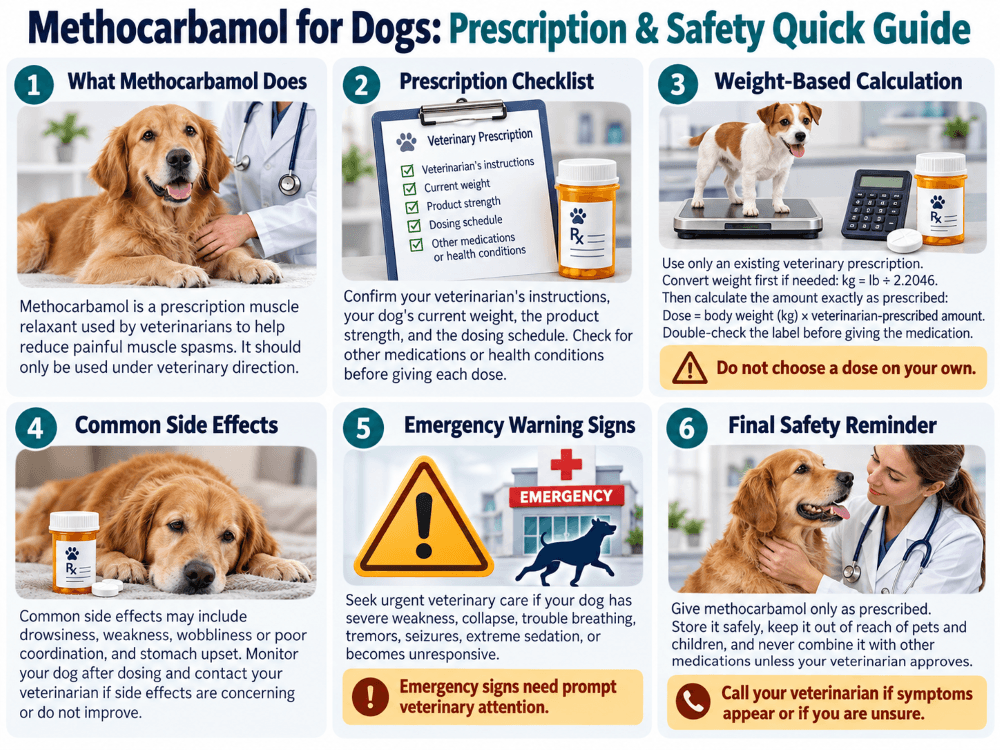
Dog Methocarbamol Dosage & Safety Infographic
Frequently Asked Questions
The Bottom Line
Methocarbamol can help relieve muscle spasms associated with injuries, spinal conditions, and other veterinary problems when used appropriately. Our dog methocarbamol dosage calculator helps you check prescription calculations based on your dog's weight and medication strength, but it cannot determine a safe dose independently or replace a veterinary diagnosis. Always verify the prescribed amount, dosing interval, and formulation before administration. Contact your veterinarian if your dog develops unusual symptoms, experiences a medication error, or needs a treatment adjustment.
For related guidance, explore Canine Bible's dog aspirin dosage calculator, dog weight loss calculator, and guide on heartworms in dogs.