
Dog Age Calculator by Weight [Free Tool]


Canine Bible is reader-supported. We receive affiliate commissions via some of our links. Learn more.
Ever wondered how old your dog really is in human years? A 10-year-old Chihuahua and a 10-year-old Great Dane may share the same birthday, but their bodies age at different rates. That’s because a dog’s size, weight, and breed influence how it ages. Our Dog Age Calculator by Weight estimates your dog’s age in human years using its actual age and adult body weight. Below, you’ll also find dog age conversion charts, life-stage guidelines, calculation examples, and practical tips for supporting your dog as it gets older.
Always consult your veterinarian if you have concerns about your dog’s age-related health or care needs, especially if your dog is a senior, large or giant breed, or has an existing medical condition, and seek prompt veterinary advice if you notice changes in mobility, appetite, weight, energy levels, behavior, or other unusual symptoms. If you can't reach your vet, you can chat live with a registered online veterinary professional via our online vet chat or video chat support (24 hours a day, 7 days a week). Or use Chewy's online vet services (6 a.m. - midnight ET).
How Old Is My Dog in Human Years Based on Weight?
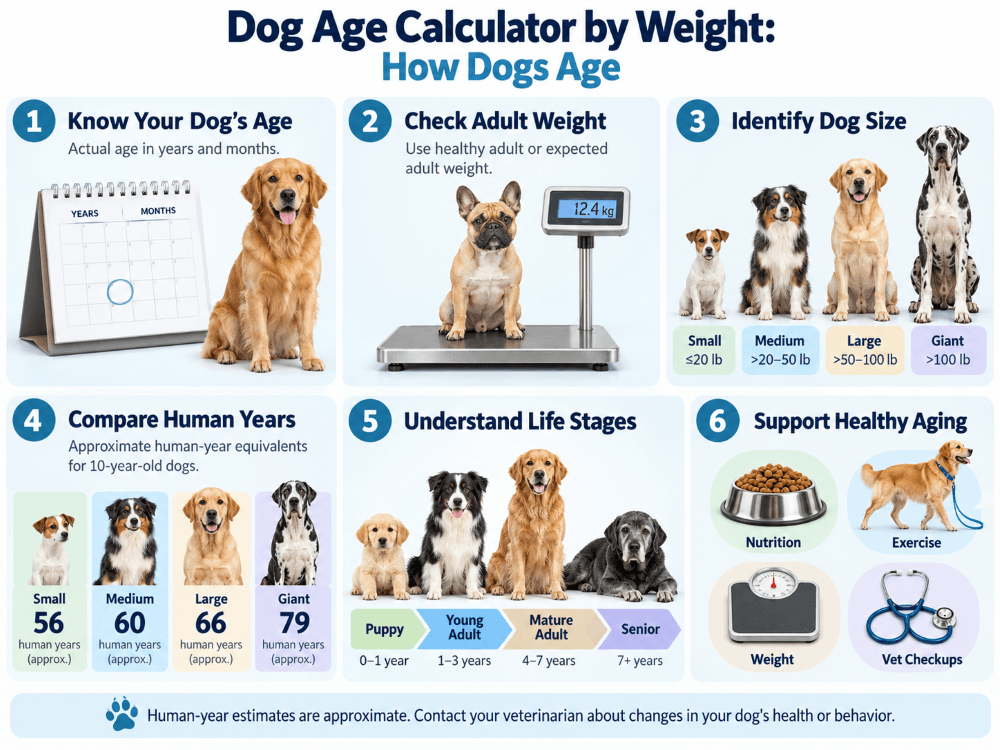
A dog's age in human years depends on its actual age and adult size. Dogs mature quickly during their first two years, but afterward, larger dogs generally age faster than smaller dogs. This means two dogs of the same age can have very different human-age equivalents.
For example, a 10-year-old small dog is approximately 56 human years old, while a 10-year-old giant dog is around 79 human years old using a commonly referenced size-adjusted conversion chart. The difference becomes more noticeable as dogs get older. Although adult weight helps estimate aging patterns, breed, genetics, and overall health also influence how a dog ages.
Why Is the Seven-Year Dog Age Rule Inaccurate?
You've probably heard that one dog year equals seven human years. While convenient, the seven-year rule doesn't reflect how dogs actually develop and age. Dogs reach important developmental milestones much faster than humans. A one-year-old medium-sized dog is roughly comparable to a 15-year-old human in terms of maturation, while a two-year-old dog is often compared to a 24-year-old human.
After those early years, aging varies considerably by size. Small dogs generally have longer lifespans, while large and giant breeds tend to experience age-related changes earlier. A weight-based conversion provides a more useful comparison than simply multiplying your dog's age by seven.


Dog Age Chart by Weight
The following dog age charts help you estimate your dog's human-equivalent age based on its adult weight. Start by identifying your dog's size category, then compare its chronological age with the corresponding human-age estimate.
Dog Weight Categories for Age Calculation
Dogs are commonly divided into four weight categories for size-adjusted age comparisons.
| Dog Size | Adult Weight (lb) | Adult Weight (kg) |
|---|---|---|
| Small | 20 or less | 9.1 or less |
| Medium | Over 20–50 | Over 9.1–22.7 |
| Large | Over 50–100 | Over 22.7–45.4 |
| Giant | Over 100 | Over 45.4 |
Note: These are approximate chart categories, not universal breed classifications. Use your dog's healthy adult weight or expected adult weight for growing puppies.
Dog Years to Human Years Chart by Weight
This dog age conversion chart shows approximate human-equivalent ages for small, medium, large, and giant dogs between 1 and 16 years old.
| Dog Age (Years) | Small | Medium | Large | Giant |
|---|---|---|---|---|
| 1 | 15 | 15 | 15 | 12 |
| 2 | 24 | 24 | 24 | 22 |
| 3 | 28 | 28 | 28 | 31 |
| 4 | 32 | 32 | 32 | 38 |
| 5 | 36 | 36 | 36 | 45 |
| 6 | 40 | 42 | 45 | 49 |
| 7 | 44 | 47 | 50 | 56 |
| 8 | 48 | 51 | 55 | 64 |
| 9 | 52 | 56 | 61 | 71 |
| 10 | 56 | 60 | 66 | 79 |
| 11 | 60 | 65 | 72 | 86 |
| 12 | 64 | 69 | 77 | 93 |
| 13 | 68 | 74 | 82 | 100 |
| 14 | 72 | 78 | 88 | 107 |
| 15 | 76 | 83 | 93 | 114 |
| 16 | 80 | 87 | 99 | 121 |
Note: All values represent approximate human-equivalent years using a commonly published size-adjusted age chart. They are not precise biological measurements or lifespan predictions, particularly at advanced ages.
Dog Life Stages by Age and Size
Your dog's human-equivalent age is only one way to understand aging. Its life stage can be more useful when deciding what preventive care, exercise, and nutrition may be appropriate.


| Life Stage | Typical Period | Main Care Focus |
|---|---|---|
| Puppy | Birth to roughly 6–9 months | Growth, vaccinations, socialization |
| Young Adult | End of rapid growth to about 3–4 years | Training, nutrition, exercise |
| Mature Adult | Physical maturity until the final 25% of expected lifespan | Weight, dental care, prevention |
| Senior | Final 25% of expected lifespan | Mobility, screening, comfort |
These stages are flexible rather than fixed milestones. A large breed may enter its senior years earlier than a small breed, and individual health can influence the care needed at each stage.
Dog Age Conversion Guidelines
Understanding how dogs age makes the calculator more useful than a simple number. The biggest differences occur during early development and later adulthood.
How Dogs Age During Their First Two Years
Dogs undergo remarkable physical and behavioral changes during their first year. Many reach reproductive maturity before their first birthday, although complete physical and social maturity takes longer.
For a medium-sized dog, the first year is commonly compared to approximately 15 human years, with the second bringing the total to around 24. These comparisons reflect broad developmental patterns, not identical physical or emotional maturity between species. Puppies also develop at different speeds depending on breed. Large and giant breeds may continue growing long after smaller breeds have reached adult size.
How Weight Affects Aging After Two Years
After the early developmental period, size-related differences become more important. Smaller dogs generally have longer average lifespans, while larger dogs often experience accelerated aging and earlier onset of some age-related health concerns.
However, being naturally large isn't the same as being overweight. A healthy 90-pound dog belongs to a different size category than a naturally 45-pound dog carrying substantial excess weight. For age conversion, your dog's expected healthy adult size is the more appropriate reference.
What Does Science Say About Dog Years?
Researchers study canine aging using lifespan records, physical changes, and molecular markers such as DNA methylation. These approaches show that aging is more complex than a fixed number of human years for every dog year.
One DNA-based approach uses a logarithmic relationship to compare age-related molecular changes in dogs and humans. However, that research focused on Labrador Retrievers and cannot automatically provide accurate age estimates for every breed. For everyday use, a size-adjusted age chart provides an accessible comparison, while veterinary assessments offer more meaningful information about an individual dog's health.
Factors That Can Affect Your Dog's Age Calculation
Weight is a useful starting point, but several other factors influence how your dog ages. Understanding them helps you interpret the estimate in context.
| Factor | Why It Matters | What to Check |
|---|---|---|
| Adult Weight | Body size influences typical aging patterns. | Healthy adult weight |
| Breed & Genetics | Longevity differs between breeds. | Breed background |
| Body Condition | Excess fat can affect long-term health. | Body condition score |
| Nutrition | Balanced diets support lifelong health. | Diet and portions |
| Activity Level | Suitable exercise supports mobility. | Fitness and stamina |
| Health Conditions | Illness can affect wellbeing independently of age. | Health history |
| Veterinary Care | Preventive visits help identify developing problems. | Checkup schedule |
A human-age estimate cannot account for all these individual differences. Consider it alongside your dog's physical condition, behavior, and veterinary health history.
Common Dog Age Calculation Mistakes to Avoid
Small input errors and outdated conversion rules can produce misleading results. These are the most common mistakes owners should avoid.
| Mistake | Why It Matters | Better Approach |
|---|---|---|
| Multiplying by 7 | Ignores nonlinear aging. | Use size-adjusted estimates. |
| Using Puppy Weight | Growing dogs may be misclassified. | Use expected adult weight. |
| Wrong Weight Units | Pounds and kilograms differ. | Confirm lb or kg. |
| Ignoring Breed | Breed lifespan patterns vary. | Consider genetic background. |
| Using Excess Weight | Obesity may distort size classification. | Use healthy adult weight. |
| Assuming Exact Results | Human-age equivalents are estimates. | Use the result as context. |
| Ignoring Health Changes | Illness is not measured by the calculator. | Seek veterinary assessment. |
| Not Updating Age | The estimate changes over time. | Recalculate as your dog ages. |
How to Use Your Dog's Age Estimate Responsibly
Knowing your dog's approximate human-equivalent age can help you think about changing care needs, but it shouldn't determine medical decisions on its own. A healthy older dog may remain active for years, while a younger dog with health problems may require more intensive care. Focus on your dog's overall condition rather than treating its calculated human age as a health score. Practical ways to support healthy aging include:
Your veterinarian can help determine which changes are appropriate for your dog's individual situation.
When Should You Contact Your Veterinarian?
Some age-related changes develop gradually, but new or persistent symptoms should never automatically be dismissed as normal aging. Contact your veterinarian if you notice:
Seek emergency veterinary care for severe breathing difficulty, collapse, seizures, or sudden inability to stand or walk. These symptoms require prompt assessment regardless of your dog's age.
What to Do If Your Dog's Calculated Age Seems Too High
Seeing that your dog is equivalent to a 70- or 80-year-old human can feel surprising, particularly if your dog still runs, plays, and behaves energetically. Fortunately, a high human-age estimate doesn't mean your dog is unhealthy or nearing the end of its life. It simply reflects the approximate aging comparison associated with its age and size. If the result seems unexpected:
- Check your inputs. Confirm your dog's age, months, weight, and measurement units.
- Review the weight category. Make sure you're using healthy adult weight instead of excess weight or puppy weight.
- Consider breed differences. Some breeds may not follow broad size-based aging patterns closely.
- Evaluate daily wellbeing. Pay attention to appetite, mobility, energy, behavior, and comfort.
- Ask your veterinarian about concerns. A physical examination provides more useful health information than a human-year comparison.
Remember that dogs can enjoy good quality of life well into their senior years. The purpose of understanding age is to support better care, not to predict an individual dog's future.
Special Considerations for Certain Dogs
How to Calculate Dog Age in Human Years Manually
You can estimate your dog's age in human years without a calculator by using a size-adjusted conversion chart. This method is particularly useful if you know your dog's age in years and months. Because there is no universally accurate formula for all dogs, the following calculation interpolates between published chart values rather than claiming to measure biological aging.
Step 1: Determine Your Dog's Actual Age
Start with your dog's chronological age in years and months. For example, a dog that is 8 years and 6 months old has a chronological age of 8.5 years.
Step 2: Identify Your Dog's Adult Weight Category
Find your dog's healthy adult weight and classify it as small, medium, large, or giant. For example, a healthy adult dog weighing 35 pounds belongs to the medium-sized category.
Step 3: Find the Human-Year Equivalents
Look up your dog's two surrounding whole-year ages in the conversion chart. For a medium dog:
- At 8 years: approximately 51 human years
- At 9 years: approximately 56 human years
These values provide the range for estimating an age between birthdays.
Step 4: Calculate the Approximate Human Age
- For a dog aged at least one year within the chart's supported range, use this interpolation formula:
- Estimated Human Age = H1 + (H2 − H1) × (M ÷ 12)
- Where:
- H1 = Human-age equivalent at the last completed birthday
- H2 = Human-age equivalent at the next birthday
- M = Number of months since the last birthday
This assumes a straight-line change between chart entries for calculation purposes. Real biological aging does not necessarily progress at a constant rate.
Example Calculation
- Suppose you have a medium-sized dog weighing 35 pounds that is 8 years and 6 months old.
- Using the conversion chart:
- H1 = 51
- H2 = 56
- M = 6
- Insert the values:
- Estimated Human Age = 51 + (56 − 51) × (6 ÷ 12)
- Estimated Human Age = 51 + 2.5 = 53.5 years
- Your dog is therefore approximately 54 years old in human-year equivalents.
This estimate offers a convenient comparison, but it cannot determine your dog's exact biological age or health status.
Alternative DNA-Based Dog Age Formula
- Another method compares age-related DNA changes in dogs and humans using a logarithmic formula:
- Human Age = 16 × ln(Dog Age) + 31
- In this equation,
lnrepresents the natural logarithm, and dog age is entered in years. - For a 10-year-old dog:
- Human Age = 16 × ln(10) + 31 ≈ 67.8 years
- This produces an estimate of approximately 68 human years.
However, the research underlying this formula focused on Labrador Retrievers. It doesn't adjust for weight categories or reliably account for every breed's aging pattern. For that reason, the DNA-based formula should be understood as a separate scientific comparison rather than combined with the size-adjusted conversion chart.
Dog Age Calculator by Weight Infographic
Frequently Asked Questions
The Bottom Line
A dog age calculator by weight offers a more useful way to estimate your dog's age in human years than the traditional seven-year rule. By considering chronological age and adult body size, it helps explain why small, medium, large, and giant dogs age differently. However, human-year equivalents are only estimates. Your dog's health, comfort, and quality of life matter much more than a calculated number.
Use the calculator and conversion charts to understand your dog's aging journey, and explore our Dog Feeding Calculator, Dog Exercise Calculator, and Dog Weight Loss Calculator to support appropriate care throughout each life stage.