Dog Color Genetics Calculator: Predict Puppy Coat Colors & Charts

Canine Bible is reader-supported. We receive affiliate commissions via some of our links. Learn more.
Two black dogs can produce a yellow puppy. A “solid” dog can secretly carry merle. Coat color is one of the few traits you can predict with real math, but only if you know what each parent carries. This guide pairs a Dog Color Genetics Calculator with clear gene charts, worked litter examples, and the color genes that affect health. You’ll also learn how to run the numbers yourself, plus answers to the questions owners and breeders ask most.
Always consult your veterinarian if your dog’s coat color or skin changes unexpectedly, or if you notice unusual pigmentation, skin irritation, hair loss, or other signs that may indicate an underlying health issue. If you can't reach your vet, you can chat live with a registered online veterinary professional via our online vet chat or video chat support (24 hours a day, 7 days a week). Or use Chewy's online vet services (6 a.m. - midnight ET).
How Does Dog Color Genetics Work?
Every dog’s coat comes from two pigments: black (eumelanin) and red/yellow (phaeomelanin). A small group of genes decides which pigment is made and where it shows. Other genes then lighten, darken, or add white and patterns on top.
Three genes decide whether a dog produces black pigment, red pigment, or both: Agouti (A locus), MC1R (E locus), and Dominant Black (K locus). Think of these as the foundation of the coat.
Base Color Genes, Modifiers, and Pattern Genes
Base color genes (E, K, A) set the black-and-red layout of the coat. Modifier genes (B and D) change the shade. The brown gene turns black pigment brown but leaves red pigment alone, while the dilution gene lightens both black and red. Pattern genes sit on top of everything else. Merle, white spotting, and harlequin can all change how the final coat looks, no matter what base color is underneath.


What Color Will My Puppies Be?
Each puppy gets one copy of every color gene from each parent, chosen at random. That’s why one litter can include several colors. For example, two black Labradors that both carry chocolate and yellow can produce black, chocolate, and yellow puppies in the same litter. The calculator works out the odds for each.
Why Same-Color Parents Can Have Different-Colored Puppies
Many color genes are recessive. A dog can carry one hidden copy for its whole life without ever showing it. Some genes also mask others. A dog with two copies of the recessive “e” allele will have a red or yellow coat even if it carries the genes for black, brown, or tan points.
Dog Color Genetics Chart
These charts show the main genes behind coat color, the colors they create, and which ones carry health concerns.
Coat Color Genes at a Glance
Here are the eight genes that explain most coat colors and patterns.
| Gene (Locus) | What It Controls | Dominance Order |
|---|---|---|
| E (MC1R) | Whether black pigment can appear in the coat, plus the facial mask. | Em > E > e (e/e = red or yellow coat) |
| K (Dominant Black) | Solid black versus allowing agouti patterns or brindle to show. | KB > kbr > ky |
| A (Agouti) | How black and red are arranged, such as sable or tan points. | Ay > aw > at > a |
| B (Brown) | Turns black pigment into liver or chocolate. | B > b (needs two b copies) |
| D (Dilute) | Lightens black to blue and brown to isabella or lilac. | D > d (needs two d copies) |
| M (Merle) | Creates patches of diluted and full color. | Incompletely dominant |
| S (White Spotting) | Adds white areas, from small marks to mostly white. | S (solid) mostly over sp (piebald) |
| H (Harlequin) | Turns merle's diluted areas white in Great Danes. | Dominant, only shows with merle |
Base Color by Genotype Chart
The B and D genes together set the main shade of a dog’s black pigment.


| Genotype | Coat Color | Nose Color |
|---|---|---|
| B_ D_ | Black | Black |
| bb D_ | Liver or chocolate | Brown |
| B_ dd | Blue (gray) | Gray-blue |
| bb dd | Isabella or lilac | Pale brown-gray |
| ee (any B or D) | Red, yellow, or cream | Set by B and D genes |
The underscore (_) means the second copy can be either version. One dominant copy is enough to show the color.
Coat Color Genes by Health Risk Level
Most colors have no known health link. These are the exceptions worth knowing before you breed or buy.
| Gene or Pattern | Risk Level | Linked Concern | Owner Action |
|---|---|---|---|
| Solid colors | Low | No known color-linked disease. | Follow standard breed health testing. |
| Single merle (M/m) | Low to moderate | Hearing or eye problems are uncommon. | Ask your vet about hearing and eye checks. |
| Double merle (M/M) | High | Deafness, eye defects, and vision loss. | Never breed merle to merle. |
| Harlequin (H/h) | Moderate | Two copies are lethal before birth. | Never breed harlequin to harlequin. |
| Extensive white | Moderate | Higher risk of congenital deafness. | Ask your vet about a BAER hearing test. |
| Dilute (d/d) | Breed-dependent | Color dilution alopecia in some dogs. | Watch for coat thinning in the first year. |
If your puppy doesn’t react to sounds, has unusual-looking eyes, or develops patchy hair loss, have your veterinarian examine them.
Coat Color Genetics by Breed
Some breeds are well-known examples of how these genes work in real dogs.
| Breed | Key Genes | Colors You'll See |
|---|---|---|
| Labrador Retriever | B, E | Black, chocolate, yellow |
| Weimaraner | b/b, d/d | Mouse-gray to silver |
| Doberman Pinscher | B, D | Black and rust, red, blue, fawn |
| Australian Shepherd | M, B | Blue merle, red merle, black, red |
| Dachshund | M, B, D | Red, black and tan, chocolate, dapple |
| Great Dane | M, H, D | Fawn, brindle, black, blue, harlequin, merle |
Dog Color Inheritance Guidelines
A few simple rules explain almost every litter:
The chart below shows the most common single-gene crosses.
| Parent Cross | Puppy Odds |
|---|---|
| Bb × Bb | 75% black, 25% chocolate. |
| Bb × bb | 50% black, 50% chocolate. |
| BB × bb | 100% black, all carrying chocolate. |
| bb × bb | 100% chocolate. |
| M/m × m/m | 50% merle, 50% non-merle. |
| M/m × M/m | 25% double merle, a pairing to avoid. |
The calculator assumes standard alleles, no new mutations, and genes that are inherited independently. Rare breed-specific variants can change real results.
Factors That Can Affect Your Dog’s Results
A prediction is only as good as the information behind it. These factors matter most.
| Factor | Why It Matters | What Owners Should Check |
|---|---|---|
| DNA results vs. looks | Appearance can't reveal hidden recessive genes. | Use coat color DNA results for both parents when possible. |
| Hidden carriers | Recessive colors can skip several generations. | Look at littermates, parents, and grandparents. |
| Cryptic merle | A dog can carry merle while looking solid. | Merle-test any dog from a merle-carrying breed or line. |
| Breed-specific alleles | Some variants exist only in certain breeds. | Choose a breed-appropriate test panel. |
| Mixed ancestry | Unknown genes make predictions much less reliable. | Treat color-only results as rough guides. |
| Age changes | Puppy coats can lighten, darken, or gray over time. | Judge final color once the adult coat is in. |
| Litter size | Small litters rarely match the exact percentages. | Read the odds as chances per puppy. |
Common Mistakes to Avoid
These errors lead to surprise litters, and sometimes to unhealthy puppies.
| Mistake | Why It Matters | Better Approach |
|---|---|---|
| Guessing genotype from color | A black dog may carry chocolate, yellow, or dilute. | Use DNA results, or select "unknown" in the calculator. |
| Reading 25% as "1 in 4" | Each puppy is a separate roll of the dice. | Expect real litters to vary from the odds. |
| Ignoring cryptic merle | A solid-looking parent can still produce double merles. | Merle-test both dogs before breeding. |
| Confusing breed color names | "Dapple" is merle, and one color name can mean different genes. | Match breed terms to the actual gene. |
| Breeding for rare colors | Some rare colors carry real health risks. | Put health testing ahead of color goals. |
| Judging color too early | Puppy coats often change with age. | Re-check color once the adult coat grows in. |
How to Use These Results Responsibly
Treat the calculator’s output as an educated estimate. With DNA-tested parents, it can be very close. With color-only inputs, it’s a rough guide. If you’re planning a litter, DNA-test both parents for coat color and for the health conditions common in your breed.
A puppy’s color tells you nothing about its overall health. Choose breeding pairs for health and temperament first. Never pair two merle-carrying dogs, including cryptic carriers. If the calculator flags a merle risk, take it seriously and confirm both dogs’ merle status with a DNA test.
Coat Color Genes Linked to Health Problems
Most coat colors are purely cosmetic. A few color genes also affect the cells in the inner ear, the eyes, or the hair follicles, and those are the ones that matter for health.
If your puppy doesn’t respond to sound, has unusual eyes, or develops patchy hair loss, schedule a veterinary exam. Coat color can raise suspicion, but only your veterinarian can diagnose a problem.
What to Do If Your Litter Could Produce Double Merles
Before breeding: DNA-test both dogs for merle status, including cryptic and harlequin-type merle variants. Any dog carrying a merle allele should only be paired with a dog that carries none (m/m). If a merle-to-merle litter has already been born:
- Book a veterinary checkup for every puppy.
- Ask your vet when BAER hearing tests can be done, and schedule an eye exam (a veterinary ophthalmologist is ideal).
- Merle-test any puppy whose status isn’t clear from its coat.
- Give new owners honest information about any hearing or vision loss, along with deaf-dog or blind-dog training resources.
- Don’t market double merles as “rare” or “special” colors.
Deaf and visually impaired dogs can live full, happy lives with the right training and a prepared home. Our guide to caring for a deaf dog is a good next step.
Special Considerations for Certain Dogs
How to Calculate Puppy Coat Color Odds Manually
You can work out the odds yourself with a Punnett square, the same method the calculator uses.
- Write each parent’s genotype for every gene you care about, such as Bb or Ee.
- Draw a 2×2 Punnett square for each gene. Put one parent’s two copies across the top and the other parent’s down the side.
- Count the outcomes. Each box is a 25% chance.
- Multiply across genes. For independent genes, multiply the odds together.
- Apply the masking rules. Check E first (e/e means red or yellow), then K, then A.
Manual math gets unreliable when either parent’s genotype is unknown, when breed-specific variants are involved, or with genes like merle that can shift in length between generations.
Example Calculation
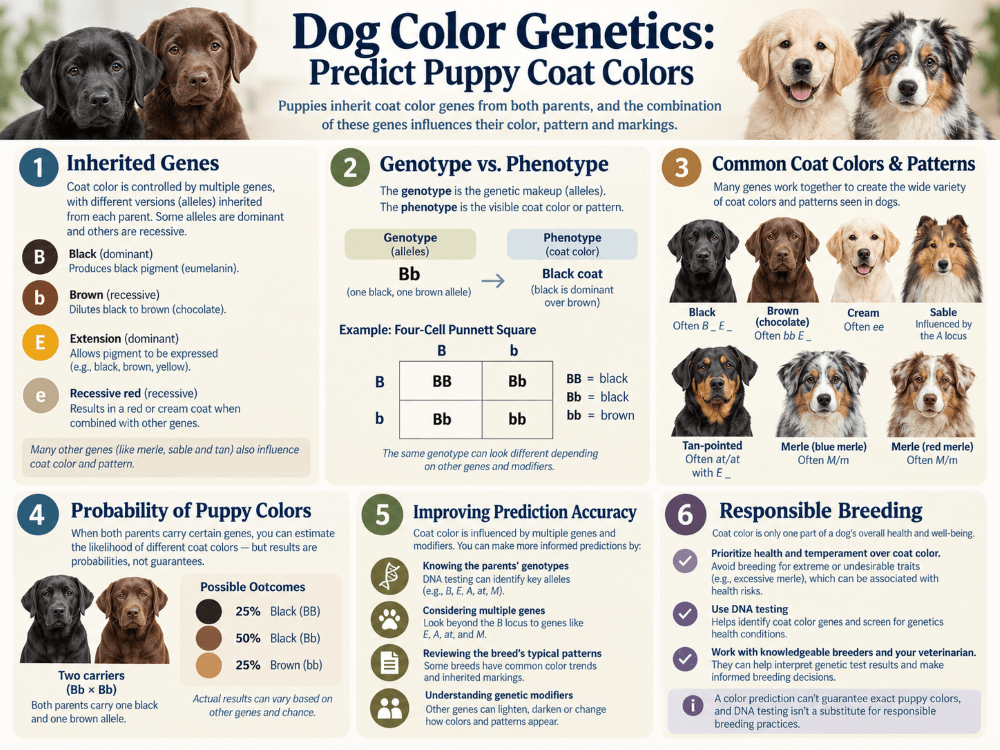
Two black Labrador Retrievers both test Bb Ee. They each carry chocolate (b) and yellow (e).
- E gene: Ee × Ee gives a 75% chance of E_ (black pigment allowed) and a 25% chance of ee (yellow).
- B gene: Bb × Bb gives a 75% chance of B_ (black) and a 25% chance of bb (chocolate).
Combine them:
- Black (B_ E_): 0.75 × 0.75 = 56.25%
- Chocolate (bb E_): 0.25 × 0.75 = 18.75%
- Yellow (ee, any B): 25%
Together, these add up to 100%. In a litter of eight, you might expect roughly four or five black, one or two chocolate, and two yellow puppies, but real litters often vary.
Dog Color Genetics Infographic
Frequently Asked Questions
The Bottom Line
A dog color genetics calculator helps you explore which coat colors and patterns puppies might inherit from their parents. Understanding dominant and recessive alleles, gene interactions, and theoretical probabilities makes the results easier to interpret. For the most informative predictions, use verified DNA test results rather than relying on appearance alone. If you're planning a litter, consider genetic health risks alongside coat color and consult a qualified professional when breeding decisions depend on specific genetic findings.
Explore related Canine Bible resources such as Dog Breed Calculator, Dog Age Calculator by Weight, and dog breeding guide to learn more about your dog.