Homemade Dog Food Calculator: Feed Exact Portions & Calories

Canine Bible is reader-supported. We receive affiliate commissions via some of our links. Learn more.
Whether you are preparing homemade meals for a puppy, adult, senior, active, or overweight dog, deciding how much to serve can be difficult. Homemade recipes vary widely in calories, moisture, fat, and portion weight, so feeding the wrong amount may lead to unwanted weight gain, weight loss, or nutritional gaps. That’s why we created this Homemade Dog Food Calculator—to help you estimate your dog’s daily calorie needs, food portion, amount per meal, and batch size based on weight and lifestyle. In this guide, you’ll also find feeding charts, calculation examples, nutrition and safety tips, and answers to frequently asked questions to help you plan homemade meals responsibly.
Remember to ALWAYS consult with your vet before making any changes that could affect your dog’s health, nutrition, or well-being. If you can't reach your vet, you can chat live with a registered online veterinary professional via our online vet chat or video chat support (24 hours a day, 7 days a week). Or use Chewy's online vet services (6 a.m. - midnight ET). Additionally, at-home dog gut health tests can analyze your dog’s microbiome, offering insights into which nutrients their diet should include. Similarly, at-home dog allergy testing kits can identify ingredients that may not be suitable for your dog, enabling you to choose the right diet and care plan to support optimal digestion, nutrition, and health.
How Much Homemade Food Should I Feed My Dog?
The amount of homemade food your dog needs depends on two main numbers: your dog’s estimated daily calorie requirement and the number of calories in each gram or ounce of the finished recipe.
The basic calculation is: Daily food weight = Calories available for meals ÷ Recipe calories per unit of weight
For example, a dog whose meals need to provide 525 calories would require about 375 grams of a recipe containing 1.4 calories per gram. The same dog would need only about 263 grams of a denser recipe containing 2 calories per gram.
That is why recommendations such as “feed two cups per day” or “feed 2% of body weight” can be misleading. A cup of a moist, lean recipe may contain far fewer calories than a cup of a recipe made with fattier meat, oil, or less water.


Your dog’s weight is only the starting point. Age, body condition, neuter status, activity, treats, health conditions, and weight goal can all change the appropriate portion. Standard calorie equations are designed to produce an initial estimate that should be adjusted according to your dog’s actual weight and body-condition response.
A Practical Portion Example
Consider a healthy, neutered adult dog weighing 20 pounds:
- Estimated resting energy requirement: about 366 calories
- Example adult maintenance estimate: about 585 calories
- Treats and extras: 60 calories
- Calories remaining for the main recipe: 525 calories
- Recipe density: 1.4 calories per gram
- Estimated food portion: 375 grams per day
- Two meals per day: about 188 grams per meal
This example demonstrates the calculation only. It does not confirm that the recipe is nutritionally complete or appropriate for a particular dog.
Homemade Food Feeding Chart for Dogs
The following charts show estimated calorie ranges and how recipe density changes the amount of food placed in the bowl.
Homemade Dog Food Calories by Weight
This weight chart provides common starting estimates for healthy adult dogs.


| Dog Weight | RER | Lower Adult Estimate | Typical Neutered Adult | Higher Adult Estimate |
|---|---|---|---|---|
| 5 lb | 129 kcal | 181 kcal | 207 kcal | 233 kcal |
| 10 lb | 218 kcal | 305 kcal | 348 kcal | 392 kcal |
| 20 lb | 366 kcal | 512 kcal | 585 kcal | 659 kcal |
| 30 lb | 496 kcal | 694 kcal | 794 kcal | 893 kcal |
| 40 lb | 615 kcal | 862 kcal | 985 kcal | 1,108 kcal |
| 50 lb | 727 kcal | 1,018 kcal | 1,164 kcal | 1,309 kcal |
| 70 lb | 936 kcal | 1,311 kcal | 1,498 kcal | 1,685 kcal |
| 100 lb | 1,223 kcal | 1,713 kcal | 1,958 kcal | 2,202 kcal |
The lower, typical, and higher columns use 1.4, 1.6, and 1.8 times resting energy requirement. They estimate calories—not grams or cups of homemade food—and may be too high or too low for an individual dog.
Calorie Factors by Life Stage and Condition
Life stage affects both energy needs and the nutrients a dog requires.
| Dog Category | Common Starting Point | Practical Guidance |
|---|---|---|
| Obesity-prone adult | 1.4 × RER | Monitor weight closely and use a veterinary plan for weight loss. |
| Neutered adult | 1.6 × RER | A common starting estimate for a healthy adult. |
| Intact adult | 1.8 × RER | Adjust for activity, body condition, and weight trend. |
| Puppy under 4 months | 3 × RER | Use only as a calorie estimate; growth nutrition needs careful formulation. |
| Puppy over 4 months | 2 × RER | Expected adult size and growth rate also matter. |
| Working or athletic dog | Individualized | Workload, climate, season, and recovery needs vary widely. |
| Pregnant or nursing dog | Veterinary plan | Needs change with pregnancy stage, litter size, and milk production. |
| Dog with chronic disease | Veterinary plan | Calories alone cannot create a therapeutic diet. |
These multipliers are commonly used starting points, but the correct amount still depends on the individual dog. Growth, pregnancy, lactation, and adult maintenance also have different nutritional adequacy requirements.
Portion Size by Recipe Calorie Density
This comparison shows how the same calorie allowance can produce very different serving weights.
| Recipe Density | Food for 500 Calories | What It Shows |
|---|---|---|
| 1.0 kcal/g | 500 g | A lower-density recipe creates a larger portion. |
| 1.25 kcal/g | 400 g | A moderate increase in density reduces serving weight. |
| 1.5 kcal/g | 333 g | The same calories fit into a smaller portion. |
| 2.0 kcal/g | 250 g | A higher-density recipe requires half the weight of a 1 kcal/g recipe. |
These are mathematical examples, not recommended calorie densities for homemade recipes.
Daily Portion and Batch-Prep Chart
Once the daily portion is known, it can be divided into meals or scaled for batch preparation.
| Daily Portion | Two Meals | 3-Day Batch | 7-Day Batch | 14-Day Batch |
|---|---|---|---|---|
| 200 g | 100 g each | 600 g | 1.4 kg | 2.8 kg |
| 300 g | 150 g each | 900 g | 2.1 kg | 4.2 kg |
| 400 g | 200 g each | 1.2 kg | 2.8 kg | 5.6 kg |
| 500 g | 250 g each | 1.5 kg | 3.5 kg | 7 kg |
| 600 g | 300 g each | 1.8 kg | 4.2 kg | 8.4 kg |
This chart scales a known portion only. Follow safe refrigeration and freezing practices rather than assuming a large batch can remain refrigerated for the entire period.
Homemade Dog Food Safety Guidelines
Calculating the portion is only one part of feeding a homemade diet. The recipe must also provide the right nutrients in appropriate amounts and ratios for the dog’s life stage.
Along with following these preparation guidelines, monitor your dog’s weight and body condition and adjust portions gradually when needed. Consult a veterinarian—especially for puppies, pregnant or nursing dogs, chronic illness, unexplained weight changes, persistent symptoms, toxin exposure, or supplement errors—and consider having a board-certified veterinary nutrition specialist formulate or review the complete homemade diet.
Ingredients to Keep Out of Homemade Dog Food
The safest approach is to prepare your dog’s food separately from seasoned family meals.
| Ingredient | Why to Avoid It | What to Do |
|---|---|---|
| Xylitol | It can cause severe, rapidly developing poisoning in dogs. | Call a veterinarian immediately after possible exposure. |
| Grapes or raisins | Even an uncertain amount may pose a kidney risk. | Seek veterinary advice without waiting for symptoms. |
| Onion, garlic, leeks, or chives | These Allium ingredients can damage red blood cells. | Exclude them from homemade recipes. |
| Chocolate or cocoa | Risk varies by type, amount, and dog size. | Contact a veterinarian or poison-control expert. |
| Alcohol or raw yeast dough | Both can cause serious poisoning. | Keep them completely inaccessible. |
| Macadamia nuts | They can cause weakness and other clinical signs. | Do not include them in food or treats. |
| Cooked bones | They may splinter or obstruct the digestive tract. | Use only safe alternatives recommended for your dog. |
| Moldy or spoiled food | It may contain bacteria or toxins. | Discard questionable ingredients and meals. |
If your dog eats a potentially toxic ingredient, contact your veterinarian, an emergency veterinary clinic, or an animal poison-control service promptly. Do not induce vomiting or try a home treatment unless a veterinary professional tells you to.
Factors That Can Affect Your Dog’s Results
These factors can change the calculator’s estimate or the portion your dog ultimately needs.
| Factor | Why It Matters | What Owners Should Check |
|---|---|---|
| Weight | Calorie calculations begin with body weight. | Confirm the value and whether it is current or target weight. |
| Body condition | Dogs of the same weight may carry different amounts of fat. | Check ribs, waist, abdominal tuck, and recent weight trend. |
| Life stage | Puppies and reproductive dogs have different needs from adults. | Enter age accurately and select the correct life stage. |
| Activity | Exercise, work, climate, and season affect energy use. | Choose the level that reflects the dog’s normal week. |
| Recipe density | More calories per gram means a smaller serving. | Use total calories and the finished cooked batch weight. |
| Treats and extras | Uncounted extras can cause overfeeding. | Include chews, oils, toppers, scraps, and training rewards. |
| Health status | Disease may alter calorie and nutrient requirements. | Ask a veterinarian before using the result for a sick dog. |
| Weight goal | Maintenance, loss, and gain require different plans. | Use a veterinarian-approved target for major weight changes. |
Common Mistakes to Avoid
Most inaccurate portions come from incorrect inputs, inconsistent cooking, or misunderstanding what the calculator can determine.
| Mistake | Why It Matters | Better Approach |
|---|---|---|
| Using cups only | Volume changes with density and packing. | Weigh finished food in grams. |
| Using raw batch weight | Cooking changes water content and yield. | Weigh the completed, cooled recipe. |
| Wrong units | Confusing pounds, kilograms, ounces, or grams changes the result. | Check every unit before calculating. |
| Ignoring treats | Extras can add substantial daily calories. | Count all food outside the main recipe. |
| Changing ingredients | Substitutions alter calories and nutrients. | Follow the formulated recipe exactly. |
| Skipping supplements | The recipe may become nutritionally incomplete. | Use the exact product and measured amount. |
| Treating results as exact | Individual calorie needs vary. | Track weight and adjust gradually. |
| Ignoring symptoms | Diet-related or unrelated illness may be missed. | Contact a veterinarian for concerning changes. |
What to Do If Your Dog Gains or Loses Weight on Homemade Food
First, confirm that the change is real. Reweigh your dog on the same scale and under similar conditions, then look at the trend rather than one isolated measurement. Then, review the entire diet. Check the weight of each portion, the recipe’s finished yield, ingredient substitutions, oils, treats, chews, table food, and foods used for medication.
If the recipe and measurements are accurate, the calorie estimate may need adjustment. Make small changes and continue monitoring rather than sharply cutting or increasing the serving.
Arrange a veterinary examination when weight change is rapid, unexpected, or accompanied by appetite changes, vomiting, diarrhea, increased thirst, increased urination, pain, weakness, breathing changes, or loss of muscle. A calculator cannot determine whether the change is caused by the diet or an underlying health problem.
Special Considerations for Certain Dogs
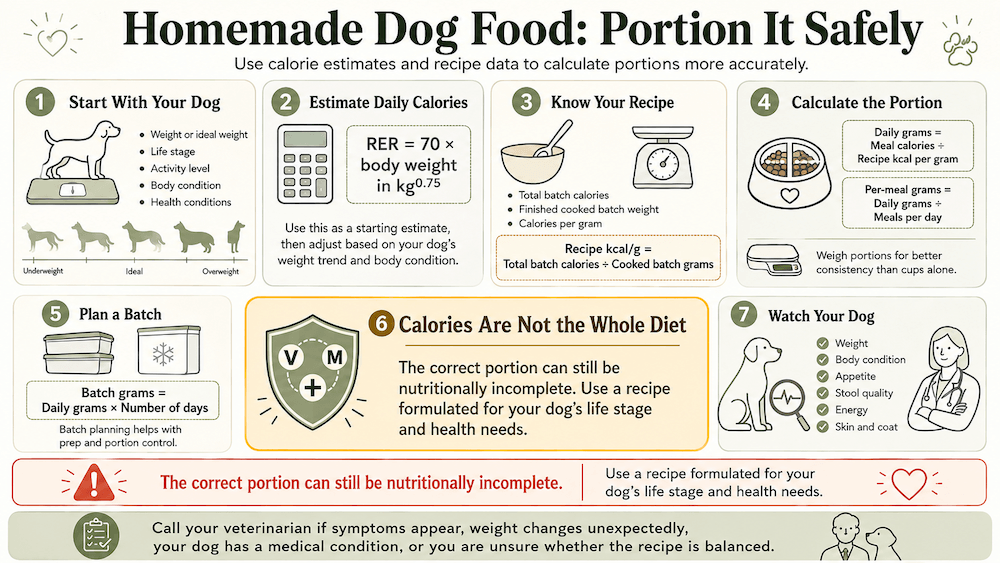
How to Calculate Homemade Dog Food Portions Manually
You can estimate a homemade food portion with the same basic method used by the calculator. This example uses a 20-pound neutered adult dog eating two meals per day.
Step 1: Convert weight to kilograms
- Weight in kilograms = Weight in pounds ÷ 2.2046
- For a 20-pound dog: 20 ÷ 2.2046 = 9.1 kg
Step 2: Calculate resting energy requirement
- RER = 70 × body weight in kg^0.75
- For a 9.1-kilogram dog: 70 × 9.1^0.75 = approximately 366 calories per day
- RER estimates the calories needed at rest, not the dog’s final daily feeding amount.
Step 3: Estimate daily calories
- Multiply RER by an appropriate life-stage factor. For a typical neutered adult:
- 366 × 1.6 = approximately 585 calories per day
- This is a starting estimate. Actual needs may be higher or lower.
Step 4: Subtract treats and extras
- If the dog receives 60 calories from treats:
- 585 − 60 = 525 calories for the main recipe
- Include chews, toppers, oils, table scraps, dental treats, and food used for medication.
Step 5: Calculate recipe calorie density
- Recipe kcal per gram = Total batch calories ÷ Finished cooked batch weight
- Example: 4,200 calories ÷ 3,000 grams = 1.4 kcal per gram
- Use the finished cooked weight, not the combined raw ingredient weight.
Step 6: Calculate the daily portion
- Daily grams = Meal calories ÷ Recipe kcal per gram
- 525 ÷ 1.4 = 375 grams per day
Step 7: Divide into meals
- For two meals per day: 375 ÷ 2 = approximately 188 grams per meal
Step 8: Scale the batch
- For seven days: 375 × 7 = 2,625 grams
That equals approximately 2.63 kilograms of finished food.
This calculation estimates quantity only. It does not confirm that the recipe is complete, balanced, safe, or suitable for long-term feeding.
Frequently Asked Questions
The Bottom Line
The Homemade Dog Food Calculator is designed to help you estimate your dog’s daily calorie needs and convert your recipe’s calorie density into a practical daily or per-meal portion. It should not be used to formulate a nutritionally complete diet, replace guidance from your veterinarian or a veterinary nutritionist, or manage medical conditions at home. Weigh the finished batch, measure portions accurately, follow the recipe exactly, and monitor your dog’s weight and body condition. Contact your veterinarian if your dog develops persistent vomiting or diarrhea, refuses food, becomes unusually tired, or gains or loses weight unexpectedly.
For more help with portioning, read our guide on how much homemade food to feed a dog, explore our homemade dog food recipes, or use our Dog Food Calculator to compare feeding amounts across different food types. You can also use our Dog Calorie Calculator for a separate daily calorie estimate. Remember that calculating the correct portion does not make an incomplete recipe nutritionally balanced, so ask your veterinarian before using homemade food as your dog’s primary long-term diet.