
Dog Sleep Calculator: How Much Sleep Does My Dog Need?

Canine Bible is reader-supported. We receive affiliate commissions via some of our links. Learn more.
Dogs spend a surprising amount of their day sleeping, but there is no single number of hours that every dog needs. Puppies, adults, seniors, working dogs, and couch-loving companions can all have different sleep patterns. The Dog Sleep Calculator helps you estimate how many hours your dog sleeps in 24 hours, compare daytime naps with nighttime sleep, and spot changes from your dog’s usual routine. Because sleep patterns vary widely, the result should be treated as an educational estimate rather than a veterinary diagnosis. This guide also covers dog sleep by age, puppy sleep patterns, factors that affect sleep, warning signs to watch for, a manual calculation method, and when a change in sleeping habits deserves veterinary attention.
Always consider your dog’s age, usual sleep pattern, activity level, health, and daily routine, and contact your veterinarian if your dog develops persistent sleep changes, unusual lethargy, nighttime restlessness, breathing difficulty, pain, or other concerning symptoms. If you can't reach your vet, you can chat live with a registered online veterinary professional via our online vet chat or video chat support (24 hours a day, 7 days a week). Or use Chewy's online vet services (6 a.m. - midnight ET).
How Much Sleep Does My Dog Need?
Many healthy adult dogs sleep roughly 8 to 13.5 hours during 24 hours, but the number varies considerably between individual dogs. Age, activity, health, household routine, environment, medications, and how sleep is measured can all influence the total. The most useful question is often not simply “How many hours did my dog sleep?” but “Is this normal for my dog?”
A dog that has always taken long naps, wakes easily for meals or walks, and acts alert and energetic while awake may simply have a naturally sleepy routine. A dog that suddenly begins sleeping through meals, stops showing interest in favorite activities, or seems unusually dull while awake deserves more attention.
Research also shows why rigid internet rules should be used cautiously. In one large owner-reported study, 16-week-old puppies averaged about 11.2 hours of total sleep, while the same population averaged about 10.8 hours at 12 months. These numbers are observations from a particular study, not required sleep targets for every puppy.
Is It More Important to Track Hours or Changes?
Both are useful, but changes from your dog’s normal pattern often tell you more than one isolated sleep total. Pay attention to whether your dog:


If the sleep total looks unusual but your dog is otherwise acting completely normal, tracking several ordinary days can provide better context than judging one day alone.
Dog Sleep Chart by Age
Age affects sleep patterns, but reliable age-specific sleep requirements are limited. The chart below combines published observations with practical life-stage guidance rather than presenting each number as a required target.
| Life Stage | Sleep Pattern | What Owners Should Know |
|---|---|---|
| Young puppy | Frequent daytime naps are common. | Focus on normal waking behavior, appetite, play, and development. |
| 16 weeks | About 11.2 hours/day in one owner-reported study. | This is an observed average, not a required minimum. |
| 12 months | About 10.8 hours/day in the same study. | Sleep becomes more consolidated at night as dogs mature. |
| Adult dog | About 8–13.5 hours/day is a broad general reference. | Individual routine and alertness matter more than one cutoff. |
| Senior dog | Sleep timing and amount may change with age. | New nighttime waking, pacing, or confusion deserves attention. |
The puppy figures above come from owner-reported data, so they should not be interpreted as exact biological requirements. Differences in how owners define “sleep” and “daytime” can affect reported totals.
Puppy Sleep: Daytime vs. Nighttime
Young dogs do not simply sleep one long block overnight. Daytime naps make up an important part of their total sleep.
| Age | Daytime Sleep | Nighttime Sleep | Total Sleep |
|---|---|---|---|
| 16 weeks | About 3.5 hours | About 7.0 hours | About 11.2 hours |
| 12 months | About 3.0 hours | About 7.3 hours | About 10.8 hours |
These values describe one longitudinal cohort and are best used as research context, not as a pass-or-fail sleep standard for individual dogs.


Dog Sleep Changes That Deserve Attention
The pattern around sleep is often more important than the exact number of hours.
| Sleep Pattern | Level | What to Do |
|---|---|---|
| Usual naps | Routine | Continue normal monitoring. |
| Extra sleep after activity | Monitor | Compare with your dog's usual recovery pattern. |
| Persistent sleep change | Check | Contact your veterinarian if the change is unexplained. |
| Night pacing or confusion | Vet visit | Arrange an assessment, especially for a senior dog. |
| Sleep change plus illness signs | Vet visit | Seek veterinary guidance promptly. |
| Difficult to wake or cannot stand | Urgent | Seek emergency veterinary care. |
Sleeping more than normal can warrant veterinary assessment, while being difficult to wake or unable to get up when prompted can indicate an emergency.
Dog Sleep Guidelines
Dogs commonly divide sleep between nighttime rest and daytime naps. That makes a 24-hour total more useful than looking at nighttime sleep alone. A good sleep assessment should consider duration, timing, quality, and behavior while awake. A dog may spend plenty of hours lying down but still have disrupted sleep if they repeatedly wake, pace, pant, change position, or struggle to settle.
Dogs Sleep in Multiple Periods
Dogs do not necessarily follow the same consolidated nighttime sleep pattern as adult humans. Many nap several times during the day in addition to sleeping overnight. This also makes owner estimates imperfect. A dog lying quietly with closed or half-closed eyes may be asleep, lightly dozing, or simply resting. For calculator purposes, count periods when your dog appears genuinely asleep and use your best estimate. You do not need to time every nap to the minute.
Activity Can Affect Sleep
A long hike, daycare session, training class, travel day, or unusually active outing may temporarily change your dog’s sleep pattern. Extra recovery sleep after a demanding day is different from an unexplained pattern of increasing lethargy. Look at whether your dog returns to their usual energy level, appetite, and behavior after resting.
Your Dog’s Normal Pattern Matters
One of the most useful things you can do is learn your dog’s baseline. For several ordinary days, note:
Once you know what is normal for your dog, meaningful changes become easier to spot.
Factors That Can Affect Your Dog’s Sleep Results
Sleep is influenced by more than age alone. These factors can change how much your dog sleeps, when they sleep, and how restful that sleep appears.
| Factor | Why It Matters | What Owners Should Check |
|---|---|---|
| Age | Puppies and seniors may have different sleep patterns. | Compare with the dog's usual life-stage routine. |
| Activity | Hard exercise can temporarily increase recovery sleep. | Note unusually active or inactive days. |
| Health | Pain or illness can increase or disrupt sleep. | Watch appetite, mobility, breathing, and behavior. |
| Medication | Some medicines can cause sleepiness or restlessness. | Review new medicines or recent dose changes. |
| Environment | Noise, heat, visitors, and travel can interrupt rest. | Check for recent household changes. |
| Routine | Dogs often adapt their sleep to household schedules. | Compare workdays, weekends, and travel days. |
| Breathing | Airway problems can reduce sleep quality. | Notice gasping, labored breathing, or severe snoring. |
Do not change or stop prescribed medication simply because your dog’s sleep has changed. If unexpected drowsiness or restlessness begins after starting or adjusting a medicine, contact the prescribing veterinarian.
Common Mistakes to Avoid
A dog sleep calculator is most useful when the inputs reflect a typical day, and the result is interpreted in context.
| Mistake | Why It Matters | Better Approach |
|---|---|---|
| Counting all resting | Quiet resting is not always true sleep. | Count periods when your dog appears asleep. |
| Ignoring naps | Daytime sleep can be a large part of the total. | Add nighttime sleep and daytime naps. |
| Using one unusual day | Travel or exercise can temporarily change sleep. | Track several typical days when possible. |
| Following one exact target | Normal sleep varies between individual dogs. | Compare the result with your dog's baseline. |
| Ignoring life stage | Puppies, adults, and seniors differ. | Consider age alongside total sleep. |
| Ignoring symptoms | Sleep changes can accompany health problems. | Check behavior, appetite, mobility, and breathing. |
| Treating estimates as diagnosis | A calculator cannot identify the cause of a change. | Use results for tracking, not diagnosis. |
How to Use Your Dog’s Sleep Results Responsibly
The calculator gives you a structured way to look at your dog’s routine. It cannot determine whether your dog has a sleep disorder, pain, cognitive dysfunction, respiratory disease, or another medical condition. The best interpretation combines the calculated number with your dog’s normal behavior.
Look at the Trend, Not Just One Number
If your dog otherwise seems well, consider recording sleep over three to seven ordinary days. A simple sleep diary can include:
Trends are much more useful than reacting to a single afternoon of extra napping.
Look at Your Dog While Awake
Healthy-looking sleep should usually be followed by normal waking behavior. Ask yourself:
A dog’s willingness to wake for familiar activities and their alertness while awake are especially useful clues when deciding whether increased sleep is simply normal variation.
When Should I Call a Vet About My Dog’s Sleep?
Contact your veterinarian if your dog develops a persistent or unexplained change in sleeping habits, especially if it occurs with:
For senior dogs, changes in the sleep-wake cycle can occur alongside cognitive decline. Daytime sleeping, nighttime restlessness, disorientation, activity changes, anxiety, and changes in learned behaviors can form part of the clinical picture, but other medical causes should be ruled out before assuming cognitive dysfunction.
When Is a Sleep Change an Emergency?
Seek urgent veterinary care if your dog:
Difficulty waking and inability to rise are important emergency warning signs rather than normal “deep sleep.”
What to Do If Your Dog Is Sleeping More or Less Than Usual
First, compare the change with your dog’s normal routine rather than immediately assuming something is wrong. Think about what happened during the previous day or two. A strenuous outing, long car trip, boarding stay, visitors, poor night of sleep, or change in the household can temporarily alter a dog’s sleep schedule.
Next, look at the whole dog. Check whether your dog is eating, drinking, walking, breathing, eliminating, and interacting normally. If your dog otherwise seems well, write down their approximate sleep for several days. This gives you something concrete to discuss with your veterinarian if the change continues.
If the change began after a new medication or dose adjustment, contact the prescribing veterinarian rather than stopping the medication yourself. For nighttime problems, a short video can also be useful. Recording pacing, panting, unusual breathing sounds, repeated waking, confusion, or vocalization may help your veterinarian understand what is happening at home.
Special Sleep Considerations for Certain Dogs
How to Calculate Your Dog’s Daily Sleep Manually
You can calculate the same basic sleep total yourself using nighttime sleep and daytime naps.
Total Daily Sleep Formula
- Total daily sleep = nighttime sleep + daytime naps
- For dogs that take several naps:
- Total daily sleep = nighttime sleep + nap 1 + nap 2 + nap 3 + any additional naps
Percentage of the Day Spent Sleeping
- To calculate the percentage of a 24-hour day spent asleep:
- Sleep percentage = total sleep hours ÷ 24 × 100
Change From Your Dog’s Normal Sleep
- If you already know your dog’s typical total:
- Sleep change = current daily sleep − usual daily sleep
A positive number means your dog slept more than usual. A negative number means your dog slept less.
Example Calculation
- Suppose an adult dog sleeps:
- 7.5 hours overnight
- 1 hour in the morning
- 2 hours in the afternoon
- Total daily sleep:
- 7.5 + 1 + 2 = 10.5 hours
- Percentage of the day spent asleep:
- 10.5 ÷ 24 × 100 = 43.75%
- If that dog normally sleeps about 9.5 hours:
- 10.5 − 9.5 = +1 hour
That extra hour alone does not prove anything is wrong. The next step is to consider activity, routine, symptoms, and whether the change continues.
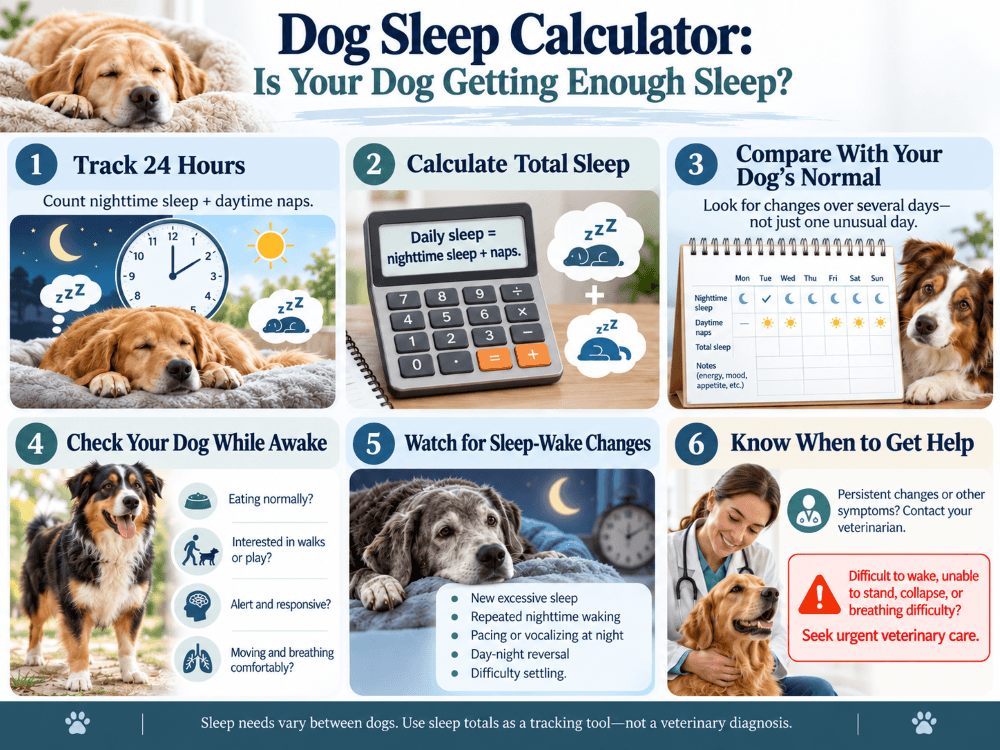
Dog Sleep Calculator Infographic
Frequently Asked Questions
The Bottom Line
A dog sleep calculator can help you turn a vague impression “my dog sleeps a lot” into something measurable. Add nighttime sleep and daytime naps, compare the total with your dog’s normal routine, and pay attention to how your dog behaves when awake. There is no perfect sleep number for every dog. Age, activity, environment, health, and individual routine all matter, and published sleep data should be used as context rather than rigid requirements. The most useful warning sign is often change. If your dog suddenly sleeps much more or less than usual, becomes restless at night, seems dull while awake, or develops other symptoms, contact your veterinarian.
For broader health tracking, related Canine Bible tools such as the dog walking calculator, dog calorie calculator, dog BMI calculator, and puppy weight and size calculator can help put sleep patterns into the context of your dog’s life stage and routine.