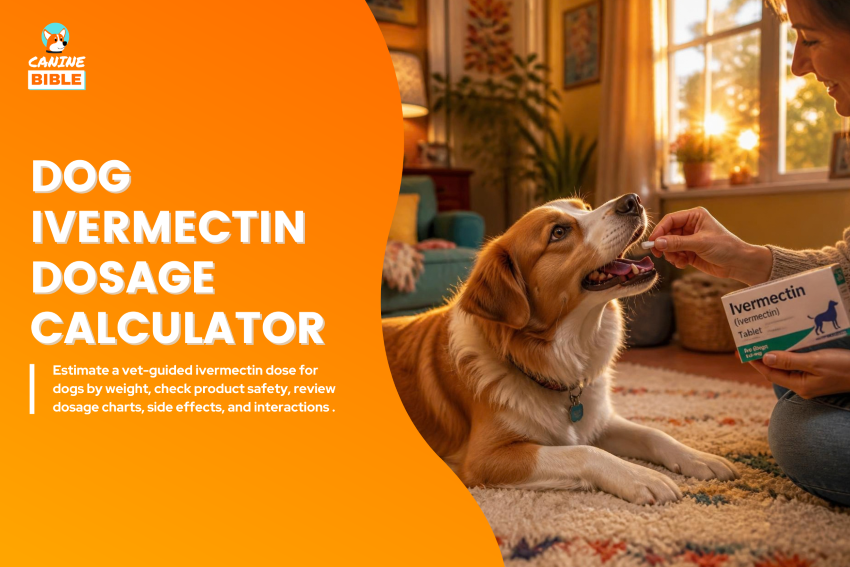
Dog Ivermectin Dosage Calculator: How Much to Give & Charts

Canine Bible is reader-supported. We receive affiliate commissions via some of our links. Learn more.
Ivermectin is used in some veterinary parasite-control products, but there is no single ivermectin dose that is appropriate for every dog or every condition. The amount can vary considerably depending on why ivermectin is being used, the exact product, your dog’s weight, and individual risk factors such as ABCB1/MDR1 drug sensitivity. This Dog Ivermectin Dosage Calculator is designed to convert a dose already provided by your veterinarian into a weight-based total. It does not choose an ivermectin dose, diagnose your dog, or determine whether ivermectin is appropriate.
Always check the full ingredient list and contact your veterinarian or a pet poison control service if your dog may have ingested too much ivermectin. If you can't reach your vet, you can chat live with a registered online veterinary professional via our online vet chat or video chat support (24 hours a day, 7 days a week). Or use Chewy's online vet services (6 a.m. - midnight ET).
How Much Ivermectin Can I Give My Dog?
There is no universal ivermectin dosage for dogs. The appropriate amount depends on the reason for treatment, the formulation being used, your dog's weight, other medications, and individual sensitivity. One of the most important distinctions is between low-dose, FDA-approved canine heartworm prevention and higher-dose or off-label ivermectin treatment. A dose used for one purpose should never be copied for another condition.
For example, Heartgard Plus is an FDA-approved prescription product containing ivermectin and pyrantel. Its current label provides ivermectin at a minimum of 6 mcg/kg once monthly through predetermined weight-based chewable strengths. That number applies to this specific labeled product and indication, it should not be treated as a universal ivermectin dose.
Higher ivermectin exposure can be especially dangerous for dogs with certain variants of the ABCB1 gene, commonly called MDR1. These dogs may allow more ivermectin into the central nervous system and can develop serious neurologic effects. If your veterinarian has supplied a dose in mcg/kg or mg/kg, this calculator can perform the arithmetic. If no veterinarian has supplied a dose, the calculator should not be used to create one.
Ivermectin Dosage Chart for Dogs
A general ivermectin treatment chart would be misleading because the appropriate dose changes with the indication and formulation. The chart below therefore shows a specific FDA-approved heartworm preventive as an example, not a general dosing recommendation.


Heartgard Plus Ivermectin Chart by Weight
| Dog Weight | Chewables Per Month | Ivermectin Content | Label Note |
|---|---|---|---|
| Up to 25 lb | 1 | 68 mcg | Heartgard Plus only |
| 26–50 lb | 1 | 136 mcg | Heartgard Plus only |
| 51–100 lb | 1 | 272 mcg | Heartgard Plus only |
| Over 100 lb | Label-directed combination | Varies | Follow the prescription label |
These are Heartgard Plus label strengths, not a general ivermectin dosage chart and not instructions for measuring generic ivermectin. The product is labeled for dogs at least 6 weeks old and is restricted to veterinary use or order.
Dog Weight Conversion Chart
Ivermectin prescriptions are commonly expressed per kilogram, so getting the weight conversion right matters.
| Weight (lb) | Approx. Weight (kg) |
|---|---|
| 5 lb | 2.3 kg |
| 10 lb | 4.5 kg |
| 20 lb | 9.1 kg |
| 30 lb | 13.6 kg |
| 40 lb | 18.1 kg |
| 50 lb | 22.7 kg |
| 60 lb | 27.2 kg |
| 70 lb | 31.8 kg |
| 80 lb | 36.3 kg |
| 90 lb | 40.8 kg |
| 100 lb | 45.4 kg |
For a more precise calculation, use your dog's current measured weight rather than selecting the nearest row.
Ivermectin Product and Formulation Safety Chart
The word “ivermectin” on a label does not mean two products can be dosed the same way.
| Product Type | Calculator Use | Owner Guidance |
|---|---|---|
| Canine prescription product | Follow label or prescription | Use the exact product instructions. |
| Vet-compounded product | Only with vet-provided dose | Verify concentration and units first. |
| Horse product | Do not self-calculate | Contact your veterinarian. |
| Cattle injectable | Do not self-calculate | Do not convert livestock concentrations yourself. |
| Livestock pour-on | Do not use | It is not a substitute for a canine product. |
| Unknown product | Stop and verify | Identify the exact label before dosing. |
Extralabel use of macrocyclic-lactone products intended for other animal species should be avoided in dogs because formulation and dosing errors can cause serious toxicity.
MDR1/ABCB1 and Ivermectin Safety Chart
ABCB1 status becomes especially important when ivermectin exposure is higher than routine labeled heartworm-prevention doses.


| ABCB1/MDR1 Status | What It Means | Practical Guidance |
|---|---|---|
| Normal/normal | No tested mutation detected. | Still use ivermectin only as directed. |
| Mutant/normal | One variant copy is present. | Tell your veterinarian before higher-dose therapy. |
| Mutant/mutant | Drug sensitivity can be much greater. | Higher ivermectin exposure requires special caution. |
| Unknown | Sensitivity has not been ruled out. | Do not assume an untested dog is normal. |
Approved canine heartworm preventives are considered safe for dogs with the MDR1 mutation when used at their labeled preventive doses. Higher ivermectin doses are a different situation and can cause neurologic effects in susceptible dogs.
Ivermectin Side Effects and Warning Signs
Watch your dog after medication, especially if the amount, product, or exposure is uncertain.
| Signs | Concern Level | What to Do |
|---|---|---|
| Vomiting or diarrhea | Possible adverse effect | Contact your vet if persistent or concerning. |
| Lethargy or drooling | Concerning | Call your veterinarian promptly. |
| Dilated pupils | Neurologic warning | Seek veterinary guidance promptly. |
| Wobbliness or weakness | Urgent | Seek veterinary care immediately. |
| Tremors or seizures | Emergency | Go to an emergency veterinary clinic. |
| Collapse or unresponsiveness | Emergency | Seek emergency veterinary care now. |
Neurologic toxicity can include ataxia, weakness, tremors, severe depression, visual abnormalities, stupor, coma, and potentially death with excessive exposure or increased sensitivity. If your dog has neurologic symptoms or may have received too much ivermectin, do not rely on the calculator to assess whether the exposure is safe.
Ivermectin Guidelines for Dogs
The safest way to think about ivermectin is as a medication whose use depends on why it is being given and exactly which product is being used. A number printed on one label cannot automatically be transferred to another formulation.
The Dose Depends on the Reason for Treatment
Ivermectin can appear in medications used for parasite prevention or treatment, but the amount appropriate for one purpose may be very different from the amount used for another. This is why a dog taking an approved monthly heartworm preventive should follow that product's weight range rather than a generic internet ivermectin chart. Off-label treatment should be planned and monitored by a veterinarian.
Product Labels Matter
Always check the exact medication name, active ingredients, concentration, formulation, and intended species before calculating anything. Two bottles can both say “ivermectin” while containing very different concentrations or being designed for entirely different animals. Never calculate from the product name alone.
Micrograms and Milligrams Are Very Different
- One of the easiest medication errors to make is confusing mcg and mg:
- 1 mg = 1,000 mcg
That means a milligram is one thousand times larger than a microgram. If your prescription says mcg/kg, do not enter it as mg/kg, or vice versa.
Heartworm Prevention Is Product-Specific
For Heartgard Plus, the current label provides a minimum ivermectin exposure of 6 mcg/kg through weight-based chewables and recommends the product for dogs at least 6 weeks old. Other heartworm preventives can contain different active ingredients, strengths, or dosing systems. Heartworm testing schedules also depend on a dog's age and prevention history. Dogs should continue to receive appropriate preventive care and regular heartworm testing based on veterinary guidance.
Higher Ivermectin Doses Need Veterinary Oversight
Higher-dose ivermectin has historically been used off-label for certain parasites, but it carries more potential for neurologic toxicity and is particularly concerning in ABCB1/MDR1-sensitive dogs. Modern alternatives may also be available depending on the parasite being treated. Do not select a higher ivermectin dose from an online chart and attempt treatment at home.
Factors That Can Affect Your Dog's Ivermectin Results
A mathematically correct calculation can still be inappropriate if the wrong product, indication, weight, or units are entered.
| Factor | Why It Matters | What Owners Should Check |
|---|---|---|
| Body weight | Weight-based calculations depend on accurate kilograms. | Use a recent measured weight. |
| Reason for use | Different indications can require different protocols. | Confirm why ivermectin was prescribed. |
| Product | Formulations can differ greatly. | Check the exact product and label. |
| Units | mcg and mg differ 1,000-fold. | Match the prescription units exactly. |
| ABCB1/MDR1 | Some dogs are more sensitive to neurologic toxicity. | Know test status when relevant. |
| Other medications | Drug combinations can change risk. | Share all medications with your vet. |
| Age and health | Individual medical factors can affect treatment choices. | Tell your vet about chronic illness. |
Genetic sensitivity is not limited to appearance alone, and an untested dog's status should not be guessed from breed. Genetic testing is available for individual dogs.
Common Ivermectin Dosing Mistakes to Avoid
Most serious medication errors start with the wrong input, product, or assumption rather than the multiplication itself.
| Mistake | Why It Matters | Better Approach |
|---|---|---|
| Mixing up mcg and mg | The units differ 1,000-fold. | Copy the prescription unit exactly. |
| Using lb as kg | This can greatly change the calculated amount. | Convert pounds before calculating. |
| Using the wrong formulation | Concentrations are not interchangeable. | Verify the exact label first. |
| Copying another dog's dose | Treatment depends on the individual dog. | Use your own vet's directions. |
| Ignoring MDR1 risk | Sensitive dogs can develop neurologic toxicity. | Discuss genetic risk with your vet. |
| Treating an estimate as a prescription | Arithmetic cannot confirm medical suitability. | Use only a vet-provided dose. |
| Ignoring symptoms | Neurologic signs can be serious. | Seek veterinary care promptly. |
| Waiting after an overdose | Treatment may be time-sensitive. | Call a vet or poison service promptly. |
Do not give an extra dose because you are unsure whether the first dose was swallowed, vomited, or absorbed. Contact your veterinarian for product-specific instructions.
Ivermectin Safety Guidelines for Dogs
Ivermectin can be used safely in dogs when the correct veterinary product and dose are chosen appropriately. Problems become more likely when the formulation is wrong, the dose is excessive, units are confused, or the dog has increased drug sensitivity.
When Should You Call a Veterinarian?
Contact your veterinarian before giving ivermectin if:
Signs of Ivermectin Toxicity in Dogs
Possible neurologic signs include enlarged pupils, wobbliness, weakness, tremors, abnormal behavior, marked depression, difficulty standing, seizures, stupor, or coma. Serious reactions require urgent veterinary assessment. Vomiting, diarrhea, lethargy, hypersalivation, ataxia, seizures, and muscle tremors have also been reported after canine ivermectin/pyrantel use, although an adverse-event report does not necessarily prove the medication caused every reported sign.
Dogs That Need Extra Caution
ABCB1/MDR1 sensitivity is particularly associated with some herding breeds and related dogs, including Collie-type dogs, Australian Shepherds, English Shepherds, and Shetland Sheepdogs. However, breed alone cannot confirm whether an individual dog carries the mutation. Extra care is also appropriate for very small dogs, dogs receiving multiple medications, dogs with existing neurologic disease, and any dog receiving an off-label ivermectin treatment plan.
Do Not Substitute Livestock Ivermectin
Livestock ivermectin is often much more concentrated than medications formulated for companion animals. A small measurement error can therefore translate into a large medication error. Do not use horse paste, cattle injectable ivermectin, livestock pour-on formulations, or another species' medication as a DIY substitute for a canine prescription.
What to Do If Your Dog Gets the Wrong Ivermectin Dose
If your dog receives more ivermectin than intended, gets a second dose by mistake, or eats ivermectin that was not prescribed for them, do not give any more medication until you have professional guidance. Keep the package or label and collect the information your veterinarian will need:
These details help a veterinarian assess a possible poisoning exposure. Do not induce vomiting or give home remedies unless a veterinarian or animal poison-control professional specifically instructs you to do so.
Whether vomiting is appropriate depends on the substance, timing, and your dog's neurologic condition, and it can be unsafe when aspiration is a concern. If your dog is wobbling, severely weak, trembling, having seizures, collapsing, struggling to breathe, or becoming unresponsive, seek emergency veterinary care immediately.
Special Considerations for Certain Dogs
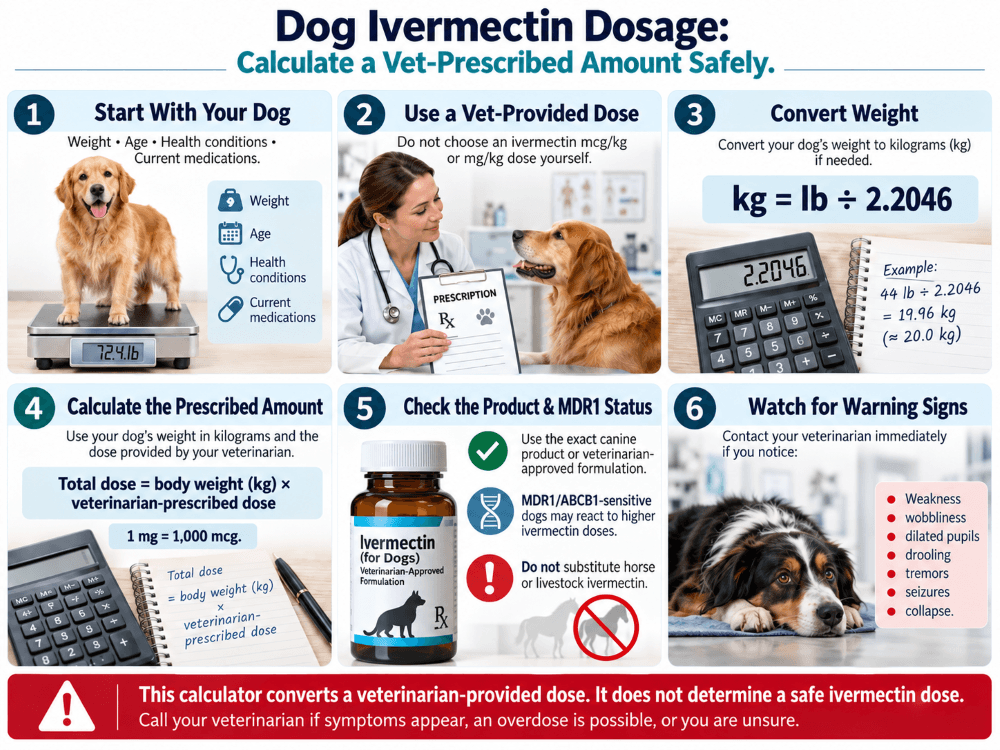
How to Calculate a Vet-Prescribed Ivermectin Dose Manually
The formulas below are for converting an ivermectin dose already supplied by your veterinarian. They are not a method for deciding what mg/kg or mcg/kg dose your dog should receive.
Step 1: Convert Pounds to Kilograms
- If your dog's weight is in pounds:
- Weight in kg = weight in lb ÷ 2.2046
- For example:
- 22 lb ÷ 2.2046 ≈ 10 kg
Step 2: Multiply by the Vet-Prescribed Dose
- If the prescription is written in micrograms per kilogram:
- Total ivermectin (mcg) = body weight (kg) × prescribed dose (mcg/kg)
- If it is written in milligrams per kilogram:
- Total ivermectin (mg) = body weight (kg) × prescribed dose (mg/kg)
Step 3: Convert Units Only If Necessary
- To convert micrograms to milligrams:
- mg = mcg ÷ 1,000
- To convert milligrams to micrograms:
- mcg = mg × 1,000
Always check the units on the prescription before converting them.
Example Calculation
Suppose a dog weighs 22 lb, or approximately 10 kg, and a veterinarian has prescribed a hypothetical dose of X mcg/kg.
- The calculation is:
- 10 kg × X mcg/kg = 10X mcg total
The value of X must come from the veterinarian or an applicable prescription label. The calculator does not determine what X should be.
What About Liquid Ivermectin?
Liquid volume cannot be calculated safely from the drug name alone. You would need the exact prescribed dose and exact concentration of the veterinarian-approved formulation. Because livestock ivermectin can be highly concentrated, this article does not provide instructions for converting generic cattle or horse formulations into a dose for dogs.
Dog Ivermectin Dosage & Safety Infographic
Frequently Asked Questions
The Bottom Line
A dog ivermectin dosage calculator is most useful for converting a vet-prescribed dose by body weight, not for choosing an ivermectin dose independently. There is no single ivermectin dose that works for every dog. Heartworm-prevention products use carefully labeled weight-based amounts, while higher-dose or off-label ivermectin requires much more caution, particularly in dogs with ABCB1/MDR1 sensitivity.
Double-check your dog's weight, product, concentration, and units before giving any medication. Never treat mcg and mg as interchangeable, and do not substitute horse or livestock ivermectin for a canine prescription. If your dog receives the wrong dose or develops weakness, wobbliness, tremors, seizures, collapse, or other neurologic symptoms, contact a veterinarian promptly rather than relying on the calculator.
For related guidance, see Canine Bible's dog toxicity calculator and best heartworm medication for dogs.