15 Best Exercises for Senior Dogs: Safe & Low-Impact Activities


Canine Bible is reader-supported. We receive affiliate commissions via some of our links. Learn more.
Good exercises for senior dogs include short, low-impact walks, gentle swimming, controlled play, scent games, and simple mobility exercises that keep the body and mind active without excessive strain. The best activities are usually moderate, consistent, and adjusted to your dog’s age, fitness level, joint health, and medical needs. Older dogs still benefit greatly from regular movement, but the intensity and duration often need to change as they slow down. Some seniors may handle several short walks better than one long outing, while others may need softer surfaces or water-based exercise. Arthritis, heart disease, obesity, or balance problems can also affect which activities are safest. Knowing when to encourage movement—and when to stop—is just as important as choosing the exercise itself. In this guide, we’ll cover the best exercises for senior dogs, how often to do them, and the warning signs that your dog may be overdoing it.
Why Exercising Senior Dogs Matters
Regular exercise helps senior dogs stay more comfortable, mobile, and mentally engaged as they age. The goal is not intense activity, but consistent movement that supports strength, joint function, balance, and quality of life.
| Why It Matters | How It Helps Senior Dogs |
|---|---|
| Maintains mobility | Keeps joints and muscles moving for easier everyday activity. |
| Preserves muscle | Supports strength for walking, standing, and climbing. |
| Supports healthy weight | Helps manage weight and reduce extra strain on joints. |
| Improves balance | Supports coordination and steadier movement as dogs age. |
| Encourages mental stimulation | Provides engaging smells, movement, and new experiences. |
| Supports circulation | Promotes healthy blood flow through regular gentle movement. |
| Reduces stiffness | Helps loosen stiff muscles and joints after periods of rest. |
| Protects independence | Helps older dogs continue normal daily activities comfortably. |
What to Know Before Exercising a Senior Dog
A senior dog may still be capable of surprisingly active exercise, while another dog of the same age may need a much gentler routine. Breed, body size, previous fitness, body condition, arthritis, heart or respiratory disease, neurologic problems, vision, and medications can all affect what is appropriate. Age alone should not be used to decide how much exercise a dog can handle.
Before significantly changing an older dog’s routine, pay attention to how the dog moves during normal daily activities. Difficulty standing, stiffness after rest, reluctance to climb stairs, shortened steps, limping, or slowing dramatically on walks can indicate that exercise should be modified and a veterinary assessment may be useful.
15 Best Exercises for Senior Dogs
The most useful activities allow a senior dog to move through a comfortable range of motion while maintaining muscle strength, coordination, and interest in the environment. Exercise does not have to be strenuous to be worthwhile. Several short, enjoyable activities can provide both physical movement and mental stimulation.
1. Short, Gentle Walks
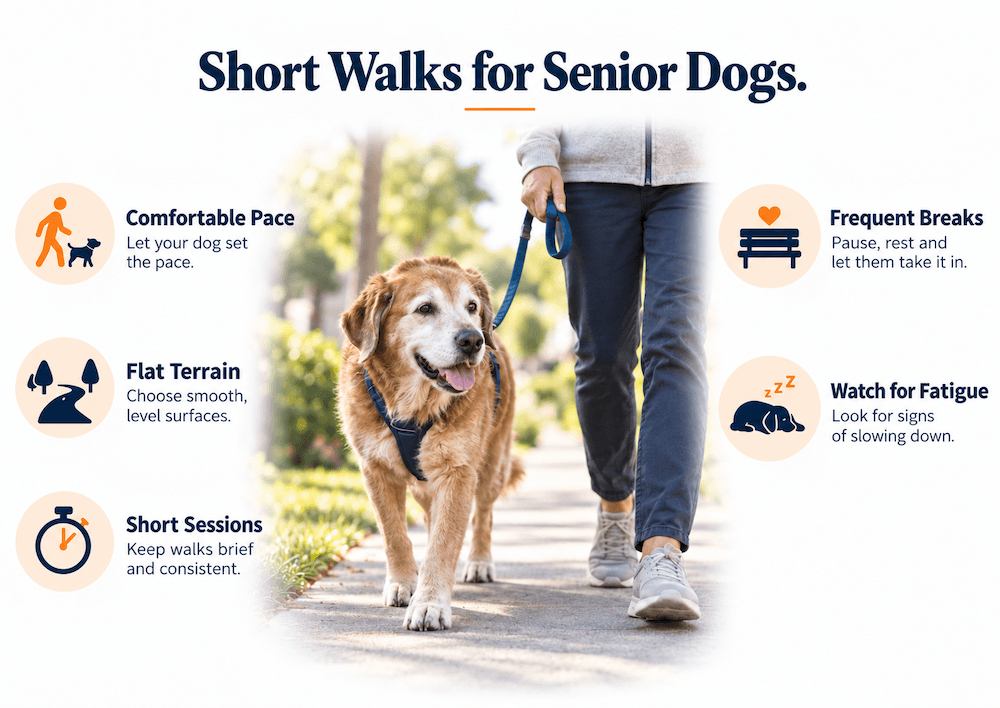
Short walks are one of the simplest ways to keep a senior dog moving without creating excessive physical demand. Choose a comfortable pace and relatively level terrain, and shorten the outing if your dog begins lagging, stiffening, or changing its gait. Several shorter walks may be easier for some older dogs than one long excursion.


2. Sniff Walks
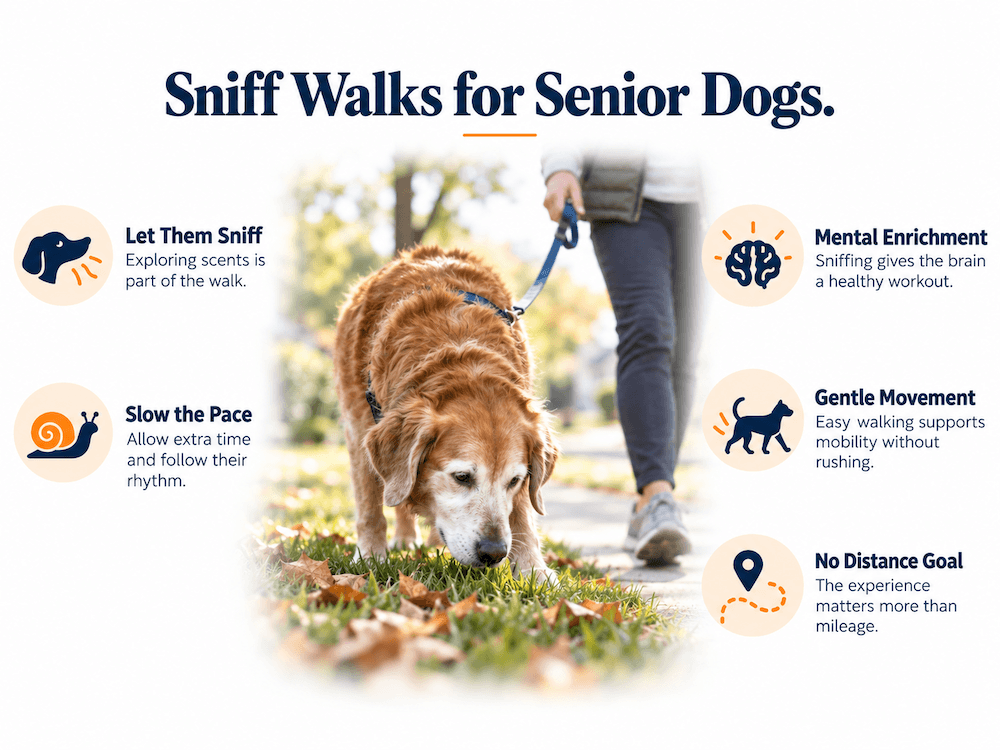
Sniff walks let an older dog explore at a slower pace while combining gentle movement with mental stimulation. Instead of focusing on distance, allow plenty of time to stop, investigate scents, and choose a comfortable walking speed. This can be particularly useful for seniors that enjoy outings but no longer tolerate brisk exercise.
3. Swimming
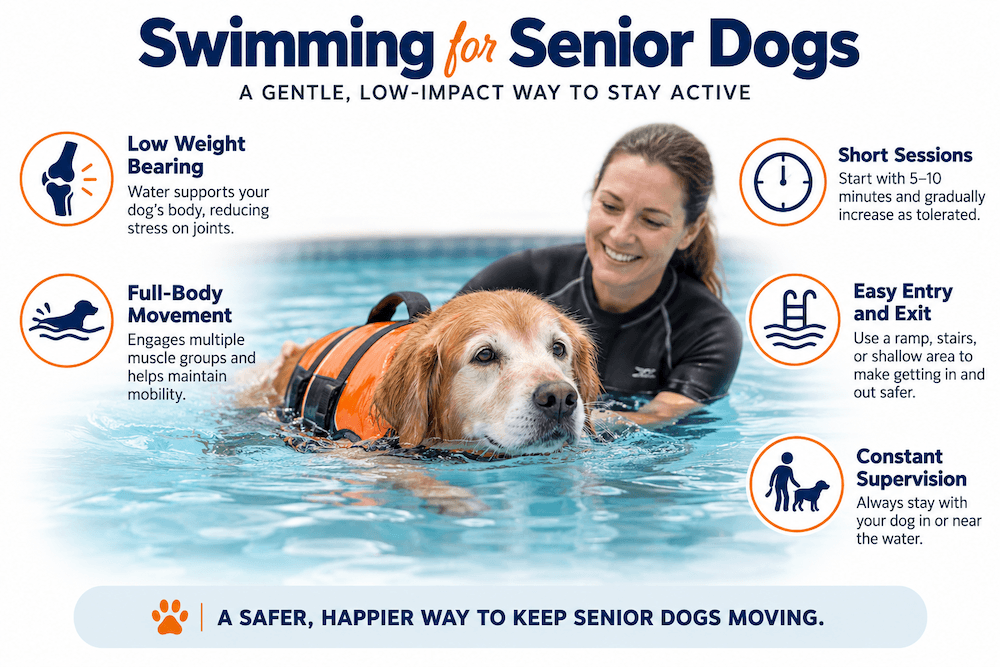
Swimming can provide whole-body exercise with less weight-bearing through the limbs than many land-based activities. However, swimming is physically demanding, so sessions should be brief and closely supervised, with an easy way for the dog to enter and leave the water. It is not appropriate for every senior dog, especially those with certain heart, respiratory, neurologic, or mobility problems.
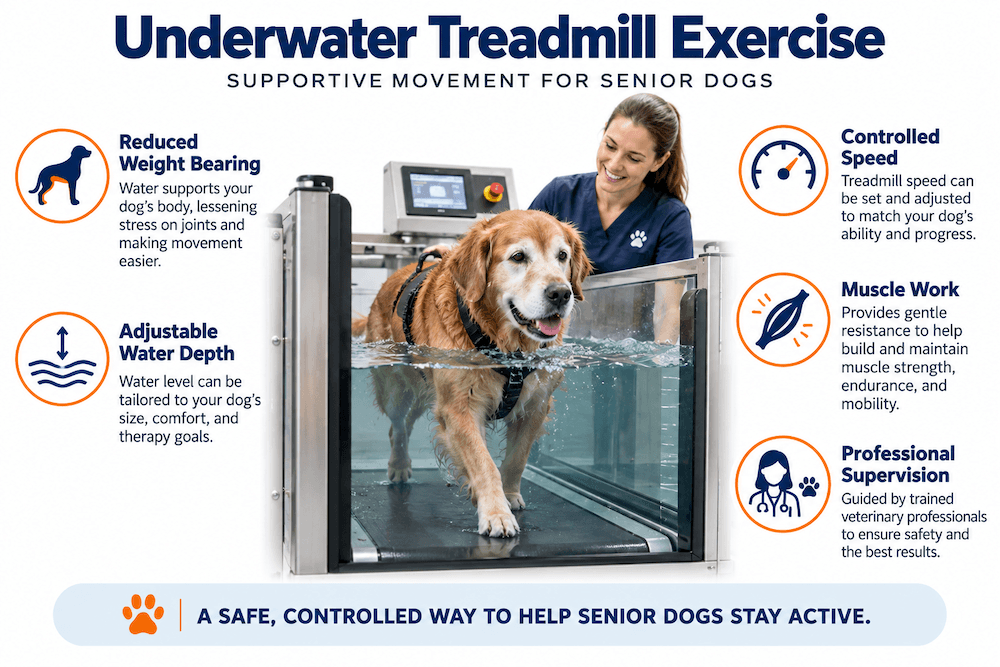
4. Underwater Treadmill Exercise
An underwater treadmill allows a dog to walk while water supports part of its body weight and provides resistance. Speed, water depth, and session length can be adjusted, making it useful in some veterinary rehabilitation programs for older dogs with mobility limitations. Because the settings should match the dog’s condition, this is best performed under professional supervision.
5. Sit-to-Stand Exercises
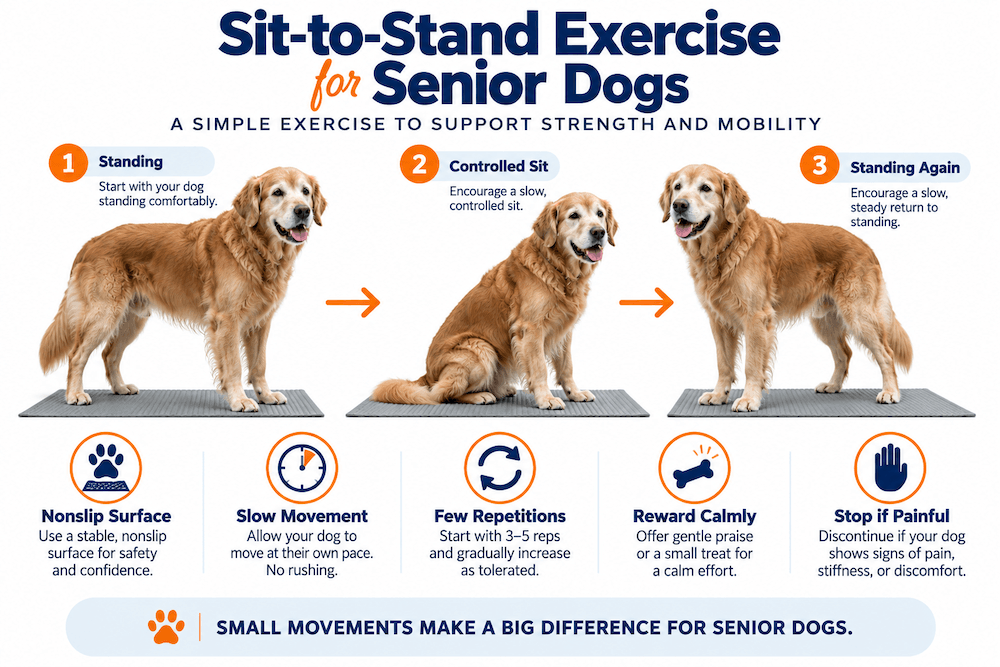
A controlled sit-to-stand movement can help work the hind limbs and supporting muscles in senior dogs that can sit and rise comfortably. Begin with only a few slow repetitions on a non-slip surface rather than turning it into a rapid exercise. Dogs that struggle to sit squarely, show pain, or have significant orthopedic problems should be assessed before using this exercise.
6. Gentle Figure-Eight Walking
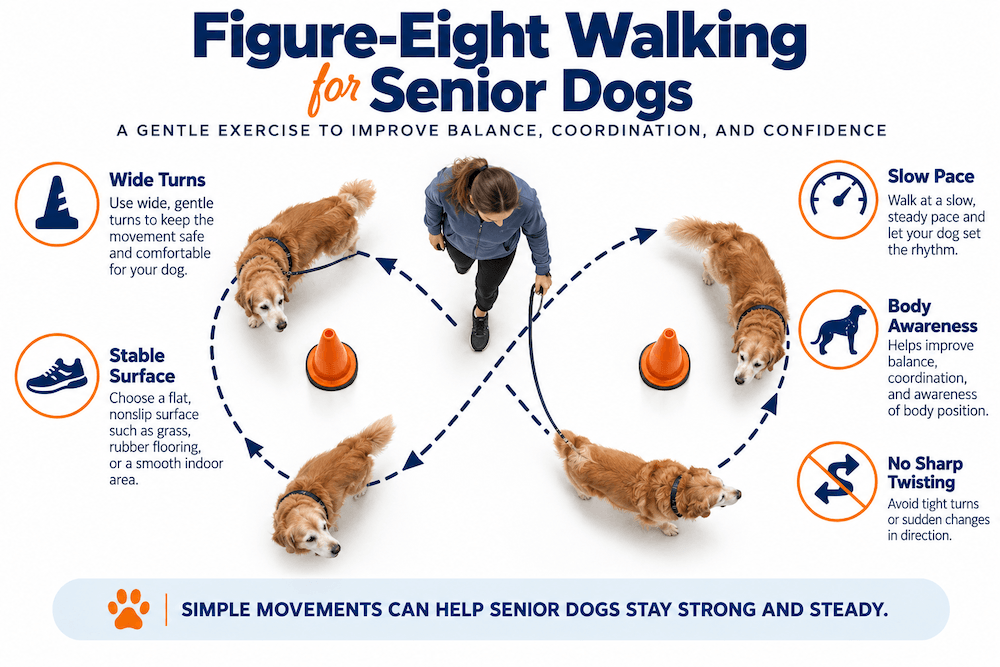
Walking slowly in a wide figure-eight pattern encourages controlled turning, coordination, and gentle weight shifting. Place two objects several feet apart and guide the dog around them without asking for tight, abrupt turns. Keep the loops wide enough that the dog remains balanced and comfortable.
7. Gentle Weight-Shifting Exercises
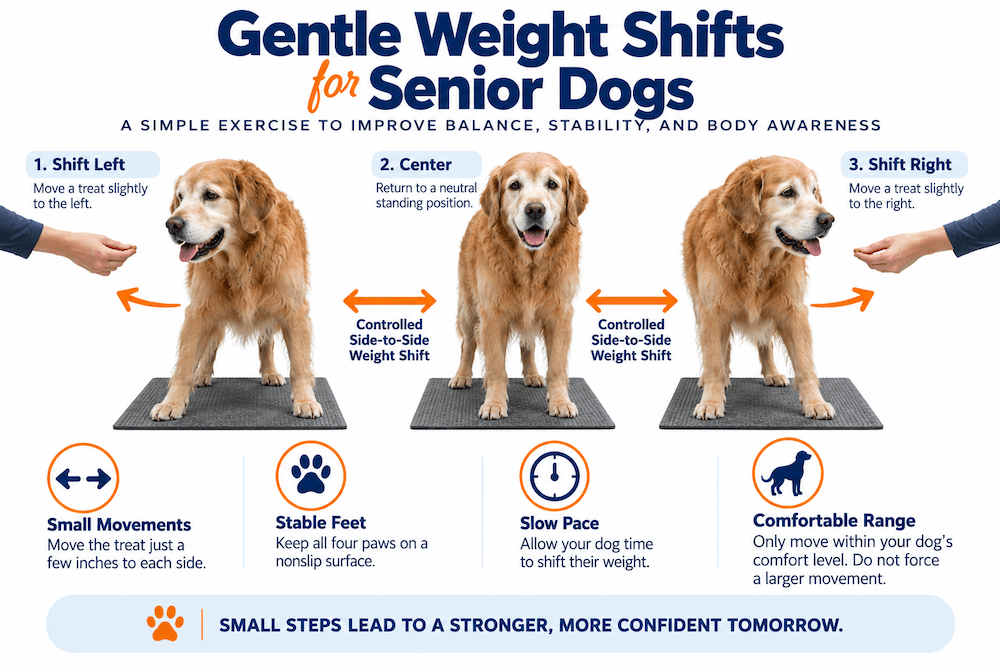
Weight-shifting exercises encourage a senior dog to redistribute weight between the limbs while remaining mostly in place. One simple version involves slowly guiding the dog’s head toward a treat positioned slightly to one side, causing a small, controlled shift through the body. Movements should remain subtle rather than pushing the dog into unstable positions.


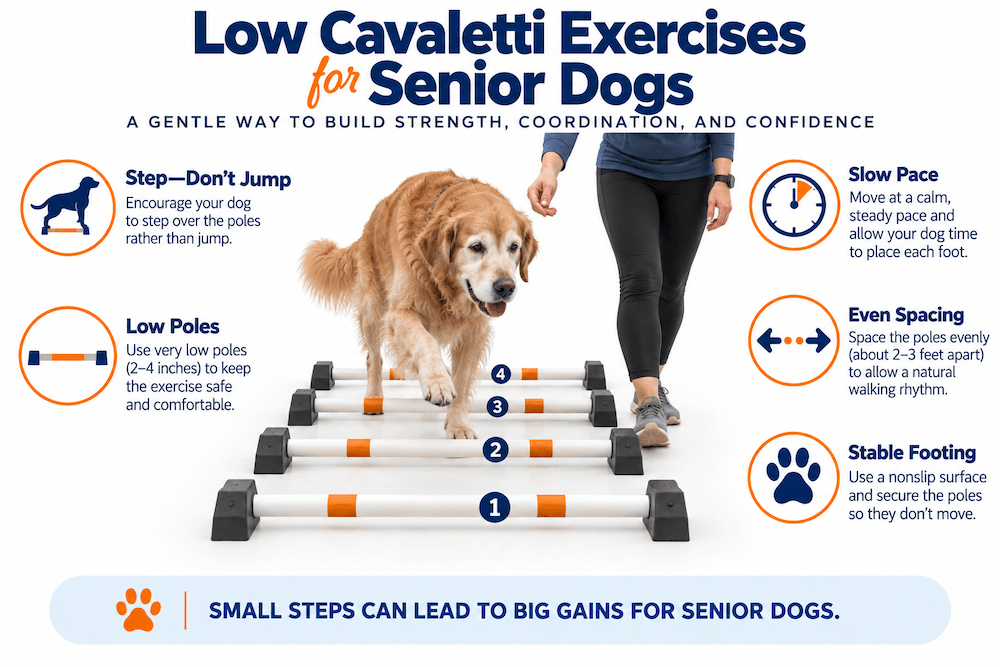
8. Low Cavaletti Pole Walking
Cavaletti exercises use very low poles placed on the ground or only slightly elevated so the dog steps deliberately over them. This can encourage paw placement, coordination, and controlled limb movement without requiring jumping. Pole height and spacing matter, so seniors with neurologic, orthopedic, or balance problems should use them only with appropriate guidance.
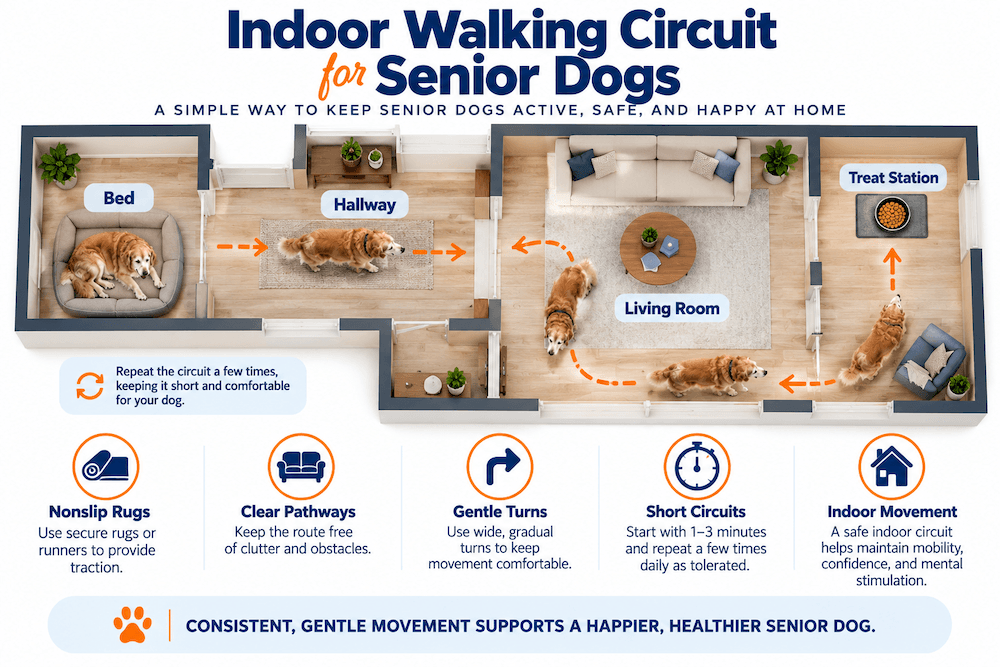
9. Slow Indoor Walking Circuits
An indoor walking circuit can keep a senior moving when weather makes outdoor exercise uncomfortable. Create a simple route through several rooms using rugs or non-slip runners and encourage the dog to calmly follow you from station to station. Keep pathways clear of clutter, stairs, and tight turns.
10. Scent-Search Games
Hide a few treats or pieces of the dog’s regular food around one safe room and encourage the dog to locate them by sniffing. The activity produces gentle walking and turning while providing mental stimulation without requiring speed or jumping. Keep hiding locations easy to reach so the dog does not need to climb, stretch awkwardly, or crawl under furniture.

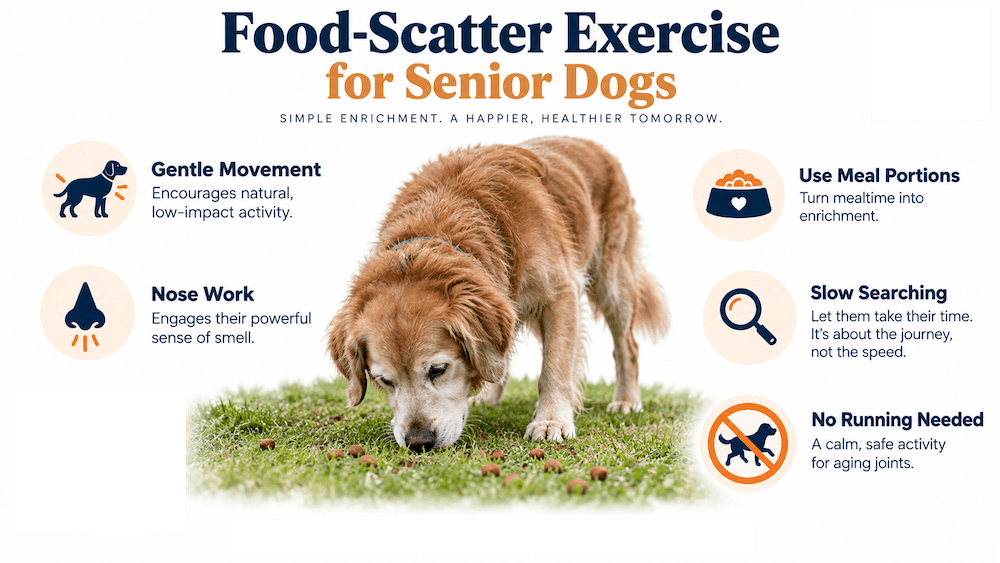
11. Gentle Food-Scatter Games
Scatter part of your dog’s normal meal across a clean lawn, snuffle mat, or large nonslip indoor area. Searching from piece to piece encourages light movement and sniffing without the repetitive impact of running games. Account for the food in the dog’s daily intake rather than adding large amounts of extra treats.
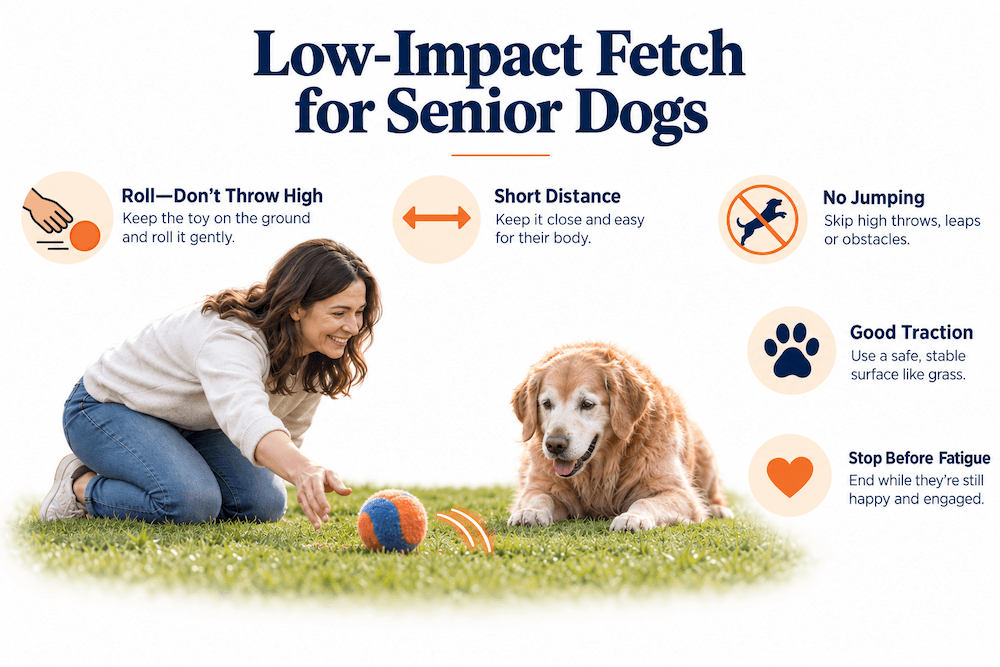
12. Rolled-Toy Fetch
Senior dogs that still love fetch can often continue playing with a lower-impact version. Instead of throwing a ball high or far, roll a toy along the ground so the dog can walk or lightly trot after it without repeated jumping and hard landings. Keep distances short and play on a surface with reliable traction.
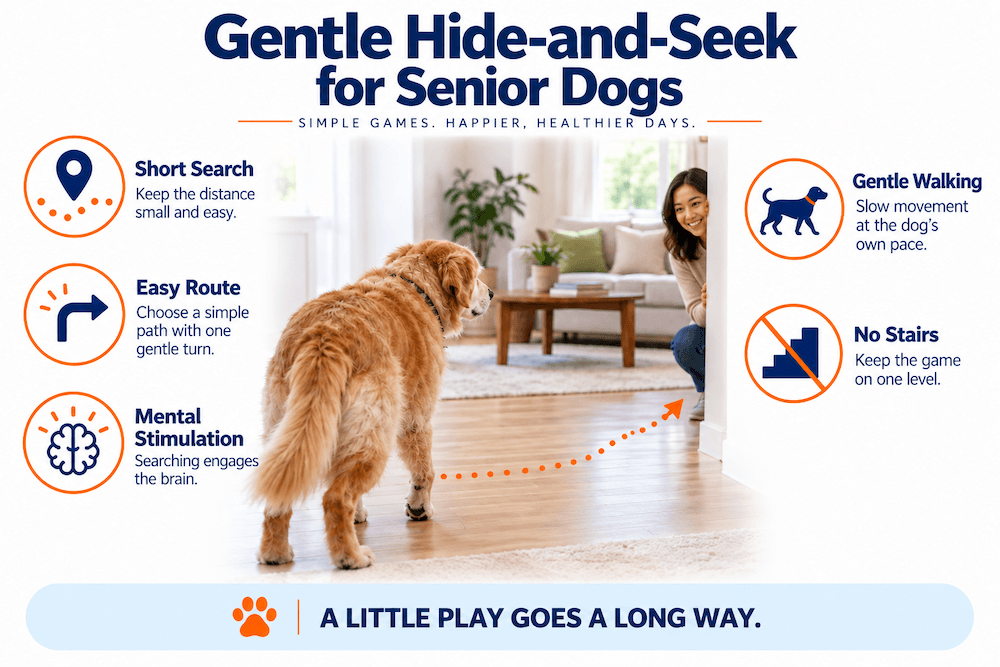
13. Gentle Hide-and-Seek
Have one person stay with the dog while another hides nearby in an easy-to-reach part of the home, then encourage the dog to find them. The game combines walking, scenting, hearing, and social interaction without needing strenuous movement. Avoid stairs, slippery flooring, and difficult hiding places.
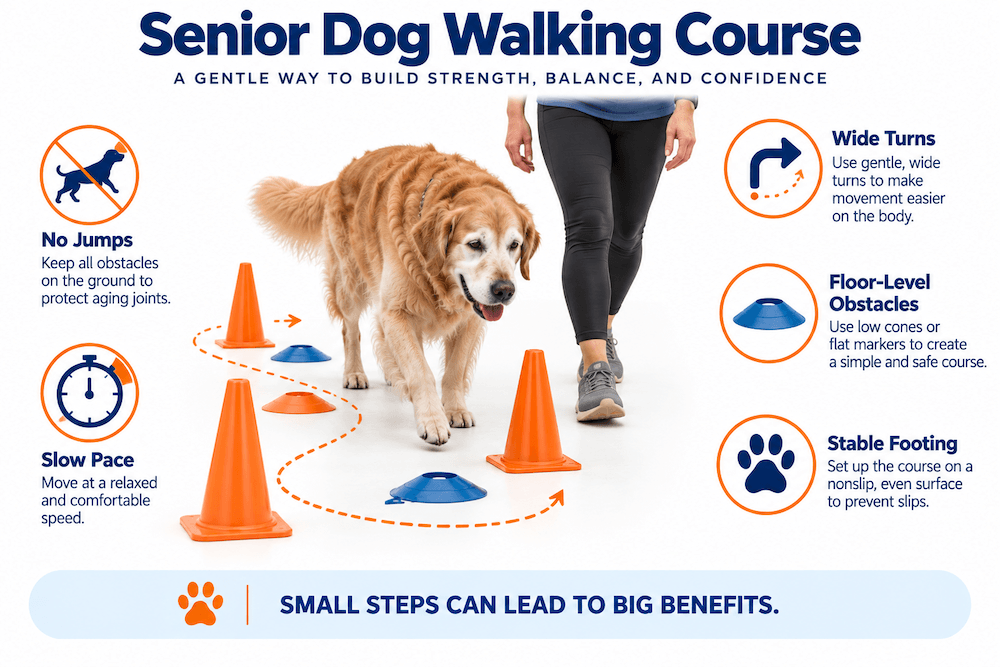
14. Slow Obstacle Walking
A senior-friendly obstacle course can include walking around cones, stepping between markers, or following a gently curved pathway. Unlike agility, the goal is controlled movement rather than speed, jumping, or difficult obstacles. Keep everything at floor level and remove an obstacle if the dog hesitates or loses balance.
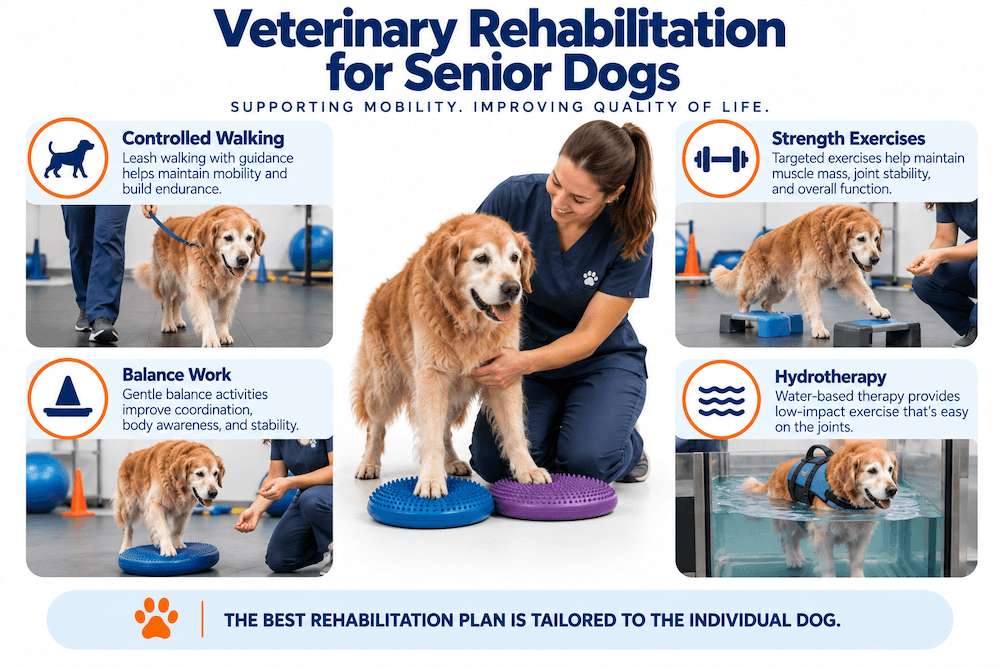
15. Veterinary Rehabilitation Exercises
A rehabilitation professional can select exercises specifically for a senior dog’s joints, muscles, balance, and neurologic function. A program may combine controlled walking, strengthening, balance work, therapeutic exercise, and hydrotherapy rather than relying on one activity. This is especially useful when arthritis, surgery, significant weakness, or chronic mobility problems make generic exercise advice inadequate.
How Much Exercise Does a Senior Dog Need?
There is no universal number of minutes that is appropriate for every senior dog. A fit 9-year-old dog that has remained active for years may comfortably exercise far longer than a sedentary 12-year-old dog with arthritis, even if the dogs are similar in size. The useful target is an amount of activity that maintains mobility and interest without producing persistent fatigue or soreness.
For an older dog that has become sedentary, beginning with several minutes of easy activity at a time may be more appropriate than immediately attempting a long walk. A comfortable senior already accustomed to longer walks may not need a dramatic reduction simply because of age; instead, pace, terrain, recovery, and emerging medical problems should guide changes.
When increasing activity, change only one variable at a time. A few extra minutes, a slightly longer route, or an additional short session is easier to evaluate than simultaneously increasing distance, speed, hills, and play. Also, regularity matters as much as duration. Shorter sessions performed consistently can keep a senior moving without the fatigue that may follow sporadic, strenuous outings.
How to Choose Exercise Based on Your Senior Dog’s Mobility
Exercise should match what the dog can currently do comfortably rather than what the dog could do several years ago. Observe walking speed, balance, recovery, and willingness before deciding how challenging the activity should be.
| Mobility Level | What It Looks Like | Good Exercise Options |
|---|---|---|
| Comfortable and steady | Walks normally with good balance and recovery. | Walks, sniffing, gentle play, light strengthening. |
| Mildly stiff or slower | Moves carefully or tires sooner than before. | Short flat walks, scent games, frequent breaks. |
| Weak or unsteady | Stumbles, struggles to rise, or loses balance. | Use a veterinarian-guided exercise plan. |
| Painful movement | Limping, reluctance, or obvious discomfort appears. | Pause increases and seek veterinary guidance. |
| Heart or breathing limits | Exercise tolerance is reduced by medical disease. | Follow veterinarian-specific activity limits. |
How to Increase a Senior Dog’s Exercise Gradually
Increase activity in small steps so your senior dog has time to adapt without becoming overly tired or sore. Change only one factor at a time—such as duration, distance, or difficulty—and watch how your dog feels later that day and the next morning.
| Adjustment | How to Increase It | What to Watch |
|---|---|---|
| Duration | Add a few minutes at a time. | Next-day stiffness or unusual fatigue. |
| Distance | Extend the route gradually, not all at once. | Lagging, slowing, or reluctance to continue. |
| Frequency | Add another short session before lengthening walks. | Whether recovery remains comfortable between sessions. |
| Terrain | Move from flat ground to gentle slopes slowly. | Changes in gait, balance, or joint comfort. |
| Strength Work | Add only a few controlled repetitions. | Pain, hesitation, or difficulty standing afterward. |
| Progression | Increase only one variable at a time. | Any decline in comfort or recovery. |
Helpful Tips for Exercising Senior Dogs Safely
Small adjustments can make a familiar activity much easier for an aging dog. The following strategies focus on comfort, consistency, and reducing unnecessary strain rather than making exercise more demanding.
| Tip | Why It Helps | How to Apply It |
|---|---|---|
| Warm Up Slowly | Lets stiff muscles and joints begin moving gradually. | Start each walk at an easy pace. |
| Choose Flat Routes | Reduces unnecessary joint and balance demands. | Save steep hills for dogs tolerating them well. |
| Use Good Traction | Helps reduce slipping and compensatory movement. | Prefer grass, rugs, or stable walking surfaces. |
| Take Breaks | Prevents fatigue from accumulating during longer activities. | Pause before your dog begins lagging behind. |
| Exercise Regularly | Helps avoid large swings in physical demand. | Favor consistent sessions over occasional strenuous outings. |
| Watch the Weather | Seniors may tolerate temperature extremes less effectively. | Shorten activity during uncomfortable heat or cold. |
How to Make Your Home and Exercise Area Safer for a Senior Dog
A safer environment can make exercise easier and reduce unnecessary strain on aging joints and balance. Focus on traction, clear pathways, easy access, and minimizing situations that require sudden jumping or awkward movement.
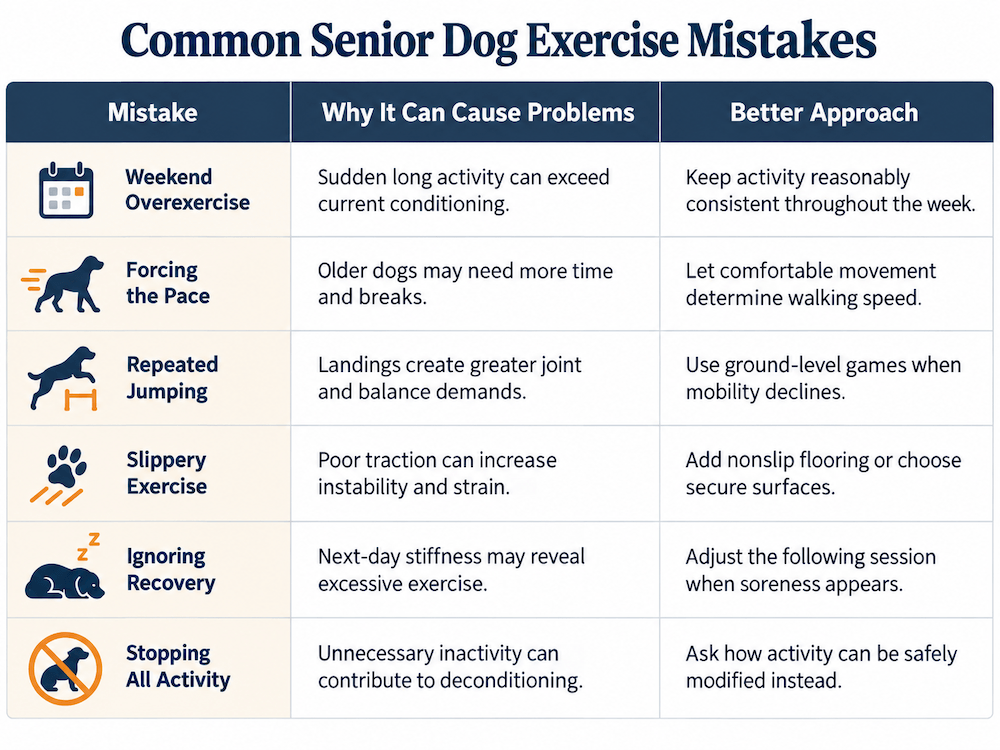
Exercise Mistakes That Can Make Senior Dogs Sore or Injured
Many exercise problems occur not because activity is inherently harmful, but because the intensity exceeds what the dog is conditioned to handle. Activities that involve repeated jumping, hard acceleration, sharp turns, or slippery footing deserve particular caution as mobility declines.
How to Tell Whether Your Senior Dog Is Exercising at the Right Level
A suitable exercise session should leave a senior dog comfortably tired rather than exhausted. During activity, the dog should remain coordinated, interested in continuing, and able to move without progressively worsening stiffness or limping. Normal recovery should occur reasonably soon after the activity rather than extending into prolonged discomfort.
| Time Check | Appropriate Exercise | Possible Overexertion |
|---|---|---|
| During exercise | Steady movement, good interest, comfortable pace. | Lagging, limping, heavy panting, repeated stopping. |
| One hour later | Relaxed rest and normal recovery. | Still very tired, uncomfortable, or unusually slow. |
| Next morning | Gets up and moves close to normal. | More stiffness, limping, or reluctance to move. |
When to Call a Veterinarian About Exercise in a Senior or Older Dog
A gradual speed reduction can occur as dogs age, but a noticeable or sudden loss of exercise tolerance should not automatically be dismissed as normal aging. Pain, osteoarthritis, heart disease, respiratory problems, neurologic disease, anemia, endocrine disorders, and other illnesses can change how a senior dog moves or recovers.
Dogs already diagnosed with heart, respiratory, orthopedic, or neurologic disease may need individualized exercise restrictions. Veterinary rehabilitation can also be useful when owners need a structured way to rebuild strength without overloading painful or unstable areas.
Should Senior Dogs With Arthritis Exercise?
In many dogs with arthritis, appropriately controlled movement remains an important part of mobility management. Complete inactivity can contribute to loss of muscle and conditioning, while overly intense exercise can aggravate discomfort. The goal is therefore not maximum exercise or zero exercise, but an amount and type the dog can tolerate consistently.
Low-impact walking, carefully chosen strengthening exercises, and professionally supervised rehabilitation may all be considered depending on which joints are affected and how severe the dog’s symptoms are. Exercise is only one part of arthritis management; pain control, body condition, home modifications, and veterinary treatment may also affect how comfortably a dog can remain active.
Uncontrolled pain should be addressed before trying to make a dog exercise through it. A senior that repeatedly refuses an activity is providing useful information, particularly if that reluctance is new.
When Can Veterinary Rehabilitation Help a Senior Dog?
Veterinary rehabilitation can be useful when age-related weakness, pain, surgery, or mobility problems make normal exercise difficult. A rehabilitation plan can target strength, balance, comfort, and safe movement based on the individual dog’s needs.
| When It May Help | Rehabilitation Goal | Possible Approach |
|---|---|---|
| Arthritis | Maintain mobility while reducing joint strain. | Controlled exercise, hydrotherapy, gentle strengthening. |
| Muscle weakness | Rebuild strength needed for daily movement. | Progressive strengthening and controlled walking. |
| Poor balance | Improve stability and body awareness. | Balance and coordination exercises. |
| After surgery | Restore movement safely during recovery. | Gradual, veterinarian-guided rehabilitation. |
| Neurologic problems | Support coordination and functional movement. | Targeted mobility and balance exercises. |
| Reduced endurance | Build activity tolerance without overexertion. | Short, structured sessions with gradual progression. |
What to Monitor as Your Senior Dog’s Exercise Needs Change
Tracking your senior dog’s mobility over time can reveal gradual changes that are easy to miss day to day. Compare walking pace, ease of standing, stair use, exercise recovery, and next-day stiffness each month, and record occasional walking videos to help spot meaningful trends.
Track Your Senior Dog’s Mobility Over Time
Small changes tell a big story. Compare the same mobility measures over time and record your observations consistently.
| Mobility Measure | Month 1 | Month 2 | Month 3 | Month 4 |
|---|---|---|---|---|
| Walking Pace | ||||
| Ease of Standing | ||||
| Stairs | ||||
| Recovery After Exercise | ||||
| Next-Day Stiffness |
What Research Says About Exercise in Senior Dogs
The 2023 AAHA Senior Care Guidelines for Dogs and Cats emphasize individualized care because aging varies substantially with breed, body size, health status, and expected lifespan. The guidelines recommend assessing exercise, movement, musculoskeletal pain, and mobility as part of senior health evaluation, including the use of owner-recorded videos when helpful. This supports tailoring exercise to the dog’s current functional ability rather than relying on age alone.
A 2023 review in Veterinary Sciences examining physiotherapeutic strategies for canine osteoarthritis describes exercise as an important component of maintaining mobility and muscular function. However, the authors also emphasize that direct clinical evidence for individual physiotherapy interventions in dogs remains limited, so programs should be practical and individualized rather than treated as universal prescriptions.[1]
A separate 2023 review in the Journal of Small Animal Practice evaluated non-drug, nonsurgical treatments for canine osteoarthritis, including therapeutic exercise and hydrotherapy. It likewise found that these approaches are used as parts of multimodal care while highlighting limitations in the strength and quantity of canine-specific evidence.[2]
Research into activity and canine cognition is also developing. A 2026 Frontiers in Veterinary Science study of 858 senior dogs found associations between lifetime sports or shared activity with owners and measures of cognitive decline, but the observational design cannot establish that exercise itself prevented cognitive decline. It does reinforce the broader idea that physical and interactive activity remain relevant areas of senior-dog health research.[3]
Frequently Asked Questions
The Bottom Line
Good exercises for senior dogs focus on maintaining movement, strength, balance, and mental engagement without placing unnecessary strain on an aging body. Short walks, sniffing activities, swimming when appropriate, gentle strengthening, and controlled indoor games can all be useful options. The right routine depends on your dog’s current mobility, health, conditioning, and recovery after activity. Exercise should be increased gradually, with changes in stiffness, gait, energy, and next-day comfort guiding future adjustments. Making floors, walking routes, and exercise areas safer can also help older dogs move with greater confidence. Dogs with arthritis, weakness, balance problems, or other mobility limitations may benefit from veterinary guidance or rehabilitation. Above all, regular activity should help your senior dog remain comfortably active rather than leave them sore or exhausted.
For more guidance on keeping an older dog comfortable and mobile, read our guide to arthritis in dogs. You may also find our article on how to tell if your dog is in pain helpful when monitoring changes in movement or exercise tolerance. For nutritional support, see our guide to the best foods for senior dogs with joint problems.
Sources
- Physiotherapeutic Strategies and Their Current Evidence for Canine Osteoarthritis
- Current evidence for non-pharmaceutical, non-surgical treatments of canine osteoarthritis
- Hard-working or hardly working dogs stay young longer? Lifetime sports engagement, joint activity with the owner and breed type are associated with the severity of canine cognitive decline